Planning a trip to Hachinohe? This English guide covers the Tanesashi coast, the morning market, seafood, rail access, and what to reconfirm before you go.
Operational details such as opening hours, admission fees, and train times can change. Prefer official pages and reconfirm before you travel (sources checked on 23 October 2026).
Why visit
- Hachinohe sits on Aomori’s Pacific coast, where the Tanesashi shoreline puts grass, pine, and rock directly beside the road and the railway.
- The coast is part of the Sanriku recovery national park, and the flat seaside path makes it unusually accessible for a northern coastline.
- The city’s morning market and seafood give the stop a food reason beyond the scenery.
- It is an easy Shinkansen stop between Aomori and Iwate, so it works as a break rather than a detour.
Top places and highlights
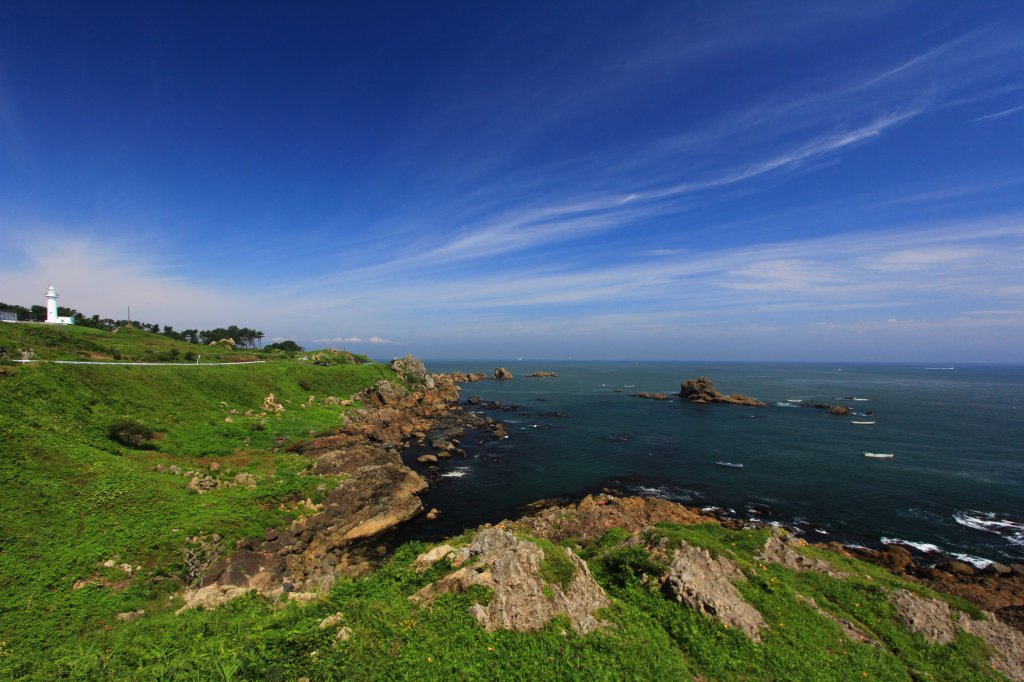
Tanesashi coast
A walkable stretch where natural lawn runs down to the water, backed by black pine. A visitor centre near the coast marks the trailheads, and the seaside path connects several small coves and rock formations on foot.
Walking the coast in stages
The Tanesashi coast is the northern end of the Michinoku Coastal Trail, a route of more than 1,000 km that runs down the Pacific shore of Tohoku to Soma in Fukushima, through Sanriku Fukko National Park. You do not need any of that ambition to use it. The official Hachinohe itinerary breaks the local section into short legs, which is the most useful thing to know before you arrive, because the coast is longer than it looks from the station.
- Kabushima to Marient, the city marine science museum: about 14 minutes, 0.7 km.
- Marient to Ashigezaki lookout, a former military observation post: about 40 minutes, 2.0 km.
- Ashigezaki to Nakasuka: about 5 minutes, 0.2 km. This is the section called Hana no Nagisa, the shore of flowers, where coastal and alpine plants grow close to the sea.
- Nakasuka to Osuka coast: about 16 minutes, 0.8 km. The sand here is known for squeaking underfoot in the right conditions, and soft sand is slower to cross than it looks.
- Osuka to Shirahama beach: about 30 minutes, 1.5 km along the sand.
- Shirahama to Shiraiwa and Fukakubo fishing port: about 22 minutes, 1.1 km. The white rock that gives Shiraiwa its name is easy to miss from a car.
- Fukakubo to Yodo-no-Matsubara pine grove: about 4 minutes, 0.2 km, then roughly 18 minutes through the grove to the Tanesashi Natural Lawn.
End to end that is a half day of walking at an easy pace, and no single leg is demanding. The useful consequence is that you can pick two or three legs and still finish at a station or a bus stop rather than retracing the whole shore.
Kabushima
A small hilltop shrine island connected to the shore, famous for a breeding colony of black-tailed gulls. The birds nest in spring and early summer, so expect noise, droppings, and a need to keep hats on during that window.
The colony is not a permanent backdrop, so the season decides what you see. Kabushima is a National Natural Monument precisely because it is a breeding ground, and the gulls arrive in March, lay eggs from late April, hatch in June, reach adult size in July and leave in August. In May the nests are everywhere on the ground, which is the reason to watch your footing rather than your camera. Counts run to tens of thousands of birds at the peak.
The birds are unusually unbothered by people, which makes close observation easy and also makes it easy to crowd a nest without noticing. Outside the breeding months the island is quiet, and the shrine and the view are the reason to walk out.
Morning market
Hachinohe’s wharf-side morning market is one of the largest of its kind in northern Japan, held mainly on Sundays in season. Stalls sell seafood, produce, and cooked food, and the whole thing finishes early, so arrive at opening.
The scale is worth stating plainly: the Tatehana wharf market runs along roughly 800 metres of quay with around 300 stalls, and it is generally described as one of the largest morning markets in Japan. It is a Sunday-dawn event rather than a daily one, so a weekday visit means no market at all.
There is a second and much smaller market in front of Mutsu-Minato Station on other mornings. Travellers who arrive on the wrong day often conclude the market was cancelled when in fact they were looking for the wrong one, so check which market is running on your date before you set an alarm.
City centre stops
The station area has a compact museum and food hall covering the city’s port history and local crafts, useful when coastal weather turns.
Food and drink
- Seafood is the reason to eat here, with squid and mackerel featuring heavily, and the morning market is the most direct way to try it.
- Market food runs from raw shellfish to grilled skewers, and stalls close as they sell out rather than at a fixed hour.
- The city also has a sake tradition, with breweries that open tasting rooms on limited days.
Getting there and around
- The Tohoku Shinkansen stops at Hachinohe, and a local line continues down the coast.
- Tanesashi-Kaigan Station puts you within walking distance of the shoreline path, which is the simplest car-free option.
- Buses along the coast are infrequent, so check return times before setting out on a long walk.
- A car makes it easier to combine the coast with the morning market on the same trip.
Where to stay
- Hotels near Hachinohe Station suit rail travellers and keep the morning market reachable by taxi.
- Small coastal inns suit a slower stay if you have a car and want the shore at dawn.
Best time to visit
- Summer is green and mild, with the coast at its most comfortable for walking.
- Autumn brings clear air and good light on the water.
- Winter is cold and windy on an exposed shore, with fewer services and shorter days.
Practical tips
- Bring a wind layer; the coast is exposed even on warm days.
- Confirm market days and the gull nesting season before planning around either.
- Wear shoes with grip; the grass paths stay damp after rain and sea spray.
Suggested day-trip outline
- Take the train to Hachinohe and continue on the coastal line to Tanesashi-Kaigan.
- Walk the shoreline path and the Kabushima area at an easy pace.
- Return to the city for seafood before the evening train.
- If it is a market morning, reverse the order and start at the wharf.
Where to go next
Guides to nearby places on this route, each checked against official sources.
Before you go
Timetables, fares, admission fees, and seasonal access rules can change. Check the official tourism and transport sites linked below for the latest information before you travel.
Sources
- Visit Hachinohe (official tourism) (checked 2026-10-23)
- Japan National Tourism Organization (JNTO) (checked 2026-10-23)
- Visit Hachinohe: Tanesashi coast walking itinerary (checked 2026-10-23)
- Visit Hachinohe: Kabushima and the black-tailed gulls (checked 2026-10-23)


Leave a Reply