Sawara is a merchant town on the Onogawa, a small river that once fed the Tone River shipping trade, about ninety minutes from Tokyo by train or coach. Its historic core is a street of Edo and Meiji shopfronts and storehouses along both banks, and in 1996 it became the first district in the Kanto region to be designated a Preservation District for Groups of Historic Buildings.
It is a working town rather than a museum piece. People live in the machiya, the soy sauce brewery still trades, and the bank building from 1914 is still the most conspicuous thing on the street. What makes Sawara worth the trip over somewhere closer is the combination: a canal you can walk in twenty minutes, a float festival with three centuries behind it, and the house of the man who mapped Japan.
Why visit
- The Onogawa canal quarter is compact and genuinely old, not a reconstruction, and it is small enough to walk in an afternoon without a plan.
- Sawara has a coherent story rather than a single sight: river trade, sake and soy sauce, and a merchant culture that considered itself a match for Edo.
- The float festival, the Sawara Matsuri, is one of the three great float festivals of Kanto and part of a UNESCO-listed tradition, and it runs twice a year.
- Inoh Tadataka, the surveyor who produced the first accurate map of Japan, was born here, and his house and museum are on the canal.
- It pairs naturally with Narita, whose temple is 30 minutes away by train, making it a sensible stop on the way in or out of the country.
The town: two banks, two halves
The Onogawa runs through the middle of the old town and divides it into two districts that historically competed as much as they cooperated. East of the river is Honjuku, the older merchant quarter, which grew up around the medieval town and whose festival belongs to Yasaka Shrine. West is Shinjuku, which developed later and whose festival belongs to Suwa Shrine. The rivalry is the reason the town has 24 festival floats rather than a dozen, and it still shapes which side of the river a family’s loyalties lie on.
The town’s wealth came from the Tone River, which carried goods to Edo. Sawara was a river port with its own warehouses and wharves, and the local boast was blunt about it: the phrase still quoted around town says that if you want to see Edo, come to Sawara, because Sawara’s main street outdoes it. That confidence is visible in the buildings, which are larger and more ornamented than a town of this size would otherwise justify.
The canal street
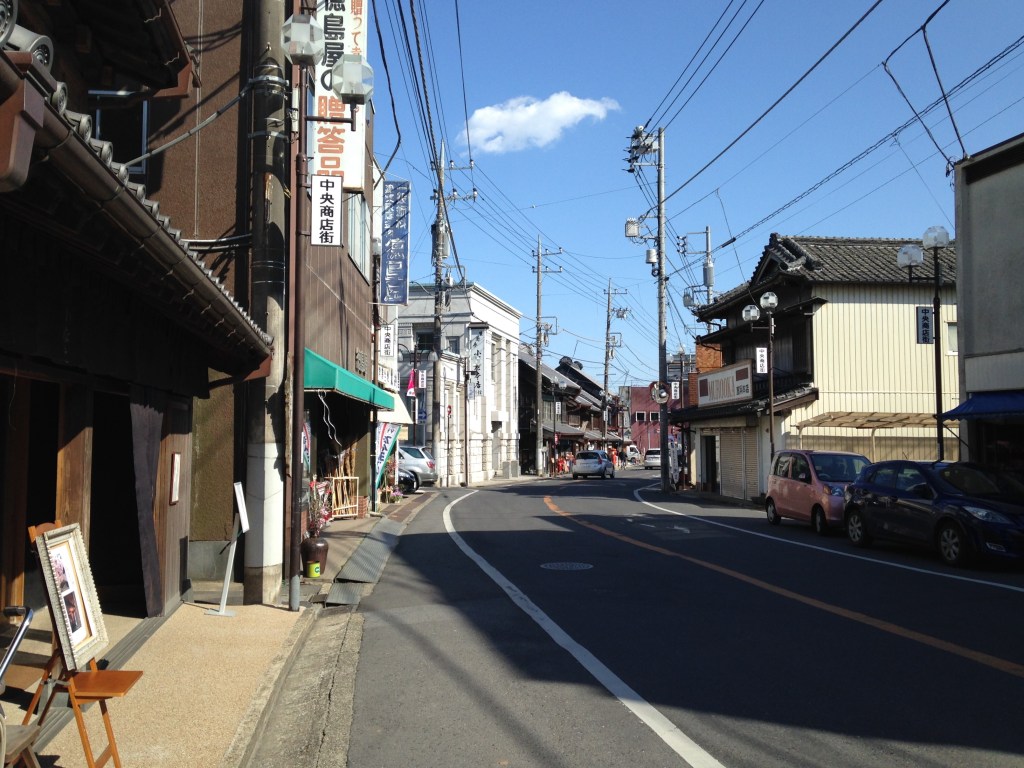
The best of the architecture runs along both banks for perhaps a kilometre: timber shopfronts with deep eaves, plastered storehouses with heavy doors, and a few houses with the upper floor projecting over the street. Sawara Mitsubishi Hall, built in 1914 as the Kawasaki Bank Sawara branch, is the red-brick outlier and now a free exhibition space. Shōjō Shōyu, a soy sauce brewer trading since 1800, occupies a shop from 1832 and a storehouse from 1868, both prefecturally designated cultural properties.
The street is not traffic-free everywhere and it is not a theme park: some buildings are shops, some are homes, and a few are closed and weathered. That is part of the appeal, but do not expect a fully curated street.
Toyohashi, the “jabbering bridge”
The small bridge over a side channel next to Inoh’s house is not really a bridge. It carries an irrigation flume across the water, with planks laid on top so people can cross. Water is released into the canal every 30 minutes between 9:00 and 17:00, and the sound is loud enough that the nickname stuck: Toyohashi is the “jājā-bashi”, the jabbering bridge. The sound was listed among Japan’s 100 soundscapes worth preserving. The present structure is a modern one built for visitors, so this is a piece of theatre rather than a working flume, but it is a good piece of theatre.
Inoh Tadataka and the map of Japan
Inoh Tadataka (1745–1818) is the reason Sawara appears in school textbooks. He took over the family business at 17, ran it for three decades, retired at 49, and then at 55 began the survey work that would occupy the rest of his life: walking the coast and the roads of Japan with a measuring chain and a theodolite, and producing the first map of the country based on actual measurement.
His former house and shop stand on the canal, with the gate, kitchen, and a study said to have been designed by Inoh himself. Entry is free. Next door, the Inoh Tadataka Memorial Museum holds the instruments, the survey drafts and the finished maps, a collection designated a National Treasure in 2010. The museum is 500 yen for adults and 250 for schoolchildren, open 9:00 to 16:30, closed Mondays except holidays.
Even if the surveying means little to you, the museum is worth half an hour for the instruments alone: brass, wood and glass, made to a precision that makes the achievement legible as labour rather than legend.
Top places and highlights
The Sawara Matsuri
The festival is the reason to plan a date rather than just turn up. It runs twice: the Gion festival of Yasaka Shrine over the Friday, Saturday and Sunday after 10 July, with 10 floats, and the autumn festival of Suwa Shrine over the Friday to Sunday around the second Saturday of October, with 14 floats. Together they make up one of the three great float festivals of Kanto and carry about 300 years of continuous practice.
Each float is a two-storey wooden cart, keyaki-built, covered in dense Kanto-style carving, with a giant doll up to four metres tall on the top. The floats are pulled through streets narrower than they are, and the signature manoeuvre is the no-ji-mawashi, a tight pivot that turns the cart on the spot. Sawara’s own festival music, played on flute and drum from inside the cart, is counted among the three great festival ensembles of Japan.
The float event was designated an Important Intangible Folk Cultural Property in 2004, and in 2016 it was inscribed on the UNESCO intangible heritage list as part of the wider Japanese float festival tradition. The float museum, in the grounds of Yasaka Shrine, displays two full floats, the carving, the instruments and one of the giant dolls, which is changed each year. It is 400 yen, or 800 yen combined with the Inoh museum, open 9:00 to 16:30 and closed Mondays.
If you go for the autumn festival: in 2026 it ran from 9 to 11 October, 10:00 to 22:00, in rain or shine with plastic sheets over the dolls. The middle day has the floats lined up at noon and pulled in procession from 13:30. A temporary car park on the Tone riverbed holds 1,000 cars for free, with a shuttle bus from 9:30 to 21:00 and a 500 yen cooperation charge per person. Extra express trains ran from Shinjuku on the Saturday and Sunday.
The canal boat
The boat ride is about 30 minutes, leaves from the landing stage in front of Inoh’s house, and costs 1,300 yen for adults and 700 yen for children. Services start at 10:00 and finish between 15:00 and 16:30 depending on the month. It is the one thing here that gives you the town from the angle it was built to be seen from: the warehouses were designed to face the water, and from the boat the loading doors and the water gates make sense.
Boats stop in high or low water, so a cancelled ride is a weather outcome rather than a fault. The boatman narrates in Japanese; the value is the view, not the commentary.
Katori Shrine
Katori Jingu, a short bus or taxi ride from the town, is the head shrine of all Katori shrines and the ichinomiya of Shimosa Province. Its main hall and tower gate were built by the Tokugawa shogunate in 1700 and are both designated Important Cultural Properties. The deity is Futsunushi, who appears in the Izumo succession myth. It is a substantial shrine in a cedar grove, and it is usually quiet, which is a contrast with the festival weekends in town.
Ayame Park
Suigō Sawara Ayame Park, about eight hectares inside Suigō-Tsukuba Quasi-National Park, is an iris garden that peaks from late May to late June, when the festival period brings some 400 varieties and 1.5 million iris plants into flower along its waterways. Outside that window it is a pleasant waterside park rather than a destination. Check the bloom state before committing a day to it.
Food and drink
Sawara’s food identity comes from the river and from fermentation. Soy sauce is the older industry: Shōjō Shōyu has been brewing since 1800, and the town’s shops sell locally made sauce, miso and pickles alongside the usual souvenirs. Sake is the other: the town had breweries serving the shipping trade, and one of them still offers tours and tastings on the canal street.
For eating, unagi is the traditional local choice, freshwater eel grilled over charcoal and served on rice, which follows from the river setting. The canal street also has soba, rice crackers and sweet shops, and the food court at the Michi-no-eki on the edge of town covers the practical option for families and drivers.
Breakfast is the gap. The town’s cafes open late relative to the first trains from Tokyo, so if you arrive early, plan to eat at the station or bring something.
Getting there and around
Sawara Station is on the JR Narita Line. From Tokyo the practical routes are the Narita Line itself, changing at Narita or Chiba, or a highway coach, which is simpler and often faster.
- Highway coach from Tokyo — about 85 minutes without a change, from Tokyo Station’s Yaesu south exit or the Yaesu bus terminal. The Kantetsu service stops at Yasaka-mae, one minute from the float museum; the Keisei service stops at Sawara Station north exit, about 15 minutes’ walk from the canal.
- Train — JR Narita Line to Sawara. This is also the route that makes Sawara combinable with Narita: the temple town is about 30 minutes away, so the two fit one day if you start early.
- Car — about 10 minutes from the Sawara-Katori interchange on the Higashi-Kanto Expressway. There is paid parking at the canal (around 500 yen a day) and free parking at the float museum, though only 25 spaces.
Once in town everything is on foot. The station to the canal is a 15-minute walk, and the canal street to the float museum is another 7 minutes. The station tourist information office, 50 m from the ticket gate, opens 9:00 to 17:00, rents bicycles, and is an accredited foreign tourist information point; the central information desk on the canal street is on the smaller side and closes Mondays.
If you are comparing Kanto’s old towns, Sawara is the water version and Kawagoe is the land version: Kawagoe has the bigger warehouse street and is closer to Tokyo, Sawara has the canal and the festival, and it is markedly quieter. For the wider picture, Japan’s Old Towns sorts the preserved districts this site covers by type.
Where to stay
Sawara is usually a day trip, and the accommodation reflects that: a handful of small hotels near the station and a few converted machiya in the historic quarter, including one operator that has restored several merchant houses as a dispersed hotel with a restaurant on the canal.
Staying has one clear advantage, which is the evening. Day visitors leave by late afternoon and the canal street empties; the buildings, the water and the lamps are at their best in that hour. If the festival is on, staying is close to essential, because the last trains out are earlier than the festival’s 22:00 finish.
Best time to visit
- Late May to late June — iris season at Ayame Park, and green, wet weather in town.
- Second week of July — the summer festival, 10 floats, hot and crowded.
- Second week of October — the autumn festival, 14 floats, the best-attended event of the year.
- November — quiet, dry, and the most comfortable walking weather, with no festival.
Avoid a Monday if museums are the point: the Inoh museum, the float museum and the central information desk all close, though the canal street itself is always walkable.
Practical tips
- Check the museum day before you go. Monday closures are the most common wasted trip here.
- Buy the combined ticket if you are doing both museums: 800 yen instead of 900.
- Time the Toyohashi for a water release; it happens every half hour between 9:00 and 17:00.
- Bring cash. Several small shops and the boat landing are not reliable with cards.
- On festival days, use the riverbed car park and the shuttle rather than trying to park in town.
- The canal street is a residential area. Keep voices down in the early morning and do not photograph into open doorways.
Suggested day-trip outline
- Arrive at Sawara Station and walk to the canal, or take the coach to Yasaka-mae if you want to start at the shrine end.
- Inoh’s house and the memorial museum first, while it is quiet.
- Walk the canal street in both directions, crossing at the Toyohashi.
- Take the 30-minute boat from the landing stage.
- Lunch on the canal street, then the float museum at Yasaka Shrine.
- Finish with Katori Shrine by bus or taxi if there is time, then back to the station.
Before you go
Museum hours, boat times, festival dates and coach timetables change annually, and the 2026 festival dates and fares above come from Katori City, the city’s tourism pages and the Chiba prefectural tourism site, checked on 26 October 2026. The 2026 autumn festival has already passed; the next dates are published by the city in the summer. Reconfirm Monday closures and the boat’s seasonal last departure before you travel.
Sources
- Katori City: places of interest, including the preservation district (checked 2026-10-26)
- Katori City: the Sawara Matsuri, dates and floats (checked 2026-10-26)
- Katori City: 2026 autumn festival schedule and access (checked 2026-10-26)
- Katori City: float museum hours, fees and access (checked 2026-10-26)
- Katori City: tourist information offices and services (checked 2026-10-26)
- Agency for Cultural Affairs: Sawara float event, designation and UNESCO listing (checked 2026-10-26)
- Chiba tourism: Suigō Sawara Float Museum (checked 2026-10-26)
Explore More of Japan
- Kawagoe Travel Guide — the other Kanto warehouse town, and how the two differ
- Kurashiki Travel Guide — a canal merchant quarter on the other side of Japan
- Japan’s Old Towns — preserved samurai, post-town and canal districts by type
- Day Trips from Tokyo — the trips that fit a single day from the city


Leave a Reply