Asahikawa is Hokkaido’s second city, an hour and a half north of Sapporo by express train, and most visitors pass through it on the way to somewhere else. That is a mistake. The city has the northernmost zoo in Japan and one of the best in the country, a ramen style that is genuinely its own, Japan’s first permanent pedestrian shopping street, and a position that puts Daisetsuzan, Biei and Furano within day-trip range.
It is also a winter city in the way Sapporo is, but with fewer visitors: snow from December into March, temperatures that regularly sit below freezing for weeks, and a February snow festival with an international ice sculpture competition. In summer it is the gateway to the highest mountain in Hokkaido.
This guide covers the zoo in detail, because that is why most people stop, plus the city itself, the food, the airport and rail links, and the day trips that work from here.
Why visit
- Asahiyama Zoo changed how Japanese zoos are designed, and it is still worth half a day on its own.
- The penguin walk in winter is the single most photographed thing in the city, and it is included in the ticket.
- Asahikawa ramen is a recognised regional style: pork and chicken stock with a seafood finish, and thin wavy noodles.
- The city is a practical base for Daisetsuzan, Biei’s hills and Furano’s flower fields, all reachable without a car if you plan around the buses.
- Accommodation and food cost noticeably less than in Sapporo, and the station area is compact.
Asahiyama Zoo
The zoo opened in 1967 and was close to closure in the 1990s before a redesign around what became known as behavioural display: enclosures built so that visitors can see animals doing what they actually do, rather than looking at them in a box. The seal tube, the polar bear pool with its underwater viewing dome, and the orangutan climbing frame are the famous examples, and the approach has been copied across the country since.
It is a large site on a hillside, and the layout matters: the entrance is at the top and the loop descends and climbs. Allow three to four hours minimum, and longer on a weekend.
Opening periods and tickets
The zoo keeps different hours by season, and the gaps matter more than the opening times. In 2026 the pattern was:
- 2 January to 7 April — 10:30 to 15:30, last entry 15:00.
- 29 April to 15 October — 9:30 to 17:15, last entry 16:00.
- 16 October to 3 November — 9:30 to 16:30, last entry 16:00.
- 11 November to 29 December — 10:30 to 15:30, last entry 15:00.
It closes between those blocks for maintenance, and on 30 and 31 December and 1 January. There are also evening openings in some years, including a run of late nights in mid-August and a few days in February.
Admission is 1,000 yen for adults and free for children of junior high age and under, which makes it an unusually good value stop for families. Residents of Asahikawa pay 700 yen, a one-year passport is 1,400 yen, and there is a two-day ticket for 1,000 yen for people staying in the city — worth knowing if you want a second morning. Tickets can be bought in advance online or at convenience stores, which saves the queue at the gate.
The penguin walk
In the snow season, from about mid-December until the snow goes in March, the gentoo penguins are walked out of their enclosure and along a path for roughly 500 metres, out and back. It happens twice a day in midwinter, at 11:00 and 14:30, and once a day from March when the birds moult. The walk is cancelled in rain or when conditions are wrong for the birds, so it is never guaranteed.
Two rules are enforced: no flash photography, and no stepping onto the route. Both are about the animals rather than about tidiness, and the walk has been suspended in the past when visitors ignored them. In summer there is no walk, and the penguins are simply in their pool.
Getting to the zoo
Buses leave from stop 6 at the Asahikawa Station bus terminal, run by Asahikawa Denkikido on the zoo line (routes 41 and 47), roughly every 30 minutes, and take about 40 minutes. The fare is 670 yen one way for adults, 340 for children, revised on 1 September 2026. Route 41 goes via 4-jo-dori and route 47 via 10-jo-dori; both end at the zoo, and the last stop is the park entrance when the zoo is closed.
There is also a direct bus from Asahikawa Airport, the 78 line, taking about 35 minutes for 840 yen, but it only runs on weekends and holidays during the zoo’s open season, once each way, timed to a single morning arrival and one afternoon departure. Do not plan an airport-to-zoo transfer on it without checking the day and the flight.
A taxi from the station is about 30 minutes and roughly 3,500 yen, which is worth it for three or four people. Driving is simpler than in most Japanese cities: the car park is large and the roads are wide.
Top places and highlights
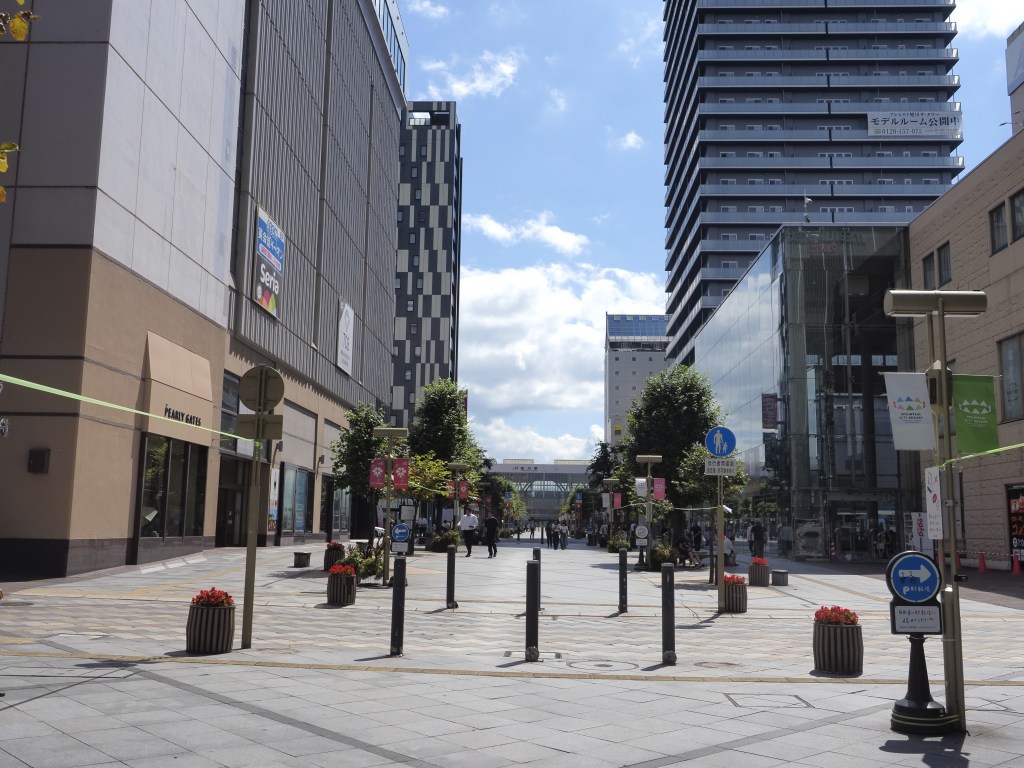
Kaimono Koen, the pedestrian mall
The street from the station towards the river is called Kaimono Koen, and it is the first permanent pedestrian-only shopping street in Japan, opened on 1 June 1972 — earlier than Ginza’s. It runs about a kilometre, with department stores, cafes, sculpture along the pavement, and heating under parts of the paving in winter.
It is not a sight in the guidebook sense; it is where the city actually is. The winter festival’s ice sculpture competition happens here in February, and the summer festival and the autumn food event use it too. Walk it once in the evening, when the lights are on and the temperature is doing its worst.
Otokoyama Sake Museum
Otokoyama has been brewing in Asahikawa for more than three centuries, and its museum in the Nagayama district explains the process with Edo-period equipment and panels. Entry is free, it is open 9:00 to 17:00 with the tasting counter and cafe closing at 16:30, and it closes over New Year. Tastings of the premium sake are paid, and the shop sells bottles that do not leave Hokkaido.
It is about 20 minutes from the station by bus, in the same direction as the Ramen Village, so the two combine into a half day.
The riverside and the hills
Asahikawa sits where the Ishikari and Chubetsu rivers meet, and the bridges over them give the best free views of the city with the Daisetsuzan range behind. Kaguraoka Park and Tokiwa Park are the two old civic parks, both walkable from the centre; Tokiwa has the Hokkaido Asahikawa Museum of Art inside it.
For a view, the Arashiyama observatory in the western hills looks over the whole basin to the range, and Kamuikotan, a gorge on the Ishikari upstream, is a short bus or taxi ride for scenery and a former station building on a disused line.
Asahikawa Winter Festival
Held in February, the winter festival builds snow and ice sculptures along the river and links to the ice sculpture world championship on Kaimono Koen. It is smaller than Sapporo’s snow festival and considerably less crowded, and the sculptures are within walking distance of the station rather than a subway ride away.
Asahikawa ramen
The local style is built on a double soup: pork bones and chicken boiled down, finished with a seafood stock, seasoned with soy sauce, and served with thin, wavy, firm noodles. The result is richer than Sapporo’s miso ramen and less heavy than tonkotsu, and the shops that define it are old.
- Hachiya — open since 1947, and the one that defines the style, with a layer of burnt lard on the surface that keeps the bowl hot to the last spoon. The main shop is a 15-minute walk from the station.
- Aoba — also from 1947, now in its third generation, with a balanced double soup and house-made noodles, 8 minutes from the station.
- Baikoken — from 1969, on Kaimono Koen itself, with a rich but clean soy bowl and a branch overseas.
A bowl at these shops runs roughly 850 to 1,000 yen as of late 2026, and the queues at lunch are real. Go at 11:00 or after 14:00.
If you want to compare several in one place, the Asahikawa Ramen Village in the Nagayama district gathers eight shops with mini bowls designed for trying more than one. It is a shopping-centre food hall rather than a market, useful with children and in bad weather.
Beyond ramen, Hokkaido’s usual strengths apply: dairy, potatoes, lamb grilled at the table, and seafood brought in from the coast. The izakaya streets around 3-jo and 4-jo are where to find them at night.
Daisetsuzan and the day trips
Asahikawa is the northern gateway to Daisetsuzan National Park, the largest national park in Japan by area, and the reason many people rent a car here.
Asahidake
Asahidake is Hokkaido’s highest peak at 2,291 m, reached by a ropeway from the Asahidake Onsen base to Sugatami station at 1,600 m in about ten minutes. From the top station a loop of the Sugatami ponds takes about an hour on boardwalk, with fumaroles steaming beside the path and the summit above. It is the easiest access to alpine scenery in Hokkaido, and the weather at the top is not the weather at the bottom.
Ropeway fares as of late 2026 are 3,500 yen return for adults in the June to October top season, or 2,800 yen from November to May, with one-way tickets available. It is about 90 minutes from Asahikawa by car, and the public bus runs seasonally and infrequently; check the timetable before relying on it.
Sounkyo
The Sounkyo gorge, with the Meteor and Galaxy waterfalls and a hot spring village at its mouth, is about two hours by bus from Asahikawa and can be done as a long day. In winter the gorge freezes and the ice waterfall festival runs from late January.
Biei and Furano
Both are on the same rail line south of Asahikawa, Biei about 30 to 40 minutes and Furano about an hour. Biei’s hills and the Blue Pond, and Furano’s lavender in July, are covered in the separate Biei and Furano guide. From Asahikawa they work as day trips by train, though the rural buses that reach the scenic spots are thin and a hire car or a taxi tour is the practical answer.
Getting there and around
- Air — Asahikawa Airport has direct flights from Tokyo Haneda (about 1 hour 35 minutes) and from other Japanese cities, plus a seasonal international terminal. Buses meet arrivals for the 35 to 40 minute run into the city; the airport is closer to the zoo than the city is, which is worth planning around.
- Rail — the JR Hakodate Line runs from Sapporo in about 1 hour 25 minutes on the limited express, and from Furano in about 1 hour 30 minutes on the Furano Line via Ashibetsu.
- Bus — long-distance coaches connect Asahikawa with Sapporo, and local buses run from the station bus terminal to the zoo, the airport, Asahidake and Sounkyo.
- Car — the expressway reaches the city from Sapporo, and a car is the most efficient way to see Daisetsuzan and Biei. Winter driving needs winter tyres and some experience of snow.
Within the city, the centre is walkable: the station, Kaimono Koen, the 3-jo and 4-jo restaurant streets, and the riverside are all within 20 minutes on foot.
Where to stay
The station area has the largest choice, from business hotels to a few larger city hotels, and it is the sensible base without a car: the zoo bus, the airport bus and the train all leave from there.
For a quieter stay, the hot spring villages at Asahidake and Sounkyo have ryokan with mountain views, and staying at Asahidake lets you be on the ropeway at opening rather than driving 90 minutes to reach it.
Book early for the February festival and for the July lavender season, when the whole region is busy and prices rise.
Best time to visit
- December to March — the penguin walk, the winter festival in February, and the coldest, clearest air of the year. Daytime temperatures stay below freezing.
- June — green, mild, and the alpine flowers begin at Asahidake.
- July — lavender in Furano, the busiest fortnight of the summer in the surrounding countryside.
- September to early October — the best month for Daisetsuzan, with the first autumn colour in Japan appearing on the high slopes.
August is warm and humid by Hokkaido standards and busy with domestic holiday travel. November and April are the shoulder gaps: the zoo runs reduced hours, the ropeway is quiet, and some rural buses stop.
Practical tips
- Buy the zoo ticket in advance and take the first bus if you want the penguin walk without a crowd.
- Check the zoo calendar, not just the opening hours: it closes for maintenance between seasons and over New Year.
- Allow more time at the zoo than you think. The site is steep and the distances between enclosures are longer than the map suggests.
- In winter, wear boots rather than shoes. The pavements are icy and the zoo paths are snow-covered.
- Cash is still useful at the smaller ramen shops and the older markets.
- If you are heading to Daisetsuzan, check the ropeway’s live status in the morning; wind closes it without much notice.
Suggested itineraries
One day in the city
- First bus to Asahiyama Zoo, and walk the loop from the top entrance.
- Return to the centre for a late ramen lunch at one of the old shops.
- Walk Kaimono Koen down to the river and back.
- Otokoyama Sake Museum in the late afternoon if you have a car or a bus pass.
- Dinner at an izakaya around 3-jo.
Two days with the mountains
- Day one: the zoo in the morning, the city and ramen in the afternoon, overnight near the station.
- Day two: early drive or bus to Asahidake, ropeway to Sugatami, the pond loop, and back down for a soak at the onsen.
- If you have a third day, add Biei’s hills on the way back to Sapporo.
Before you go
Zoo hours and admission, ropeway fares and bus timetables all change by season, and the figures above come from Asahikawa City’s zoo pages, the Asahikawa Denkikido timetable and the Asahidake ropeway operator, checked on 26 October 2026. The zoo’s 2026 season closed on 29 December and reopened in January; the penguin walk depends on snow, so confirm it is running before you build a morning around it. Reconfirm the airport bus times against your flight, since the zoo service is limited to certain days.
Sources
- Asahikawa City: Asahiyama Zoo opening calendar and hours (checked 2026-10-26)
- Asahikawa City: zoo admission fees and tickets (checked 2026-10-26)
- Asahikawa City: zoo access, bus routes and fares (checked 2026-10-26)
- Asahikawa City: penguin walk times and rules (checked 2026-10-26)
- Asahikawa Denkikido: bus operator, zoo and airport line timetables (checked 2026-10-26)
- Kaimono Koen: history of Japan’s first permanent pedestrian street (checked 2026-10-26)
- Asahidake Ropeway: fares and operating times (checked 2026-10-26)
- Otokoyama Sake Museum: hours and admission (checked 2026-10-26)
Explore More of Japan
- Biei and Furano Travel Guide — the hills, the Blue Pond and the lavender fields south of the city
- Sapporo Travel Guide — Hokkaido’s capital, 90 minutes by express
- Otaru Travel Guide — canal warehouses and the glass workshops
- Noboribetsu Onsen Travel Guide — Hokkaido’s best-known hot spring town


Leave a Reply