Kiyomizu-dera is the temple that invented the postcard view of Kyoto. The Main Hall sits on a cliff above a valley of maples, its floor of cypress boards carried out over the drop on a frame of pillars, and from the stage you look straight down the Higashiyama hills to the city. In autumn the whole slope turns red beneath you; in spring the same slope is pink.
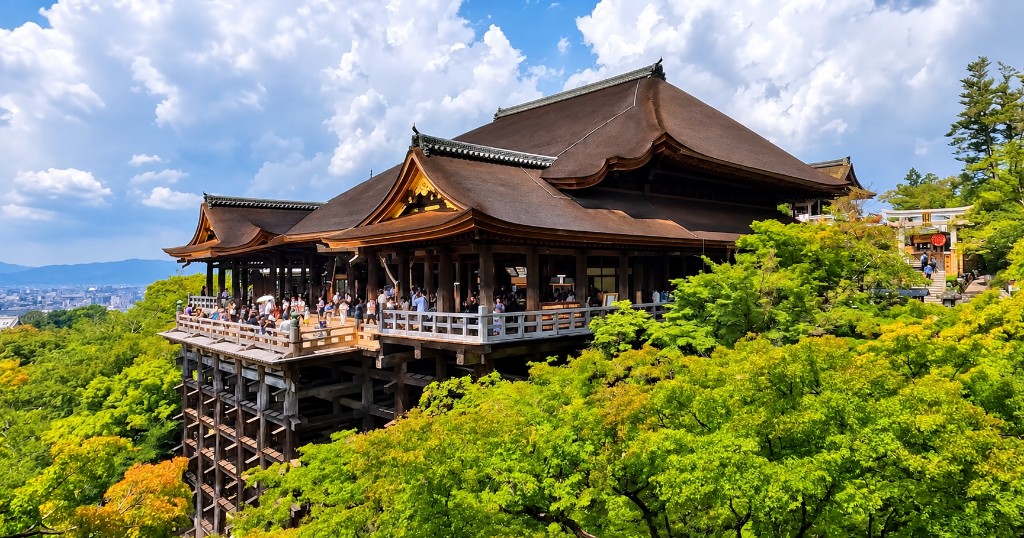
It is also the easiest World Heritage site in Kyoto to visit badly. Almost everyone arrives between ten and three, walks up a shopping street built for exactly that crowd, and sees the stage in a slow-moving queue. The temple opens at six in the morning, which is the single most useful fact in this guide: at seven you can have the stage almost to yourself, and be drinking tea in Gion before the tour buses reach the car park.
Quick facts
| Name | Otowa-san Kiyomizu-dera, head temple of the Kita-Hosso school |
| Address | 1-294 Kiyomizu, Higashiyama-ku, Kyoto 605-0862 |
| Opening time | 6:00 every day of the year |
| Closing time | 18:00, or 18:30 from 1 July to 31 August; 21:30 during special night viewing, last entry 21:00 |
| Admission | 500 yen for adults, 200 yen for primary and middle school students, no group discount |
| Nearest stops | Gojozaka or Kiyomizu-michi, Kyoto City Bus, about 10 minutes on foot |
| Time needed | 60 to 90 minutes, plus the approach street |
| Parking | None inside the grounds; use city or private car parks at the foot of the hill |
Why the stage matters
The Main Hall, Hondo, is a National Treasure, rebuilt in 1633 on the orders of the third Tokugawa shogun, Iemitsu. It is a hall of worship rather than a palace, but the design borrows the elegance of aristocratic architecture: a central core with wings pushed forward either side, and the space between them floored as a stage that projects over the cliff.
The stage covers roughly 200 square metres, and during the restoration that ran from 2008 the floor was replaced with 166 boards of Kiso hinoki cypress. Underneath, the platform is carried by pillars more than 13 metres tall, assembled without nails in the traditional way, standing on a slope that has been holding them for nearly four centuries. Standing on the edge and looking down is the reason the Japanese expression “jumping off the Kiyomizu stage” exists: it means making a decision so bold that the consequences cannot be undone.
The hall holds the temple’s principal image, an Eleven-Headed Thousand-Armed Kannon, kept in a cabinet in the innermost room and shown only once every 33 years; the last opening was in 2000. You will not see it. What you see is the architecture, the view and the century-old cedar and zelkova frame doing the work that concrete does elsewhere.
A short history
The temple begins with a spring. According to its own origin story, a monk named Kenshin, trained at Kojima-dera in Nara, was told in a dream to travel north, and found a pure waterfall on Mount Otowa where a hermit named Gyoei-koji was living. Gyoei gave him a sacred tree and asked him to carve a thousand-armed Kannon and build a hall for it. The foundation date is given as 778, and two years later the warrior Sakanoue no Tamuramaro, who had come to the mountain to hunt, met Kenshin and helped him establish the temple, naming it Kiyomizu, “pure water”, after the falls.
That association with a warrior is why the temple has always been popular: it was never a closed aristocratic chapel. It burned more than ten times, and each time the city rebuilt it. Most of what stands today dates from the 1633 reconstruction, and the temple became the head of the Kita-Hosso school in 1965 under abbot Onishi Ryokei, who is remembered for turning a wealthy temple into one that ran nursing homes and children’s institutions. In 1994 the temple was inscribed as part of the Historic Monuments of Ancient Kyoto World Heritage site.
Walking the grounds
The grounds spread over about 130,000 square metres on the slope of Mount Otowa, with thirty buildings, and the route runs up and around rather than in a straight line.
The Nio-mon is the main gate, a two-storey structure burned in the civil war of 1469 and rebuilt around 1500, then taken apart and refurbished in 2003. Beyond it, the Zuigu-do of 1735 holds a hidden Daizuigu Bodhisattva and runs the Tainai-meguri, a walk through a completely dark passage under the hall that represents passing through the womb; it is short, cheap and not for anyone who dislikes the dark.
The Main Hall is the centre. Walk the stage, look down at the treetops, and then follow the path down the slope to the Okuno-in, which has its own smaller stage directly above the waterfall and gives the photograph everyone wants: the Main Hall stage seen from across the valley, standing on its pillars in the trees.
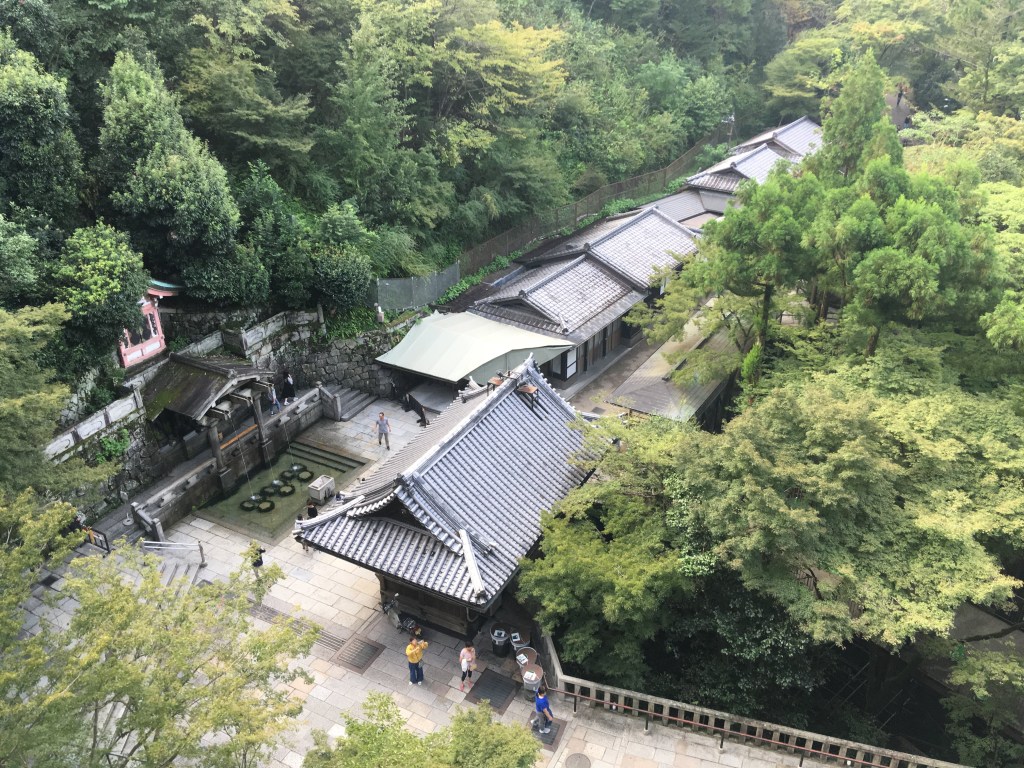
The Otowa Waterfall is where the temple began. The water is channelled into three streams, and visitors queue with long-handled ladles to catch one, drink, and pray. The three are said to grant longevity, success in study and luck in love, and the custom is to choose one rather than drink from all three, which is read as greed. The queue moves quickly, the water is cold, and the metal ladles are shared.
Joju-in, up the slope beyond, was the residence of the priest Gana and later the sub-temple that managed the temple’s finances. Its Moon Garden is open only for limited seasons in spring and autumn, and it is the quietest place on the mountain when it is.
Tickets, hours and night viewing
- Admission is 500 yen for adults and 200 yen for primary and middle school students, paid at the gate. There is no group discount; teachers leading official school trips are admitted free with identification and an itinerary.
- Gates open at 6:00 all year, which is earlier than almost any other paid sight in Kyoto and the reason an early start works.
- Closing is 18:00 for most of the year and 18:30 from 1 July to 31 August.
- Special night viewing in 2026 runs from 27 March to 5 April, from 14 to 16 August for the Thousand-Day Prayer, and from 21 to 30 November. On those dates the gates stay open until 21:30 with last entry at 21:00. The dates shift each year, so check the temple’s own calendar.
- Cash is the practical assumption at the gate and at the small counters inside.
Getting there
From Kyoto Station
Kyoto City Bus 206 towards the Higashiyama-dori Kitaoji bus terminal, or the 100 sightseeing service towards Kiyomizu-dera and Ginkaku-ji, both stop at Gojozaka. From the stop it is about ten minutes uphill on foot to the gate. The 206 is frequent and crowded; the 100 is aimed at visitors and runs only in busy periods.
From Gion and Kawaramachi
City bus 207 from Gion-Shijo or Shijo-Kawaramachi towards Tofuku-ji stops at Kiyomizu-michi, from where it is also about ten minutes uphill. Keihan bus routes 83, 85, 87 and 88 cover the same stops.
On foot
Keihan Kiyomizu-Gojo station is about 25 minutes on foot, which is the pleasantest approach: you climb through the old streets rather than arriving at a bus stop. From Gion it is a 20-minute walk up Ninenzaka and Sannenzaka, and those lanes are half the reason to come.
Two entrances only
The temple is explicit about this. You can enter from the Kiyomizu-zaka approach in front of the Nio-mon, or from Chawan-zaka up the disaster-prevention road. Map apps sometimes route people to gates that do not admit visitors, so follow the signs once you are on the slope.
By car
There is no car park inside the grounds. City and private car parks sit at the foot of the approach streets and fill early in cherry and maple season; the temple recommends public transport or a taxi. Note that the street in front of the main gate is closed to vehicles from 8:00 to 19:00.
When to go
Kiyomizu-dera has roughly 1,500 cherry trees and about 1,000 maples, and both seasons are spectacular enough to be crowded beyond comfort. The temple publishes the state of the blossom and the colour on its news page each season, and the peak moves by a week or two every year.
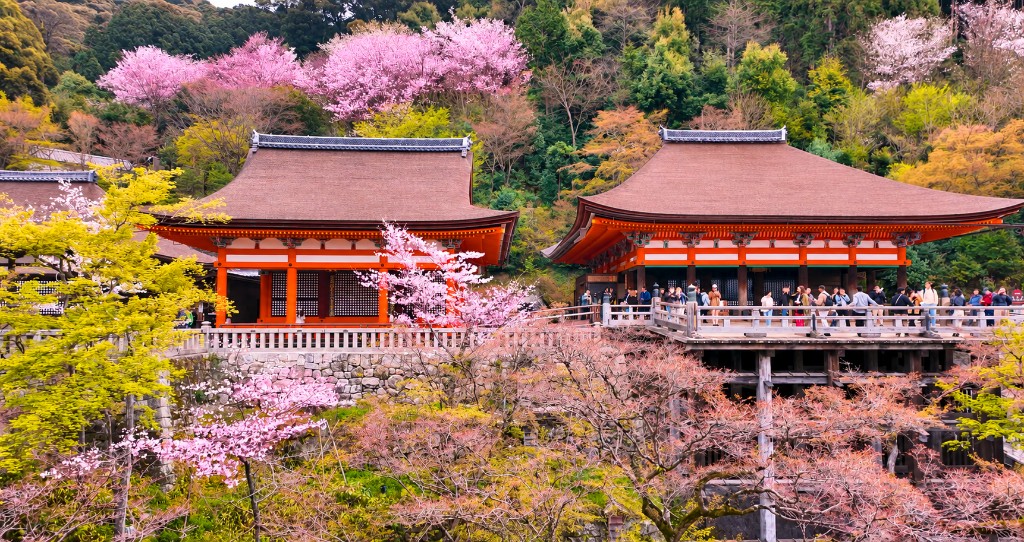
- Early morning, any season is the answer. The gate opens at 6:00, the light comes over the eastern hills, and until about 8:30 the stage belongs to locals walking their dogs and a few photographers.
- Late March to early April for cherry blossom, with night viewing until 21:30 in the first week of April.
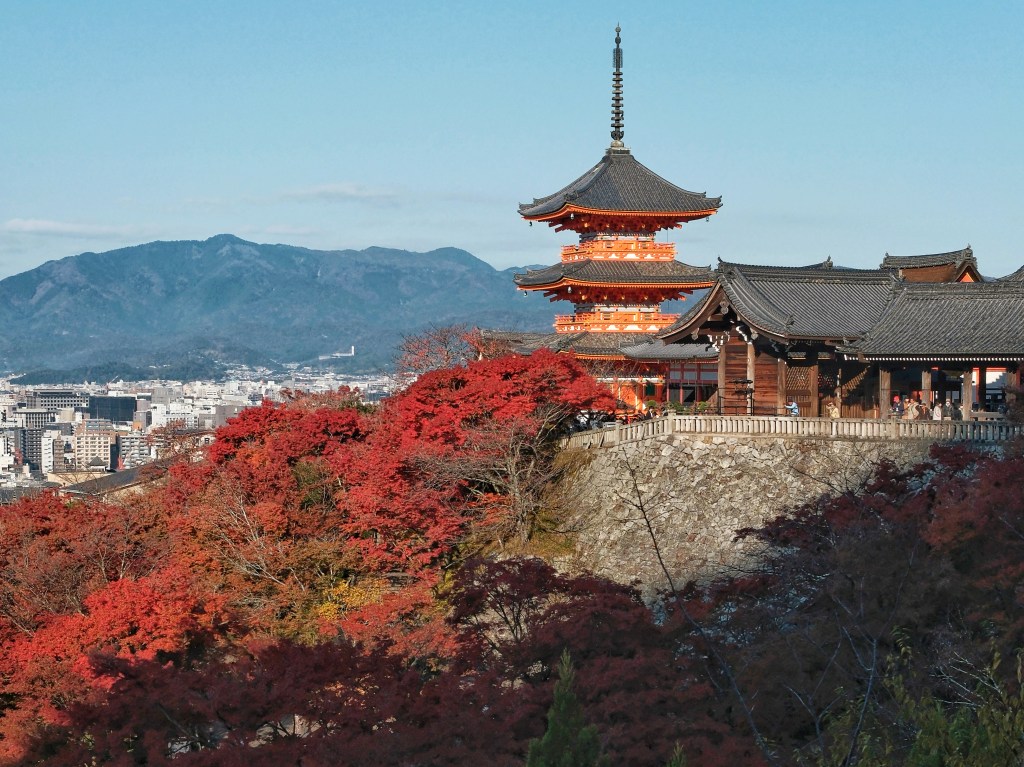
- Mid to late November for the maples, and the night viewing at the end of the month, when the illuminated stage floats above the red slope.
- January and February are cold, quiet and occasionally snowy; the stage in snow is the least photographed version and the most atmospheric.
- June is the rainy season: wet stone, green hills, very few people before nine.
Food and practicalities
The approach is a shopping street: Kiyomizu-zaka, then Sannenzaka and Ninenzaka, the preserved lanes that lead down towards Gion. Yudofu, the Kyoto tofu hot pot, is the traditional meal here, and there are noodle shops and matcha stands all the way up. Expect queues at the famous places between eleven and two, and expect to pay for the view as much as the food.
Eating while walking is discouraged across the Higashiyama lanes, and some shops ask you to finish drinks at the counter. The grounds are entirely non-smoking with no smoking area, food other than sealed drinks is not allowed inside, and pets are not admitted. The stone steps on the approach are steep and slippery when wet, and the route inside includes a slope down to the waterfall and back up again, so shoes matter more than they look like they should.
Where to stay
- Higashiyama, around Kiyomizu-Gojo and Gion, puts the temple within a 20-minute walk for a 6 a.m. start. Ryokan and small hotels, quieter at night than the centre.
- Kawaramachi and Karasuma give you restaurants, the subway and the Keihan line, with a bus or a 30-minute walk to the temple.
- Kyoto Station suits a short stay or a rail pass; bus 206 runs from outside.
What to see next
- Kodai-ji, five minutes down the hill, has a garden by Kobori Enshu and a fraction of the crowd.
- Yasaka Shrine and Gion are a 15-minute walk down through Ninenzaka and Sannenzaka, and the lanes themselves are the sight.
- Sanjusangendo, south along the Higashiyama road, holds 1,001 standing Kannon in a hall 120 metres long; the contrast with Kiyomizu’s single hidden image is the point.
- Fushimi Inari is 15 minutes away by Keihan line from Kiyomizu-Gojo, and worth pairing if you are starting at six.
- Ginkaku-ji is at the other end of the same bus 100 route, which makes a full day along the eastern hills.
Before you go
Opening and closing times above are the temple’s 2026 schedule and the admission fee is the figure published by Kyoto city’s tourism site; both were checked on 27 October 2026. Night viewing dates are set each year and the 2027 dates are not published yet. Two things are worth confirming on the temple’s own site before you travel: whether a special viewing of the Joju-in garden is running on your dates, and whether anything in the grounds is closed for repair, since the temple has been carrying out a long programme of work on its halls since 2008. Carry cash, arrive at opening, and walk up rather than taking the bus for the last stop.
Sources
- Kiyomizu-dera official site (checked 2026-10-27)
- Kiyomizu-dera official access page: 2026 hours, bus routes and parking (checked 2026-10-27)
- Kiyomizu-dera official grounds guide: Main Hall, waterfall, Joju-in and event calendar (checked 2026-10-27)
- Kiyomizu-dera official history and Main Hall page (checked 2026-10-27)
- Kiyomizu-dera FAQ: admission, group discounts and rules (checked 2026-10-27)
- Kyoto City tourism: Kiyomizu-dera history and buildings (checked 2026-10-27)
- Kyoto City tourism: 2026 autumn night viewing and admission fee (checked 2026-10-27)
Explore More of Japan
- Kinkaku-ji Travel Guide — the other temple everyone photographs in Kyoto
- Kyoto Higashiyama Travel Guide — the district around the temple
- Fushimi Inari Travel Guide — the torii path, 15 minutes away by train
- Nijo Castle Travel Guide — the shogun’s Kyoto residence
- Kurama and Kibune Day Trip — mountain temples north of the city


Leave a Reply