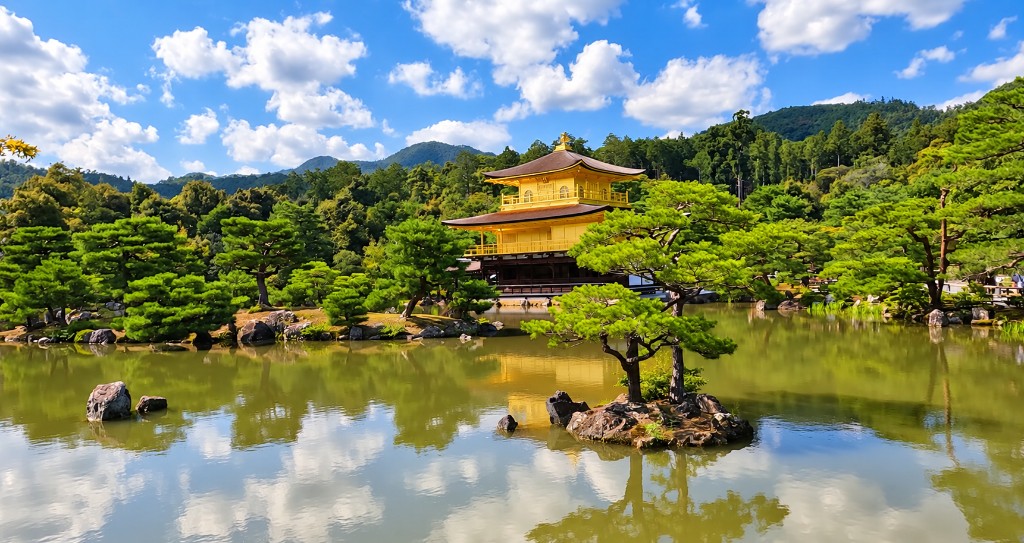
Kinkaku-ji is the building most people picture when they picture Kyoto: two storeys of gold leaf above a pond, with a pine tree leaning out over the water and a hill of cedar behind. It is also the most crowded single sight in the city, visited by coach groups from opening time, and the gap between the photograph and the visit surprises people.
Both things are true. The pavilion is smaller than it looks in pictures, you cannot go inside it, and the walking route through the grounds takes under an hour. It is still worth the trip, because the garden around it is a genuine Muromachi-period landscape, because the gold changes completely with the weather, and because no other building in Japan carries six hundred years of politics, arson and reconstruction in one silhouette.
Quick facts
| Official name | Rokuon-ji, a branch temple of Shokoku-ji in the Rinzai Zen school |
| Address | 1 Kinkakuji-cho, Kita-ku, Kyoto 603-8361 |
| Hours | 9:00 to 17:00, open all year; hours can change for special events |
| Admission | 500 yen for adults, 300 yen for primary and middle school students, paid at the entrance |
| Nearest stop | Kinkakuji-michi, Kyoto City Bus, about three minutes on foot |
| Time needed | 40 to 60 minutes at an easy pace |
| Parking | 250 cars, open 8:40 to 17:10, 400 yen for the first hour |
Why the Golden Pavilion matters
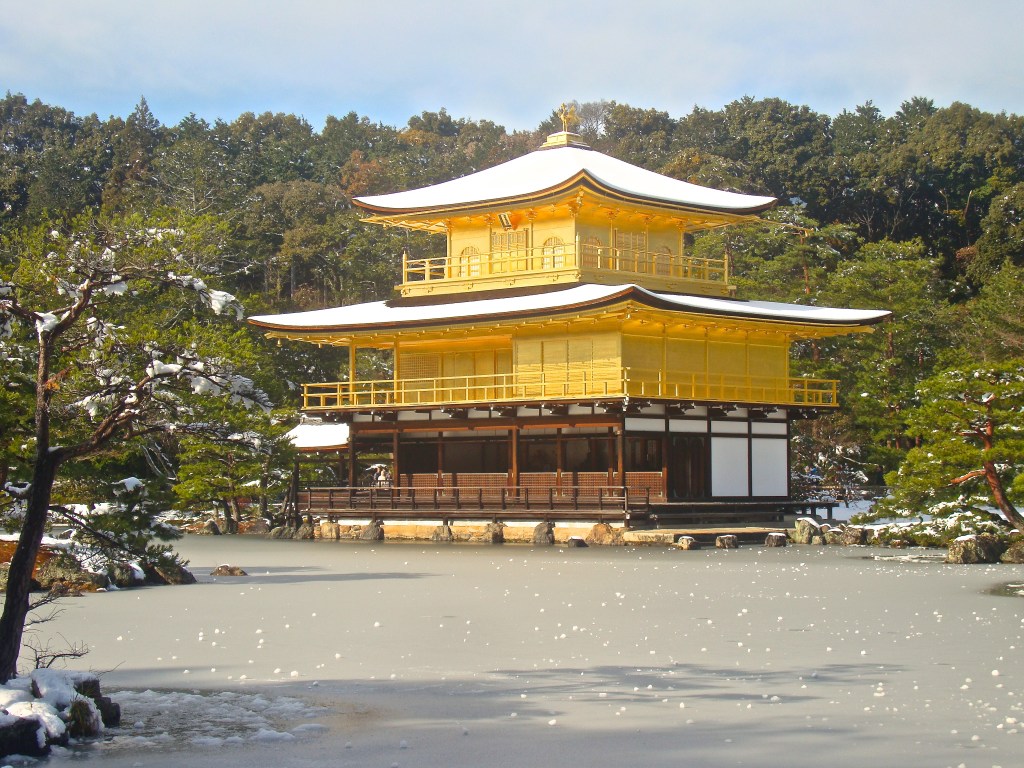
The building is a relic hall, a shariden, built to hold the ashes of the Buddha, and its three floors are deliberately three different architectures. The ground floor, Hossui-in, is in the palace style of the Heian court, open and residential. The middle floor, Cho’on-do, is in the warrior style of the Kamakura period. The top floor, Kukkyo-cho, is a Chinese Zen Buddha hall, and it is the only one with gold on all four sides. Only the upper two floors are covered in gold leaf; the ground floor is plain wood, which is why the pavilion seems to float above its own reflection.
The roof is layered cypress bark rather than tile, topped by a gilded phoenix, and the whole thing sits at the edge of the pond so that the gold doubles in the water. The lacquer and gold leaf were completely renewed in the autumn of 1987, together with the ceiling painting and the statue of Ashikaga Yoshimitsu inside, which is why the surface looks newer than the fifteenth century.
Almost nothing inside is visible from the path. The first floor holds a Shakyamuni triad, the second a Kannon, the third the relics themselves, and the doors are shut. You are looking at a container, not a room, and the experience is the exterior, the pond and the setting.
A short history
The site was a country villa before it was a temple. In the Kamakura period it belonged to Saionji Kintsune, a court noble whose Kitayamadai estate was famous enough that the poet Fujiwara no Teika came to see it in 1225 and wrote about a waterfall forty-five feet high and a pond as blue as lapis lazuli. The pond he saw is the only part of that estate still there.
In 1397 the third Ashikaga shogun, Yoshimitsu, took over the abandoned property and built the Kitayama palace, moving the business of government out of central Kyoto to a compound whose gardens and halls were meant to represent the Pure Land on earth. He received the Ming emperor’s envoys here, and in 1408 he held a state visit for Emperor Gokomatsu that became known as the Imperial Visit to Kitayama. The culture that grew around him, importing Ming Chinese painting, ceramics and Zen learning, is what historians call Kitayama culture.
Yoshimitsu died in 1408 at fifty-one, and by his will the palace became a Zen temple. It took its name, Rokuon-ji, from the first two characters of his posthumous name, Rokuon-in; Muso Soseki, who had died decades earlier, was named honorary founder. The Golden Pavilion, the stone Fudo hall and the Goma hall survived the Onin War of 1467 to 1477 that destroyed most of the city’s Zen temples, and the pond garden was restored in the Edo period by the abbot Horin Josho. The tea house on the hill, Sekkatei, was built at that time by the tea master Kanamori Sowa for the retired Emperor Go-Mizunoo.
The temple opened to the public in 1894, when the abbot Kanso Choro admitted visitors during a trade fair in Osaka. Then came the event that explains why you are looking at a twentieth-century building: on 2 July 1950 a novice monk set fire to the pavilion and burned it to its stone base. The reconstruction was completed in 1955, using the surviving drawings and photographs, and in 1994 the temple was inscribed on the UNESCO World Heritage list as part of the Historic Monuments of Ancient Kyoto.
Walking the grounds
The route runs in one direction from the Somon gate to the exit, past the bell tower whose bell is said to come from the Saionji family, the Kuri, built in the 1490s, and the Karamon gate, and then the view opens.
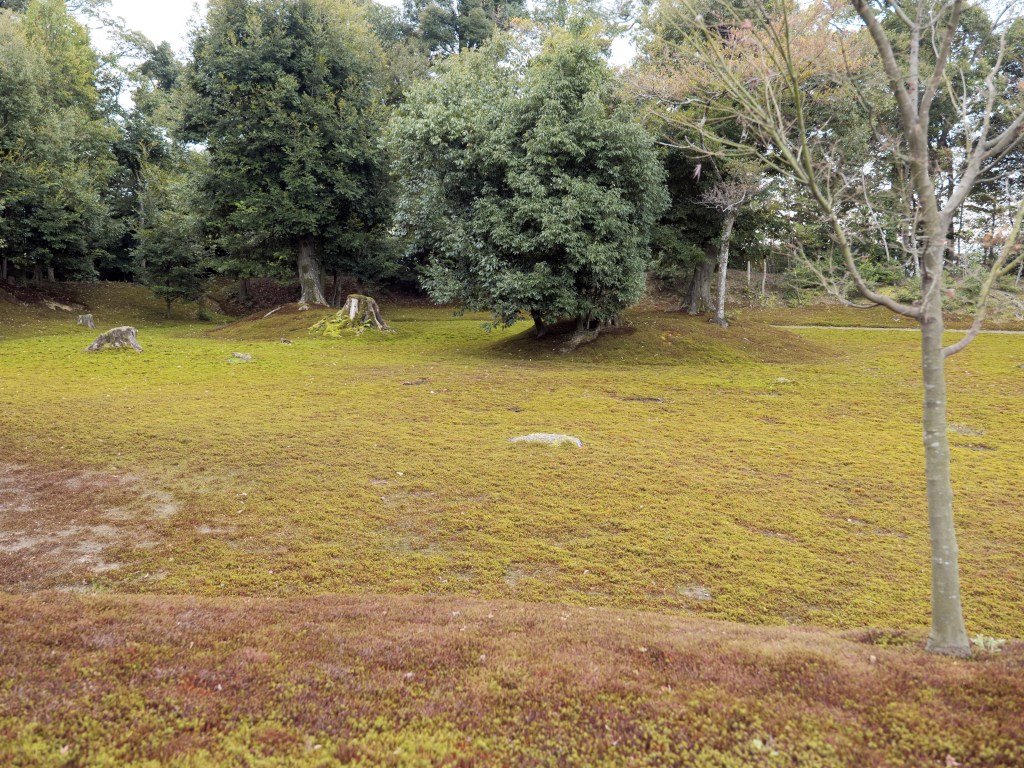
The pond is the centre of the visit. Kyoko-chi covers about 6,600 square metres, with islands including Ashiharajima and named stones such as Hatakeyama-ishi arranged so that the composition changes as you walk. The garden was laid out as a Pure Land landscape, with the pavilion as the palace in the middle of it, and the whole 92,400 square metres of garden is designated a Special Historic Site and Special Place of Scenic Beauty.
Behind the pavilion the path climbs. You pass the Gingasen spring, said to be where Yoshimitsu drew water for tea, and the Gankasui stream where he washed his hands. Then the Ryumon Falls, 2.3 metres high, with a carp-shaped stone at the lip in reference to the Chinese legend of a carp that jumped the waterfall and became a dragon, and the small Kokei-kyo bridge beside the low bamboo fence known as Kinkakuji-gaki.
Above that, the Anmin-taku pond does not dry up even in drought and was once used for rain prayers; the five-ring stone pagoda on its island, Hakuja-tsuka, is said to enshrine the Saionji family deity. The path ends at Sekkatei, the three-mat tea house with a nandina post and bush clover shelves, named because the setting sun on the pavilion looks best from there. The Fudo-do near the exit holds a hidden stone Fudo Myo-o attributed to Kobo Daishi, whose doors are opened on 3 February and 16 August.
Tickets, hours and rules
- Admission is 500 yen for adults and 300 yen for primary and middle school students, with no group discount. If you are a group of thirty or more, the temple asks you to enter together.
- Hours are 9:00 to 17:00, and the temple does not close on any day of the year. The fee and hours can change during special exhibitions.
- No interior visit. The pavilion is viewed from the path across the pond and from behind; there is no entry to any of the three floors.
- One way through. Plan your photographs before you move on, because the route does not loop back to the pond.
- Parking is on site, open 8:40 to 17:10 for 250 cars: 400 yen for the first hour and 200 yen for each half hour after that. Coaches and motorcycles have their own rates.
Getting there
From Kyoto Station by bus
Kyoto City Bus 205 runs from the station to Kinkakuji-michi, the stop closest to the temple, and the journey takes around 45 minutes in normal traffic. The stop is about a three-minute walk from the gate. The 205 is the obvious choice and also the slowest, because it serves the whole north-west of the city and fills up.
By subway, then bus
The faster route is the Karasuma subway line to Kitaoji, then city bus 204 or 205 from the bus terminal beside the station. Buses for the temple leave from the Blue boarding area, and the ride to Kinkakuji-michi takes about 11 to 15 minutes. This avoids the long crawl through the city centre and is the route locals use.
Other approaches
- City bus routes 12, 59, 205 and M1 all stop at Kinkakuji-michi, so the temple is reachable from several parts of the city without changing.
- JR Sagano line to Enmachi, then bus 204 or 205. Useful if you are coming from Arashiyama.
- Weekends and holidays add the 102 Rakuraku line, which links Kinkaku-ji with Ginkaku-ji across the north of the city, and seasonal 109 services run in late April to early May and in autumn.
- Taxi from central Kyoto is the quickest way to arrive early, and the most expensive; the temple has a drop-off area at the main gate.
When to go
Kinkaku-ji opens at 9:00 and the coach groups are already there. The single best decision you can make is to be at the gate a few minutes before opening, walk straight to the pond, and take the classic view before the path fills. By mid-morning the narrow stretch in front of the pavilion is a slow queue.
- Late November is the peak: the maples behind the pavilion turn, and the temple is at its busiest. Expect to shuffle.
- Early April brings cherry blossom on the approach and the same crowds.
- January and February are cold and quiet, and a snowfall turns the gold and the pines into the picture on every poster. Snow in Kyoto is rare and rarely lasts past midday.
- June is the rainy season: wet, green, and the least crowded month in which the garden looks its best.
- Weekday afternoons after 15:00 are calmer than mornings, though the light is flatter.
What to see next
The temple sits in the north-west of Kyoto, away from the Higashiyama and Arashiyama clusters, so it makes sense to pair it with other sights in the same corner of the city rather than crossing town.
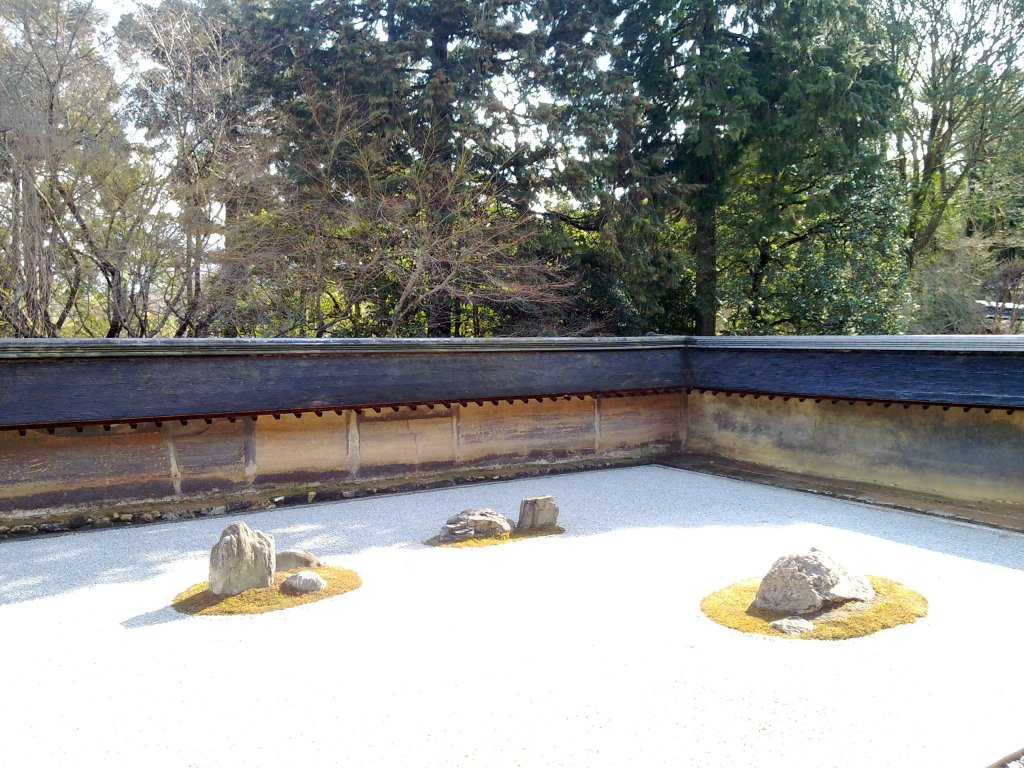
- Ryoan-ji, the rock garden temple, is a short bus ride south and belongs to the same World Heritage listing. Two gardens, two completely different ideas of what a garden is.
- Daitoku-ji, a walled complex of Zen sub-temples with some of the best dry gardens and screen paintings in the city, is further south and almost empty on weekdays.
- Nijo Castle and central Kyoto are 20 to 30 minutes away by bus, and the castle’s nightingale floors make a good contrast to a Pure Land garden.
- Arashiyama can be reached on bus 59 or by the JR line via Enmachi, which makes a long but coherent day: pavilion in the morning, bamboo grove in the afternoon.
Food and practicalities
Kinkakuji-michi has a strip of souvenir shops and snack stands, and the surrounding streets are residential. For a proper meal, most visitors go back towards Kitaoji or into central Kyoto; Nishijin and the streets around Imadegawa have more choice than the immediate approach. Matcha soft cream and yatsuhashi sweets are the standard souvenirs, and the shops are set up for coach traffic rather than for browsing.
Wear shoes you can walk in: the route is gravel and packed earth, with a slope and some steps after the pavilion. There are toilets and a small rest area near the entrance, and the site is not large enough to need a plan beyond an hour. Photography is allowed outdoors; tripods and drone use are not appropriate in a crowded temple garden.
Where to stay
- Kitaoji is the practical base for an early start: a subway stop, a bus terminal and a handful of business hotels within a few minutes of the temple bus.
- Central Kyoto around Kawaramachi and Karasuma gives you restaurants and the rest of the city, at the cost of a 30-minute trip north.
- Kyoto Station suits a short stay or a rail pass, with the 205 bus leaving from outside.
Before you go
Opening hours, the admission fee and the bus routes above come from the temple’s own pages and Kyoto city’s tourism site and were checked on 27 October 2026. The fee is small and has been stable for years, but it can change during special exhibitions, and the 102 and 109 bus services run only on certain days or in certain seasons. Check the temple’s access page for the current bus list, and go early: the difference between 8:55 and 10:00 is the difference between a photograph and a queue.
Sources
- Kinkaku-ji official site: hours, address and live camera (checked 2026-10-27)
- Kinkaku-ji official access page: buses, parking and admission (checked 2026-10-27)
- Kinkaku-ji official history: Saionji villa, Yoshimitsu and the 1987 restoration (checked 2026-10-27)
- Kinkaku-ji official grounds guide: pond, falls, Sekkatei and Fudo-do (checked 2026-10-27)
- Kyoto City tourism: Rokuon-ji, 1950 fire and 1955 reconstruction (checked 2026-10-27)
- Japan National Tourism Organization: Kinkakuji access and history (checked 2026-10-27)
Explore More of Japan
- Fushimi Inari Travel Guide — the other Kyoto sight that everyone photographs
- Arashiyama and Sagano Travel Guide — the bamboo grove and the river, west of the city
- Nijo Castle Travel Guide — the shogun’s Kyoto residence
- Kyoto Higashiyama Travel Guide — the eastern temple district
- Kurama and Kibune Day Trip — mountain temples north of the city


Leave a Reply