There is a moment on the platform at Mojiko Station that catches almost everyone. The train has just pulled out, the wooden roof beams are quiet, and the station sign reads mojiko in the old rounded lettering. Behind you, the two-storey station building is symmetrical, cream-coloured and slightly absurd for a town this small. Ahead, past the end of the platform, the strait opens up and the Kanmon Bridge cuts across the water to another island.
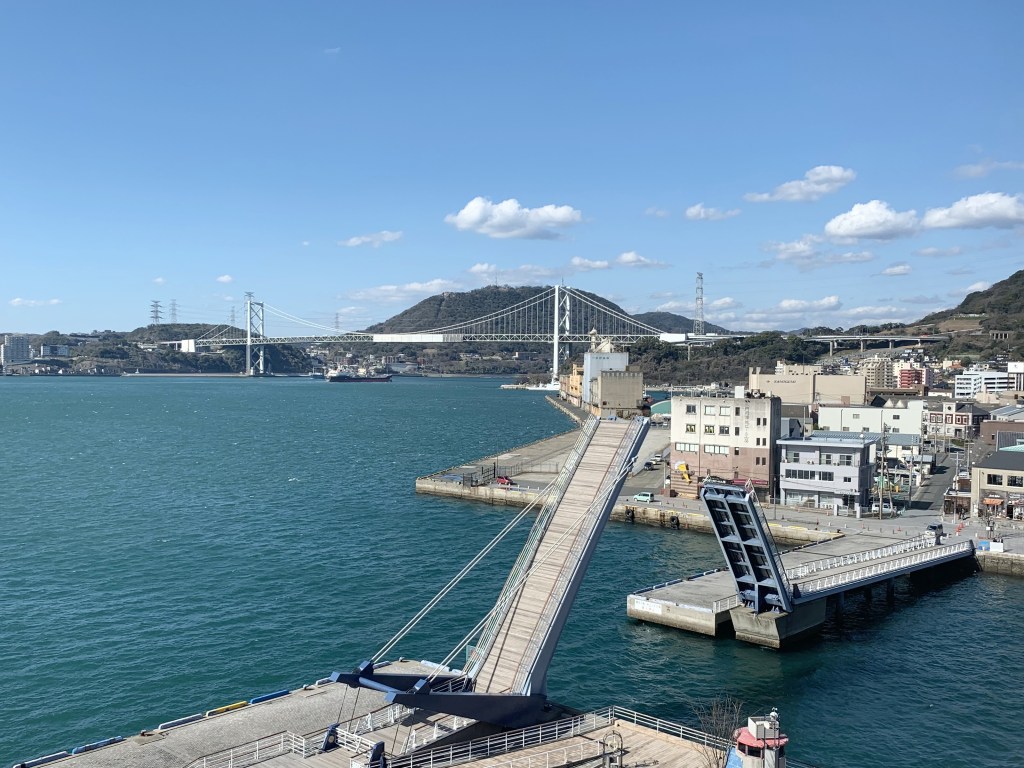
Mojiko is the point where Kyushu almost touches Honshu. The channel here is about 700 metres wide at its narrowest, and boats, ferries and container ships thread through it all day. On the Kyushu side is a compact district of early twentieth-century warehouses, customs houses and trading offices that has been restored as Mojiko Retro. On the Honshu side is Shimonoseki, with a fish market, a shrine to a drowned child emperor, and the site of the battle that ended the Heike clan.
What makes the place unusual is that you can walk between the two islands. A pedestrian tunnel runs under the seabed, 780 metres long, free to use, with a prefecture border painted on the floor at the midpoint. You can also take a five-minute ferry, or a train through a different tunnel, or drive over the bridge. Very few places in the world let you choose between four ways of crossing a national strait in the space of an afternoon.
This guide covers what to see and what to skip, the 2026 admission fees for the paid attractions, the timetables and fares for the tunnel, ferry and retro train, what to eat and where, how to build a half-day or full-day route, and the practical traps: closed days, the market’s odd hours, the fact that the ropeway on the far side no longer runs, and the restaurant that has just closed inside one of the most famous buildings in the district.
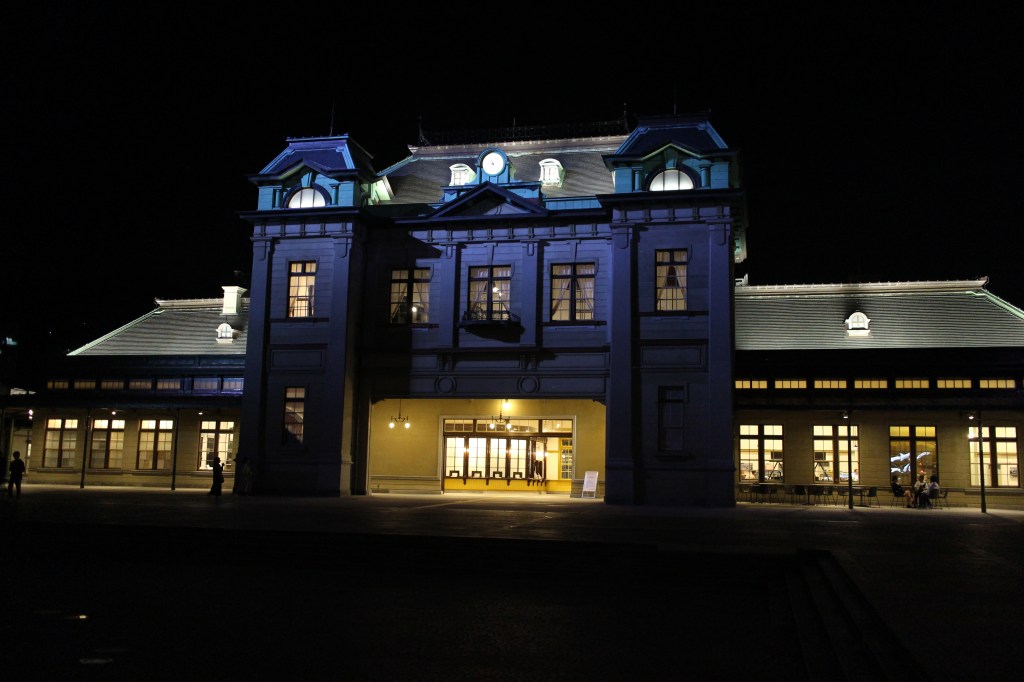
Mojiko and the Kanmon Strait at a glance
| Location | Moji ward, Kitakyushu, Fukuoka prefecture, Kyushu; the strait separates it from Shimonoseki, Yamaguchi prefecture, Honshu |
|---|---|
| Strait width | About 700 m at the narrowest point (Hayatomo no Seto) |
| Station | JR Mojiko, the terminus of the Kagoshima Main Line, about 14 minutes from Kokura |
| Mojiko Station | Built 1914, Important Cultural Property since 1988, restored and reopened in March 2019 |
| Observation deck | ¥600 adult (¥400 for Kitakyushu residents), ¥300 for schoolchildren; 10:00–22:00 |
| Pedestrian tunnel | 780 m, about 15 minutes one way, free for walkers, 6:00–22:00 |
| Ferry to Shimonoseki | About 5 minutes, ¥400 adult one way, every 20 minutes in the daytime |
| Retro train (Shiokaze) | Weekends and holidays only, ¥500 adult one way, 2.1 km in about 10 minutes |
| Time needed | Half a day for Mojiko alone; a full day to add the tunnel and Shimonoseki |
| Main caveat | Most paid attractions close at 17:00; several shut on irregular weekdays each year |
Why Mojiko feels different from other retro towns
Japan has no shortage of restored streets. What separates Mojiko from a theme-park version of the past is that the buildings were here for a reason, and the reason is visible from the waterfront. Mojiko was the gateway to the continent: the port where passengers boarded ships for Shimonoseki, Busan and beyond, and the place where goods from Taiwan, Korea and China were landed and taxed. The customs house, the shipping company offices and the trading club were not decorative. They were infrastructure.
The second difference is scale. The historic core is small enough to walk in twenty minutes, but dense enough that you keep finding things: a brick warehouse with a copper roof, a blue bascule bridge that opens on the hour, a stretch of stone quay where the water slaps against the steps. The district sits between the station and the strait, so the water is never far away and the light changes constantly.
The third difference is that it is a working port, not a preserved one. Container ships pass behind the heritage warehouses. The fish market on the other side of the strait still auctions seafood at half past three in the morning. The retro train runs on a former freight line. You are walking through a place that has been repurposed, not frozen.
A short history of the port
Mojiko grew up around a railway. The station opened in 1891 under the name Moji, as the western terminus of the line that would become the Kagoshima Main Line, and the port expanded alongside it. The present station building dates from 1914, a symmetrical neo-Renaissance design with a stone-faced facade, a copper roof and a clock that was installed in 1918. It was renamed Mojiko in 1942, when the older Moji station further north took over the name.
For the first half of the twentieth century this was one of the busiest ports in western Japan. Passenger ferries crossed to Shimonoseki, and from there the journey continued by train towards Honshu. Troops embarked for the continent. Trading houses built offices and clubhouses on the slope above the harbour. The customs house handled cargo in a long brick building with a tower that still dominates the waterfront.
Then, in March 1958, the Kanmon road tunnel opened, followed by the rail tunnel that had already been carrying trains under the strait. The ferry traffic that had defined the port collapsed. The bridge followed in 1973. By the 1980s the warehouses were empty and the district was a backwater, which is precisely why the historic buildings survived: nobody could afford to demolish them and build something taller.
The restoration began in the mid-1990s, when the city redeveloped the waterfront as a pedestrian district and moved the observation deck, shops and museum into the new buildings. Mojiko Station was designated an Important Cultural Property in 1988, the first railway station building in Japan to receive the status, and a six-year restoration project returned it to its 1914 appearance, finishing with a grand reopening on 10 March 2019. Only two working station buildings in Japan hold that designation: Mojiko and Tokyo.
The strait as a working waterway
One of the pleasures of Mojiko is that the view is never still. The Kanmon Strait is a busy commercial channel, and the water moves fast: the tidal current through the narrows can reach several knots, which is why the strait has been a maritime chokepoint for centuries and why the bridge had to be built high enough to clear the largest ships.
Stand on the quay in front of the former customs house for ten minutes and you will see a container ship, a car ferry, a pilot boat and a fishing boat, all using the same narrow channel. The ferries from Mojiko to Karato cut across it every twenty minutes. The bridge carries traffic on the expressway above, and the trains run underneath the seabed. In a single view you have four layers of transport stacked on top of each other, and the effect is oddly satisfying.
The strait also explains the food. The fast current and the meeting of the Japan Sea and the Seto Inland Sea produce a rich fishery, which is why Shimonoseki became the centre of the fugu trade and why the market on the other side is worth crossing for. The same water made Mojiko a port, and the same narrowness made it a battleground, twice: once in 1185 and once in the 1860s, when the Choshu domain fired on foreign shipping from the shore that is now a public park.
If you have an interest in ships, the strip of waterfront between the customs house and the bridge is the place to sit. There are benches, a few explanatory panels, and a constant supply of vessels to watch. It costs nothing and it is the most authentic thing in the district.
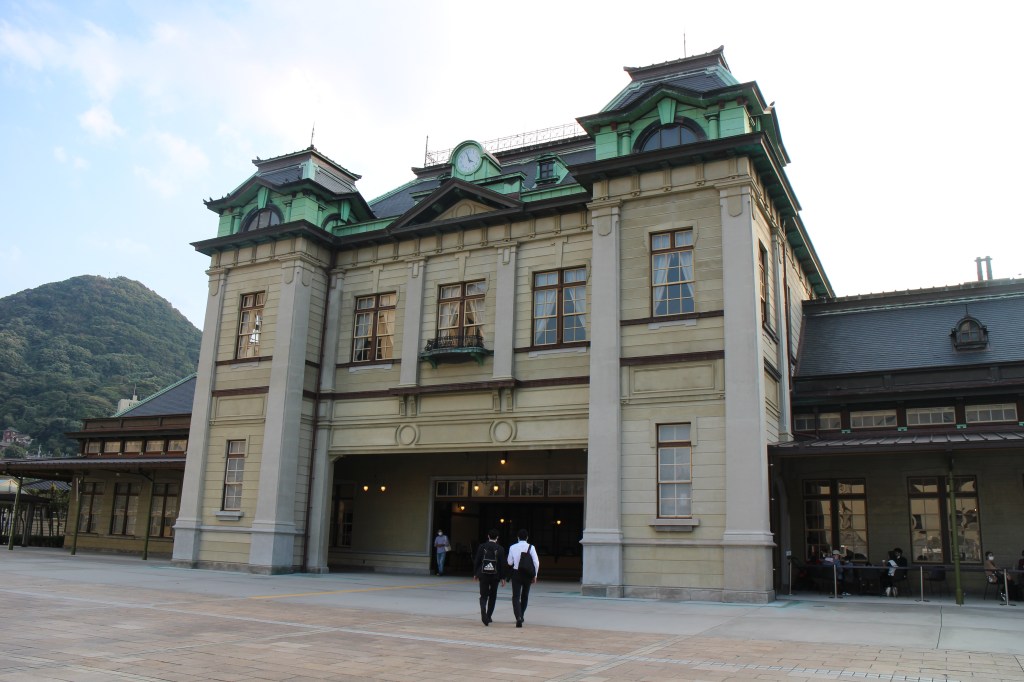
Mojiko Station: what to look at
The station is the reason many people come, and it repays more than a photograph. Stand outside on the plaza and look at the symmetry: a central entrance, two wings, a stone-textured render that imitates masonry, and a roof of natural slate. The clock above the entrance is the 1918 original, kept because of its historical value.
Inside, the ticket hall has a wooden counter, brass fittings and a ceiling that is higher than it needs to be. On the first floor the old third-class waiting room is now a coffee shop, and the former first- and second-class waiting rooms are used by the ticket office and the tourist information desk. The old ticket windows and a reconstruction of the original ticket gate are still in place, and there is a small exhibition room with objects from the station restaurant that once operated here.
Upstairs, the former VIP room and the adjoining anteroom are open to visitors. This is where imperial and government guests waited, and the red carpet, wallpaper and heavy fittings have been restored. Entry to the second floor is free, but the hours are shorter than the station’s: 9:30 to 20:00, and the VIP room can be closed when the restaurant uses it as a private room. The stairway is on the ticket-gate side, or you can take the lift behind the cafe.
Two small details are worth knowing. The platforms have no benches and no vending machines, deliberately, which makes the long straight view under the wooden canopy the cleanest station photograph in Kyushu. And the station announcements are made by staff in person rather than by automated recording, a quirk the city is proud of.
If you want to walk onto the platforms without catching a train, buy a platform ticket at the gate rather than from the machine. The gate version comes in three designs and is stamped by staff, which makes it a better souvenir than the standard ticket.
The retro district on foot
The district runs from the station down to the water in a loose grid, and the obvious route is to start at the station, walk down the main street towards the strait, and then follow the waterfront in either direction. Allow two hours for the free sights and a full afternoon if you add the paid ones.
Former Moji Customs
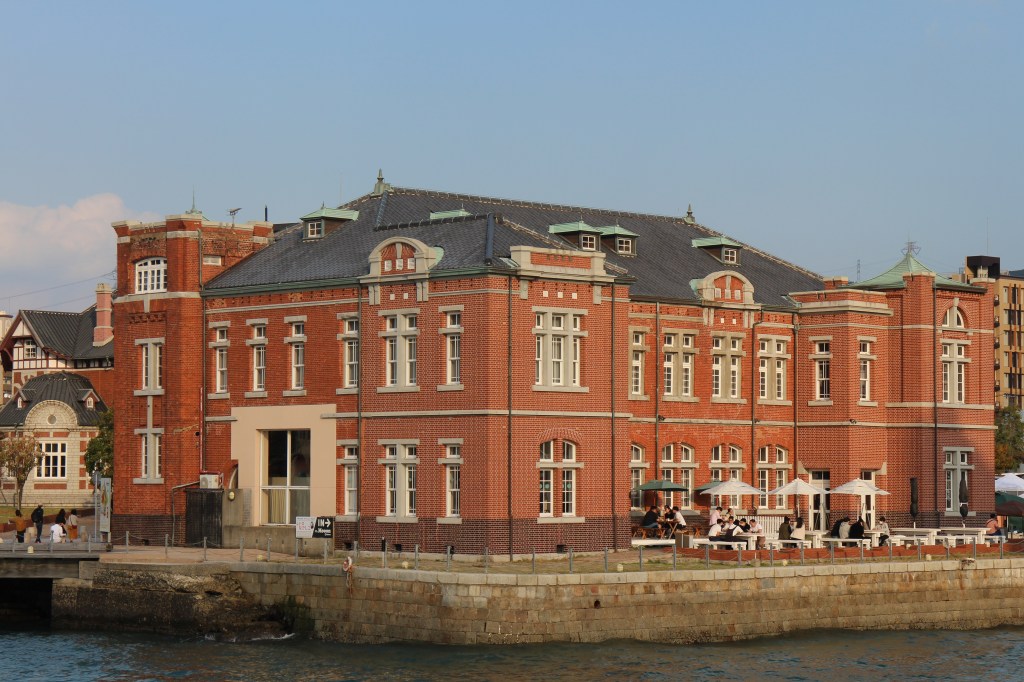
The long red-brick building on the waterfront, with a square tower at one end, is the former Moji customs house, completed in 1912 and now used as a gallery and event space. It is the most photogenic building in the district and the one that best explains what Mojiko was: a place where cargo was inspected, taxed and forwarded inland. The interior is free to enter, and the tower and the quay in front of it are the classic view, especially in the late afternoon when the brick turns orange.
Mojiko Retro Highmart and the observation deck
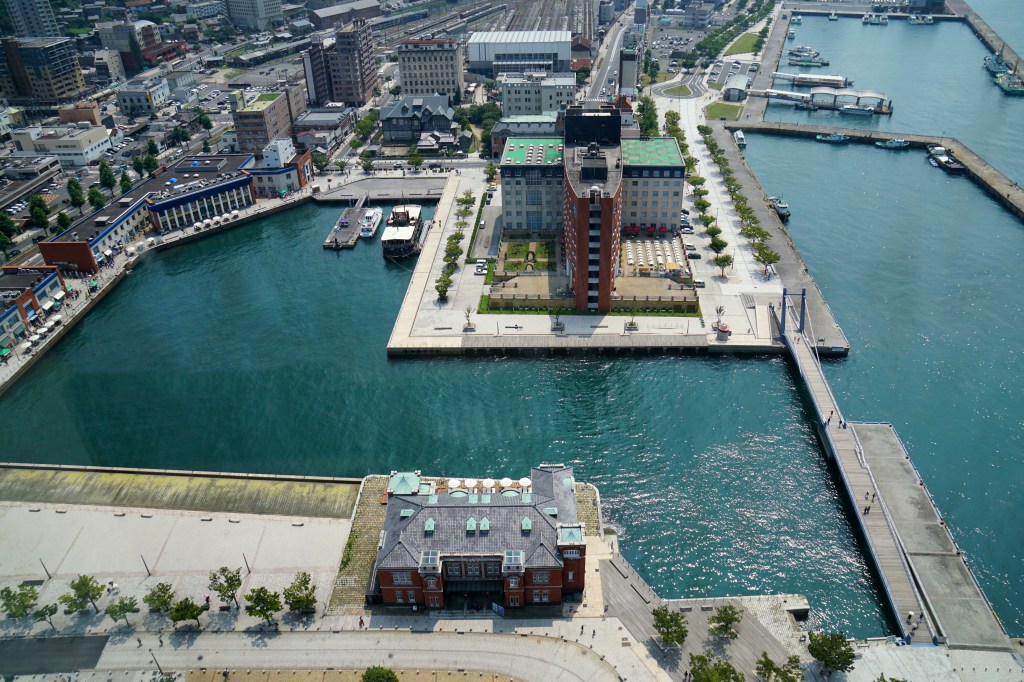
The tall tower at the eastern end of the district is a mixed building with shops and, on the 31st floor, an observation deck 103 metres above the water. The view takes in the strait, the bridge, the Shimonoseki skyline and, on a clear day, the hills of Honshu. It has been certified as one of Japan’s night view heritage sites, and the evening view is genuinely better than the daytime one, partly because the bridge and the port lights come on and partly because the district below empties out.
| Item | Detail |
|---|---|
| Hours | 10:00–22:00, last entry 21:30 |
| Adult, outside Kitakyushu | ¥600 |
| Adult, Kitakyushu resident | ¥400, with proof of address |
| Schoolchild | ¥300 |
| Group of 30 or more | ¥400 adult, ¥200 schoolchild |
| Senior discount | 20 per cent off for 65 and over with ID from Kitakyushu, Fukuoka, Shimonoseki, Kumamoto or Kagoshima |
| Disability discount | Free for the holder and one carer in some categories |
| Closed days | Four irregular days a year; in 2026 these were 21 April, 16 June and 15 September, with the next on 19 January 2027 |
Note the two-tier pricing. The fee rose on 1 April 2026 and the city introduced a resident rate at the same time, so the price on an old blog post will be wrong. The cafe on the same floor serves drinks and local beer from 10:30 to 21:30, and there is a bookable private seat area in the evening that is aimed at couples rather than photographers.
Blue Wing Moji
The blue pedestrian bridge across the inner harbour is a bascule bridge, one of the largest pedestrian-only opening bridges in Japan. It lifts to let boats through, accompanied by music, and the schedule is fixed enough to plan around.
| Opening | Closing |
|---|---|
| 10:00 | 10:20 |
| 11:00 | 11:20 |
| 13:00 | 13:20 |
| 14:00 | 14:20 |
| 15:00 | 15:20 |
| 16:00 | 16:20 |
There is no noon opening, which surprises people who assume it happens every hour. The bridge is free, takes a couple of minutes to cross, and is at its best just after it closes, when the deck is still wet and the light is low. It is also the spot from which the former customs house and the bridge frame each other, which is the shot most visitors are actually looking for.
Former Moji Mitsui Club
Directly across from the station stands a half-timbered villa built in 1921 as a social club for the Mitsui trading company. It was moved to its present site in 1990, the year it was designated an Important Cultural Property. Albert Einstein stayed here for five nights in 1922 during his lecture tour of Japan, and the bedroom and sitting room he used are preserved as a memorial room on the second floor.
The ground floor is free and contains a hall, reception rooms and period details including art deco door frames and stained glass. The second floor, with the Einstein room and a memorial room for the writer Hayashi Fumiko, costs ¥150 for adults and ¥70 for schoolchildren, and is open from 9:00 to 17:00 with no closing days. A senior discount of 70 per cent applies with identification.
One important change: the restaurant that operated on the ground floor closed on 31 August 2026, and the city has not announced a replacement. Do not plan lunch here on the assumption that it is still serving. The building itself remains open.
Kanmon Strait Museum
The glass building shaped like a sailing ship, five minutes’ walk from the station, is a museum about the strait: its currents, its shipping, its role in the Genpei War, and the history of the port. The paid exhibition area is upstairs, arranged around a four-storey atrium with a huge screen showing films about the water and the history of the crossing. The highlight for most visitors is the reconstructed Taisho-era street on the ground and first floors, complete with a tram and the sound of a banana auction.
| Item | Detail |
|---|---|
| Hours | 9:00–17:00, last entry 16:30 |
| Adult | ¥500 |
| Schoolchild | ¥200 |
| Free areas | Promenade deck, cafe, rooftop observation deck, the retro street |
| Closed days | Five irregular days a year; in 2026 these were 10 March, 9 June, 8 September and 10 November, with 12 January 2027 next |
| Children’s play area | ¥100 for ages one and over |
The free areas are worth using even if you skip the exhibition. The rooftop deck has a good view of the strait, the retro street is a decent rainy-day substitute for walking the district, and the building has proper toilets, lockers and a large car park, which makes it a useful base.
Kyushu Railway History Museum
A two-minute walk from the station, in the red-brick former headquarters of the Kyushu Railway Company, is a museum of rolling stock and railway history. Locomotives and carriages are displayed outdoors, and visitors can climb into many of them, including sleeping cars and the cab of a steam locomotive. Inside there is a large model railway theatre and a driving simulator. The miniature train outside, which children can drive, costs ¥300 per ride and takes three passengers.
| Item | Detail |
|---|---|
| Hours | 9:00–17:00, last entry 16:30 |
| Adult | ¥500 |
| Adult, Kitakyushu resident | ¥400, with proof of address |
| Junior high and younger | ¥250, under four free |
| SUGOCA holders | 20 per cent off from 1 April 2026 |
| Closed days | About ten irregular days a year; the next published closure was 11 November |
Allow an hour, or ninety minutes if you have children or an interest in trains. The museum shop is one of the better places in the district for a souvenir that is not a banana-themed snack.
What else is in the district
The former Osaka Shosen building, the old Dairen route warehouse, and the Mojiko Retro Kanko Bussan-kan near the station are all free or nearly free and worth ten minutes each. The waterfront promenade between the customs house and the bridge is the best place to sit, and the stone quay in front of the customs house is where the district’s evening light shows best. The banana auction monument stands in front of the station on the Mitsui Club side, and the district’s mascot statues and retro signage are scattered along the main street.
The observation deck or the bridge? A note on viewpoints
Visitors often ask which viewpoint is best. The answer depends on what you want. The observation deck gives the aerial view of the whole district and the strait, and it is the only place to see the layout clearly, but it is behind glass and the reflections are a nuisance at night. The Blue Wing bridge gives you the district at eye level, with the customs house on one side and the water on the other, and it is free, but the angle is limited. The best free view of the bridge and the strait is from the Mekari side, near the pedestrian tunnel entrance, where the bridge fills the frame and the water is close enough to see the current.
If you have time for only one paid attraction, choose the observation deck at dusk. If you have time for two, add the railway museum, which is the most substantial collection in the district and the least dependent on weather.
Mojiko at night
The district changes character after five o’clock. The museums close, the tour groups leave, and the waterfront quiets down. The warehouses are lit with warm floodlights, the Blue Wing bridge glows blue, and the observation deck stays open until 22:00, which makes it possible to see the whole thing from above and then walk through it at ground level.
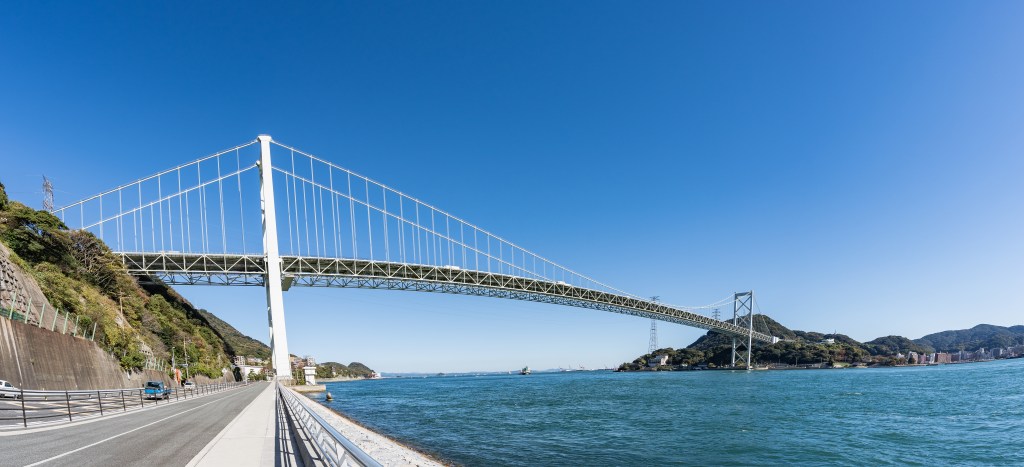
Three spots are worth the evening. The first is the observation deck, ideally arriving about twenty minutes before sunset so that you see the transition from daylight to the lit district. The second is the quay in front of the former customs house, where the reflection of the brick building sits in the water and the bridge frames the background. The third is the Blue Wing bridge itself, just after it closes for the last time, when the deck is empty and the lights are on.
Dinner is easier in Kokura or Fukuoka, but Mojiko has enough restaurants around the station and the waterfront to make an evening work, particularly for yaki curry and casual Japanese food. Note that many kitchens close by 20:00 or 21:00 on weekdays, and a few close earlier in winter. If you are staying overnight, eat before eight and leave the late evening for walking.
The walk back to the station at night is safe and well lit, though the streets between the waterfront and the station are quiet and some of the smaller side streets are dim. The station itself is lit after dark and is at least as photogenic as it is in daylight, with the clock face glowing above the entrance.
Food: yaki curry, bananas and the market across the water
Yaki curry
Mojiko’s signature dish is yaki curry: curry rice topped with cheese and often an egg, baked in a dish until the top is browned and bubbling. The story is that a local coffee shop in the 1950s reheated leftover curry in an oven gratin-style and found that the crust improved it. In March 2007 restaurants in the district formed the Mojiko Yaki Curry Club to promote it as a local brand, and most places now serve their own variation.
Expect to pay somewhere around ¥1,200 to ¥1,500 for a set at the better-known shops. Two of the most established are a short walk from the station, and both are sit-down restaurants rather than street food: the dish arrives in a hot ceramic dish and is far too hot to eat standing up. Portions are large. If you are also planning to eat at Karato Market, share one.
The banana connection
Mojiko’s other food identity is the banana. Bananas were first imported to Japan in about 1903, and from 1908 onwards large quantities were landed at Mojiko because it was the closest Japanese port to Taiwan. Green bananas were ripened in cellars and sold on; fruit that had ripened in transit or was slightly damaged was sold off quickly by street vendors, and the theatrical patter of the banana no tatakiuri, the banana auction, developed from that trade.
A monument in front of the station marks the birthplace, and demonstrations still take place on Saturdays and Sundays at 13:00 in front of the Mojiko Retro Kanko Bussan-kan, except in the fifth week of a month. They are cancelled in rain and sometimes for other events. The patter is fast, rhythmic and largely incomprehensible even to native speakers, which is part of the show; the city publishes an English leaflet and a video for visitors.
Banana-flavoured souvenirs are everywhere, from soft serve to baby castella. The best of them are in the shopping complex next to the station, where a specialist shop makes soft serve and a smoothie that you crush yourself in a pouch.
Karato Market, across the strait
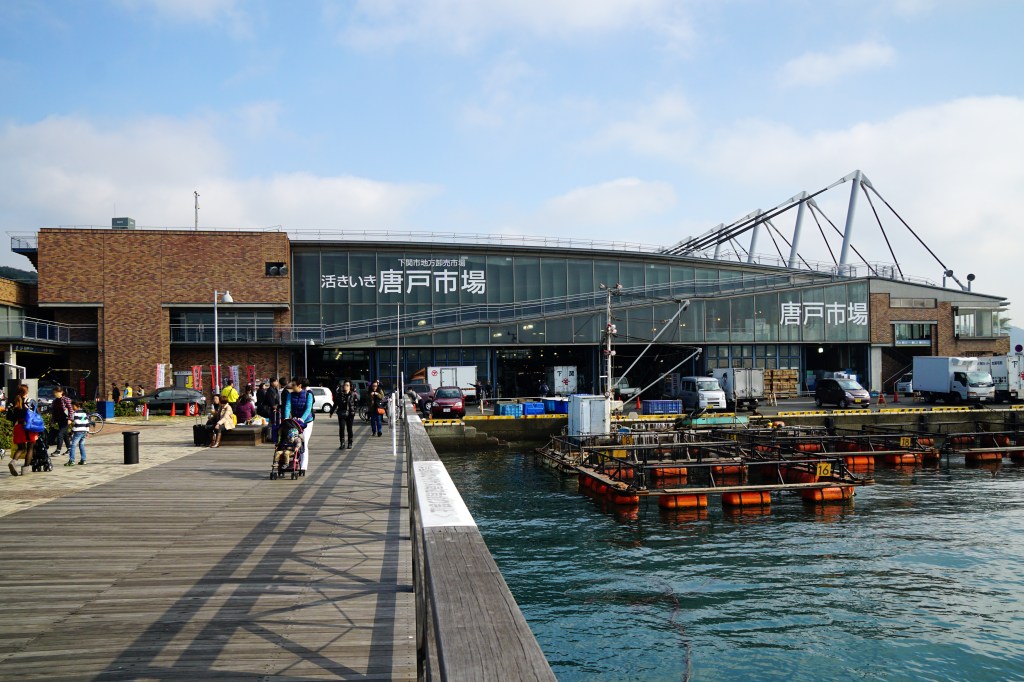
The serious seafood is on the other side. Karato Market in Shimonoseki is the main wholesale fish market for the region and the centre of Japan’s fugu trade. The wholesale auction starts at 3:30 in the morning on weekdays and Saturdays, and visitors can watch from the gallery. More relevant to travellers is the weekend food event on the ground floor, where stalls sell sushi, seafood bowls, fried fish and fugu soup to the public.
| Day | Open | Note |
|---|---|---|
| Fri, Sat | 10:00–15:00 | Busiest |
| Sun, holidays | 8:00–15:00 | Arrive early |
| Mon to Thu | Wholesale only | Few stalls |
This is the single most useful thing to know about a Mojiko day trip. People cross on a Tuesday expecting a market breakfast and find a working wholesale hall with almost nothing to eat. Plan the crossing for a Friday, Saturday, Sunday or public holiday, and arrive early, because the good stalls sell out before lunch and the queue for sushi can be forty minutes by 11:00.
Fugu is the local speciality and the market sells it in every form, but it is not cheap and it is not for everyone. A simpler and very good option is a seafood bowl assembled from whatever is in season, eaten at the tables outside with a view of the strait.
Crossing the strait: four ways
This is the part of the trip that makes Mojiko more than a pretty street. The strait is narrow, and there are four ways to get from Kyushu to Honshu, each with a different character.
| Method | Time | Cost |
|---|---|---|
| Tunnel walk | 15 min | Free |
| Ferry | 5 min | ¥400 |
| JR train | Minutes | Fare |
| Bridge, by car | Minutes | Toll |
The pedestrian tunnel
The Kanmon pedestrian tunnel runs beneath the road tunnel, 780 metres from the Moji side to the Shimonoseki side. It opened with the road tunnel on 9 March 1958 and is the only place in Japan where you can walk between two of the main islands under the sea. Walkers pass free; bicycles and small motorbikes pay ¥20 and must be pushed.
The entrance on the Moji side is near Mekari, at the western end of the Mojiko waterfront, a short bus ride or a 25-minute walk from the station. You take a lift down about 60 metres, walk through a tiled tunnel with a painted line down the middle, and come up on the other side about 55 metres below ground. The walk takes about fifteen minutes at an ordinary pace, but most people take longer because of the photographs.
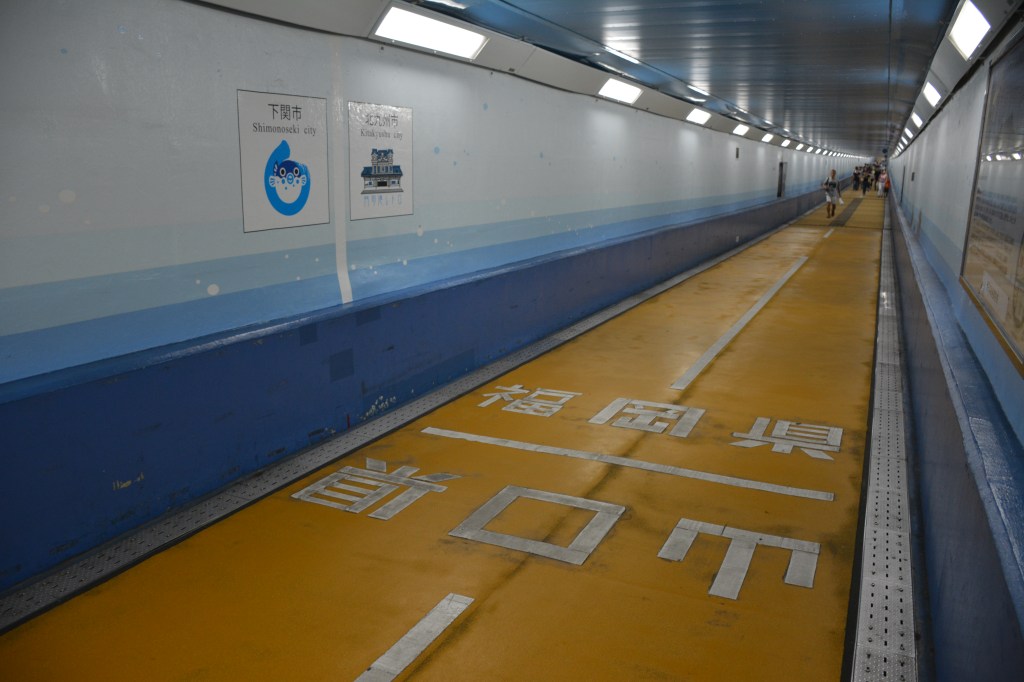
The border between Fukuoka and Yamaguchi prefectures is marked at the midpoint, and straddling it is the thing everyone does. Both elevator halls have a commemorative stamp; collect both on the provided card, show it at a tourist information desk and complete a short survey, and you receive a “Kanmon TOPPA” certificate. There are eight designs, including one for exam success, one for romance and one in English.
Practical notes: the tunnel is open from 6:00 to 22:00 and is staffed and monitored. It is cool and humid inside, and the floor is flat, which makes it one of the few genuinely easy walks in the area. There are toilets and a lift at both ends, and free parking for about forty cars on the Shimonoseki side. It is also used by commuters and runners, so keep to the left and do not stop in the middle of the lane for a group photo.
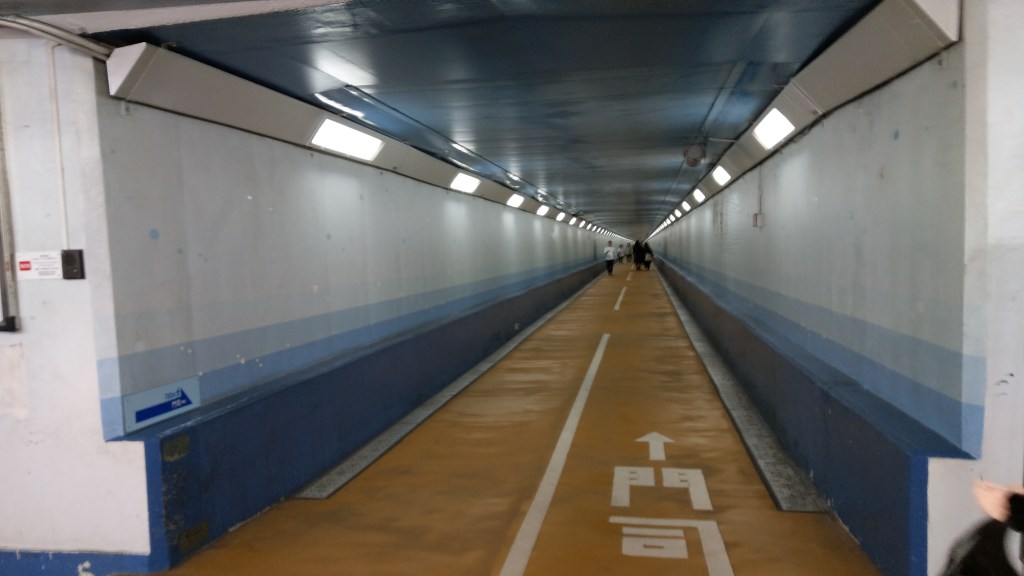
The tunnel is plainer than people expect. The walls are tiled in a pale colour, the lighting is even, and there is a painted line down the centre with the prefecture border marked in the middle. There is no shop, no music and no view. What makes it memorable is the knowledge that above your head is several dozen metres of water and, above that, the road tunnel carrying traffic between the islands.
It takes about fifteen minutes at a steady walk, and the return leg feels shorter because the novelty has worn off. If you are walking both ways, allow forty-five minutes including the lifts and the photographs. The temperature stays mild all year, which makes it a genuinely good option in winter and in the worst of the summer heat.
The ferry
The Kanmon ferry between Mojiko and Karato is the most convenient crossing for a day trip. The terminal is three minutes’ walk from Mojiko Station, and the boat takes about five minutes. Fares are ¥400 for adults and ¥200 for children one way, with no reservation needed and boats roughly every twenty minutes during the day.
The first boat from Karato is at 6:00 and the last at 21:30; from Mojiko the first is at 6:15 and the last at 21:50. A few early boats do not run on Sundays and holidays, so check the board if you are relying on the 6:15. From the deck you can see the Kanmon Bridge to the east and Ganryujima, the island where Miyamoto Musashi fought Sasaki Kojiro, to the west.
There is also a sightseeing cruise from the Mojiko waterfront that lasts about twenty minutes and costs ¥1,000 for adults and ¥500 for children, with sunset and night departures. It runs on an irregular schedule, so telephone or check the operator’s site before planning around it.
The trains and the bridge
JR trains run from Mojiko through the Kanmon railway tunnel to Shimonoseki, a few minutes and a few hundred yen, and continue down the Sanyo Main Line. The road bridge, opened in 1973, carries the expressway and is not open to pedestrians or bicycles; drivers pay a toll, and the view from the bridge is impressive but brief.
For most travellers the ferry is the best combination of speed, cost and view, and the tunnel is the best experience. Doing one in each direction is a good plan: ferry across in the morning, walk back through the tunnel in the afternoon, and take the retro train from the Mekari side to the station.
The Mekari side: shrine, park and the retro train
Mekari Shrine
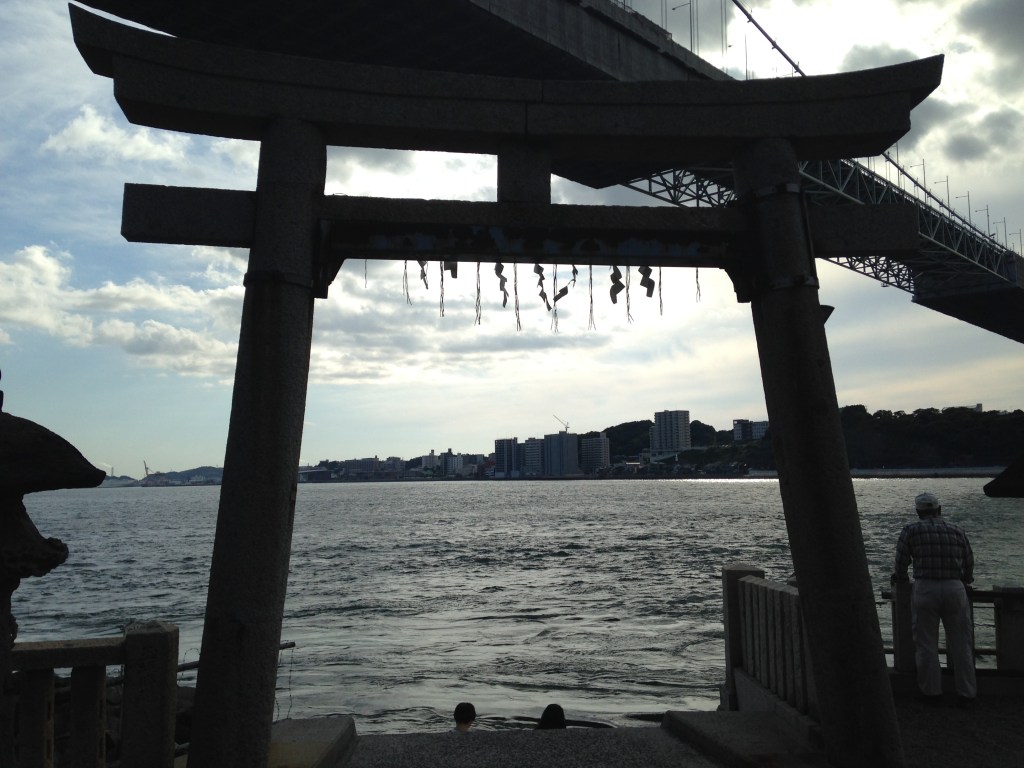
At the western tip of the Mojiko waterfront, near the tunnel entrance, stands Mekari Shrine, the northernmost shrine in Kyushu. It is dedicated to the sea and to safe passage, and its ritual is unusual: at the old lunar new year, three priests wade into the sea at night with torches, buckets and sickles to cut the first kelp of the year and offer it at the altar. The ceremony, Mekari Shinji, has been performed for centuries and is the reason the place is called Mekari, “kelp cutting”.
The shrine is free and always open for worship, with a view through its torii to the strait and the bridge. A stone lantern donated by local worshippers about four hundred years ago stands at the water’s edge, and container ships pass behind it. The combination of a small shrine, a huge bridge and working shipping is the most photogenic thing on the Kyushu side, and it is almost empty on weekday mornings.
Mekari Park
The park above the shrine covers the site of the old Moji castle and stretches down to the coast. The second observation terrace looks directly at the bridge, which is about 700 metres away at this point, and the view is best at sunset and after dark when the bridge is lit. There is a saltwater pool (summer only), a large ceramic mural depicting the Genpei sea battle, and plenty of parking. Entry and parking are free.
Do not expect to take a ropeway. The Mount Hinoyama ropeway on the Shimonoseki side was permanently closed in November 2024 because of ageing equipment, and the road up the mountain is now the only vehicle access; the park itself and its car park remain free. Several websites still advertise the ropeway, which is a good reminder to check dates on travel content.
The Shiokaze retro train
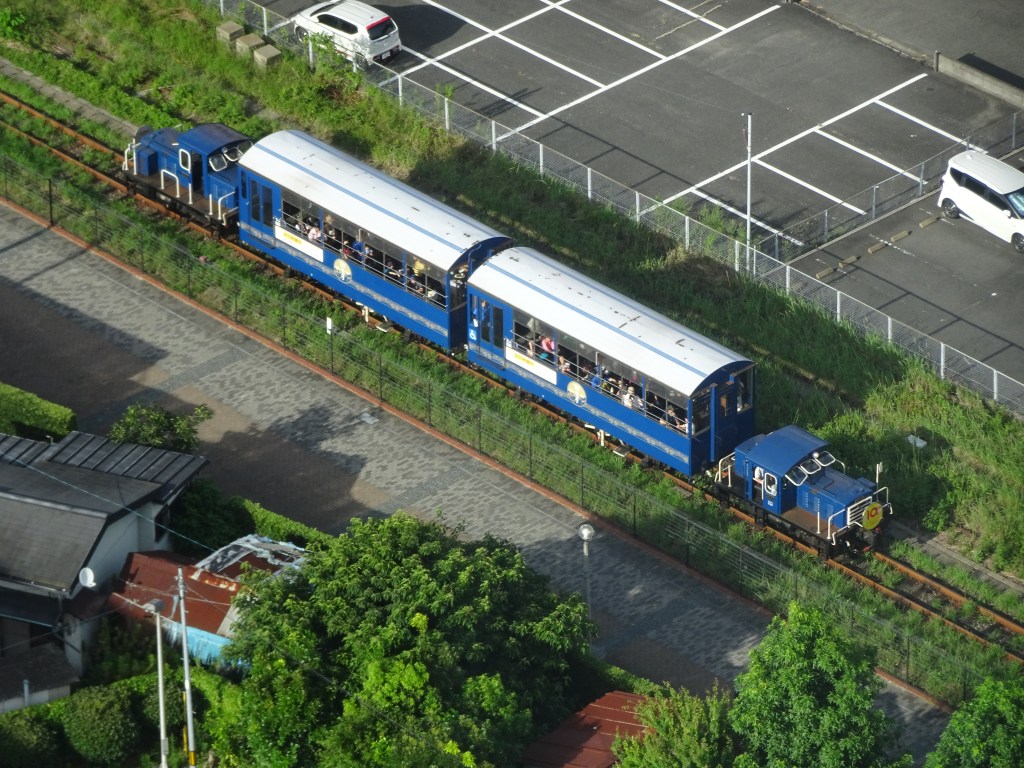
The small open-sided tourist train that runs along the waterfront from the Kyushu Railway History Museum to Mekari is called Shiokaze, operated by the Heisei Chikuho Railway on a former freight branch. It covers 2.1 kilometres in about ten minutes, passing the observation deck, a small station named after a museum, and a tunnel before ending at Kanmon Kaikyo Mekari Station, five minutes’ walk from the shrine and the tunnel entrance.
| Item | Detail |
|---|---|
| Operating days | Weekends and public holidays in the 2026 financial year, plus daily during Golden Week (29 April to 10 May) and Obon (8 to 16 August) |
| Closures | 1 to 3 January; no weekday service |
| One-way fare | ¥500 adult (junior high and over), ¥250 child (elementary) |
| Under school age | Free, up to two per adult |
| Day pass | ¥1,000 adult, ¥500 child |
| Crossing ticket | ¥1,000 adult, ¥500 child, covering the train, the Kanmon ferry and the Sanden bus |
The crossing ticket, sold as the Kanmon Clover Ticket, changed on 10 January 2026. It now costs ¥1,000 for adults instead of ¥800, covers the train, the ferry and the Sanden bus, and no longer includes the Nishitetsu bus between Mojiko Station and Mekari. It is only usable on days when the train runs, so check the calendar before buying it.
The train is a toy compared with a real railway, and that is the appeal. In fine weather the carriages are open, the sea is on one side and the heritage warehouses on the other, and the ten minutes feel like a fairground ride. In rain it is less pleasant, and in the busiest holiday periods the first station can fill up, leaving no room for passengers at intermediate stops.
The Shimonoseki side: what to do after you cross
Mimosuso River Park
Directly above the Shimonoseki entrance to the pedestrian tunnel is a free waterfront park on the site of the Battle of Dan-no-ura, the 1185 sea battle in which the Minamoto destroyed the Taira and effectively ended the Heian aristocracy’s grip on power. Two statues face each other across the grass: Minamoto no Yoshitsune, who led the attack, and Taira no Tomomori, who tied an anchor to himself and jumped into the sea.
Along the sea wall stand replicas of Choshu domain cannons, installed in the 1860s when the domain fired on foreign ships passing through the strait. One of them is fired with sound and smoke on the hour during the day, which startles people who are not expecting it. The park takes thirty to forty-five minutes to walk, is free, and has a car park and accessible toilets at the tunnel entrance.
Akama Shrine
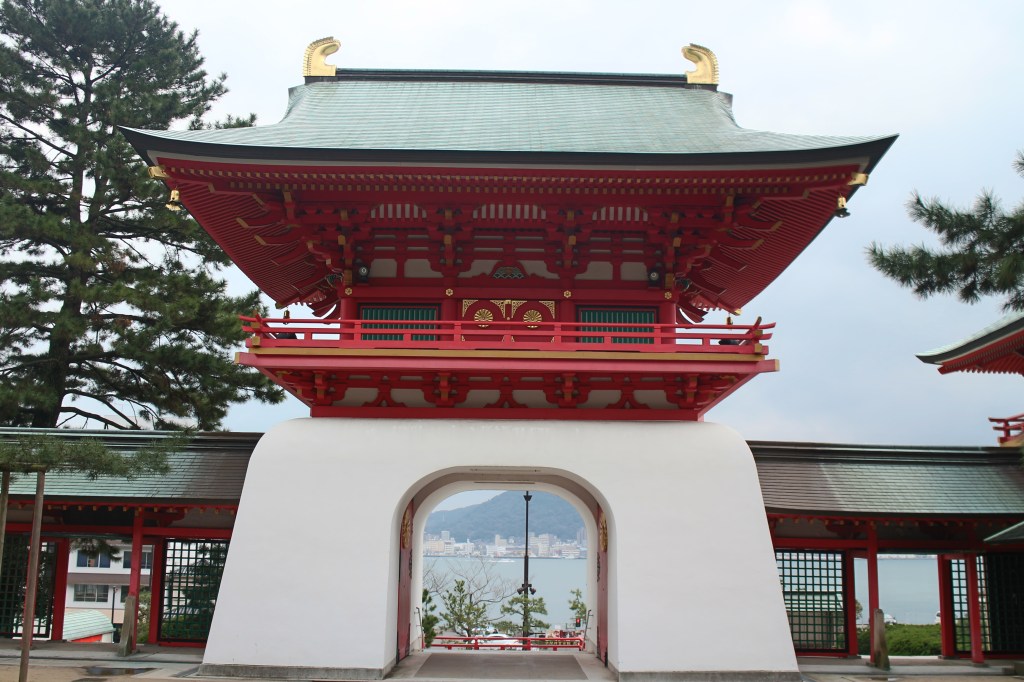
A short bus ride or a twenty-minute walk from the tunnel entrance, Akama Shrine is dedicated to the child emperor Antoku, who drowned at Dan-no-ura at the age of six or eight depending on the source. The shrine’s gate is built in the style of a dragon palace, painted vermilion and white, in reference to the words of the emperor’s grandmother, who is said to have told him that there was another capital beneath the waves.
The grounds are free and open at all hours. The treasure hall costs ¥100 and is open from 9:00 to 18:00, or to 17:30 between October and March. The shrine holds a festival in May, with a procession of women in Heian costume, and is busy at New Year. For most visitors it is a twenty-minute stop on the way to the market, but the gate is one of the most distinctive pieces of architecture in the region.
Karato and the waterfront
The Karato area, five minutes from the ferry terminal, combines the fish market, the aquarium and a waterfront promenade with views back across the strait to Mojiko. The aquarium, Shimonoseki Marine Science Museum, is built around a recreated strait current tank and a large collection of pufferfish species; admission is ¥2,090 for adults, ¥940 for schoolchildren and ¥410 for children aged three and over, and it is open from 9:30 to 17:30.
Between the market and the ferry terminal there is a pleasant walk along the water with benches, sculptures and a view of the bridge. It is the best place in the area to sit with a takeaway seafood bowl, and it is where the day-trippers from Fukuoka tend to end up at lunchtime.
Getting there
From Fukuoka and Kokura
Mojiko is the terminus of the Kagoshima Main Line, so there is no need to worry about which stop to get off at. From Hakata the journey takes about one hour forty minutes on a direct local or rapid train and costs ¥1,730 one way, or ¥860 for a child. From Kokura it is fourteen minutes and ¥340. The train is a red-and-cream JR Kyushu commuter set, and the last stretch along the coast is the prettiest part.
If you are coming from further afield, Kokura is the shinkansen stop, and the transfer to the local line is straightforward. Allow fifteen minutes to change platforms.
From Tokyo, Osaka and Hiroshima
Take the Tokaido and Sanyo Shinkansen to Kokura, then the local line to Mojiko. From Tokyo the shinkansen takes about four and a half hours to Kokura; from Osaka about two and a half; from Hiroshima about forty-five minutes. From Shimonoseki, the JR Sanyo Main Line crosses to Mojiko in a few minutes, and the ferry is an alternative if you are starting on the Honshu side.
Within the district
Almost everything on the Kyushu side is walkable from the station in ten to twenty minutes. The exception is the Mekari area at the western end, which is about 25 minutes on foot from the station or five minutes by taxi, and is reached by the retro train on the days it runs or by the Nishitetsu bus from the station forecourt. Buses to Mekari Park and the tunnel entrance run from the station, but they are not frequent.
By car
Mojiko is close to the Mojiko interchange of the Kyushu Expressway and to the Kanmon Bridge. There are several paid car parks around the district, including a large one at the Kanmon Strait Museum; the waterfront itself is pedestrianised. On the Shimonoseki side there is free parking at the tunnel entrance and at Mimosuso River Park.
What a day costs
Prices below are per adult and reflect the fees in force in October 2026. They exclude long-distance travel and alcohol.
| Item | Cost |
|---|---|
| Hakata to Mojiko, return by JR (Kokura to Mojiko is ¥680 return) | ¥3,460 |
| Observation deck (¥400 for Kitakyushu residents) | ¥600 |
| Kyushu Railway History Museum, optional | ¥500 |
| Kanmon Strait Museum (free areas available) | ¥500 |
| Former Moji Mitsui Club, second floor (ground floor free) | ¥150 |
| Retro train, one way (weekends and holidays only) | ¥500 |
| Ferry to Shimonoseki, one way | ¥400 |
| Pedestrian tunnel | Free |
| Akama Shrine treasure hall (grounds free) | ¥100 |
| Lunch, yaki curry set | ¥1,200–1,500 |
| Karato Market snacks (cash is easier) | ¥1,000–2,000 |
A simple day from Hakata, using the ferry one way and the tunnel the other, with one paid attraction and a market lunch, comes to roughly ¥8,000 to ¥10,000 per person. Adding two more museums and a retro train ride pushes it towards ¥12,000. It is not a cheap day out, but it is a dense one.
Suggested itineraries
Half day: the district only
- Arrive at Mojiko Station and spend fifteen minutes on the building and the platform view.
- Walk down to the waterfront past the Mitsui Club and the customs house.
- Cross the Blue Wing bridge on one of the hourly openings.
- Ride up to the observation deck, or visit the railway museum if it is raining.
- Eat yaki curry near the station and catch a train back.
This is a comfortable four to five hours and works well as a stop between Kokura and Shimonoseki.
Full day: both sides of the strait
- Start early and be at Mojiko Station by 9:00.
- Walk the district, cross the bridge, and take the ferry to Karato at about 10:30.
- Eat at Karato Market before the queues build, then walk to Akama Shrine.
- Take the bus or walk to Mimosuso River Park and go down into the pedestrian tunnel.
- Walk under the strait to the Moji side, come up at Mekari, and visit the shrine.
- If the retro train is running, ride it back to the station; otherwise take a bus or taxi.
- Finish with the observation deck at dusk.
This is a long day but a satisfying one, and it gives you the ferry, the tunnel and the train in a single loop. Check two things before you start: that the market is open to eaters that day, and that the retro train is running.
Two days: add Shimonoseki properly
Day one as above, but sleep in Shimonoseki or Kokura. Day two: the Chofu castle town, with the Mori clan mansion and the temple where the Meiji Restoration’s leaders met; then the Hinoyama viewpoint in the late afternoon. Alternatively, stay on the Kyushu side and use day two for Kokura, with its castle and the Tanga Market, which is a good counterpoint to Karato.
Seasons and weather
The strait has a maritime climate, milder than inland Kyushu in winter but windy all year. Spring and autumn are the best months: comfortable temperatures, clear air and good light on the water. Cherry blossoms in Mojiko come in late March or early April, and the district is busy then.
Summer is hot and humid, and the walk to Mekari has little shade. The waterfront is more pleasant in the evening, and the night view from the observation deck is at its best on a clear August night. The Kanmon Strait fireworks festival in August is one of the largest in the region, and the district is packed; the bridge opens specially for it.
Winter is quiet and often grey, with strong wind off the strait. Snow is rare but possible. The advantage is that the indoor attractions are empty and the photographs of the brick warehouses in low light are excellent. The tunnel is a good rainy-day activity at any time of year, and the retro street inside the museum is a reasonable substitute for the waterfront when the weather turns.
Where to stay
Mojiko itself has a handful of hotels, including a large one on the waterfront with views of the strait. It is the obvious choice if you want to photograph the district at night and in the early morning, and the prices are lower than in Fukuoka city.
Kokura, ten minutes away by train, has the widest range of hotels and the best transport connections, including the shinkansen. It is a better base if you are combining Mojiko with other parts of Kyushu. Shimonoseki has business hotels near the station and a few traditional inns further out, and staying there lets you reach Karato Market early without crossing the strait.
There are no ryokan in the Mojiko historic district itself, and no onsen. If a hot-spring night is part of the plan, look elsewhere; the closest options are inland.
Accessibility and practical limitations
The Mojiko waterfront is flat and largely step-free, with wide pavements, dropped kerbs and accessible toilets in the station and the museum. The observation deck has lifts. The Blue Wing bridge has a gentle ramp but is closed to pedestrians while it is raised, and the deck can be slippery in rain.
The pedestrian tunnel is one of the most accessible crossings in Japan: lifts at both ends, a flat floor, handrails, and a monitored route. It is genuinely usable by wheelchair users and people with limited mobility, which cannot be said for most of the sights around it. The tunnel is also a good option in bad weather.
The limits are elsewhere. The retro train is not wheelchair accessible, and neither are the historic buildings, which have steps, narrow doorways and uneven floors. Mekari Shrine is approached by a slope and steps. The walk from the station to Mekari is along a road with a narrow pavement in places. Karato Market is flat but crowded, and the food stalls are not designed for wheelchairs.
Cash still matters. The ferry, some buses, the market stalls and the smaller cafes prefer it, and a few ticket machines do not take foreign cards. Carry a few thousand yen in coins and small notes.
Common mistakes
- Crossing on a weekday and expecting market food. Karato’s public food stalls operate mainly Friday to Sunday and on holidays. Monday to Thursday is a wholesale day.
- Assuming the observation deck is cheap. The fee rose in April 2026 to ¥600 for adults from outside Kitakyushu, and old guides still quote ¥300.
- Missing the Blue Wing openings. There is no noon opening, and each cycle lasts only twenty minutes.
- Planning lunch at the Mitsui Club. The restaurant closed at the end of August 2026.
- Looking for the Hinoyama ropeway. It was abolished in November 2024; the mountain is reached by road or on foot.
- Arriving after 17:00. The museums and the customs house close then, and the district becomes a walk and a view rather than a set of attractions.
- Buying the crossing ticket on a weekday. The Clover Ticket depends on the retro train, which runs only at weekends and on holidays outside peak periods.
- Forgetting the walk to Mekari. It is 25 minutes from the station, and the bus is infrequent; budget the time or take a taxi.
Frequently asked questions
Can you walk from Kyushu to Honshu?
Yes. The Kanmon pedestrian tunnel is 780 metres long, free for walkers, and takes about fifteen minutes one way, plus the lifts at each end. It is open from 6:00 to 22:00.
Is Mojiko worth a whole day?
Mojiko alone is a half day. The full day comes from adding the ferry, the tunnel and Shimonoseki. If you only have three hours, concentrate on the station, the waterfront and one paid attraction.
Do I need to book anything?
No. The ferry, the train and the tunnel are all turn-up services. The observation deck and museums sell tickets at the door. The only thing worth checking in advance is the retro train calendar and the market’s food-stall days.
Is the Kanmon Bridge walkable?
No. The bridge carries the expressway and has no pedestrian or cycle path. Walkers use the tunnel, and cyclists must either use the tunnel (pushing the bike) or take a ferry.
What should I eat?
Yaki curry in Mojiko and seafood at Karato Market. Fugu is the local speciality and is priced accordingly. Banana sweets are the local snack, and the soft serve is better than it sounds.
Is it good for children?
Yes, particularly the railway museum, the miniature train and the tunnel, which children tend to find exciting. The district is compact and flat, and the ferry is short enough that nobody gets bored.
What happens if it rains?
The tunnel, the museums and the covered retro street inside the Kanmon Strait Museum all work in rain. The waterfront and the shrine walks do not. Carry a compact umbrella; the wind off the strait makes long umbrellas useless.
Before you go
Check three things before you set out. First, the day of the week: if you want to eat at Karato Market, go on a Friday, Saturday, Sunday or public holiday. Second, the retro train calendar, if you want to ride it, because it does not run on weekdays outside Golden Week and Obon. Third, the closing days of the museums, which are irregular and differ from each other, so a Monday holiday or a Tuesday in September can catch you out.
Reconfirm the fees, since several rose in 2026: the observation deck, the railway museum and the retro train all changed their prices within the last year, and the Mitsui Club lost its restaurant. Carry cash, wear shoes you can walk in, and leave the evening free for the observation deck, because the district is at its best after the day-trippers have gone.
Sources and verification
Opening hours, admission fees and closing days for the observation deck, the Kanmon Strait Museum, the Kyushu Railway History Museum and the former Moji Mitsui Club were checked against the official Mojiko Retro site and the facilities’ own pages in October 2026, including the fee revisions that took effect on 1 April 2026. Tunnel length, hours, fares, lift depths and the commemorative stamp scheme were checked against the Fukuoka prefecture tourism site, the Kitakyushu regional tourism site and the Kanmon Strait Navi access page. Ferry fares and timetables are from the Kanmon Kisen official site, and the retro train fares and 2026 operating calendar are from the Heisei Chikuho Railway’s official pages, including the January 2026 revision of the Clover Ticket. Station history and restoration details are from Kitakyushu city and JR Kyushu. Market hours and the food-stall schedule are from the Karato Market operator and the Shimonoseki tourism association. Prices, timetables and closures change; reconfirm before travelling.


Leave a Reply