Planning a first visit to Ise? This English guide covers Naiku and Geku, Oharai-machi, Meoto Iwa, transport from Nagoya and Osaka, and when to go.
Operational details such as opening hours, admission fees, and train times can change. Prefer official pages and reconfirm before you travel (sources checked on 05 November 2026).
Why visit
- Ise Jingu is the most important shrine complex in Japan, and it is not a single building but a forested precinct of 125 shrines centred on two: the Naiku, or Inner Shrine, dedicated to Amaterasu Omikami, and the Geku, or Outer Shrine, dedicated to Toyouke Omikami, the deity of food, clothing and shelter. Both sit in woodland of tall cedar and camphor, entered over bridges across the Isuzu River, and both are free to visit.
- The scale is easy to underestimate. The Geku precinct alone covers about 89 hectares a five-minute walk from Ise-shi Station, and the Naiku sits in its own forest a bus ride to the south. Between them lie the pilgrimage street of Oharai-machi, the reconstructed Edo and Meiji streetscape of Okage Yokocho, and the coast at Futami, where the Meoto Iwa rocks stand in the sea below Futami Okitama Shrine.
- Ise is also unusually easy to reach for a place that feels this removed. The Kintetsu limited express runs direct from Osaka in roughly an hour and forty minutes to two hours, and from Nagoya after a Shinkansen transfer the whole trip from Tokyo takes about three hours. That makes it one of the few genuinely grand Japanese destinations that works as a day trip from the Kansai cities, though two days rewards the traveller far more.
- What surprises first-time visitors is the tone. There is no gilded hall to photograph, no treasure to queue for: the inner sanctuary at both shrines stands behind a fence, screened by a white curtain, and photography at the prayer area is not allowed. The visit is about walking, purifying at the temizuya, and following a path through trees to a place you glimpse rather than see. Go expecting that and Ise delivers something rare; go expecting a monument and it can feel baffling.
Top places and highlights
Naiku, the Inner Shrine
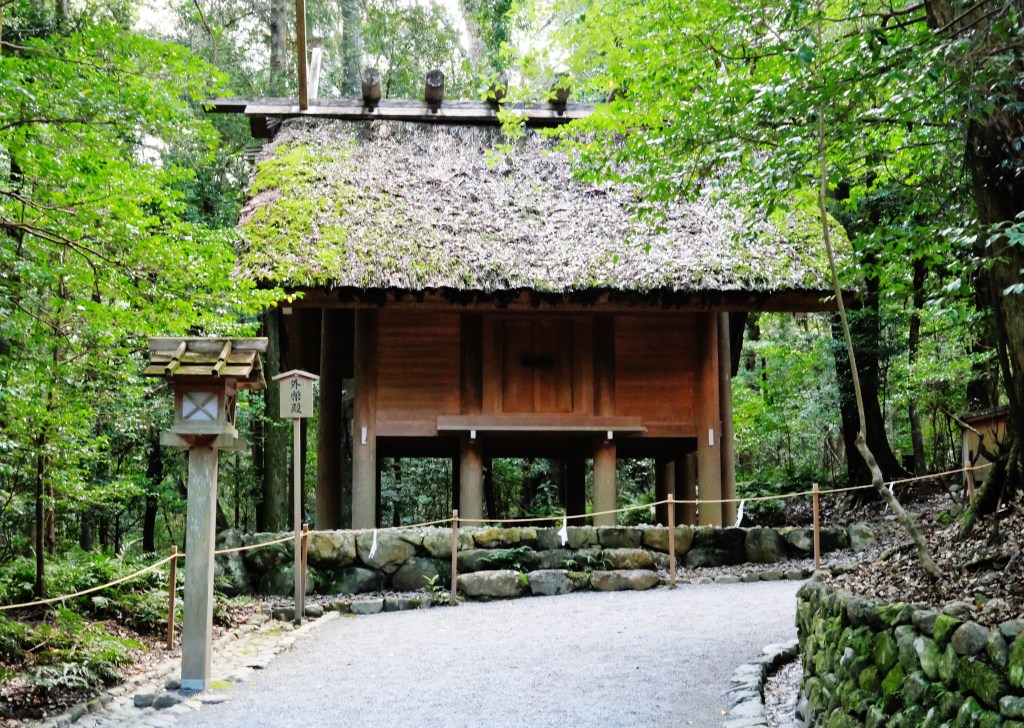
The approach begins at the Ujibashi, a long wooden bridge over the Isuzu River, and continues on gravel through a forest of towering cedars beside the stream. From the bridge to the main sanctuary takes about twenty minutes at an unhurried pace, and the atmosphere shifts within a few steps of the torii: the river noise, the moss, the sense of an enormous site kept deliberately quiet. Visitors purify at the temizuya just past the bridge, then follow the left-hand side of the path as custom asks. The sanctuary itself stands behind a fence with its roof visible above it, screened by a white curtain; photography at the prayer area is not permitted, so the memory you take away is of the forest rather than the building. Allow ninety minutes to two hours if you also walk down to the Isuzu River at Mitarashi, where pilgrims have traditionally washed before praying.
Geku, the Outer Shrine
The Geku is the traditional starting point of an Ise pilgrimage, and it is the easier of the two to reach: about five minutes on foot from JR and Kintetsu Ise-shi Station, straight along the shop-lined approach. Inside, the precinct opens into about 89 hectares of tall trees, with the main sanctuary roughly ten minutes’ walk from the entrance bridge. It is dedicated to Toyouke Omikami, the deity of food, clothing and shelter, and many Japanese visitors stop here first to thank the kami for daily life before heading south to the Naiku. Because it is smaller and closer to the station, the Geku is a good place to learn the etiquette without the crowds: two deep bows, two claps, one more deep bow. Early morning here, soon after the gates open at five, is one of the calmest experiences in the region.
Oharai-machi and Okage Yokocho
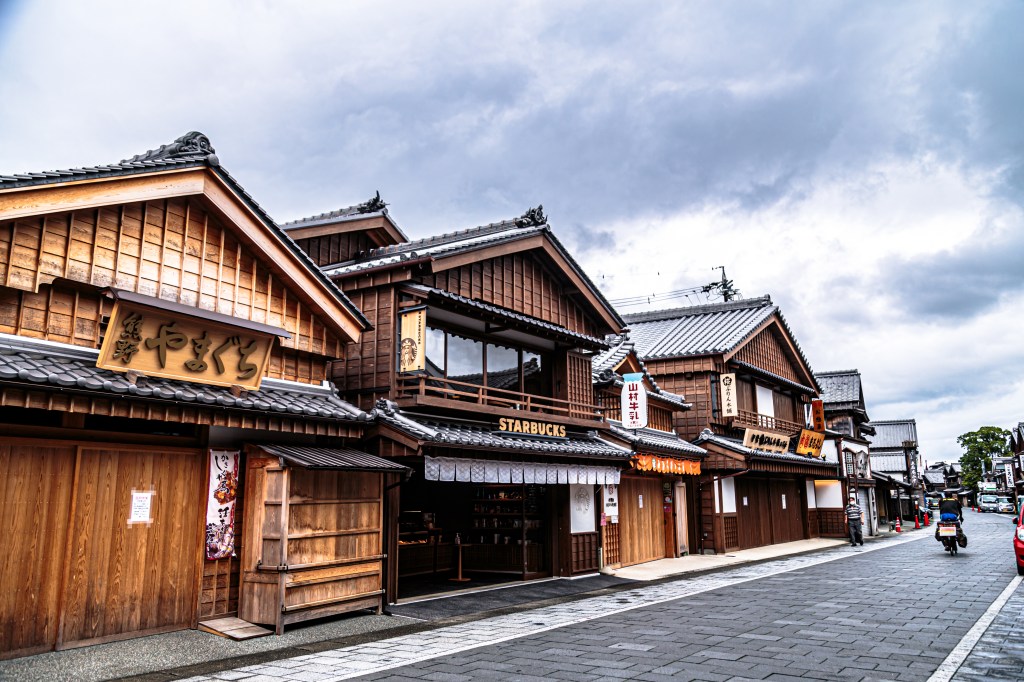
The street running about 800 metres from the Ujibashi towards Sarutahiko Shrine is Oharai-machi, the old pilgrimage road, now lined with shops selling Ise sweets, udon, souvenirs and grilled seafood. In the middle of it sits Okage Yokocho, a lane where buildings from the Edo to Meiji periods along the Iseji route have been relocated and rebuilt, so the street reads as a stage set of old Japan rather than a modern shopping arcade. It is unashamedly commercial, and it is also genuinely enjoyable: this is where to eat Ise udon, buy akafuku-style sweets, and sit by the Isuzu River at the narrow alley called Seiko. Come here after the Naiku rather than before, when the shrine has put you in the right frame of mind and the shops have opened.
Meoto Iwa and Futami Okitama Shrine
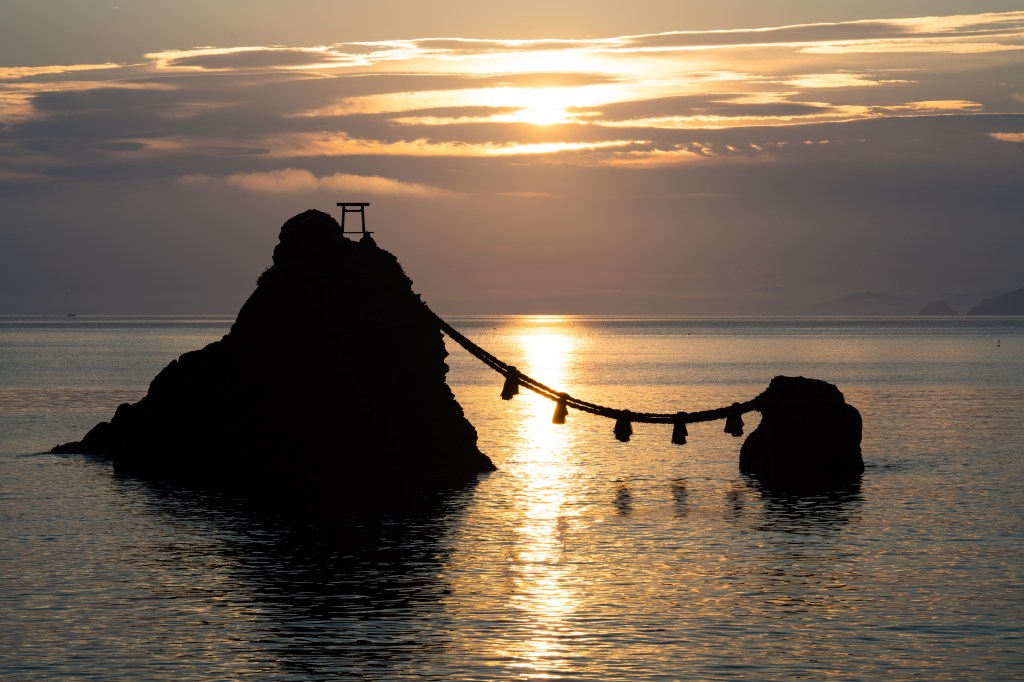
At Futami, on the coast west of the city, two rocks stand in the sea tied together by a heavy shimenawa rope. The larger is said to be male and the smaller female, and the shrine on the shore behind them, Futami Okitama Shrine, is dedicated to Sarutahiko Okami, the deity who guides the way. Traditionally pilgrims came here first to purify themselves in the sea before entering Ise, and the custom still reads well as a way to open a trip. Worship hours are listed as 9:00 to 16:00. The rocks are at their most photogenic at sunrise around the summer solstice and under the moon around the winter solstice, when the sun or moon rises between them. There are frogs all over the precinct, a play on the Japanese word for returning safely.
Sarutahiko Shrine and the upper Naiku approach
Most visitors turn back at the Naiku, but the road continues a short bus ride or a pleasant walk north to Sarutahiko Shrine, which enshrines the kami who guided Ninigi-no-Mikoto down to earth and, by extension, the deity of roads and directions. It is much smaller and far quieter than the two great shrines, and the walk between them passes through the edge of the forest and the upper end of Oharai-machi. Buses from the Geku stop at Sarutahiko Shrine-mae for 380 yen, less than the fare to Naiku-mae, which makes it an easy addition for anyone with an hour to spare. Photographers tend to like it for the moss and the stone lanterns rather than for any single monument.
The Isuzu River and Mitsususo
The Isuzu River curves around the Naiku precinct, and the stretch beside the shrine is one of the prettiest short walks in Mie. Paths lead down to the water at points where visitors traditionally washed their hands and rinsed their mouths before praying, and the shallow, clear river over white stones is worth ten minutes of anyone’s time. In early summer the shrine’s own iris beds come into flower, and the forest holds its green even in the heat of August. Because the shrine paths are gravel and the riverbank steps are uneven, this is not an accessible route for wheelchairs or strollers, and the main sanctuary approach should be used instead. Bring water in summer: the precinct is large and shade only partly makes up for the humidity.
Food and drink
- Ise udon is the local dish to try: thick, soft noodles in a dark soy-based broth, usually with a spring onion on top, served in the restaurants along Oharai-machi and around Ise-shi Station. It is plain food by design, and the soft texture is the point rather than a fault.
- Akafuku is the sweet most associated with Ise, a small mochi covered in red bean paste that has been made here since the Edo period. The main shop near the Naiku approach is the classic stop, and there are branches elsewhere in the city for anyone who misses it.
- Tekone-zushi, raw bonito or tuna marinated briefly in soy and laid over rice, is a Mie and Ise-Shima staple and appears on many menus in the city. It is a good choice for a quick lunch before an afternoon of walking.
- The Okage Yokocho lane inside Oharai-machi concentrates local snacks in one place: grilled shellfish, croquettes, soft-serve and sweets. Prices are tourist-street prices, but the convenience for a family or a short visit is real.
- Ise-Shima is famous for seafood, particularly spiny lobster and abalone, and the ports at Toba and Futami are where much of it lands. Expect premium prices for lobster and seasonal availability rather than a year-round menu.
- Note that eating and drinking are not allowed inside the shrine precincts. The rest areas have water, and the shops and restaurants of Oharai-machi are just outside the Naiku, so plan meals around the shrine visit rather than during it.
Getting there and around
- From Tokyo: Shinkansen to Nagoya, then the Kintetsu limited express to Ise-shi or Ujiyamada Station, about three hours in total. All seats on the Kintetsu limited express are reserved, so a limited express ticket is needed on top of the fare.
- From Osaka: the Kintetsu limited express runs direct to Ise-shi from Osaka-Namba, Osaka-Uehommachi and Tsuruhashi in roughly one hour forty minutes to two hours, with no change of train. Note that trains leave from more than one station in Osaka, so check the departure point.
- From Kyoto: Kintetsu limited express from Kyoto Station, sometimes with a change at Yamato-Yagi for Ise-Shima. The route avoids the crowded Osaka subway transfer and is the easier option with luggage.
- Ise-shi Station is the practical base: JR and Kintetsu share it, the Geku is about five minutes on foot from the JR exit, and buses to the Naiku leave from the station square. Ujiyamada Station, one stop or two minutes away on the Kintetsu line, also has lockers and a handsome registered station building.
- Between the shrines: buses from Geku stop 3 to Naiku-mae take 15 to 20 minutes and cost 520 yen one way; the fare to Jingu Kaikan-mae for Okage Yokocho is 450 yen and to Sarutahiko Shrine-mae 380 yen. Return buses from the Naiku area to the stations run every 10 to 15 minutes. A taxi between the two shrines is around 2,500 yen per car.
- To Meoto Iwa: from April 2026 the CAN sightseeing bus departs from Kintetsu Isuzugawa Station rather than Ise-shi Station, dropping at Meotoiwa Higashiguchi for a five-minute walk. Alternatively JR from Ise-shi to Futaminoura takes 7 to 10 minutes for 210 yen, roughly twice an hour, followed by a 15-minute walk; Futaminoura is unmanned and does not accept IC cards, so buy a return ticket at Ise-shi.
- Coin lockers at Ise-shi are limited, and the luggage counter beside the station charges a flat 600 yen per piece regardless of size, which is the simpler option with a suitcase on a day trip.
Where to stay
- Most visitors stay in Ise city itself, within walking distance of Ise-shi Station and the Geku, where hotels and ryokan range from business hotels to traditional inns with dinner. Staying close to the station makes an early start at the Geku straightforward.
- Futami and Futaminoura, on the coast near Meoto Iwa, have a cluster of older resort hotels and inns with sea views. This is the better base if you want sunrise over the rocks and a quieter evening, at the cost of a train or bus ride into the city.
- Toba, twenty minutes further east by train, is the base for Ise-Shima’s islands, pearl cultivation and seafood, and has larger resort hotels. It suits travellers combining Ise with the coast rather than a shrine-only trip.
- Book well ahead for weekends, the New Year period and the autumn foliage season, when domestic pilgrimage traffic is heaviest. Note that many small inns quote rates with two meals included and that solo travellers may find fewer rooms than couples.
Best time to visit
- Spring is the most popular season, with mild weather and the shrine forest at its freshest. Cherry blossom around the precincts and along the Isuzu River draws crowds, and weekends in late March and early April are busy.
- Early summer brings the iris beds at the Naiku into flower and warm, humid weather; the shrine opens until 19:00 from May to August, which makes a late-afternoon visit possible after the day-trippers leave.
- Autumn is the other peak, with comfortable temperatures and colour in the surrounding hills. September still runs on the summer closing time of 18:00, while October moves to 17:00, so check the date before planning an evening visit.
- Winter is quiet and cold but rarely harsh, and the early closing time of 17:00 from October to December catches people out. The New Year period is by far the busiest of the year, when millions come for hatsumode, and opening hours change; avoid it unless the crowds are the point.
Practical tips
- Visit the Geku first and the Naiku second. The official guidance says there is no fixed rule, but this has been the customary order since the Edo period, and it also puts the smaller shrine first while you are still learning the etiquette.
- Both shrines open at 5:00 and entry is free. An early start is the single best way to see the Naiku without crowds, and the first buses and trains from Ise-shi will get you there soon after the gates open.
- Carry cash. Buses accept IC cards, but JR Futaminoura and Toba stations are unmanned and do not take IC cards, and some smaller shops along the approach are cash only.
- Wear shoes you can slip off and expect gravel paths. The Naiku approach is a long walk on loose stone, and the riverbank paths are uneven; this is not a wheelchair-friendly route beyond the main paved sections.
- Do not photograph at the prayer areas. Photography within the precinct is restricted to protect worshippers, and the inner sanctuary is screened from view in any case.
- No eating, drinking or smoking inside the precincts except in designated rest areas. Plan lunch on Oharai-machi before or after the Naiku rather than carrying food in.
- The buses between the Geku and the Naiku are frequent but fill up in the middle of the day during holidays. Walking between Jingu Kaikan-mae and the Naiku takes only minutes, and the Okage Yokocho stop is closer to the shops than Naiku-mae.
- If you want Meoto Iwa, check the bus arrangements before you go: the CAN bus now leaves from Isuzugawa Station rather than Ise-shi Station as of April 2026, and the JR option requires cash at an unmanned station.
Suggested day-trip outline
- Day 1, early morning: start at the Geku soon after 5:00, five minutes from Ise-shi Station, and walk the precinct at its quietest.
- Day 1, mid-morning: bus from Geku stop 3 to Naiku-mae, then the Ujibashi, the temizuya and the walk to the inner sanctuary, allowing about two hours.
- Day 1, lunchtime: walk back along Oharai-machi for Ise udon and sweets, with a detour into Okage Yokocho and down to the Isuzu River.
- Day 1, afternoon: bus or walk to Sarutahiko Shrine, then return to Ise-shi Station for the journey home, or continue to Futami for Meoto Iwa if time allows.
- Day 2: a slower day on the coast, with Meoto Iwa and Futami Okitama Shrine in the morning and Toba or the Ise-Shima shoreline in the afternoon, staying overnight in Futami or Toba rather than day-tripping from Osaka.
Before you go
Timetables, fares, admission fees, and seasonal access rules can change. Check the official tourism and transport sites linked below for the latest information before you travel.
Explore More of Japan
Published guides that pair with this one:
- Inuyama Castle Travel Guide: Japan’s Oldest Surviving Keep
- Takayama Travel Guide: Hida Old Town and Alps Access
- Kanazawa Travel Guide: Kenrokuen and Teahouse Districts
- Matsumoto Castle Travel Guide: Japan’s Original Black Keep
Browse every Chubu guide on this site for the rest of the region.
Sources
- isejingu.or.jp (checked 2026-11-05)
- isejingu.or.jp (checked 2026-11-05)
- iseshima-kanko.jp (checked 2026-11-05)


Leave a Reply