Ainokura is the quieter half of the World Heritage designation that most people know as Shirakawa-go. It is a hamlet of 23 thatched houses on a river terrace in the Shogawa valley, in Toyama prefecture, and unlike the village made famous by photographs, it has no coach park at the door and no row of souvenir shops along a single main street. What it has is a slope of roofs seen from a small viewpoint above, a few lanes between the houses, and the sound of the river below.
It is also, awkwardly for the visitor, somewhere people live. Twenty-three thatched houses with families in them, farms around them, and a preservation foundation that asks you to be in and out between 08:30 and 17:00. That is the deal, and it is a good one: you get to walk through a working mountain village rather than a set.
Why visit
- It is one of only three gassho-zukuri villages in the World Heritage listing, and the least visited of them.
- The houses are genuine, most built between the late Edo period and the Meiji era, with the oldest possibly from the seventeenth century.
- You can see the roof structure from inside, in a way that the bigger village does not easily allow, and understand why the roof is the whole building.
- The valley setting is dramatic: steep slopes, beech forest kept as an avalanche barrier, and rice terraces on what little flat land exists.
- It pairs naturally with Shirakawa-go and Suganuma, and the three can be done in one day by bus.
Gassho-zukuri, and why the roof is everything
The name means “praying hands”, after the shape of the steep triangular roof. That shape exists for snow: this valley gets some of the heaviest snowfall in Japan, and a roof at around 60 degrees sheds it instead of carrying it. The houses are built without nails in the roof frame, with the lower storey by carpenters and the roof truss assembled by the villagers themselves.
The roof space was not wasted. It was a workshop: silkworms were raised in the upper floors, which is why the houses are so tall internally, and why the windows and ventilation openings are arranged the way they are. The thatch itself is susuki grass, cut from communal meadows on the slopes, and rethatching is a village-wide job that happens every few decades.
Gokayama’s economy had two other pillars, both now gone as industries. One was washi paper, made from mulberry in the winter. The other was saltpetre, the raw material of gunpowder, produced from soil under the floors of the houses and sold to the Kaga domain. The region’s relative isolation made both possible, and both are the reason the village was too poor to modernise its houses in the twentieth century.
Top places and highlights
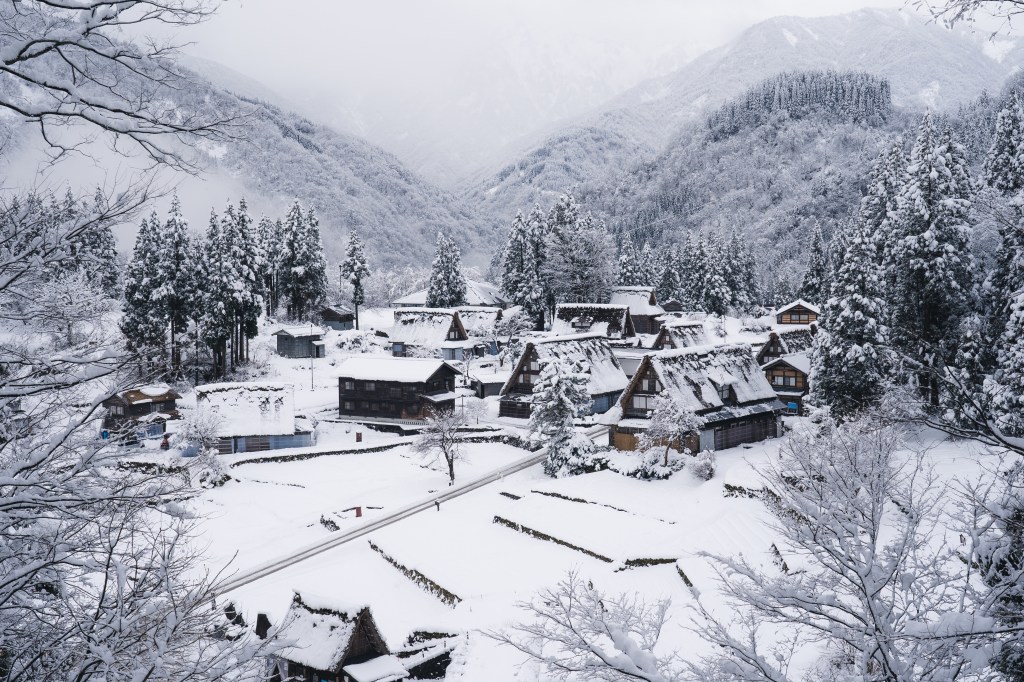
The viewpoint above the car park
From the first car park, a path beside a small hut climbs for a few minutes to a platform that looks down on the whole village: the roofs stepping down the terrace, the fields between them, and the ridge behind. This is the photograph, and it is worth doing first, before the light changes and before you walk among the houses and lose the shape of the place.
The mountain visible beyond the village is Mount Ningyo, and in early spring the melting snow on its slope forms a shape that locals read as a figure. The viewpoint is also where the village is most obviously a composition rather than an accident.
The lanes between the houses
Nine or ten lanes run between the houses, some paved, some gravel, and the houses open onto them with their gable ends facing sideways. Several are minshuku, several sell tea or souvenirs from a front room, and several are simply homes with a notice asking you not to enter the garden.
There is a small shrine, a thatched temple building, and a pond. The village is not big: forty minutes of walking covers it slowly, and most visitors spend an hour and a half. The reason to stay longer is to sit somewhere and let the place be quiet.
The folk museum and the traditional industries hall
The Ainokura Folk Museum occupies a real gassho house, with the household goods, silkworm equipment and papermaking tools of the Edo period, and the climb to the roof space is the part that makes it worth the entry: you can walk through the truss and see how the whole structure locks together.
Be warned that the museum has been closed for some time, and a notice on the official Gokayama tourism site says the closure is indefinite. The adjacent traditional industries hall shares a ticket with it when both are open: 500 yen for adults and 200 for schoolchildren for the combined ticket, or 300 and 150 for one building. Check at the village before you count on it.
Murakami-ke, down the valley
The most important single building in Gokayama is not in Ainokura but in the village of Kaminashi, about ten minutes away by car. Murakami-ke is a gassho house from the Tensho era — the late sixteenth century — with a roof 20 metres deep, four internal levels, and a frame assembled without a single metal cramp. It is a national important cultural property, and the family still explains the house to visitors over a fire in the hearth, with a cup of kawarake-tsumame herbal tea.
Admission is 400 yen for adults and 200 for schoolchildren. It closes on Tuesdays and Wednesdays except holidays, and shuts entirely from 15 December to the end of February apart from booked groups, so it is a summer and autumn visit rather than a winter one.
Suganuma, the third village
Fifteen minutes north up the valley, Suganuma is the smallest of the three, with nine gassho houses on a shelf above the river and a viewing car park reached by lift or a short walk. It is even quieter than Ainokura and takes half an hour. If you have a car, do Suganuma first, then Kaminashi, then Ainokura, which puts the best light at the end.
Food and drink
The local cooking is mountain food, and the staples are soba, tofu and river fish. Gokayama’s firm tofu, pressed hard and sold as a block, is the regional speciality; it holds together in a pot and is served grilled or simmered. Tochimochi, a mochi made with horse chestnut, is the sweet, and it is dense and slightly bitter in a way that shop-bought mochi is not.
Several houses in Ainokura serve lunch, usually a set with soba, tofu, mountain vegetables and a small grilled fish, in a room with an irori hearth. They open around 10:00 and close when the food runs out, which on a busy autumn weekend can be early afternoon. There is no convenience store in the village, and the nearest are down in the valley.
For coffee there are one or two small cafes, and for anything else you eat in Kaminashi or down at Johana, the little town at the end of the railway line, which has a handful of restaurants and a sake brewery.
Getting there and around
This is a valley with a bus and no train, and the bus is the constraint on the whole day.
- By train and bus — Hokuriku Shinkansen to Shin-Takaoka, then the Johana line to Johana station (about 30 minutes), then the World Heritage Bus to the Ainokura-guchi stop, about 25 to 40 minutes. The bus also runs from Takaoka station and Shin-Takaoka.
- From the bus stop — Ainokura-guchi is at the bottom of the village; the walk up to the houses is about five minutes, and up to ten to the museum.
- By car — about 16 minutes from the Gokayama interchange on the Tokai-Hokuriku expressway, following route 156 then route 304 from the Shimono intersection. There are two car parks below the village.
- Parking — a preservation fee of 1,000 yen for a standard car, 300 yen for a motorcycle, payable in cash. Some older sources still quote 500 yen, which is another reason to have a note ready.
- From Shirakawa-go — the same World Heritage Bus continues over the pass, about 50 minutes, which makes a three-village day possible.
Once you are in the village, everything is on foot and the paths are steep in places. The site is not barrier-free: the lanes are uneven, and the climb to the viewpoint is a real climb. In winter the village is often under snow, the car parks can be closed, and the pass road to Shirakawa-go may be shut; check the road conditions before setting out.
Where to stay
- Minshuku in Ainokura — a handful of thatched houses take guests, with dinner, breakfast and a bath. This is the reason to stay: the village after the last bus is silent and dark, and you get the morning before anyone arrives.
- Kaminashi and Shimono — a few more minshuku and small hotels down the valley, cheaper and easier to book.
- Johana — the old town at the railway terminus, with a couple of inns and the most convenient base for an early bus.
- Takayama or Kanazawa — possible as a day trip, but the bus timetable makes it a long one; staying in the valley is better.
Best time to visit
- Late April to May — fresh green, the rice fields flooded, and the village at its most photogenic without crowds.
- Late October to early November — autumn colour on the slopes and the busiest two weeks of the year.
- January to February — deep snow on the roofs, the classic image, and light-up events on selected dates. Access is the risk.
- June to August — green but hot and humid, with the rice fields at their best in July.
The village opens at 08:30 and closes at 17:00, and early morning or late afternoon visits outside those hours are discouraged. Plan the bus around those hours rather than the other way round.
Practical tips
- Take the bus timetable seriously. There are only a few services a day, and missing the last one means a taxi you may not find.
- Bring cash for parking and museums; card acceptance is limited.
- Do not enter gardens, fields or private property, and do not fly a drone over the houses.
- Wear shoes with grip; the lanes are steep and, in winter, icy.
- Check whether the folk museum has reopened before you pay for a combined ticket.
- Combine with Suganuma and Murakami-ke if you have a car, or with Shirakawa-go by bus if you do not.
- Do not expect restaurants to be open late. Eat at midday.
Suggested itineraries
Half day from Johana
- Train to Johana, then the mid-morning World Heritage Bus to Ainokura-guchi.
- Climb to the viewpoint first, then walk the lanes.
- Lunch at one of the houses, then the folk museum if it is open.
- Take an afternoon bus back, or continue north to Suganuma.
Three villages in a day
- Start at Suganuma, which opens at 08:00 in summer.
- Stop at Kaminashi for Murakami-ke.
- Ainokura for the afternoon, with the viewpoint in good light.
- Bus on to Shirakawa-go for the evening, or back down the valley to Johana.
Before you go
Opening hours, museum closures, parking fees and bus times all change, and the figures above come from the Gokayama official tourism site, the Nanto city cultural archive (offline at the time of checking), the Murakami-ke foundation and the Gokayama tourism association, checked on 26 October 2026. Two things are worth reconfirming before you travel: whether the Ainokura folk museum has reopened, and the current preservation fee, since published figures vary between 500 and 1,000 yen. In winter, check the pass road and the bus before committing to a day built around the village.
Sources
- Gokayama official tourism site: Ainokura village, hours and parking (checked 2026-10-26)
- Gokayama official tourism site: Ainokura folk museum and ticket prices (checked 2026-10-26)
- Gokayama official tourism site: World Heritage listing and village history (checked 2026-10-26)
- Murakami-ke: hours, closures and admission (checked 2026-10-26)
- Nanto city (official): the municipality that includes Gokayama (checked 2026-10-26)
Explore More of Japan
- Shirakawa-go Travel Guide — the largest of the three gassho villages
- Takayama Travel Guide — the old town on the other side of the mountains
- Gujo Hachiman Travel Guide — another castle town of thatched-roof country
- Kanazawa Travel Guide — the nearest big city, with its own craft traditions
- Magome and Tsumago Travel Guide — two more preserved villages, on a different old road


Leave a Reply