The Shimanami Kaido is a cycling route that crosses the Seto Inland Sea on the bridges of an expressway, island by island, from Onomichi in Hiroshima prefecture to Imabari in Ehime. It is about 70 kilometres from end to end, it crosses six islands, and the bridges carry pedestrians and cyclists for free. No other route in Japan does this.
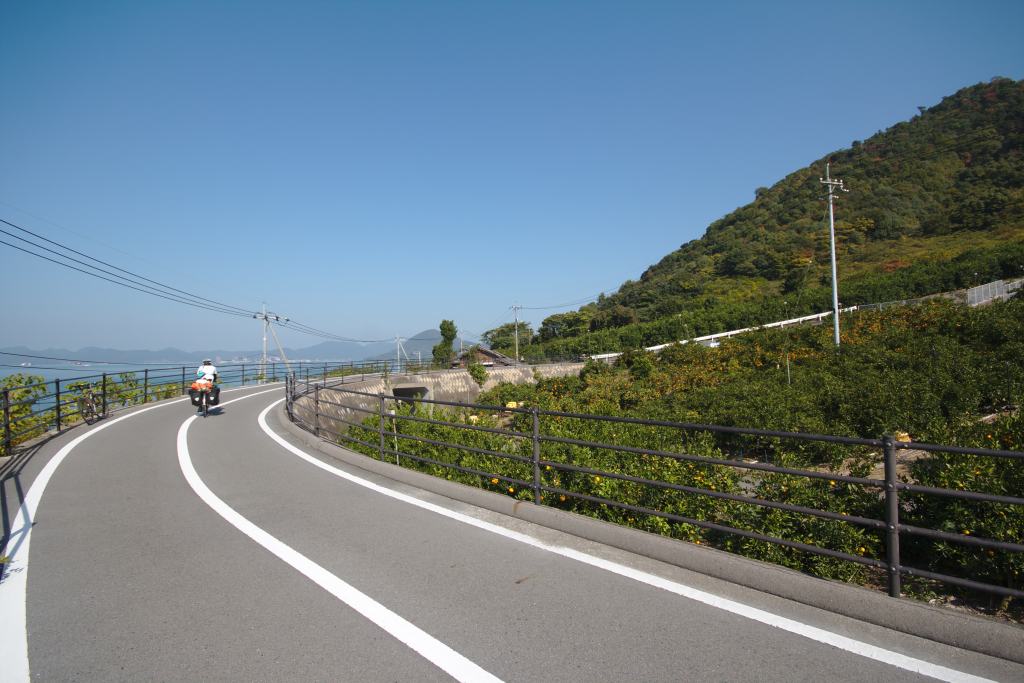
What makes it more than a long ride is the sequence. You climb onto a bridge, ride above the shipping lanes for a kilometre or two, drop onto an island with a village and a shrine or a lemon grove, cross that in half an hour, and climb onto the next bridge. The sea is always on both sides, and the scale changes constantly.
Why visit
- It is the only place in Japan where a cyclist can cross the sea between islands on expressway bridges, and the crossing itself is the attraction.
- The cycling path is separate from the road, waymarked with a blue line, and free — there is no toll for bikes.
- One-way rental is straightforward: you pick up a bike at one terminal and leave it at another, so a 70-kilometre traverse needs no return journey.
- The islands are not scenery only. There is a temple complex built by one man, a shrine with the country’s largest collection of samurai armour, and a lemon-growing economy you can taste.
- It works as a day trip from Onomichi or Imabari, or as two days with a night on Omishima.
The route, bridge by bridge
The corridor is the Nishi-Seto Expressway, 59.4 kilometres of expressway that was completed in 1999. The cycling route runs beside it and is slightly longer, because it dips into the islands rather than flying over them. The bridges, in order from Onomichi, are these:
- Shin-Onomichi Ohashi — 546 metres, a cable-stayed bridge from the mainland to Mukaishima. Many cyclists skip it by taking the ferry from Onomichi to Mukaishima instead.
- Innoshima Ohashi — 1,270 metres, a suspension bridge completed in 1983, long before the rest of the corridor.
- Ikuchi Bridge — 790 metres, from Innoshima to Ikuchijima.
- Tatara Ohashi — 1,480 metres, with a main span of 890 metres. When it opened in 1999 that was the longest cable-stayed span in the world, and it is still the longest in Japan.
- Omishima Bridge — 328 metres, an arch bridge, and the oldest structure on the route, opened in 1979.
- Hakata-Oshima Ohashi — 840 metres, a suspension bridge from 1988.
- Kurushima Kaikyo Ohashi — 4,105 metres in three linked suspension spans, the first triple suspension bridge in the world, crossing the strait between Oshima and Imabari.
The Kurushima bridge is the finale and the best of them. The strait below runs one of the fastest tidal currents in Japan — it is usually counted with Naruto and Kanmon as the country’s three great tidal races — and the water turns white and green under the deck. The cycling path is on the side, high enough that the cars are a lane away and the view is uninterrupted.
Top places and highlights
Onomichi, the starting point
Onomichi is a port town built up a hillside, with a temple walk, narrow lanes and a covered shopping street, and it deserves the night before you start. The ferry to Mukaishima takes a few minutes and costs a couple of hundred yen, and it drops you closer to the route than the bridge does. If you take the bridge instead, you start with the climb over Shin-Onomichi.
Innoshima
The second island was the domain of the Murakami clan, the seafaring family who controlled the shipping lanes of the Inland Sea in the sixteenth century and who appear throughout this coast’s history. There is a small castle museum on the hill, and the island is also where the path starts to feel rural: mandarin orchards, low houses, and a long flat run to the next bridge.
Ikuchijima and Setoda
This is the island most people stop on. Setoda town has a lemon-growing history that goes back more than a century, and the shops sell lemon soft cream, lemon cakes and lemon juice that taste of the actual fruit rather than flavouring. The town is also where Kosanji temple stands.
Kosanji is the obsession of one man, Kanemaru Kosan, a businessman who built it from 1936 as a memorial to his mother and kept adding for the rest of his life. It is not an old temple but a copy of one: the main hall imitates Nikko’s Yomeimon, the pagoda imitates the one at Nara, and the result is a compound of borrowed masterpieces in marble and lacquer. Behind it, on a hillside of white marble, is the garden called Miraishin no Oka, a sculpted landscape of curves that photographs better than it sounds.
Admission has risen: from April 2026 it is 1,800 yen for adults, 1,200 for university and high school students, and free for younger children. The Shoseikaku villa on the site costs another 500 yen. It is open 9:00 to 17:00 with last entry at 16:30, and it does not close for holidays.
Omishima and Oyamazumi shrine
Omishima is the largest island on the route and the one with the most weight. Oyamazumi shrine sits in a grove of old camphor trees near the west coast, and its treasure hall holds the largest collection of samurai armour and weapons in Japan, much of it designated national treasure or important cultural property. The armour belonged to the clans of the Inland Sea, including the Murakami, and it is displayed in ranks of helmets, cuirasses and swords rather than as individual showpieces.
The treasure hall is 1,000 yen for adults, 800 for university and high school students and 400 for younger children, open 8:30 to 17:00 with last entry at 16:30. The shrine grounds themselves are free. Cyclists are expected to walk their bikes through the precinct.
Omishima is also the sensible overnight stop: it sits around 47 kilometres from Onomichi and 23 from Imabari, which splits the route into two manageable days.
Hakatajima and Oshima
Hakatajima is the salt island — Hakata no Shio has been made here for centuries by a method that concentrates the brine on bamboo branches — and the shop sells salt soft cream, which is better than it has any right to be. Oshima is the last island before Imabari, and the climb to the Kiro observatory at the top gives you the whole of the Kurushima bridge from above, the three spans laid across the strait. It is a detour of a few kilometres and the single best view on the route.
Imabari
The finish is a working industrial city, and its rewards are towel shops and food. Imabari towels have been made here since the Meiji period and are sold at the towel headquarters near the station; they are the standard Japanese gift towel for a reason. The local dish is yakibuta tamago meshi, a bowl of rice under a sweet soy-glazed pork cutlet and a fried egg, which is exactly the meal you want after 70 kilometres.
Food and drink
The route eats in short stops rather than long lunches, and the island specialities are the point: lemon everything on Ikuchijima, salt soft cream on Hakatajima, and grilled fish or a seafood bowl at the small ports. There are convenience stores on most islands but not many, and the gaps between them are longer than you expect.
On Omishima and Ikuchijima there are a handful of cafes aimed squarely at cyclists, with bike racks and water taps, and they are reliable for a coffee and a cake in the afternoon. In Onomichi, eat Onomichi ramen — a soy-based broth with chicken and dried sardines, and flat noodles — before you start. In Imabari, yakitori and the pork bowl after you finish.
Getting there and around
Both ends are on the railway, which is what makes a one-way traverse practical.
- Onomichi — JR Sanyo line to Onomichi station, or Shinkansen to Shin-Onomichi and a short local ride. From Hiroshima it is about 1 hour 40 minutes by local trains, or 40 minutes by Shinkansen to Fukuyama plus a connection. From Tokyo, Shinkansen to Fukuyama takes about 3 hours 30 minutes.
- Imabari — JR Yosan line, about 40 minutes by limited express from Matsuyama, and about 2 hours from Okayama with a change.
- Flights — Hiroshima airport for the Onomichi end, Matsuyama for the Imabari end.
The rental system is what makes the route work. Shimanami Japan runs ten terminals from Onomichi station to Imabari station, and you can return a bike at any of them:
- Cross bike or city bike — 3,000 yen a day for adults, 1,000 yen for primary school children, multi-day rental allowed.
- Electric assist — 4,000 yen a day, available at six terminals including Onomichi station, Setoda, Omishima and both Imabari terminals.
- E-bike — 8,000 yen a day, at Onomichi and the two Imabari terminals, same-day return only.
- Drop-off at another terminal — 1,000 yen for adults, 500 yen for children, on top of the rental.
Helmets are lent free with the bike and are expected to be worn. Night riding is prohibited, so the day has to be planned around daylight, and the terminals close in the late afternoon. On holiday weekends the whole fleet of around 2,000 bikes can be out by mid-morning, so reserve ahead or start early.
Ferries fill the gaps where you do not want to ride: Onomichi to Mukaishima, and Onomichi to Setoda, which lets you skip the first two islands entirely if you are short of time.
Where to stay
- Onomichi — the best base before the ride, with a good range of hotels and guesthouses and the town’s temple walk in the evening.
- Setoda on Ikuchijima — small hotels and guesthouses, and the shortest ride to Kosanji.
- Omishima — the classic midway stop, with minshuku and a few hotels, and the shrine at the door.
- Imabari — business hotels near the station, and a hot spring or two, for the night after the crossing.
Book Omishima early in spring and autumn; it has the fewest beds on the route and the most people wanting them.
Best time to visit
- March to May — the best window: mild, dry, and the islands green. Cherry blossom comes early here, in late March.
- October to November — clear air, comfortable riding and the citrus harvest starting.
- June to July — warm and humid, with the rainy season in June and the lemon harvest in autumn rather than summer.
- August — hot enough to make a 70-kilometre ride a serious undertaking; start at dawn and carry more water than you think.
Wind matters more than temperature. The route runs roughly east to west, and a headwind on the bridges can turn a flat day into hard work. Check the forecast the night before and consider riding Imabari to Onomichi if the wind is against you.
Practical tips
- Reserve the bike, especially at weekends and in cherry blossom season, and choose the electric assist if you are not a regular cyclist.
- Start early. The terminals close before dark and night riding is banned.
- Take the drop-off fee into account: a one-way adult rental is 4,000 yen, not 3,000.
- Carry cash; many island shops and cafes do not take cards.
- Water and food are sparse between towns. Fill up at every convenience store you pass.
- The descents off the bridges are steep and end at junctions. Slow down before the bottom, not at it.
- Do not ride on the expressway itself. The cycling path is signposted with a blue line and separate from the road.
- If the full route is too much, do Onomichi to Setoda and take the ferry back, which is half the distance and most of the scenery.
Suggested itineraries
Two days, the full traverse
- Day one: pick up the bike at Onomichi in the morning, cross to Mukaishima by ferry, and ride through Innoshima to Ikuchijima. Stop at Kosanji and eat lunch in Setoda.
- Continue over Tatara bridge to Omishima in the afternoon, visit Oyamazumi shrine, and stay the night on the island.
- Day two: cross to Hakatajima for salt soft cream, then Oshima, climb to the Kiro observatory, and finish over the Kurushima bridge into Imabari.
- Return the bike at Imabari station, eat yakibuta tamago meshi, and take the train onward.
One day, the western half
- Take the ferry from Onomichi to Setoda in the morning.
- Rent a bike at the Setoda terminal and visit Kosanji.
- Ride over Tatara bridge to Omishima and the shrine.
- Return the bike at Omishima and take the bus or ferry back, or continue to Imabari if you have the legs.
Before you go
Rental prices, terminal hours, bridge access and ferry timetables change, and the figures above come from Shimanami Japan, the Honshu-Shikoku Bridge Expressway Company, Kosanji, Oyamazumi shrine and Imabari city, checked on 26 October 2026. Reconfirm the drop-off fee and the electric-assist availability at your terminal before you set out, since both vary by season, and check that your travel dates fall inside daylight hours. If you plan to ride in summer, the heat is the constraint rather than the distance.
Sources
- Honshu-Shikoku Bridge Expressway Company: Shimanami Kaido bridges and free access for cyclists (checked 2026-10-26)
- Shimanami Kaido portal: the 70-kilometre cycling road (checked 2026-10-26)
- Shimanami Japan: rental cycle prices and terminals (checked 2026-10-26)
- Shimanami Japan: rental FAQ, riding times and reservations (checked 2026-10-26)
- Kosanji Museum: hours and admission (checked 2026-10-26)
- Imabari city: Oyamazumi shrine treasure hall (checked 2026-10-26)
- Ehime prefecture: Kurushima and Tatara bridge records (checked 2026-10-26)
Explore More of Japan
- Onomichi Travel Guide — the starting town, its temple walk and its ramen
- Dogo Onsen Travel Guide — the bathhouse at the Imabari end of the line
- Matsuyama Castle Travel Guide — 40 minutes by train from Imabari
- Tomonoura Travel Guide — another old port on the same Inland Sea
- Hiroshima Peace Memorial Travel Guide — the nearest big city to the Onomichi end


Leave a Reply