The wholesale fish market left Tsukiji on 6 October 2018, and the outer market did not. That distinction is the single most useful thing to understand before you go, because half the travel writing about this district still describes a tuna auction that has not happened here since 2018, and the other half describes a market that closed.
What remains is better than a consolation prize. The outer market — the jōgai shijō — is a dense grid of alleys north-east of the old wholesale site, with roughly 460 shops selling fish, knives, seaweed, pickles, tea, ceramics and lunch. It was always the part that served the public, and it has kept doing that without the wholesale market next door.
Why visit
- It is the most concentrated food market in Tokyo, and one of the few where the shops are still run by the families that own the expertise rather than by a management company.
- Breakfast here is a genuine Tokyo experience: sushi at seven in the morning, grilled scallops at eight, tamagoyaki on a stick at nine.
- The non-food side is underrated. Knife shops, pottery, dried fish and kombu, and professional-grade kitchen tools at prices that make sense.
- It is free, central, and a ten-minute walk from Ginza, which makes it the easiest early-morning stop on a Tokyo itinerary.
- The etiquette is part of the experience: this is a working trade street, not a food festival, and behaving accordingly changes how the visit feels.
What happened to the fish market
Tokyo’s fish market began at Nihonbashi in the early seventeenth century, when the shogunate brought fishermen from Tsukuda in Osaka to supply Edo castle and let them sell the surplus. That market ran for three centuries. The 1923 earthquake destroyed it, a temporary market opened at Shibaura, and in February 1935 the city opened the Nihonbashi fish market’s successor on reclaimed land at Tsukiji: a 230,000-square-metre facility with its own railway siding and wharf.
It became the largest fish market in the world, and by the 2000s it was also obsolete: too small, too old, and impossible to rebuild on the site. After two decades of argument, the wholesale market moved to Toyosu, which opened on 11 October 2018. The old buildings were demolished; the site has been empty since.
The outer market was never part of that facility. It grew up alongside it from the 1930s as a separate quarter of shops supplying the trade and the neighbourhood, and it stayed. One consequence is that the outer market follows the wholesale market’s calendar rather than a tourist calendar: it closes on Sundays and holidays, and many shops also close on the wholesale market’s Wednesday closures. The official line is that about a third of the shops, mostly restaurants, stay open on Sundays and holidays.
Top places and highlights
The alleys
The market is not one street but a grid: a main lane running east from the Namiyoke shrine towards the river, crossed by narrower lanes with shops two or three metres wide. The names on the shopfronts are the families, the fish is laid out in polystyrene boxes on ice, and the knives are displayed in rows by length.
The centre of gravity is the stretch between the Tsukiji Uogashi buildings and the shrine. Tsukiji Uogashi is the modern replacement for the lost wholesale floor: two three-storey buildings, Odawara-bashi and Kaiko-bashi, with around 60 tenants, fish and produce on the ground floor, a food court on the third. It opened provisionally in November 2016 and fully in October 2018. The ground floor is for the trade until 09:00 and opens to the public after that; the food court upstairs starts earlier.
Namiyoke Inari shrine
At the north end of the market, the shrine is the district’s guardian and, by its own foundation story, the reason the land exists. The reclamation of the Tsukiji shoreline kept failing — the story goes — until a glowing object was found floating offshore in 1659. It was a figure of Inari, the shrine was built, the waves calmed, and the landfill was completed. The name Namiyoke means wave barrier.
The shrine holds a pair of gold-lacquered lion heads from 1848, and above the worship hall a 2.4-metre, one-tonne black cypress lion head, rebuilt in 1990. The lion festival in early June carries the heads through the streets. It is worth ten minutes even if you are only here to eat, and the market’s workers do actually stop and bow on the way past.
The knife shops
Several of the shops sell professional knives, sharpened on the premises, with the carbon steel and the single-bevel blades that Japanese cooking actually uses. Staff will explain the difference between a yanagiba and a deba if you ask, and many shops will engrave a name for a small fee. The prices are honest; this is where chefs buy.
If you are carrying only hand luggage, remember that knives go in checked baggage, not the cabin.
Tsukiji Honganji, two minutes away
The one thing most market visitors miss is the temple immediately to the south-west. Tsukiji Honganji is a Jodo Shinshu temple whose main hall was rebuilt in 1935, after the earthquake, to a design by Ito Chuta — the architect who spent his career arguing that Japanese buildings should absorb Asian rather than European precedents. The result is a stone-faced hall with a rounded Indian-style roof, carvings of elephants and peacocks, and an interior with a vaulted ceiling and stained glass. It looks like nothing else in Tokyo and it is free to enter.
The temple runs a morning service that is open to visitors, and the courtyard between the gate and the hall is a calm place to sit after an hour in the lanes. Coming out of the market’s noise into this is a good way to end the morning.
What is not here
No tuna auction. That moved to Toyosu, where viewing is by advance lottery: 100 places a day, a 05:45 to 06:25 session, applications roughly a month ahead, and identity checks at the door. If the auction is the reason for your trip, plan it as a separate morning in Toyosu, not Tsukiji.
Food and drink
The food is the point, and it divides into three kinds.
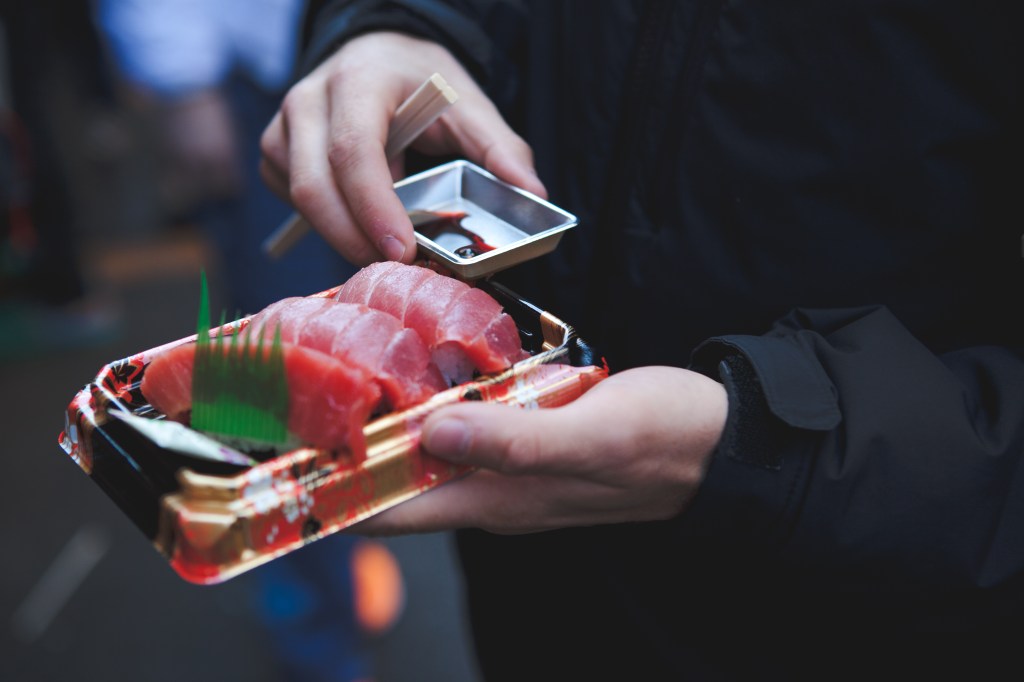
Breakfast sushi. Counters open early, the queues form by seven, and the fish is whatever came in that morning. The famous names have the longest lines; the second row of shops is usually just as good and half the wait. Sets are the sane order if you do not read Japanese.
Street food. Tamagoyaki on a skewer is the signature: Marutake has been grilling it since the shop opened, opens at 04:00, and sells a hot slice for a couple of hundred yen. Grilled scallops, oysters, crab legs, unagi skewers and tuna cutlet sandwiches are all sold from the front of shops.
Rice bowls. Kitsuneya, on the main lane, has been serving horumon — beef offal simmered in hatcho miso — over rice since 1947, and the queue is worth it. It is open 06:30 to 13:30, closed Sundays, holidays and market closure days, and there are only about five counter seats.
Two rules shape the eating. First, eating while walking is discouraged: the market asks visitors to eat inside the shop or in the designated space in front of it, because the lanes are narrow and hot food ends up on other people. Second, cash still matters. Cards are increasingly accepted but many small shops are cash only, so carry notes.
Getting there and around
Tsukiji is one of the easiest places in Tokyo to reach, and there are two stations that put you at the edge of the market.
- Tsukiji station — Tokyo Metro Hibiya line, exits 1 and 2, one minute from the market.
- Tsukiji-shijo station — Toei Oedo line, exit A1, one minute.
- Higashi-Ginza — Hibiya and Asakusa lines, five minutes on foot, which is useful if you are coming from Asakusa or Narita.
- From Tokyo station — about ten minutes by taxi, or a bus to Tsukiji 3-chome.
- From Shinjuku, Shibuya or Roppongi — the Oedo line to Tsukiji-shijo is the direct option.
Driving is a bad idea. The lanes are pedestrian, parking is limited to the Tsukiji River No. 1 car park nearby (231 spaces, 200 yen per 30 minutes, open 24 hours), and the surrounding streets are narrow.
Once inside, it is all walking, and the distances are small: the market is perhaps 400 metres across. The constraint is not distance but crowding, and the official advice is to come with a small group rather than a large one.
Where to stay
Few people stay in Tsukiji itself, and there is a case for doing so: the market at 06:00, before the first tour groups, is a different place.
- Tsukiji and Shintomicho — business hotels and a few small inns, five minutes from the stalls, cheaper than Ginza.
- Ginza — ten minutes on foot, with the full range of hotels and the best evening restaurants.
- Hatchobori and Kayabacho — quieter, cheaper, and one stop away on the Hibiya line.
Best time to visit
- 06:00 to 09:00 — the trade is working, the restaurants are open, and the lanes are clear. This is the best two hours.
- 09:00 to 11:00 — the shops are fully open and the crowds arrive. Good for shopping, harder for eating.
- After 14:00 — many shops close and the market empties. Not worth a special trip.
- Monday, Tuesday, Thursday, Friday — the safest days. Saturday is busiest, and Wednesday, Sunday and holidays close a large share of the shops.
Weather matters less than the calendar. The market is outdoors but the lanes are narrow and the eaves keep off most rain. Avoid the days before New Year, when the crowds are at their worst and pickpocketing rises, and note that most shops close until 4 January.
Practical tips
- Come before nine. The trade gets the market until then, and the food is at its best.
- Do not eat while walking. Eat in the shop or at its frontage.
- Carry cash, and expect some shops to refuse cards.
- Leave the suitcase at a coin locker. The market asks visitors not to wheel large bags through the lanes, and the information desk will hold a pushchair.
- Do not touch the fish or the produce. Ask staff if you want a closer look.
- Do not haggle. Prices are already wholesale.
- Go in a small group. The lanes cannot absorb a party of ten.
- Wear shoes you can slip off if you end up at a counter with a step.
- If you want the Toyosu tuna auction instead, apply for the lottery a month ahead; it is a separate trip.
Suggested itineraries
Early morning, the classic version
- Arrive at Tsukiji station at 06:30 and walk the main lane while the deliveries are still happening.
- Breakfast at a sushi counter, or horumon rice at Kitsuneya if you want something hot and cheap.
- Namiyoke shrine, then the knife shops and the dried fish stalls.
- Tsukiji Uogashi for produce and the food court.
- Tsukiji Honganji for ten quiet minutes, then walk to Ginza by 10:00 as the market fills up.
With children
- Start at 08:00 rather than 06:00, when the trade rush is ending.
- Tamagoyaki skewers and grilled scallops are the reliable hits.
- Tsukiji Uogashi’s food court has seating, which the alleys do not.
- Finish at the shrine, which has space to run, before the lanes get tight.
Before you go
Shop hours, closure days and the market calendar change, and the figures above come from the Tsukiji Outer Market official site, the Namiyoke shrine, the Tokyo Metropolitan Central Wholesale Market and the Toyosu Market, checked on 26 October 2026. Two things are worth reconfirming: the monthly closure calendar, since the outer market follows the wholesale market’s holidays, and the Toyosu auction lottery window, which opens in the first week of the preceding month. Do not plan the trip around a tuna auction at Tsukiji; it has not been there since 2018.
Sources
- Tsukiji Outer Market (official): shops and suggested plan (checked 2026-10-26)
- Tsukiji Outer Market: opening hours and closure calendar (checked 2026-10-26)
- Tsukiji Outer Market: visitor FAQ, parking and Sunday opening (checked 2026-10-26)
- Tsukiji Outer Market: access (checked 2026-10-26)
- Namiyoke Inari shrine: foundation and lion heads (checked 2026-10-26)
- Toyosu Market: history of the Tokyo fish market (checked 2026-10-26)
- Tokyo Metropolitan Government: the former Tsukiji market (checked 2026-10-26)
- Tsukiji Outer Market: Kitsuneya (checked 2026-10-26)
- Tsukiji Outer Market: Marutake (checked 2026-10-26)
Explore More of Japan
- Shibuya Travel Guide — the other Tokyo district worth an early start
- Tokyo Skytree Travel Guide — the east side of the city, on the same subway network
- Yokohama Travel Guide — the port city 25 minutes away, with its own food history
- Day Trips from Tokyo — what else fits a single day from the city


Leave a Reply