Yokohama is the first treaty port Japan opened to foreign trade, in 1859, and almost everything worth seeing in the city comes from that fact. The harbour, the warehouse district, the hillside of foreign residences, the Chinese community that formed around the trading houses — none of it is older than the mid-nineteenth century, and none of it is a reconstruction of something older. It is Japan’s most convincing port city, and it is 25 minutes from Tokyo by train.
That proximity is both the advantage and the trap. Yokohama is easy enough to treat as an afternoon, and most people do exactly that: a walk along the waterfront, lunch in Chinatown, back to Tokyo by dinner. It works. But the city rewards a longer visit more than its reputation suggests, because the good parts are spread along six kilometres of coast and hill, and they close at five.
Why visit
- It is a real port with a working waterfront, not a themed district, and the scale of the harbour is the thing you notice first.
- The range within one city is unusual: Victorian warehouses, a Chinese quarter of 600 shops, a hillside of free foreign residences, and a classical Japanese garden assembled from buildings moved here from Kyoto and Kamakura.
- Half of the best sights cost nothing — the Osanbashi pier roof, the Yamate houses, the waterfront promenade, and the view from the hill.
- There is food that was invented here rather than merely served here, including the seafood doria and the spaghetti napolitan at the Hotel New Grand.
- It works in any weather, which is not true of Kamakura or Hakone, and it is the best bad-weather day trip from Tokyo.
How the city came to look like this
Until 1859 Yokohama was a fishing village. Commodore Perry’s squadron arrived at Uraga in 1853, the treaty was signed at Yokohama the following year, and the port opened five years later. What followed was built fast: a foreign settlement on the flat land behind the harbour, a Japanese merchant town beside it, and a bluff above — which the foreign residents called the Bluff — where the consuls and trading companies put their houses to escape the summer heat and the smell of the port.
The 1923 earthquake destroyed most of it, and the war destroyed much of what was left; the harbour area was requisitioned by the occupation until 1952, and parts of Yamashita Park were not returned until 1960. So the Yokohama you walk through is a third or fourth version of the city. The stone warehouses on Bashamichi and the stretch of Nihon-odori survived, and they are the reason those two streets feel older than anything else here.
The modern waterfront is newer still. Minato Mirai, the district of towers and the ferris wheel, is built on reclaimed land from the shipyards and rail yards, and the first buildings went up in the 1980s. It looks like a plan because it was one.
Top places and highlights
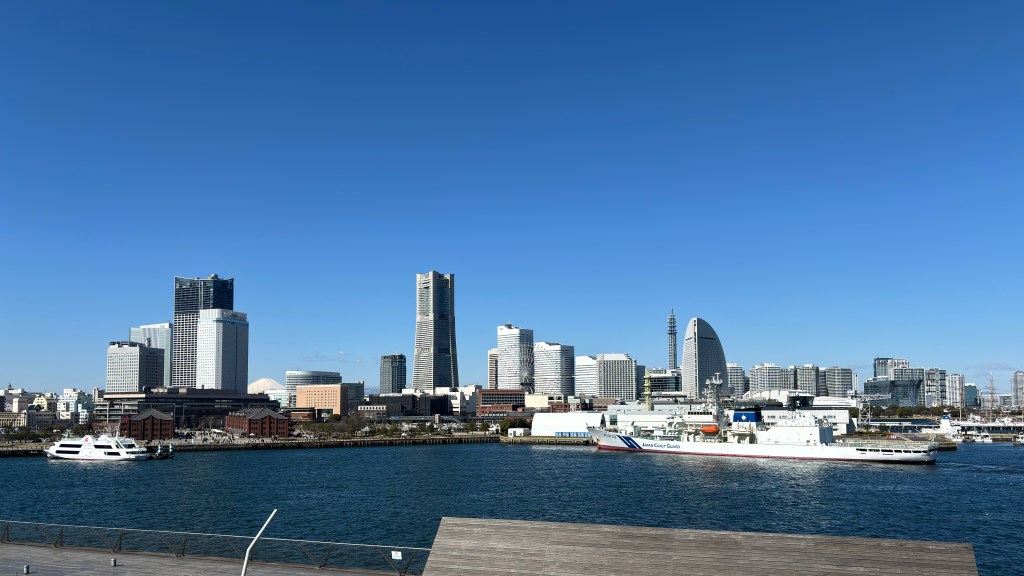
Minato Mirai and the Air Cabin
The redeveloped harbour district is the postcard: the Landmark Tower, the ferris wheel, the museum ships, and a promenade that runs from Sakuragicho station to the water. It is at its best in the late afternoon, when the light comes across the bay and the towers go gold, and again after dark.
One warning that changes plans: the observation floor at the top of the Landmark Tower, the Sky Garden on the 69th floor, has been closed since the end of 2025 for a major renovation of the building. The operator says it will not reopen before 2028. Travel guides written earlier still list it as the main viewpoint, so ignore them.
The Yokohama Air Cabin, opened in April 2021, is Japan’s first permanent urban ropeway: a 630-metre gondola line linking Sakuragicho station with the Canal Park at the far end of the district, about five minutes in the air and 1,000 yen one way for adults. It is a short ride rather than a sight, but it saves a long walk around the water and gives the harbour from above.
Osanbashi pier
The international passenger terminal is the best free viewpoint in the city. The roof is a rolling wooden deck open 24 hours, designed so you walk up onto it without noticing, and from the top you have the bay, the Bay Bridge, Minato Mirai on one side and the hills on the other. Cruise ships moor alongside, which is either a bonus or an obstruction depending on the day. Go at sunset.
Yamashita Park and the Hikawa Maru
The park along the waterfront was laid out in 1930 on land reclaimed with rubble from the 1923 earthquake, which is worth remembering while you walk it. It is a pleasant strip rather than a destination: roses, a fountain, a memorial to a singing competition, and a good view of the bay.
Moored at its edge is the Hikawa Maru, a 1930 ocean liner that crossed the Pacific to Seattle and survived the war as a hospital ship. Entry is 300 yen for adults, 100 yen for schoolchildren, cash only, from 10:00 to 17:00 with last entry at 16:30, closed Mondays except holidays. It is a well-preserved ship rather than a museum about a ship: you walk the promenade deck, the first-class cabins and the engine room, and the art deco interiors are the reason to go.
Yokohama Chinatown
The Chinese community here began with the interpreters and traders who came with the foreign merchants after 1859, and grew into the largest Chinatown in Japan and one of the largest in the world: about 630 shops inside a square roughly 500 metres on each side, of which around 200 are Chinese restaurants. The main street from the Zenrin-mon gate to the police box is about 300 metres, which gives you a sense of how compressed it is.
It is free to walk and expensive to eat well. The gate streets are full of steamed buns and takeaway counters aimed at the crowd, and the better restaurants are on the side lanes and up the stairs. Book for dinner; at lunch on a weekend the queues are the main activity.
Yamate and the foreign houses
The hill above the port is where the foreign residents built, and seven of their houses are now open to the public, all of them free. They are not a single museum but separate buildings scattered along the slopes: a diplomat’s house moved here, a trading company villa, a garden with a view over the bay. The Italia Sangiokan, the Berrick Hall and the Bluff No. 18 are the ones worth the walk, and each has a cafe or a terrace.
Between them are the Foreign General Cemetery, which begins with a sailor from Perry’s squadron buried in 1854, and the Harbour View Park at the top, which is the classic view of the bay with the ferris wheel in the distance.
Sankeien
Sankeien is the reason to leave the waterfront. It is an 18-hectare garden opened to the public in 1906 by Hara Sankei, a silk trader who used his fortune to buy historic buildings from Kyoto, Kamakura and elsewhere and reassemble them around a pond. There are 17 structures, ten of them Important Cultural Properties, including a three-storey pagoda from a temple in Kyoto that now stands on the ridge above the water.
It is 900 yen for adults and 200 for schoolchildren, open 9:00 to 17:00 with entry until 16:30, closed from 26 to 31 December. The circuit takes about 90 minutes at a walk. In late March the plum and cherry are the draw, in June the irises, and in November the maples along the valley behind the pagoda — which is when it is busiest, and the only time you will queue.
Cup Noodles Museum
The museum on the Minato Mirai waterfront is devoted to instant ramen, with a room of packaging from around the world and a workshop where you decorate your own cup and choose the ingredients. Admission is 500 yen for adults with high school age and under free, open 10:00 to 18:00 with last entry at 17:00, closed Tuesdays except holidays. The workshop is the part worth booking; the rest is quick.
Marine Tower and the old streets
The Marine Tower at Yamashita Park is the 1961 lighthouse-shaped tower with an observation deck; tickets are sold separately for day and night. Beyond it, Bashamichi and Nihon-odori are the two streets that survived the earthquake, with stone banks and warehouses now used as shops and galleries, and a row of ginkgo trees planted in the Meiji period. Noge, a few minutes inland, is the old drinking quarter and still has around 700 bars and restaurants.
Food and drink
Yokohama’s food history is a history of firsts, because this is where foreign food entered Japan. The Hotel New Grand, opened in 1927 on the bluff above the park, is credited with the seafood doria, the spaghetti napolitan and the pudding à la mode, and still serves all three.
Chinatown is the obvious meal, and it is better than its reputation if you avoid the main street. Look for the restaurants with a queue of local families rather than tour groups, and consider a set lunch over the all-you-can-eat places, which are aimed at exactly the crowd you are trying to avoid.
Beyond those two, the city eats well in ordinary ways: a large sushi and seafood market scene, a ramen cluster around Yokohama Station, and the Noge bars for an evening. The Shin-Yokohama Raumen Museum is 20 minutes away on the subway and is a theme park of noodle history with several regional shops inside — worth it with children, skippable otherwise.
Yokohama is also beer country: the Kirin brewery has been here since the Meiji period, and there is a beer hall in the old brewery grounds near Yokohama Station.
Getting there and around
Yokohama is one of the easiest cities in Japan to reach, and the mistake people make is getting off at the wrong station.
- From Tokyo Station — the Tokaido or Yokosuka line to Yokohama takes about 25 to 30 minutes.
- From Shinjuku or Shibuya — the Shonan-Shinjuku line runs direct to Yokohama in about 30 minutes.
- From Haneda Airport — the Keikyu line reaches Yokohama in about 25 minutes, which makes the city an easy first or last stop.
- Shinkansen — Shin-Yokohama is on the Tokaido Shinkansen, but it is a separate district 15 minutes from the centre by subway. Do not get off there expecting the harbour.
The key to moving around is the Minato Mirai line, a subway that runs from Yokohama Station through Minato Mirai to Motomachi-Chukagai, linking the waterfront and Chinatown in about seven minutes. It is not a loop and it does not run along the coast, so plan your stops rather than expecting to hop on and off.
Two other options are worth knowing. The sea bus connects Yokohama Station East exit, the Hammerhead pier, the Red Brick Warehouse and Yamashita Park by water: 1,300 yen for the shorter legs and 1,500 yen from the station to the park, roughly 10 to 17 sailings a day depending on the day. And the Air Cabin links Sakuragicho with the Canal Park for 1,000 yen.
Most of the walking is flat along the waterfront, but the Yamate hill and Sankeien involve real slopes. Comfortable shoes matter more here than in most Japanese cities.
Where to stay
Yokohama is usually a day trip, and if you are staying in Tokyo there is no reason to move. The case for staying is the evening: the waterfront after dark, when the day visitors have gone and the harbour lights come on, is the best hour the city has.
- Minato Mirai — the big hotels with harbour views, at harbour prices. Best for a special night.
- Yokohama Station — practical, cheaper, and the transport hub for everything including the airport line.
- Chinatown and Yamashita Park — smaller hotels and a couple of historic ones, within walking distance of the park and the ships.
- Shin-Yokohama — only if you are arriving or leaving by Shinkansen; it is a business district with nothing else to offer.
Best time to visit
- Late March to April — cherry blossom in Sankeien, Yamashita Park and the Yamate slopes, and the busiest weekends of spring.
- May to June — mild, green, and the irises at Sankeien.
- November — the maple season in Sankeien and clear, dry walking weather. The best month overall.
- December to February — cold and clear, with illuminations along the waterfront into the new year and far fewer people.
August is hot and humid with little shade on the waterfront. The city is at its worst in the middle of a summer afternoon, and at its best in the two hours before sunset in any season.
Practical tips
- Get off at Yokohama or Sakuragicho, not Shin-Yokohama, unless you are changing to the Shinkansen.
- Do Minato Mirai in the late afternoon and Chinatown at lunch, not the other way round; the light and the queues both work better.
- Allow for closing times. The Hikawa Maru, Sankeien and the museums all stop admitting around 16:30, and the day disappears faster than you expect.
- Skip the Sky Garden at the Landmark Tower — it is closed until at least 2028. Use the Osanbashi roof or the Marine Tower instead.
- Chinatown is cash-friendly but crowded; the side lanes are cheaper and calmer than the main street.
- Sankeien is a bus ride from the centre. From Yokohama Station East exit, take the bus from stop 2 and get off at Sankeien-iriguchi, then walk five minutes.
- Yokohama is a good rain plan: the Cup Noodles Museum, the Hikawa Maru and the Red Brick Warehouse are all indoors or covered.
Suggested itineraries
Half day, waterfront only
- Sakuragicho station, and walk into Minato Mirai along the promenade.
- Red Brick Warehouse and the Hammerhead pier, then the Air Cabin or the sea bus to Yamashita Park.
- Walk the park and the Osanbashi roof for the view.
- Chinatown for an early dinner, then back to Tokyo.
Full day, port and hill
- Start at Sankeien when it opens, before the coach parties.
- Bus back to Yamate and walk the foreign houses and the Harbour View Park.
- Down the hill to Yamashita Park and the Hikawa Maru.
- Lunch in Chinatown, then the Osanbashi roof and Minato Mirai.
- Stay for the harbour lights, or take the Minato Mirai line back to Yokohama Station.
Before you go
Opening hours, admission and the state of individual buildings change, and the figures above come from the Port of Yokohama’s own guide, the Chinatown association, Sankeien, the Hikawa Maru and the Cup Noodles Museum, checked on 26 October 2026. Two things are worth reconfirming before you travel: that the Landmark Tower’s observation floor is still closed, since the reopening date may be announced, and the Sankeien bus, which has a weekend-only service from Yokohama Station in some seasons. The Marine Tower’s official site was unreachable when this was checked, so treat its ticket prices as unconfirmed and check at the gate.
Sources
- City of Yokohama (official) (checked 2026-10-26)
- Port of Yokohama guide: port history, Chinatown, Yamate and Sankeien (checked 2026-10-26)
- Yokohama Chinatown: shop numbers and area (checked 2026-10-26)
- Sankeien: hours and admission (checked 2026-10-26)
- Hikawa Maru: hours, admission and closed days (checked 2026-10-26)
- Cup Noodles Museum Yokohama: hours and admission (checked 2026-10-26)
- Minato Mirai 21: Landmark Tower Sky Garden closure notice (checked 2026-10-26)
Explore More of Japan
- Day Trips from Tokyo — the trips that fit a single day from the city, sorted by travel time
- Kamakura Travel Guide — the other great day trip south of Tokyo, and a very different port
- Hakone Travel Guide — onsen, ropeways and Fuji views, on the same line out of Tokyo
- Shibuya Travel Guide — the Tokyo district you pass through on the way


Leave a Reply