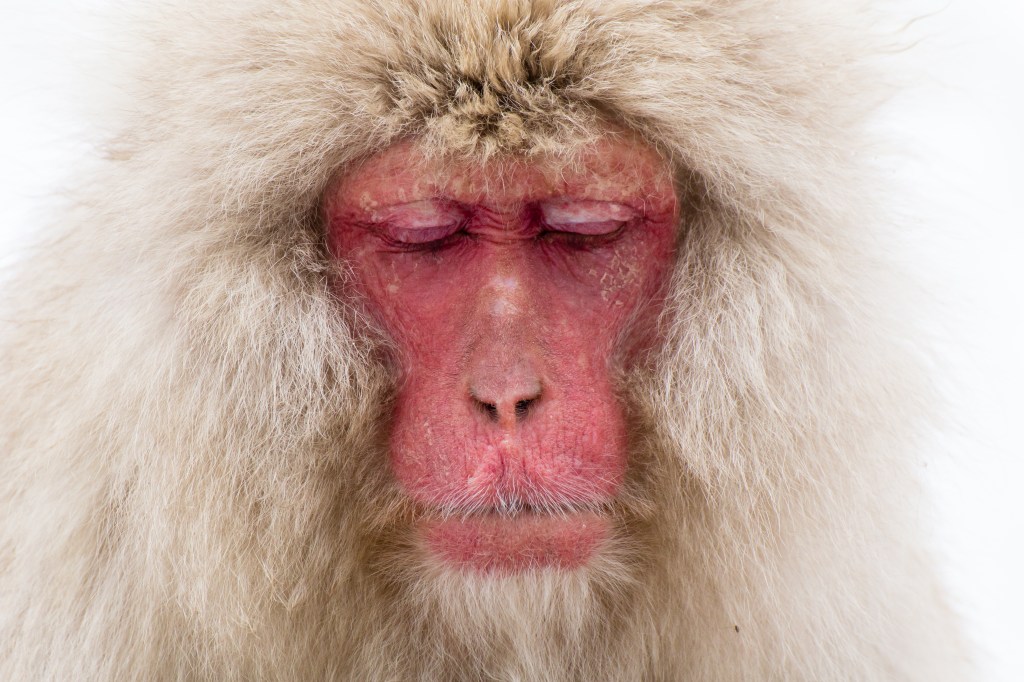
The photograph is one of the most reproduced images in Japanese travel: a macaque with a frosted face, shoulders hunched, sitting chest-deep in steaming water while snow falls on its head. The picture has been on magazine covers, in school textbooks and on more social feeds than anyone can count. What the photograph rarely shows is the walk to get there, the crowd around the pool, or the fact that the monkeys are wild animals that may simply decide not to appear.
Jigokudani Yaen-koen, usually marketed in English as the Jigokudani Snow Monkey Park, sits in a narrow river valley in Yamanouchi town, northern Nagano prefecture, at about 850 metres above sea level. It is inside Joshin’etsu Kogen National Park, at the back of a small hot-spring hamlet called Jigokudani, which is reached on foot from Kanbayashi Onsen or by a forest road from Shibu Onsen. There is no fence between visitors and the troop. That is the point of the place, and also the reason it demands more care than a zoo.
This guide covers what the park is and is not, the fees in 2026 including the price change on 1 December, opening hours, how to get there by train and bus, how long the walk takes and what to wear, the rules that matter, the best seasons and times of day, photography advice, where to stay and eat in Shibu Onsen and Yudanaka, and several honest reasons the visit can disappoint if you plan it badly.
Jigokudani at a glance
| Location | Hirao 6845, Yamanouchi town, Shimotakai district, Nagano prefecture, Chubu |
|---|---|
| Altitude | About 850 m, in the Yokoyu river valley inside Joshin’etsu Kogen National Park |
| Founded | 1964, by Nagano Dentetsu (the private railway that still serves the area) |
| Troop size | Roughly 160 Japanese macaques, with a home range of about 2 km |
| Admission to 30 November 2026 | ¥800 adult (18 and over), ¥400 child (elementary to high school), under 6 free with a guardian |
| Admission from 1 December 2026 | ¥1,000 adult, ¥500 child at the gate; web tickets ¥880 and ¥440 |
| Opening hours | April to October 8:30–17:00; November to March 9:00–16:00; no fixed closing days |
| Time needed | About 1 to 2 hours at the park, plus 30 to 35 minutes walking each way |
| Nearest station | Yudanaka (Nagano Dentetsu), then a 15-minute bus and a 35-minute walk |
| Main caveat | The monkeys are wild: they may not appear, and in warm weather they rarely enter the water |
What the park actually is
Jigokudani is not a zoo, a sanctuary or a theme park. It is a feeding station in a forest, built around a troop of wild Japanese macaques that come and go as they please. Staff provision food to keep the troop in the valley and to keep them away from farmland, and visitors watch from a few metres away with nothing in between. There are no cages, no barriers, no keeper talks and no scheduled animal shows.
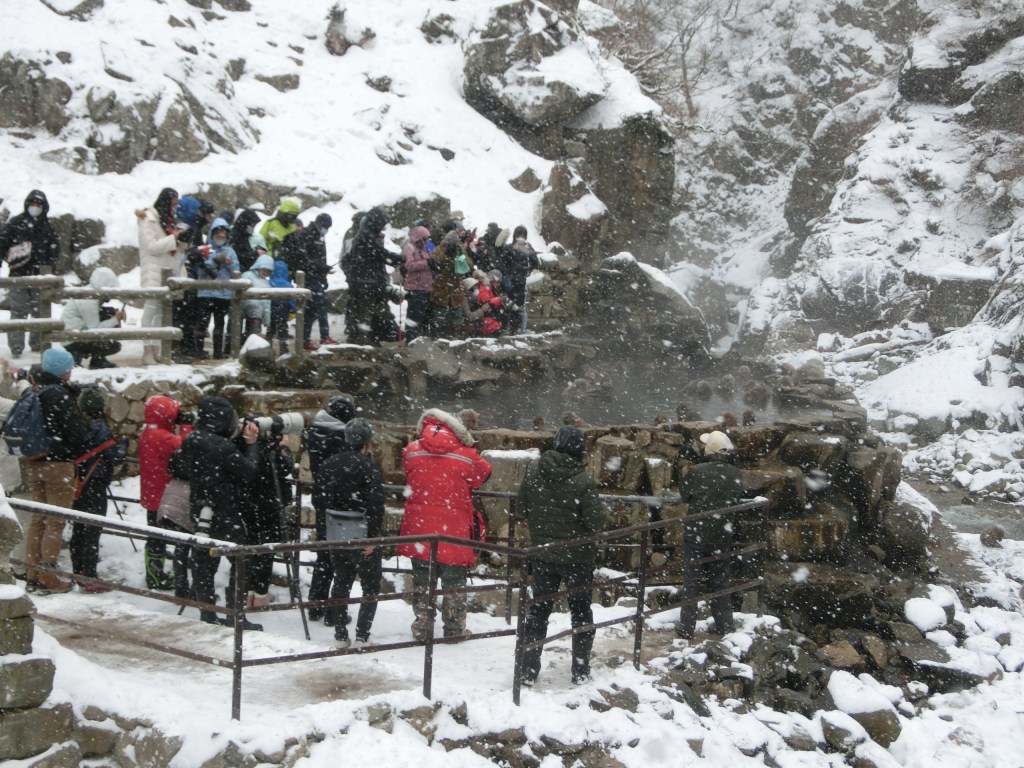
The site is small. A stone-lined pool sits at the bottom of a slope, with a few viewing areas around it and a wooden building at the entrance where you buy a ticket. On a quiet morning you might spend forty minutes watching a dozen monkeys groom each other, pick through barley husks and ignore the water entirely. On a busy winter midday you might be one of a hundred people with phones held over heads while two monkeys sit in the pool and the rest of the troop sleeps in the trees.
Both experiences are normal. The park’s own English leaflet is unusually blunt about it: the opening hours are only a guideline, and the monkeys may not show up at all. It also points out that the animals are wild, that the troop has a home range of roughly two kilometres, and that staff feed them barley with the chaff still on, plus apples and soybeans from time to time. Admission buys access to the valley and the pool, not a guaranteed sighting.
The valley itself explains the name. Jigokudani means “hell valley”, a reference to the bare, steaming cliffs, the sulphur smell and the geyser that hisses and spouts beside the path. In winter the snow lies more than a metre deep, the temperature drops below minus 10°C, and the steam freezes on the branches. The contrast between that landscape and a relaxed monkey in warm water is the whole reason the place became famous.
What it feels like at the pool
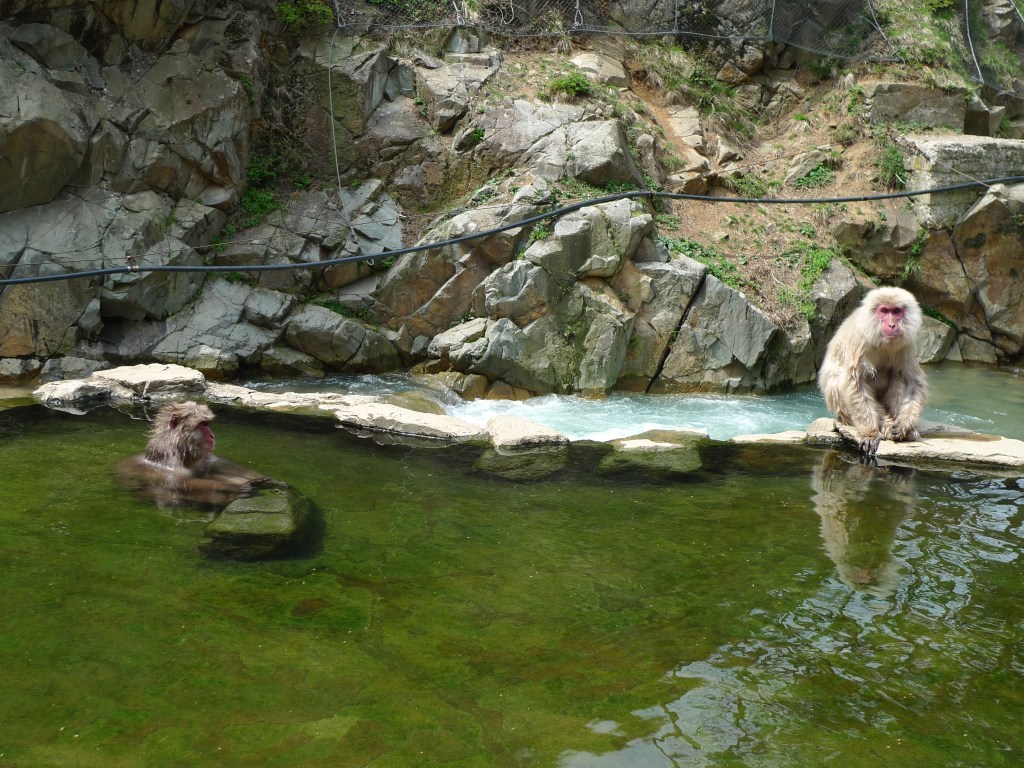
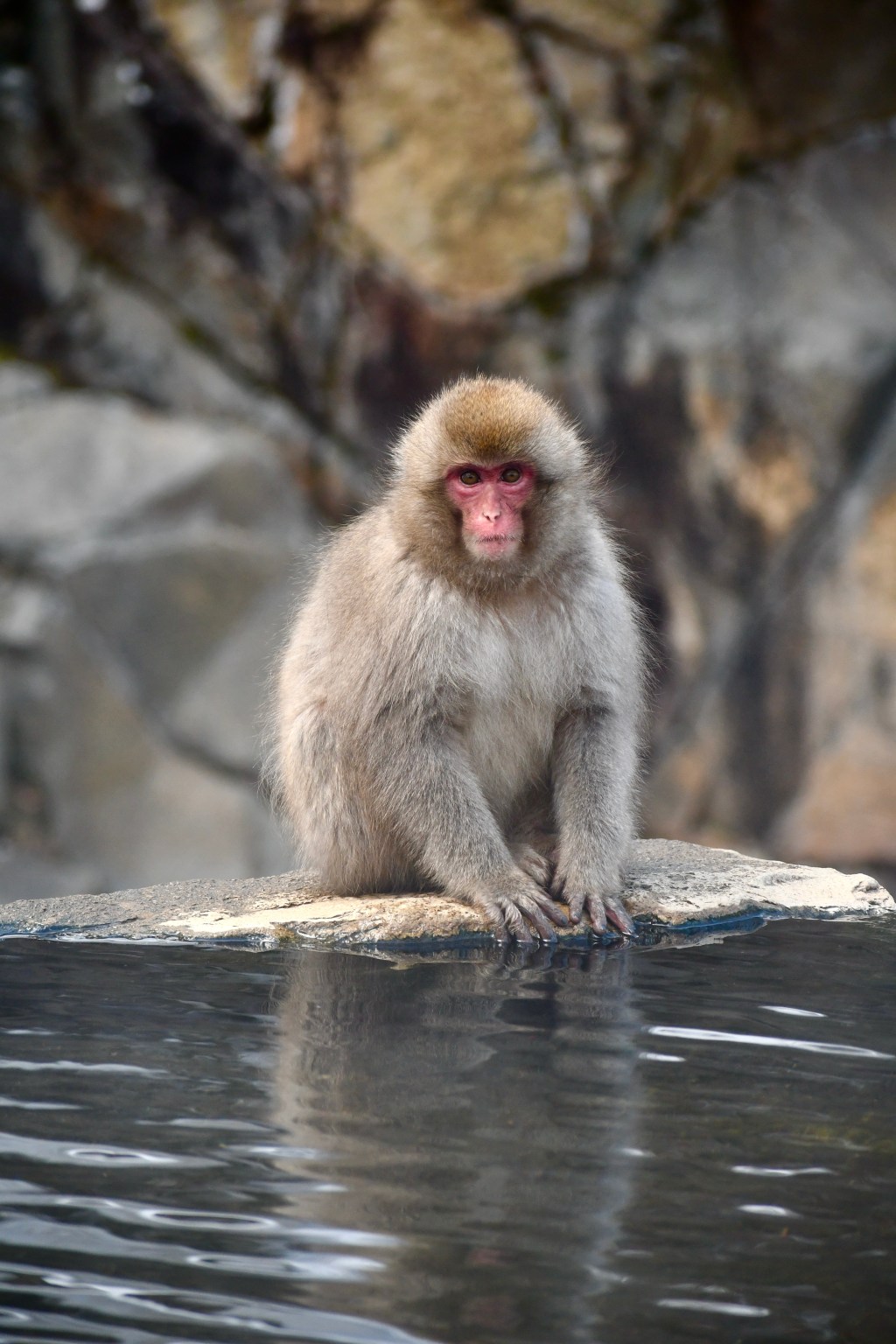
The pool is smaller than most first-time visitors expect: a rough oval of stone, perhaps five or six metres across, with a wooden rail on one side and a slope of bare earth and snow on the other. The water is opaque and greenish, fed from a hot spring at the top of the valley and cooled just enough that a monkey can sit in it without cooking. Steam rises continuously, and in cold weather it rolls across the surface in slow sheets, hiding and revealing the animals as the wind shifts.
Around the pool there is a low wall, a few flat rocks, and space for perhaps thirty people to stand. Behind them the ground rises into the forest, where the rest of the troop sits in the branches or picks through the barley that staff have scattered on the snow. The sound is not a zoo sound: there is no music, no commentary, no amplified keeper. You hear water, wind, the crunch of boots and the occasional soft vocalisation of a monkey.
The animals ignore visitors almost completely, which is both the attraction and the difficulty. A monkey will walk between two people, sit on a warm rock, groom its infant and then wander off, without any acknowledgement that it has just walked through a crowd of cameras. When someone steps too close or blocks the path, the monkey does not perform; it simply changes direction. That indifference is the best evidence that the park is doing something right.
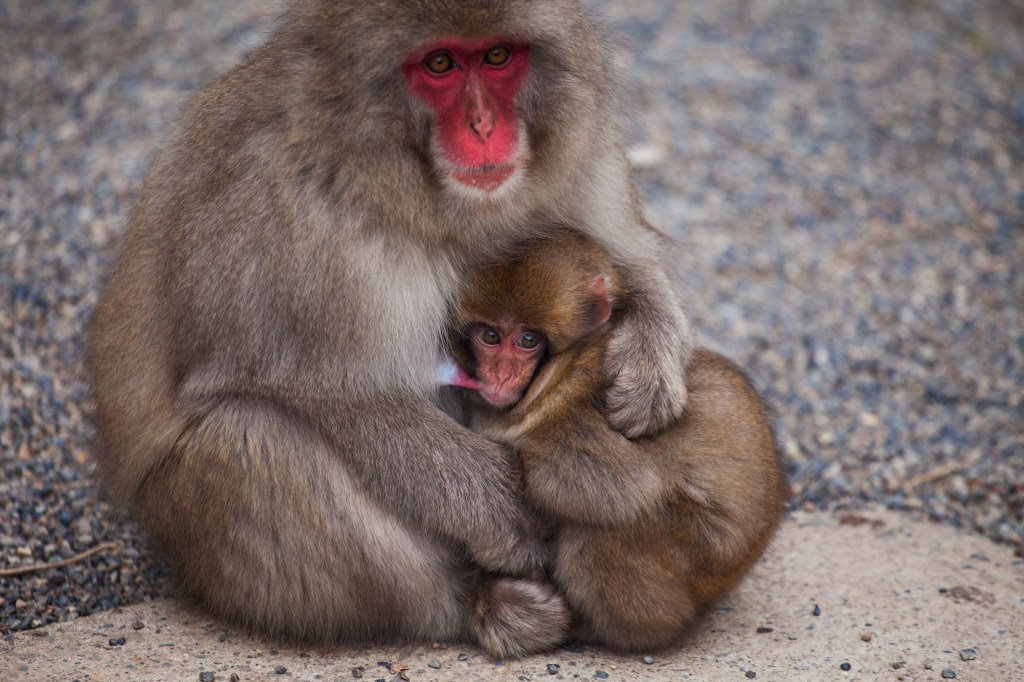
In winter, the pool is a small theatre of hierarchy. The dominant animals take the warmest spots, usually nearest the inflow. Younger monkeys hover at the edge, testing the water with a hand, retreating, trying again. Mothers sit with infants clinging to their chests, the baby’s fur sodden and spiky. Older males often stay out entirely, sitting on the snow with their backs to the steam as if the whole business were beneath them.
A short history of the park
The story begins with a conflict. After the Second World War, logging and the expansion of ski areas around Shiga Kogen pushed the monkeys out of the higher forest. The troop came down towards the orchards around Yudanaka and started raiding apple trees. Farmers asked the forestry agency for permission to cull the animals, and a licence to shoot fifty monkeys was issued.
A local railway employee and conservationist, Hara Sogo, argued for a different solution: feed the monkeys upstream, away from the orchards, so that they would stay in the valley and stop damaging crops. With the help of the landlady of the Korakukan inn and members of the Nagano Railway alpine club, he spent several years persuading a wary troop to accept food. Provisioning succeeded in September 1962. The park opened on 3 June 1964 as a place where people could watch the troop at close range, and where the troop could live without being treated as a pest.
The bathing came later and almost by accident. Once the monkeys were spending long periods near the inn, a young monkey climbed into the Korakukan’s open-air bath. Others copied, and over time mothers carried their infants into the water, passing the habit down the generations. Because a monkey in a human bath is a hygiene problem, the park built a pool for the monkeys’ exclusive use. The behaviour has continued ever since.
Fame arrived quickly. In 1970 a photograph of a bathing monkey appeared on the cover of LIFE magazine, and the image of the “snow monkey” entered global visual culture. When Nagano hosted the Winter Olympics in 1998, athletes, officials and the world’s press visited the valley, and the park became a standard stop on winter itineraries. Today the surrounding area leans heavily on the association: there is a Snow Monkey Pass, a Snow Monkey Park bus stop, and a resort branding built around the animal.
The monkeys: what you are watching
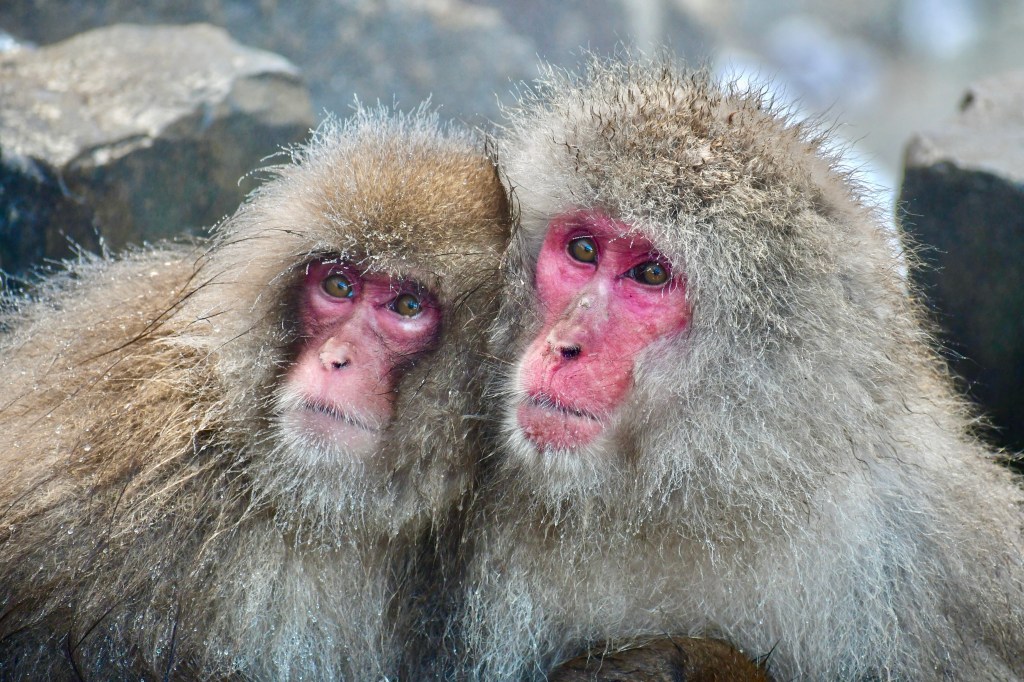
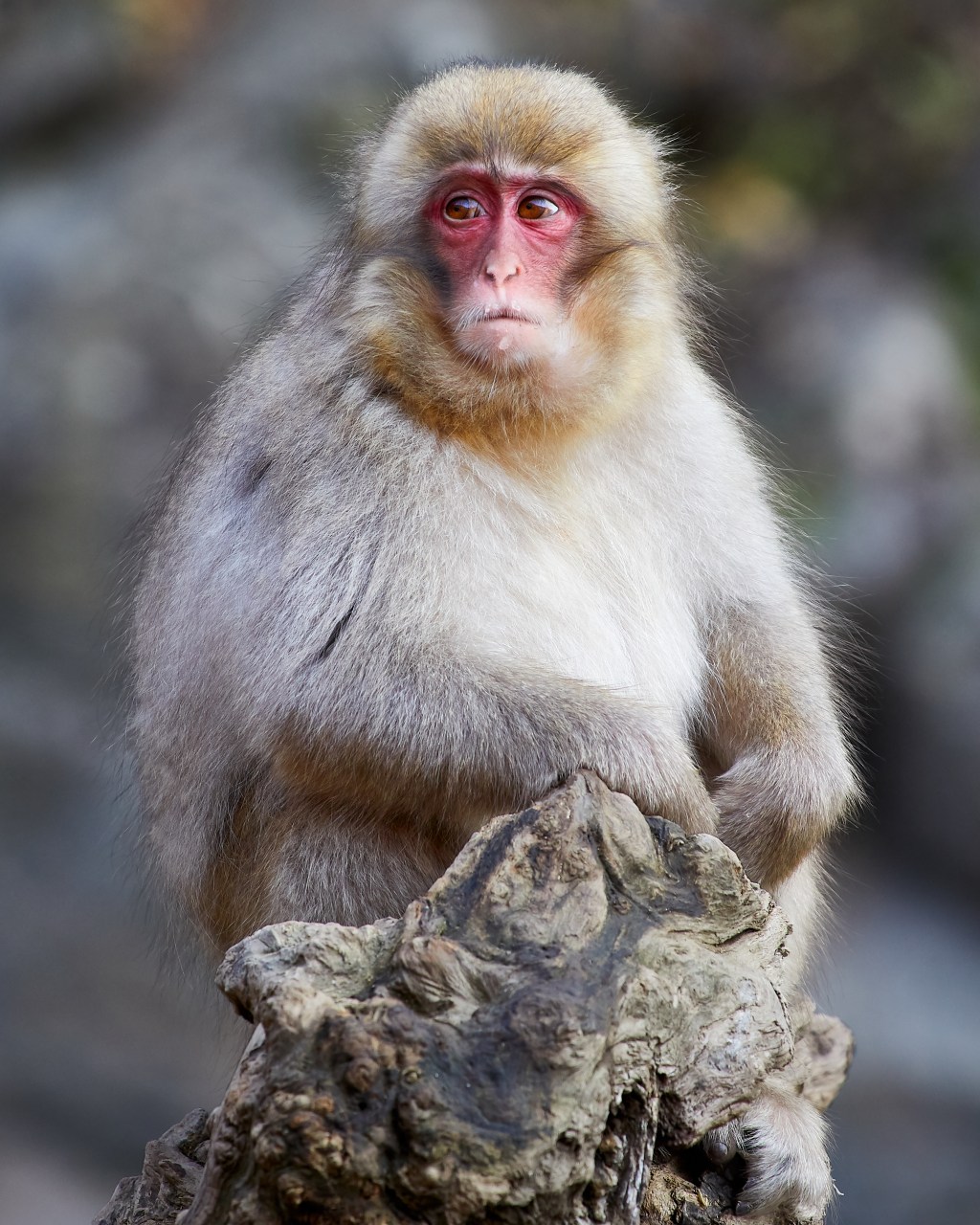
The animals are Japanese macaques (Macaca fuscata), a species found only in Japan and the northernmost non-human primate in the world. They are stocky, with thick grey-brown fur, reddish faces that brighten in the autumn mating season, and a tolerance for cold that lets them live through winters which would kill most primates.
The Jigokudani troop is a single social group of around 160 animals. Within it there are matrilines, ranked families, alliances and a great deal of politics expressed through grooming, glances, small charges and the occasional scream. Watching a grooming chain is more interesting than watching the pool, because you are seeing the maintenance of a social order rather than a photo opportunity. Infants are born in spring, usually from April into June, and by summer the valley is full of clumsy, over-confident juveniles.
Hot-spring bathing is a learned cultural behaviour, not an instinct. Researchers studying the troop have described how the habit spread from young monkeys and was transmitted by mothers to their offspring. It is also not universal: some monkeys never take to the water, and even enthusiasts spend most of their day eating, resting and grooming. The pool is a small part of their lives.
This matters for planning. The monkeys bathe mainly to keep warm, so the reliable window is roughly December to March, when the valley is at its coldest. In summer they have no reason to enter hot water, and in autumn the forest provides so much food that the troop may not come down to the valley at all. If a photograph of a monkey in the steam is the whole point of your trip, come in deep winter; if you want to see monkeys behaving like monkeys, any season can work, but check the park’s daily updates before you commit to the walk.
How to read what you are seeing
A little knowledge of macaque behaviour makes the visit far more interesting. Grooming is not affection in the human sense, although it can be friendly; it is the main currency of social life, used to build alliances, console a loser after a fight, and confirm rank. A monkey presenting its back to another is asking to be groomed, and a monkey that refuses is making a point. When a fight breaks out, the noise is brief and theatrical, and the aftermath, with former opponents sitting close together and grooming, is often more revealing than the fight itself.
Eye contact matters. A long stare between two monkeys is a challenge, and the subordinate animal usually looks away, yawns, or turns its back. Visitors who stare at a monkey are, from the animal’s point of view, being rude. This is why the park asks people not to look into their eyes at close range, and why a photograph taken through a long lens usually captures a more relaxed animal than one taken with a phone held at arm’s length.
Feeding is the reason the troop stays near the valley, but it is not a performance. Staff scatter barley with the husk on, which takes time to eat and keeps the animals occupied, and supplement it with apples and soybeans. There is no published feeding schedule for visitors to plan around, and asking staff to make a monkey appear is not part of the deal. If the troop is up the mountain, it is up the mountain.
Admission fees in 2026 and the December change
The park announced a fee revision in September 2026. Until 30 November 2026 the current gate prices still apply. From 1 December 2026 they rise, and a slightly cheaper web ticket is available for visitors who buy in advance.
| Ticket | To 30 November 2026 | From 1 December 2026 |
|---|---|---|
| Adult, gate (18 and over) | ¥800 | ¥1,000 |
| Child, gate (elementary to high school) | ¥400 | ¥500 |
| Adult, web ticket | — | ¥880 |
| Child, web ticket | — | ¥440 |
| Under 6, with a guardian | Free | Free |
| Group of 20 or more, adult | ¥680 | Reconfirm |
| Annual pass, adult | ¥5,000 | Reconfirm |
| Annual pass, child | ¥2,500 | Reconfirm |
| Visitors with a disability certificate | ¥400 adult, ¥200 child | Reconfirm |
Several details are worth noting. The child category runs from elementary school to high school, so a 15-year-old pays the child rate, while an 18-year-old pays the adult rate. The under-six exemption requires a guardian. There is no senior discount. Annual passes run for one year from the date of purchase. The park accepts major credit cards and electronic money at the gate but not QR code or barcode payments, so a phone-only traveller should carry a card.
The web ticket is date-specific and is sold in advance rather than at the gate; according to the park’s ticketing information it can be bought from about three months before the visit. It is the cheapest option after 1 December, but it does not come with the disability discount, which is only handled at the window. If your plans are fixed and the saving matters, buy online; if you are travelling flexibly or need the discount, use the gate.
One warning that rarely appears in English guides: at the busiest period the park can hit its capacity limit. In the 2025–26 season the railway and bus company suspended sales of the combined Snow Monkey Pass between 30 December and 4 January precisely because the park was receiving more visitors than it could hold, and a pre-purchased pass does not guarantee entry. Expect similar pressure around New Year and the February holiday weekends, and reconfirm before buying a combination ticket for those dates.
Opening hours and how long to allow
The park is open every day of the year, with hours that shift by season.
| Season | Hours | Notes |
|---|---|---|
| April to October | 8:30–17:00 | Last entry is effectively 30 minutes before closing |
| November to March | 9:00–16:00 | Short days; the walk out is in dusk or dark if you linger |
| Closing days | None scheduled | Weather, snow and monkey behaviour can close the park without notice |
Allow two to three hours in total from the bus stop: thirty-five minutes in, an hour or so at the pool, and thirty-five minutes out. Photographers often stay longer, and in winter the walk is slower than the distance suggests because of snow, ice and the need to step aside for other visitors on the narrow path. The park asks visitors to arrive at least thirty minutes before closing so that they can leave by the gate time.
Because the monkeys are wild, the hours are a framework rather than a promise. If the troop is up the mountain, the park may still be open but the pool will be empty. Staff post daily updates on social media, and it is worth checking before you set out, particularly in autumn.
Getting there: train, bus and car
From Tokyo by train
The standard route is the Hokuriku Shinkansen from Tokyo to Nagano, which takes as little as about 79 minutes on the fastest services, then the Nagano Dentetsu line from Nagano Station to Yudanaka. The private railway takes about 38 minutes on the limited express. From 1 December 2025 the ordinary fare between Nagano and Yudanaka is ¥1,660; limited express passengers pay a surcharge on top, with reserved seats costing more than non-reserved. The train is a small, slow, single-track line that climbs through apple country, and the last stretch past Shinshu-Nakano is scenic in a quiet way.
From Yudanaka Station, the Nagaden local bus to the Snow Monkey Park stop takes about 15 minutes and costs ¥390. The stop is called Snow Monkey Park (the old name, Jigokudani Yaen-koen, is still used in some maps and signs). Buses are not frequent, and the last return bus in the late afternoon can be crowded, so check the timetable on arrival rather than assuming you can turn up and ride.
From Nagano Station by express bus
There is also a direct express bus from the east exit of Nagano Station to the Snow Monkey Park stop, taking about 41 minutes. In the 2026–27 winter season the operator planned a dedicated Snow Monkey Park express (route Ex24) running every 20 to 30 minutes from 5 December 2026 to 5 April 2027. Note that the Shiga Kogen express (Ex23) does not stop at the park, a distinction that catches out visitors who board the wrong bus.
Combination tickets
Two different products share a similar name, and they are not interchangeable.
| Ticket | What it includes | 2026 price |
|---|---|---|
| Snow Monkey Pass (railway) | One day of unlimited Nagano Dentetsu trains, one round trip on the local bus between Yudanaka and Snow Monkey Park, one park admission | ¥4,800 adult, ¥2,400 child; sold 1 April to 30 September 2026, valid only on the day of purchase |
| Snow Monkey Pass for Bus (summer) | Round trip on the express bus from Nagano Station east exit plus park admission | ¥4,800 adult, ¥2,400 child |
| Snow Monkey Pass for Bus (winter) | Same, for the winter period | ¥6,800 adult, ¥3,400 child; winter sales from 5 December 2026 to 5 April 2027 |
Do the arithmetic before buying. A return trip by train and local bus plus admission comes to roughly ¥4,100 at the old fares, so the pass is mainly worth it if you also want to stop in Obuse or Suzaka on the same day. The bus pass bundles the long express ride from Nagano, which is a different calculation and can be good value if you are staying in Nagano city and making a day trip. The railway pass is sold only from ticket machines, not at staffed counters, and its validity is limited to the day of purchase.
What a day actually costs
Prices below use the fares and fees in force in October 2026 and are per adult. They exclude the limited express surcharge on the Nagano Dentetsu, which depends on the seat type, and exclude food.
| Item | Cost | Notes |
|---|---|---|
| Nagano to Yudanaka, ordinary return | ¥3,320 | ¥1,660 each way; limited express costs more |
| Yudanaka to Snow Monkey Park bus, return | ¥780 | ¥390 each way |
| Park admission | ¥800 | Rises to ¥1,000 at the gate from 1 December 2026 |
| Car park, if driving | ¥0 or ¥500 | Free at Kanbayashi Onsen; ¥500 at Jigokudani |
| Day-use bath at Korakukan | ¥1,500 | Optional, 12:00–16:00 |
| Day-use bath at Shibu Oyu | ¥800 | Optional, 10:00–17:00 |
A bare-bones day trip from Nagano therefore costs about ¥5,000 before express surcharges and lunch, and a comfortable version with a bath and a proper meal is closer to ¥8,000. From Tokyo, add the shinkansen fare, which dominates the budget; if you are doing the park as a day trip from the capital, the bus-based combination pass is usually the simpler purchase even if it is not the absolute cheapest.
By car
Driving is straightforward in summer and more complicated in winter. There are two parking options. The free car park at Kanbayashi Onsen is the standard choice, with a walk of about two kilometres and thirty minutes to the park. The smaller Jigokudani car park, closer to the valley, costs ¥500 for a normal car and cuts the walk to about fifteen minutes, but the forest road to it from Shibu Onsen is narrow, unsuitable for large vehicles, and closed in winter from December to March. In heavy snow, chains or winter tyres are essential and the road can be closed at short notice.
Whichever way you arrive, note that there are no toilets on the trail between Kanbayashi Onsen and the park. Use the facilities at the car park or wait for the park entrance, and plan accordingly if you are travelling with children.
Step by step from Tokyo
- Take the Hokuriku Shinkansen from Tokyo or Ueno to Nagano. The fastest services take about 79 minutes; slower services stop more often and take a little longer.
- At Nagano Station, follow the signs to the Nagano Dentetsu line. It is a separate small station on the east side, not a platform inside the shinkansen station, and the transfer takes a few minutes on foot.
- Buy a ticket to Yudanaka. If you want the limited express, pay the surcharge; the ordinary trains are slower but cheaper and run on the same track.
- Ride to the end of the line, about 38 minutes on the limited express. Yudanaka is a small terminus with a single main exit.
- Outside the station, find the Nagaden bus bound for Snow Monkey Park or Shiga Kogen and get off at the Snow Monkey Park stop, about 15 minutes away. Pay the ¥390 fare on exit.
- Walk about two kilometres up the forest trail, roughly 30 to 35 minutes, following the signs and the other visitors.
- Buy your ticket at the gate, read the rules board, and walk the last few metres to the pool.
From Osaka, Nagoya and Kanazawa
From Osaka, take the Tokaido Shinkansen to Nagoya and the limited express Shinano to Nagano, which takes about 2 hours 43 minutes from Nagoya, then follow the route above. From Kanazawa, the Hokuriku Shinkansen reaches Nagano in about 1 hour 49 minutes from Tsuruga via the new extension, or you can approach from the Nagano end. From Matsumoto, the JR Shinonoi line runs to Nagano in about 50 minutes to an hour, which makes Matsumoto a practical base if you are combining the park with the castle and the Northern Alps.
Whichever direction you come from, the last leg is the bottleneck. The Nagano Dentetsu is a country railway with a limited number of carriages, and the bus from Yudanaka is a local service. In winter, when every seat is taken by people heading for the monkeys or the ski slopes, the difference between catching the 9:00 bus and the 10:00 one can be the difference between a quiet pool and a crowd.
The walk in
Everyone walks the last stretch. From the Snow Monkey Park bus stop or the Kanbayashi car park the path is about two kilometres of unpaved forest trail, climbing gently through cedar and mixed woodland along the Yokoyu river. The park’s own guidance gives thirty to thirty-five minutes, and in summer that is realistic for most people. In winter it is optimistic: snow compresses into ice, the edges of the path disappear, and the last section has steps and a slope.
The trail is part of the experience rather than an obstacle. In the upper reaches you pass the geyser and the first whiff of sulphur, then the trees open and the wooden buildings of Jigokudani appear. There is a public toilet at the park entrance and a small ticket window. Cash is no longer essential at the gate, but the car park and some buses still prefer it.
Footwear makes or breaks the day. Trainers are fine in dry summer weather and dangerous in winter. The park recommends snow boots or crampons from December to March, and even in November the shaded parts of the path can be icy. A waterproof outer layer is worth carrying at any time of year, because the valley creates its own weather and a clear forecast in Nagano city does not guarantee a dry walk.
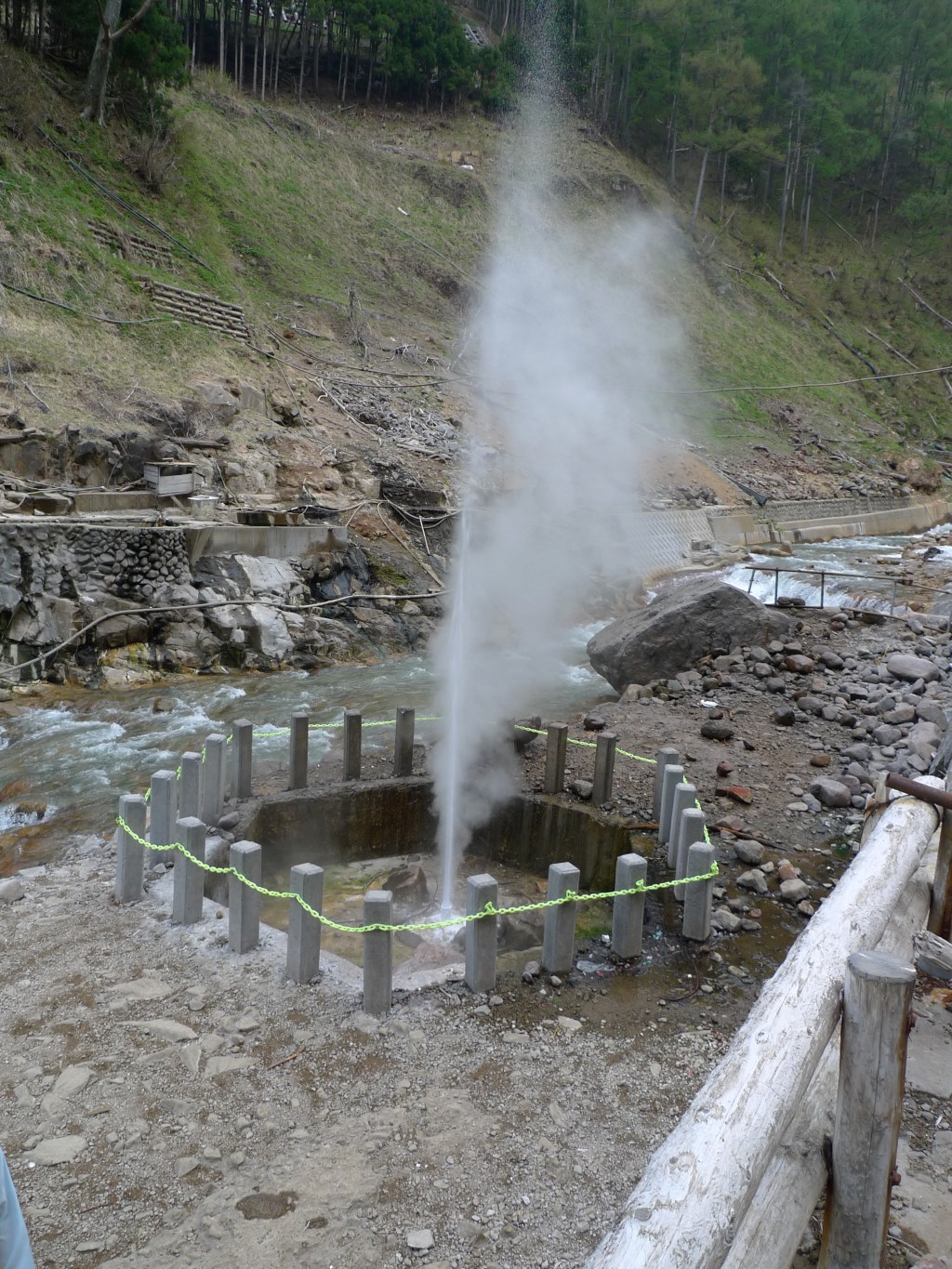
Just before the park, the path passes the Shibu Jigokudani geyser, a natural fountain that spouts hot water and steam at irregular intervals beside the river. The ground around it is bare and mineral-stained, which is what gives the valley its name. It is worth stopping for five minutes, partly because the geyser is the best free sight in the area, and partly because the spray and the noise set up the arrival at the pool.
A note on the snow and the season
Yamanouchi is one of the snowiest inhabited parts of Japan. Snow can lie from December into April, and the trail is usually packed rather than cleared, which means a surface of polished ice after a freeze-thaw cycle. The park recommends simple crampons, sold cheaply at sports shops and sometimes at the bus stop, and they are the single most useful piece of winter kit. Snow boots with a good tread are the alternative. In spring the trail turns to slush and mud, which is less dangerous but messier.
The cold is also a factor in how long you can stay. Standing still in a valley at minus 8°C for an hour is different from walking in it. Chemical hand warmers, a thermos and a hat that covers the ears make the difference between a pleasant hour and a rushed ten minutes. Camera batteries drain quickly in the cold, so carry a spare inside a warm pocket.
Seasons: when to go and what you will see
Winter (December to March)
This is the season the park exists for, at least in the popular imagination. Snow lies deep, steam pours off the pool, and the monkeys that choose to bathe sit in it for long periods with expressions of profound self-satisfaction. January and February are the coldest and most reliable months. The trade-off is crowds, especially between 10:00 and 14:00, and the risk of a snowstorm closing the road or making the walk genuinely hard. Go early, accept that you will share the pool with thirty other cameras, and build in a buffer for transport delays.
Spring (April to June)
Babies appear, the snow melts into mud, and the troop spends more time in the open. The pool is quiet because the air is warm, but the social life of the troop is at its most entertaining: infants testing their limits, mothers retrieving them, juveniles wrestling in the dust. This is the best season for people who care more about behaviour than about the steam photograph.
Summer (July to August)
Green, humid and relatively empty. The monkeys come to the valley for food and shade, not for hot water. The walk is pleasant if you start early, and the surrounding area offers hiking, cycling and the higher altitudes of Shiga Kogen as a refuge from the heat. Do not come expecting the iconic photograph.
Autumn (September to November)
The forest is full of nuts and fruit, which means the troop has less reason to visit the provisioning site. The park’s own guidance warns that autumn sightings can be irregular. When the monkeys do appear, the cold mornings of late November sometimes bring the first bathers back to the pool, and the red faces of the mating season make for striking portraits. Treat autumn as a gamble rather than a plan.
| Season | Bathing | Crowds | Best for |
|---|---|---|---|
| December to February | Most reliable | Heaviest | The classic snow-monkey photograph |
| March | Still likely | Moderate | Snow, longer days, fewer buses full of tour groups |
| April to June | Rare | Light to moderate | Infants and troop behaviour |
| July to August | Very rare | Light | Hiking and avoiding heat |
| September to November | Occasional late in the season | Moderate | Autumn colour, with uncertain sightings |
Time of day and crowds
The first hour after opening is the calmest. Staff have usually put food out, the monkeys are down in the valley, and the tour buses have not yet arrived from Nagano and Hakone. By mid-morning in winter the pool area can be dense with visitors, and by early afternoon the light in the valley is flat and the monkeys are often resting in the trees.
Late afternoon can be good in spring and autumn, when the light comes low through the trees and the day-trippers have gone, but in winter the park closes at 16:00 and the walk out in the dark is not appealing. If you have only one day, aim to be at the gate at opening, spend an hour with the troop, and use the rest of the day for Shibu Onsen or the surrounding area rather than trying to squeeze in a second distant sight.
How Jigokudani compares with other monkey parks
Japan has several places where you can watch macaques, and they are not interchangeable. Arashiyama Monkey Park Iwatayama in Kyoto uses an inverted arrangement: visitors enter a building and look out at the monkeys, who roam the hillside outside. It is convenient, family-friendly and busy, but the animals are viewed through glass or from a balcony, and the experience is closer to a wildlife exhibit than to a valley visit.
Takasakiyama in Oita is the other extreme. It is a large provisioning site on a forested hill above Beppu, with a much bigger troop and a cable car or steep walk up. The monkeys are wild and the setting is spectacular, but the scale makes close observation harder and the place is often overrun with school groups. Jigokudani sits between the two: small enough to watch individuals, wild enough that nothing is guaranteed, and cold enough in winter that the animals do something no other troop in the world is famous for.
That combination is why photographers keep coming back. It is also why the park can feel crowded and why expectations need calibrating. If you want a guaranteed, comfortable monkey experience, a zoo will serve you better. If you want to stand in a snowy valley and watch a wild troop go about its business, with a hot pool in the middle of it, there is nowhere else quite like this.
The rules, and why they matter
The park’s rules are short, sensible, and enforced by staff who will ask people to leave. They are also the difference between a functioning co-existence and a monkey that learns to snatch bags.
- Do not show or give food. Not a snack, not a bottle, not a piece of fruit. Once monkeys associate people with food they approach, grab and become aggressive, and the animal that pays the price is usually the monkey. Bags of any kind attract attention; keep food sealed and out of sight.
- Do not touch or threaten the monkeys. They are not pets. A scared monkey will bite, and a mother with an infant is unpredictable. Keep at least a couple of metres away and let them move around you.
- Do not stare into their eyes at close range. In macaque society a direct stare is a threat. Look slightly past them, or watch through a camera.
- Do not bring dogs, cats or other pets. Assistance dogs are also refused, which is a genuine access problem for some visitors and worth knowing before you travel.
- Photography is allowed, including flash. Drones, selfie sticks and putting a camera into the water are prohibited. Do not push a phone or lens into a monkey’s face.
- This is not a bathing facility. People cannot enter the pool, and the park is explicit that hygiene rules forbid bathing with the monkeys.
Beyond the written rules, a little courtesy goes a long way. The viewing area is small, and a tripod set up across the front of the pool blocks everyone behind you. If you want a low angle, take your shot and move on. Do not try to make the monkeys look at the camera by calling, clapping or waving; it stresses them and spoils the atmosphere for everyone else.
Photography: how to get the shot without ruining the visit
The classic image is made by three things: cold air, warm water and backlight. Steam is only visible when it is colder than the pool and the light comes from behind or the side, so early morning in January and February is the best combination. Front-lit photographs of a wet monkey look like a grey lump; rim-lit photographs of the same animal look like the postcard.
A moderate telephoto lens in the 70–200 mm range is ideal. It lets you isolate a single animal from the crowd and keeps you at a respectful distance, which also keeps the monkey relaxed enough to stay put. A wide lens is useful for the environmental shot of the pool with the valley behind it, but there is usually someone’s head in the frame, so be patient and wait for a gap.
Flash is permitted under the park’s rules, but direct flash on a wet face produces a flat, harsh result and can startle the animal. If you use it, bounce or diffuse it, and use it sparingly. Protect your gear: spray from the pool and snow from the trees both find their way into lens hoods and camera bags, and a microfibre cloth is more useful than a second lens.
Do not use a drone, a selfie stick or a camera on a pole, and do not lower a camera into the water for a “monkey’s-eye view”. These are explicitly banned. Tripods are not banned, but in a crowded winter pool area they are antisocial; a monopod or a steady hand is usually enough.
Where to stay
Jigokudani Onsen: Korakukan
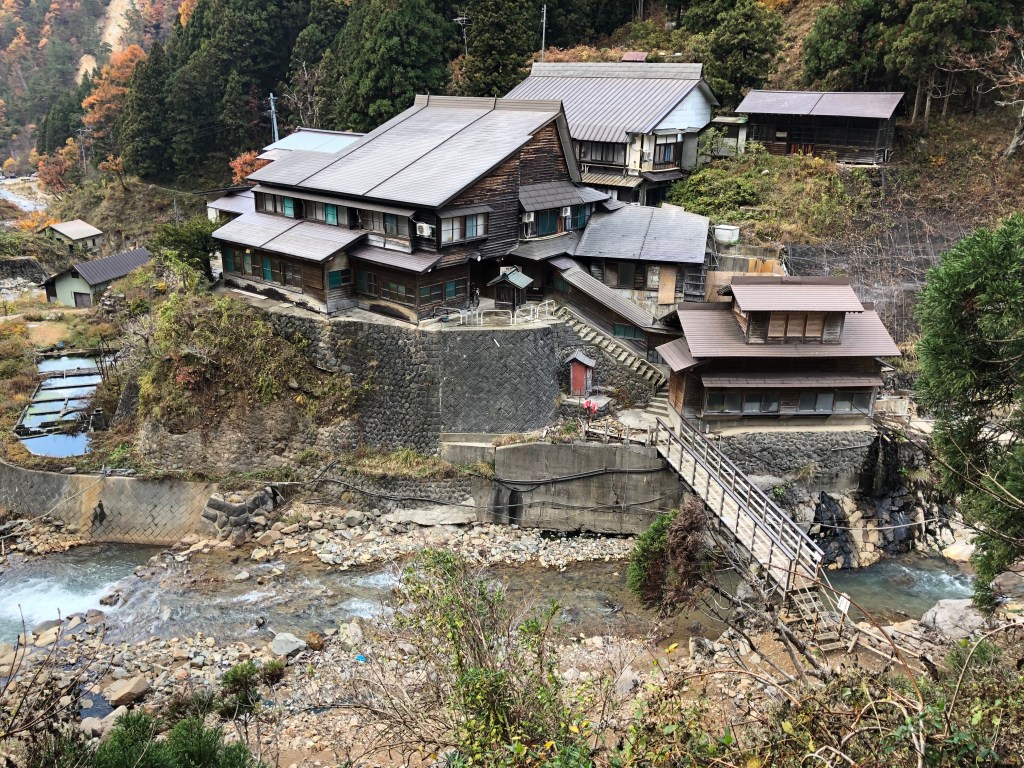
There is exactly one inn in Jigokudani itself: Korakukan, a wooden ryokan founded in 1864 and reached on foot, about 1.8 km up the valley. It is the place where the monkeys first learned to bathe, and the connection is not marketing: the open-air bath looks out towards the geyser, and monkeys sometimes come down to the roof or the edge of the bath.
Korakukan is simple and old-fashioned. It has thirteen rooms, shared toilets, no Wi-Fi, and a bath complex that includes a mixed open-air pool, a women-only outdoor pool, indoor baths for men and women, and one family bath, all fed directly from the source at temperatures between about 62°C and 76°C and cooled with water. Day visitors can bathe between 12:00 and 16:00, or until 15:30 in winter, for ¥1,500 adult and ¥750 child. Meals are built around mountain vegetables and mushrooms, with a largely lacto-vegetarian base, and reservations are by telephone, with English support.
Staying here means walking in with your luggage, which is impractical in deep snow for anyone with heavy bags. The compensation is the valley after the day visitors leave: quiet, dark, and often snowy, with the geyser audible from the bath.
Shibu Onsen
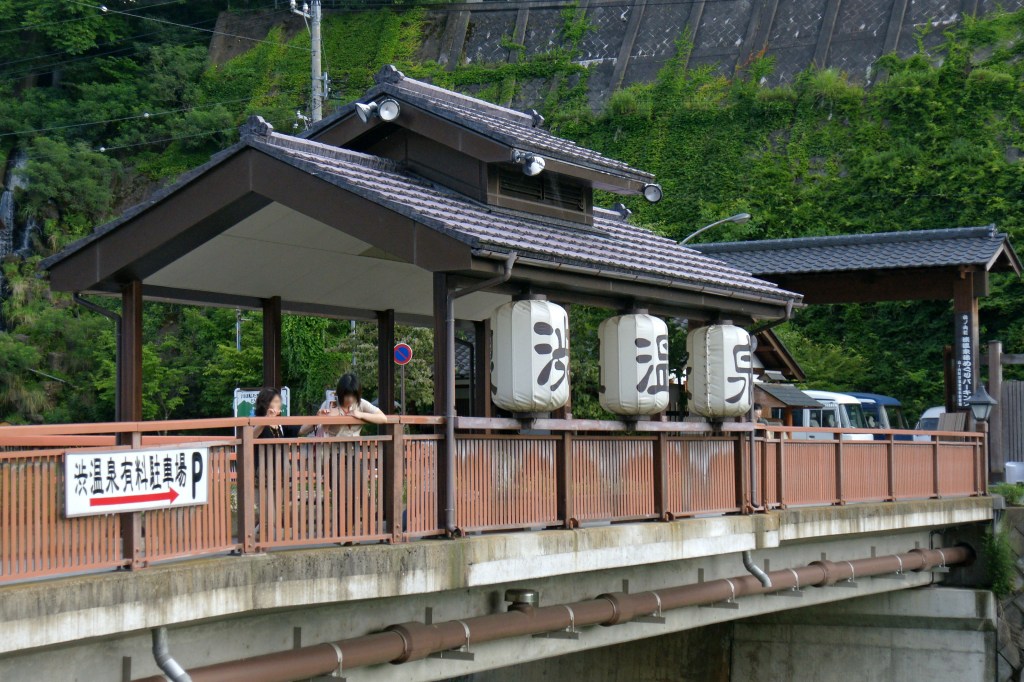
Ten minutes by bus from Yudanaka, Shibu Onsen is a narrow stone-paved hot-spring street with wooden inns, steam vents and nine public baths. Guests staying at a Shibu inn receive a key that opens all nine soto-yu, free of charge, from check-in until check-out, generally between 6:00 and 22:00. The tradition is to walk between them in a cotton yukata and wooden geta, stamping a pilgrim’s towel at each bath and finishing at the Shibutakayakushi shrine above the street.
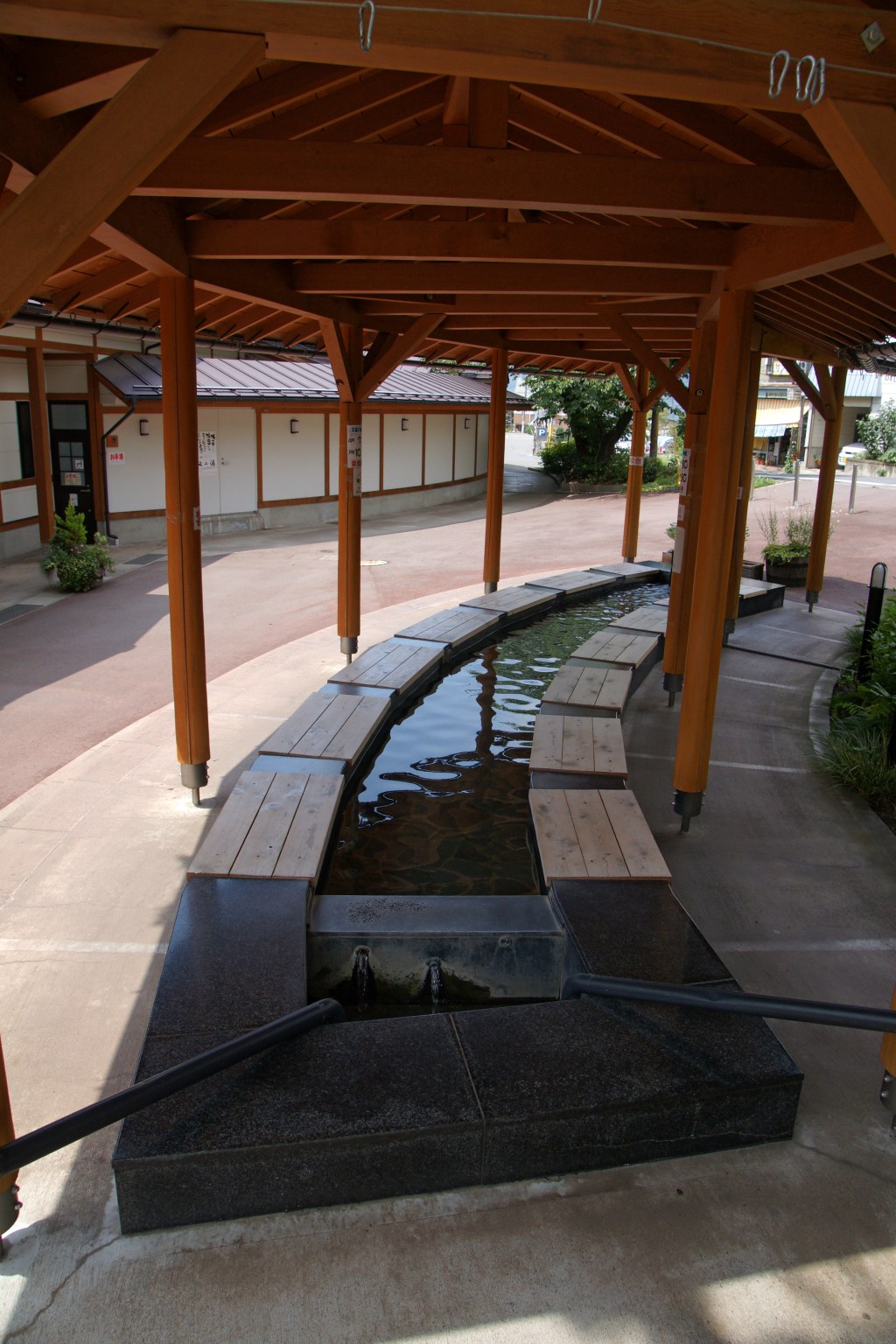
The baths are small, hot and locally used, and each has a different source and reputation. The water is hot enough that first-timers should test it with a hand before committing. Day visitors cannot use the nine baths; the exception is the ninth, Shibu Oyu, which opens to day visitors from 10:00 to 17:00 for ¥800 adult and ¥500 child, with a small steam room and a free foot bath on the roof.
The nine, in order, are Hatsu-yu, Sasa-no-yu, Wata-no-yu, Take-no-yu, Matsu-no-yu, Mebore-no-yu, Nanakuri-no-yu, Shinmeidaki-no-yu and Shibu Oyu. Each is a small wooden or stone building with a single pool, a changing shelf and a lock, and each is associated with a different ailment or blessing: stomach trouble at the first, skin conditions at the second and third, chronic gout at the fourth, nerve pain at the fifth, eye complaints and beauty at the sixth, seven illnesses at the seventh, women’s health at the eighth, and general recovery at the ninth. The reputations are traditional rather than medical, but the ritual is taken seriously, and the stamp towel and the final visit to the Shibutakayakushi shrine are the point as much as the water.
Two practical notes. The baths are extremely hot, because the source is around 97°C and the water is cooled only by the flow; pour a bucket over yourself before entering and do not stay in long. And the lanes are steep and uneven, which is charming in geta and treacherous in the snow after dark. If you are staying in Shibu in winter, bring shoes you can walk in and change into geta at the bath house.
Yudanaka
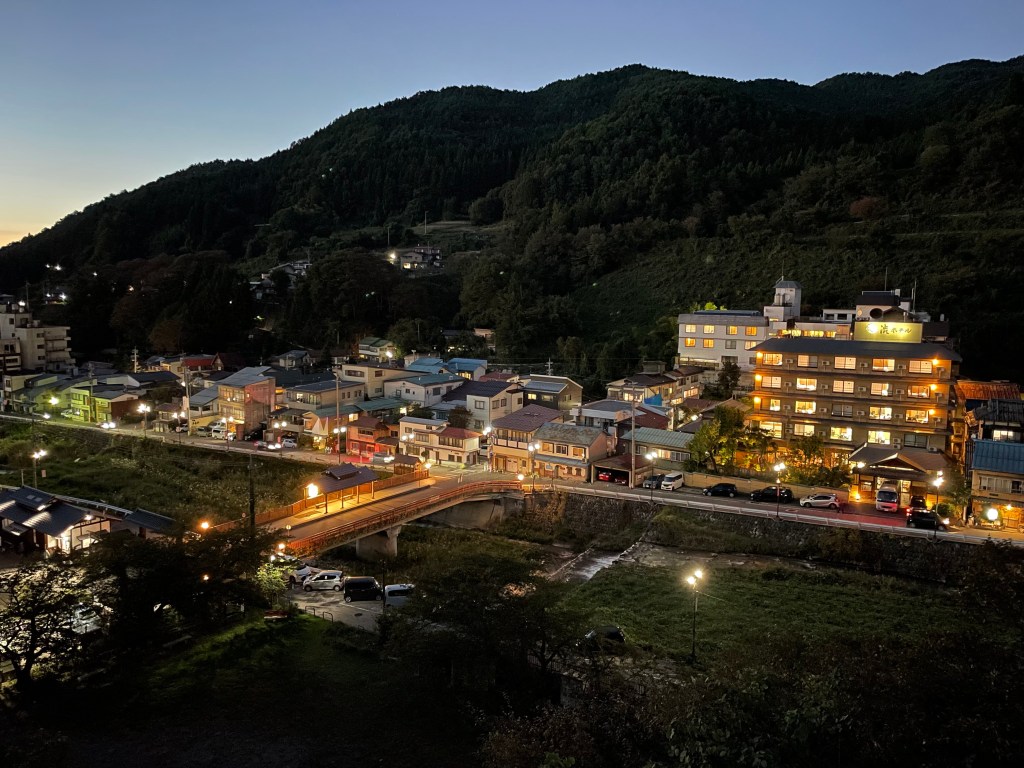
Yudanaka is the station town at the end of the line, with a larger concentration of hotels, restaurants and shops than either Shibu or Jigokudani. It is less atmospheric but more practical: you can walk to dinner, buy supplies, and catch an early bus without a snowy hike. For a one-night trip built around the monkeys, Yudanaka is the low-risk choice; for the atmosphere, Shibu is better; for the full experience, Korakukan is in a category of its own.
Food and drink
Nagano is apple country, and the local food reflects a cold-climate, mountain larder. Expect shinshu soba, buckwheat noodles served cold with a dipping sauce or hot in a broth; oyaki, grilled dumplings of fermented buckwheat or wheat dough filled with pumpkin, eggplant, pickles or sweet bean paste; mountain vegetables, mushrooms, river fish and preserved pickles. Shibu Onsen’s lanes have small shops selling onsen manju and roasted chestnuts, and several inns serve kaiseki-style dinners built around local produce.
Vegetarians and vegans should plan rather than improvise. Korakukan’s kitchen is explicitly lacto-vegetarian in style and can discuss requirements when you book by phone; elsewhere, soba and mountain-vegetable dishes are usually safe, but broth and seasoning often contain fish. If you have a serious allergy, carry a Japanese written explanation and eat where you are staying.
Tap water is drinkable. The tap water in the valley is cold and clean, and the local sake is worth trying if you are staying overnight; driving is not compatible with that, and the mountain roads at night are not the place to test your reactions.
Suggested itineraries
Half day from Nagano
Take an early shinkansen to Nagano, transfer to the Nagano Dentetsu limited express, and be at Yudanaka before 10:00. Bus to the Snow Monkey Park stop, walk in, spend an hour at the pool, walk out and take the bus back. You can be in Nagano for a late lunch and a visit to Zenkoji, or continue to Obuse for the Hokusai museum. This is the minimum viable visit and leaves no margin for a missed bus or a closed path.
Full day with Shibu Onsen
Start at the park at opening, then walk back to the bus stop and ride to Shibu Onsen for lunch and a wander through the stone lanes. If you are staying, check in, change into yukata and spend the afternoon moving between the public baths. If you are not staying, visit Shibu Oyu and the foot bath, then return to Yudanaka for the train. This is the best balance of wildlife, onsen and atmosphere in a single day.
Two days in winter
Day one: park in the morning, Shibu Onsen in the afternoon, night in a Shibu or Jigokudani inn. Day two: an early return to the pool before the buses arrive, then either the snow-monkey trail again or a trip up to Shiga Kogen for skiing or snowshoeing. In January the days are short, so plan one major activity per day and leave the rest to the weather.
A sample winter day, hour by hour
This is an example rather than a timetable, and it assumes you are staying in Yudanaka or Nagano and travelling independently.
| Time | What to do |
|---|---|
| 07:15 | Breakfast; check the park’s social media and the weather for Yamanouchi |
| 08:00 | Train or bus towards Yudanaka; buy a ticket and keep the return leg in mind |
| 08:45 | Arrive Yudanaka; use the toilet, buy water, find the bus stop |
| 09:00 | Bus to Snow Monkey Park; pay on exit |
| 09:20 | Start the walk; crampons on if the path is icy |
| 09:55 | Arrive at the gate, buy a ticket, read the rules |
| 10:00–11:15 | Watch the troop; the pool is at its quietest and the light is still good |
| 11:15 | Walk out before the midday buses arrive |
| 12:00 | Bus to Shibu Onsen; lunch and a wander through the lanes |
| 14:00 | Shibu Oyu bath, or check in and start the nine-bath circuit |
| 16:00 | Return to Yudanaka before the light goes |
The schedule is deliberately front-loaded. Almost every disappointment at Jigokudani comes from arriving in the middle of the day, when the buses unload and the monkeys are digesting. Being at the pool at opening is worth more than any other decision you will make.
Nearby: what else is worth the detour
Shibu Onsen is the obvious companion, and the nine-bath circuit is the reason many Japanese travellers come at all. Yudanaka has a small station with a railway museum flavour, a few temples and the practical advantage of shops. Shiga Kogen, one of Japan’s largest ski areas, is a bus ride further up the mountain and offers summer hiking and autumn colour when the snow is gone.
Obuse, a short train ride back towards Nagano, is a small town of chestnut sweets, sake breweries and a museum devoted to Hokusai, who spent his last years there. Nagano city has Zenkoji, one of Japan’s most important pilgrimage temples, and a compact centre that works well for a half-day before or after the park. Matsumoto, with its black-and-white castle, is a longer but feasible detour by train, and the surrounding Northern Alps offer some of the best mountain scenery in the country.
Accessibility and practical limitations
This is not an accessible site in the conventional sense. The park’s own guidance is clear: the valley has slopes, steps, uneven ground and stairs, and wheelchairs and pushchairs cannot be used, either at the park or on the unpaved approach path. Assistance dogs are not admitted, because the monkeys react badly to other animals. Visitors with limited mobility should consider whether the two-kilometre walk and the final slope are realistic, and should not rely on there being a vehicle drop-off at the gate.
There is no restaurant inside the park, only a small shop and toilet at the entrance. Mobile signal is patchy in the valley. Cash is useful for the car park, buses and small shops. In winter the cold is serious: minus 10°C is normal, and wind in the valley makes it feel colder. Bring gloves, a hat, a warm layer and footwear you can trust on ice.
What to pack
| Season | Essentials | Worth adding |
|---|---|---|
| Winter | Waterproof boots, crampons, insulated gloves, hat, warm base layer, outer shell | Hand warmers, thermos, spare camera battery, sunglasses for snow glare |
| Spring | Waterproof shoes, light shell, layers | Change of socks, insect repellent from May |
| Summer | Trainers or hiking shoes, sun hat, water, rain shell | Bear bell if hiking beyond the valley, quick-dry towel |
| Autumn | Warm layer, waterproof shoes, light gloves | Trekking poles for the icy sections in November |
Bring a small bag that closes rather than an open tote, keep food sealed and out of sight, and carry out your rubbish. The park has a shop at the entrance but no large convenience store in the valley, so buy what you need in Yudanaka or Nagano.
Common mistakes
- Coming in summer for the steam photograph. The monkeys have no reason to bathe in warm weather, and the pool is often empty.
- Arriving at midday in winter. You will share the pool with the largest crowd of the day and may find the path congested in both directions.
- Underestimating the walk. Two kilometres each way on snow is not the same as two kilometres on pavement, and the last bus back can be full.
- Assuming a sighting is guaranteed. The troop is wild. The park says so, and no ticket refunds the absence of monkeys.
- Carrying visible food. A plastic bag of snacks attracts attention and creates exactly the behaviour the rules exist to prevent.
- Buying the wrong pass. The railway pass and the bus pass are different products with different routes and seasons.
- Planning a tight connection. The local buses are infrequent, and winter delays are normal.
- Wearing trainers in January. The path is compacted snow and ice, and the park recommends boots or crampons.
Frequently asked questions
Are the monkeys guaranteed?
No. They are wild animals with a home range of about two kilometres, and the park says openly that some days they do not appear. Autumn is the least reliable season because the forest is full of food. Winter mornings are the most reliable, but even then the pool may be empty while the troop sits in the trees.
Can I bathe with the monkeys?
No. The pool is for the monkeys, and the park is not a bathing facility. Human bathing is not permitted, and the hygiene reasons are explained on the park’s notice boards. If you want an onsen, Korakukan and the Shibu Onsen baths are nearby.
Is the park suitable for young children?
Yes, with supervision. The walk is two kilometres each way and there are slopes and steps, so a pushchair is not practical. Children should be kept close, should not approach the monkeys, and should not carry visible snacks. The park asks parents to hold small children by the hand.
Can I visit in a wheelchair?
Not realistically. The park states that wheelchairs and carts cannot be used, and the approach path is unpaved with steps and gradients. Assistance dogs are also refused because the monkeys react to other animals.
Do I need a reservation?
No for individuals; you can buy a ticket at the gate. Groups of twenty or more should contact the park in advance for the group rate. Web tickets are date-specific and can save money after 1 December 2026, but they are not required.
What happens if it snows heavily?
The park may close or open late, and the road to the Jigokudani car park can be shut. The Kanbayashi route stays open more reliably, but the walk is longer. Check the park’s updates and the bus operator’s notices before setting out, and keep a flexible plan for the day.
Is there anywhere to eat nearby?
There is a small shop at the park entrance, and Shibu Onsen and Yudanaka have restaurants and cafés. The walk between them is not long by bus, but the local bus is infrequent, so check the timetable before committing to a late lunch.
How does the December 2026 price change affect pass holders?
The combined passes bundle admission, and the operators were still selling 2026 products at the old structure in October. If you are travelling across 1 December, confirm at the point of purchase which admission price is included, particularly for the winter bus pass that goes on sale in December.
Before you go
Check the park’s social media on the morning of your visit for the day’s monkey situation, and check the weather for Yamanouchi rather than Tokyo or Nagano. Reconfirm the fee you will pay: until 30 November 2026 it is ¥800 for an adult, and from 1 December 2026 it is ¥1,000 at the gate or ¥880 online. Reconfirm bus times for your date, especially in the winter schedule, and remember that the combined passes can be suspended when the park is at capacity. If you are staying overnight, book directly with the inn and ask about winter access and luggage transport.
The park rewards patience more than planning. The best visits are the ones where you arrive early, walk slowly, put the phone down for ten minutes and watch what the troop is actually doing. The photograph will still be there when you get home; the behaviour is what you came for.
Sources and verification
Fees, hours, access routes, rules and the December 2026 price revision were checked against the park’s official site and the Nagano Dentetsu and Nagaden Bus fare and timetable pages in October 2026. Troop size, feeding and the history of the bathing behaviour were checked against the park’s own explanation and the Japan Tourism Agency’s multilingual description. Inn details for Korakukan and the nine-bath system at Shibu Onsen were checked against their official sites. Prices, timetables and closures can change; reconfirm before travelling.


Leave a Reply