Mount Fuji is not a hike that rewards improvisation. It is a 3,776 m volcano, a sacred mountain, a UNESCO World Heritage site and, for about ten weeks each summer, one of the most crowded high-altitude trails in the world. The climb is achievable for fit walkers who prepare, but it is not a theme-park ascent. The weather changes fast, the air holds roughly two-thirds of the oxygen at sea level, and the difference between a good climb and a miserable one is usually decided before you leave the fifth station.
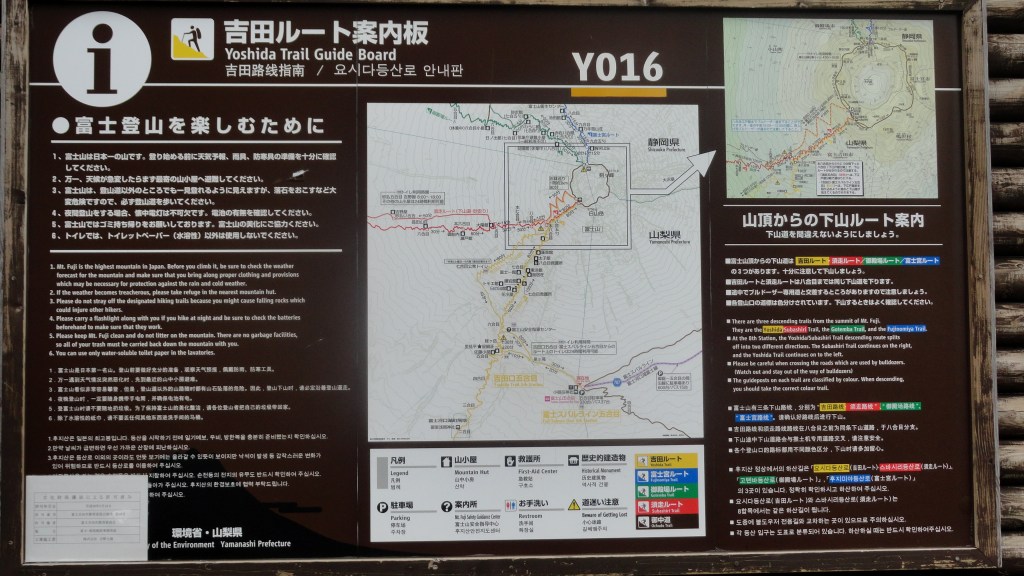
This guide concentrates on the Yoshida Trail, the most popular route and the one that starts at the Fuji Subaru Line fifth station on the Yamanashi side. It covers the 2026 season dates, the ¥4,000 climbing fee, the gate rules, the reservation system, mountain huts, bus access, gear, altitude, toilets, crowds and the summit circuit. It also explains when to choose one of the three Shizuoka-side routes instead, and what to do if you are travelling with someone who should not climb.
The short version: go in the official season, pay the fee, reserve a hut or start very early, carry real rain gear and warm layers, and do not treat the sunrise as a guaranteed event. Fuji is generous when the weather is stable and unforgiving when it is not.
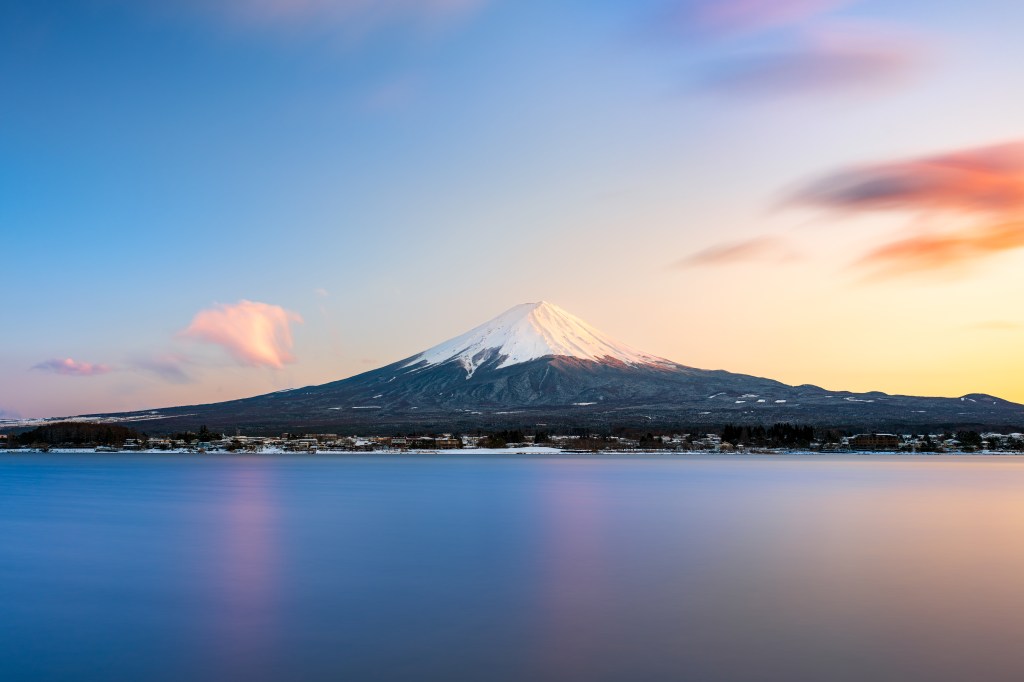
Mount Fuji at a glance
| Location | Yamanashi and Shizuoka prefectures, central Honshu, about 100 km west of Tokyo |
|---|---|
| Summit | 3,776 m at Kengamine, the highest point in Japan |
| Main route in this guide | Yoshida Trail from the Fuji Subaru Line fifth station (2,305 m) |
| Yoshida route length | About 6.8 km up and 7.0 km down, with roughly 1,450 m of ascent |
| Standard time | About 6 hours up and 3.5 to 4 hours down, excluding long rests |
| 2026 season | 1 July to 10 September on the Yoshida Trail; Shizuoka routes opened on 1 or 10 July |
| 2026 climbing fee | ¥4,000 per person per climb on both the Yamanashi and Shizuoka sides |
| Yoshida gate hours | Closed 14:00 to 03:00 for climbers without a hut booking |
| Best for | First-time Fuji climbers who want the fullest hut and transport network |
| Main caveat | The season is short, the summit is cold even in August, and the trail is crowded at weekends and sunrise |
What climbing Fuji is actually like
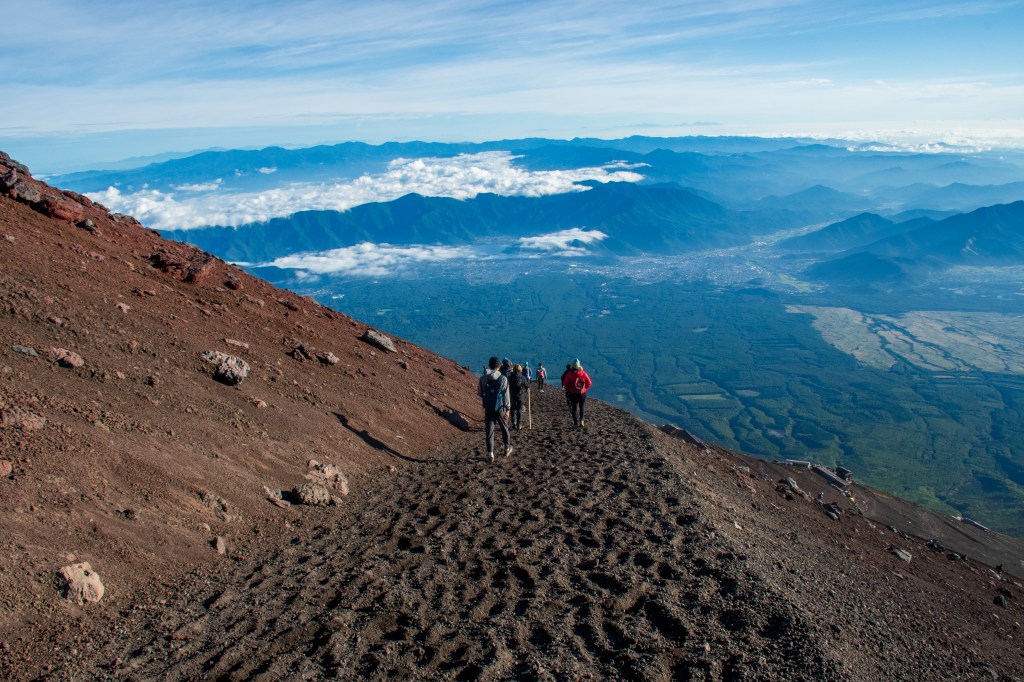
The Yoshida climb begins in forest. From the fifth station at 2,305 m, the first section to the sixth station is a gentle walk through larch and scrub, with the noise of the bus terminal falling away behind you. It is the only part of the route that feels like an ordinary mountain path. Above the sixth station the trees disappear, the ground turns to red-brown volcanic gravel, and the trail begins to switchback up a bare slope.
The middle of the climb is a long, steady grind. The air thins, the views open, and the weather can change from sun to cloud to cold wind in less than an hour. From around the seventh station there are short rocky steps and chains in places; none of it is technical climbing, but the combination of altitude, loose rock and fatigue makes it feel harder than the distance suggests. By the eighth station, the route is shared with day hikers, tour groups and people who started at midnight, and the trail can become a slow queue.
The final push from the ninth station to the summit is the steepest and narrowest part of the Yoshida route. It is also where many people turn around. That is not a failure. Altitude sickness is the most common reason climbers abandon the summit, and the official advice is simple: if you feel bad, go down. The mountain will still be there.
The summit is not a single point. The Yoshida Trail arrives at the Yoshida mouth, around 3,710 m, and the true highest point at Kengamine is a further walk around the crater rim. The full circuit, the ohachi-meguri, takes about 90 minutes and adds real exposure and effort. Many climbers watch sunrise from the Yoshida mouth or from a hut and skip the circuit. That is a reasonable choice, especially if the weather is turning.
The 2026 season: dates, fees and gate rules
The 2026 Yoshida Trail season ran from 1 July to 10 September. The dates can shift slightly because of late snow or weather, and the 2027 dates had not been announced when this guide was updated in October 2026. Always check the official Mount Fuji site and the Yamanashi prefecture page before booking transport or a hut.
Everyone who passes the fifth-station gate pays a climbing fee of ¥4,000 per person, per climb. The fee applies to adults and children alike, and it is separate from hut charges and bus fares. It can be paid on the day or in advance through the official Yoshida Trail reservation system. The fee is used for trail maintenance, safety measures and environmental protection, not as a hut deposit.
The Yoshida Trail has two hard rules at the fifth-station gate. First, the gate closes from 14:00 to 03:00 for anyone without a mountain-hut booking. Second, the trail has a daily cap of 4,000 climbers, excluding hut guests. If the cap is reached, the gate closes and climbers without a reservation or hut booking cannot pass. In 2024 and 2025 the cap was not reached on any day, according to the official FAQ, but the 14:00 closure still catches people who start too late.
A passage reservation is optional, not legally mandatory. It costs ¥4,000, is paid in advance, and gives you a faster gate process and a wooden tag while stocks last. About 3,000 places a day were released for advance booking in 2026, with the rest held for same-day arrivals. If you do not reserve, arrive early in the morning. If you have a hut booking, you can pass the gate after 14:00, but you still pay the ¥4,000 fee and you should still aim to be through the gate well before 14:00.
Do not confuse the passage reservation with a hut booking. They are separate systems. A hut booking guarantees you can pass the gate outside the 14:00 to 03:00 window; a passage reservation does not give you a bed. The official FAQ is explicit about this, and every year people arrive at the fifth station believing they have reserved a futon when they have only paid the trail fee.
The gate staff also check equipment. You need warm clothing, a jacket-and-trousers rain set, and proper hiking shoes or boots. A poncho, jeans and trainers are not enough. If the check finds you unprepared, you can be refused passage. This is not a formality; the upper mountain can be close to freezing in summer, and hypothermia is a real risk.
Choosing a route
Fuji has four main climbing routes. The Yoshida Trail is the busiest and has the most huts, the most buses and the most English signage. The three Shizuoka routes are quieter or shorter depending on which you pick. All four reach the summit area, and all charge ¥4,000 per person in 2026.
| Route | Trailhead | Ascent | Standard time | Character |
|---|---|---|---|---|
| Yoshida | Fuji Subaru Line fifth station, 2,305 m | 6.8 km, about 1,450 m gain | 6 h up, 3.5–4 h down | Most popular; most huts; busiest at the top |
| Fujinomiya | Fujinomiya fifth station, 2,380 m | Shortest route | About 5 h up, 3 h down | Steep, rocky, popular with strong walkers |
| Subashiri | Subashiri fifth station, 1,970 m | Longer, forested lower section | About 7 h up, 4 h down | Quieter; famous long sandy descent |
| Gotemba | Gotemba new fifth station, 1,440 m | Longest, about 2,300 m gain | About 8.5 h up, 4.5 h down | Fewest huts; for experienced, fit climbers |
Yoshida Trail
Choose Yoshida if this is your first Fuji climb, if you want the widest choice of huts, or if you are coming from Tokyo or Kawaguchiko. It is the best-supported route: buses run to the fifth station, there are restaurants and shops at the trailhead, and the trail is marked and busy enough that navigation is rarely the issue. The trade-off is crowds, especially around the eighth station and the summit at sunrise.
Fujinomiya Trail
The Fujinomiya Trail starts higher and is the shortest way to the summit. It is steep and rocky, with fewer gentle sections, and it is a good choice for confident walkers who want a shorter day. Access is from Mishima Station or Shin-Fuji Station by bus, and the Shizuoka-side rules apply: e-learning, ¥4,000 fee, and no entry between 14:00 and 03:00 without a hut booking.
Subashiri Trail
The Subashiri Trail begins lower, passes through forest for longer, and joins the Yoshida Trail near the eighth station. It is quieter than Yoshida and gives a more gradual introduction to the altitude. The descent includes a long sandy slope, which is fast and fun but hard on the knees. In 2026 the Subashiri season opened on 1 July, aligned with Yoshida, while Fujinomiya and Gotemba opened on 10 July.
Gotemba Trail
The Gotemba Trail is the longest and most demanding of the four. It starts at 1,440 m, which means more than 2,300 m of ascent, and it has few huts. It is suitable for experienced climbers who are comfortable with a long day and can carry more water. It is not the route for a first climb or for anyone unsure about altitude.
Getting to the Yoshida trailhead
The Yoshida Trail starts at the Fuji Subaru Line fifth station, usually called Fuji Subaru Line 5th Station or simply Kawaguchiko fifth station. During the climbing season, private cars are banned from the Subaru Line for most of the day, so most climbers arrive by bus or shuttle.
By train and bus from Tokyo
The most common route is to take the JR Chuo Line from Tokyo to Otsuki, change to the Fujikyu Railway to Fujisan Station or Kawaguchiko Station, and then take the Fujikyu bus to the fifth station. In 2026 the bus cost ¥2,000 one way or ¥3,400 return from either station, with the first departure from Fujisan Station at 6:30 and the last at 17:30. The last bus down from the fifth station left at 18:45. The journey takes about an hour.
There are also direct highway buses from Tokyo. In 2026 the Shinjuku to fifth-station service ran during the season at ¥4,800 one way or ¥9,600 return. It is convenient if you are staying in west Tokyo, but it can be affected by traffic on summer weekends. Book ahead and leave a buffer before your gate time.
By car
If you drive, you cannot take your car up the Subaru Line during the 2026 restriction period, which ran from 18:00 on 3 July to 18:00 on 10 September. Park at Fujisan Parking and take the shuttle bus. Parking cost ¥1,000 per car in 2026, and the shuttle cost ¥2,000 one way or ¥3,400 return. The first shuttle from the parking area left at 3:00, and the last shuttle down from the fifth station left at 18:30. The early shuttles are aimed at climbers doing a sunrise ascent; they are not a way to avoid the 14:00 gate closure.
By bus from Shizuoka
For the Fujinomiya Trail, buses run from Mishima Station to the Fujinomiya fifth station. In 2026 the fare was ¥3,500 one way or ¥7,000 return, and the service ran from 10 July to 10 September. Shin-Fuji Station also has seasonal buses. Check the current timetable before relying on a late return.
The Yoshida Trail step by step
The timings below are standard summer times for a reasonably fit walker who is not rushing. They exclude long hut stays and sunrise waits. Altitude affects everyone differently, so treat them as a planning baseline, not a schedule to defend.
Fifth station to sixth station (2,305 m to about 2,390 m)
The trail leaves the back of the fifth-station complex and enters larch forest. It is wide, gentle and shaded, and it takes about 50 minutes to an hour. This is the section to slow down deliberately. The official advice is to spend one to two hours at or near the fifth station before starting, both to acclimatise and to sort out gear. If you arrive by bus at 10:00 and start walking at 10:15, you have skipped that advice.
The sixth station has a small hut, toilets and a safety guidance centre. It is the last easy place to turn back without losing much time. If you are already breathless, headachy or dizzy, stop here and descend. Do not take a headache pill and push on.
Sixth station to seventh station (about 2,390 m to 2,700 m)
Above the sixth station the forest ends and the trail becomes a series of long switchbacks over volcanic gravel. There is little shade. On a sunny day the reflected heat is strong, and on a cloudy day the wind can be cold. This section takes about 70 to 90 minutes. The views of Lake Yamanaka and the Fuji Five Lakes open up behind you, which is a good excuse to stop and breathe.
Seventh station to eighth station (about 2,700 m to 3,100 m)
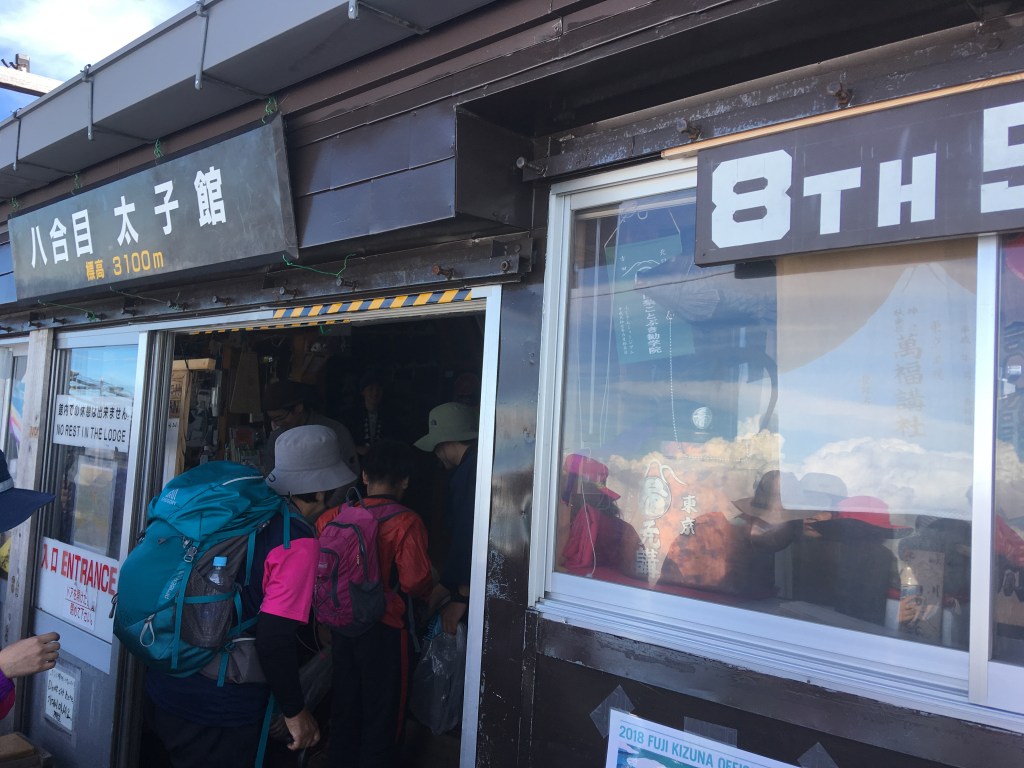
The trail steepens and becomes rockier. There are short sections with chains and fixed handholds, and in busy periods you will wait behind other climbers. This is where the altitude starts to bite. Eat and drink before you feel hungry or thirsty, and keep the pace conversational. If you cannot speak a full sentence without gasping, you are going too fast.
The seventh station has several huts, including Toyokan and Hinodekan. The eighth station is a cluster of huts rather than a single building. The names can be confusing: Fujisan Hotel is at the eighth station, not at the fifth station, and Edoya is also at the eighth station. Check the hut name and station number on your booking.
Eighth station to ninth station (about 3,100 m to 3,400 m)
This is the most congested part of the Yoshida Trail. The route merges with climbers coming from the Subashiri Trail, and tour groups often stop here to rest. The trail is a mix of rock steps and loose gravel. In wet weather it is slippery; in dry weather the dust is hard on the eyes and throat. A mask or buff and sunglasses help.
If you are staying in a hut, this is likely where you will sleep. Most huts serve dinner from around 16:00 and lights go out early. The beds are shared futons, the rooms are cold, and the toilets are basic. Earplugs and a sleep mask are worth more than they weigh.
Ninth station to the summit (about 3,400 m to 3,710 m)
The last section is steep, narrow and rocky. It is the part where the queue can stop for long periods, especially before sunrise. Keep your hands free, use your headlamp, and do not overtake on narrow ledges. If the weather turns, this is the place to turn around; the summit is not worth a fall.
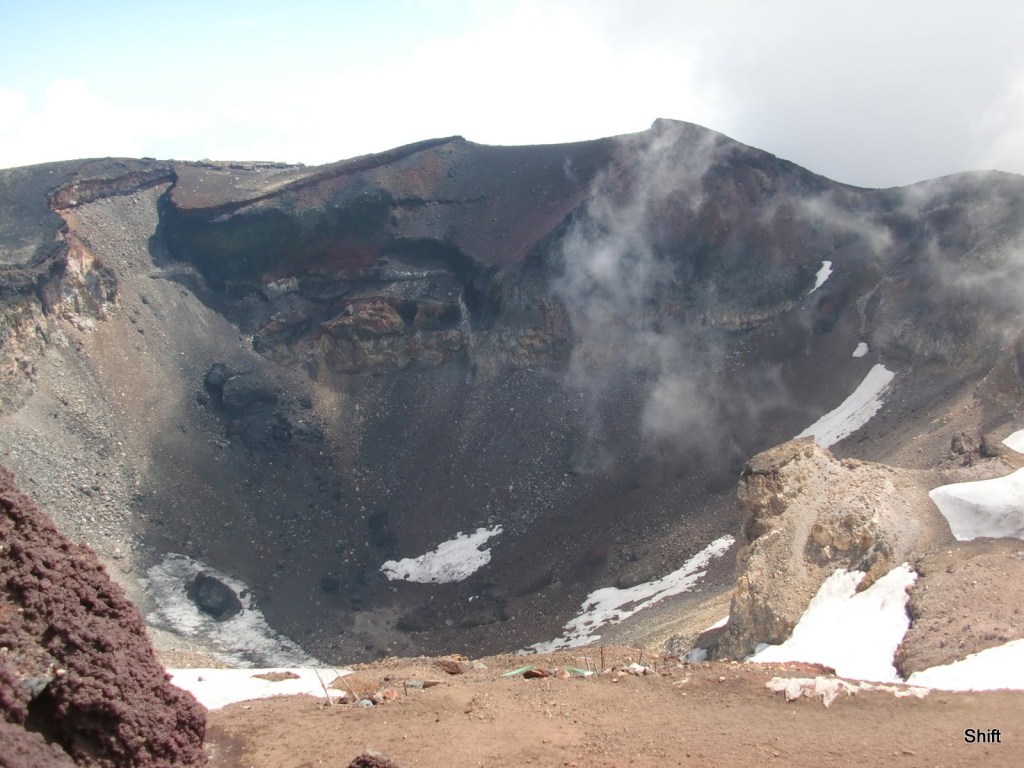
The Yoshida Trail reaches the crater rim at the Yoshida mouth. From there, Kengamine, the true 3,776 m summit, is a further walk along the crater rim. The full ohachi-meguri circuit takes about 90 minutes. It is worth doing only if you have the time, the weather and the energy. Many climbers are satisfied with the Yoshida mouth and the view into the crater.
Timing, sunrise and the summit
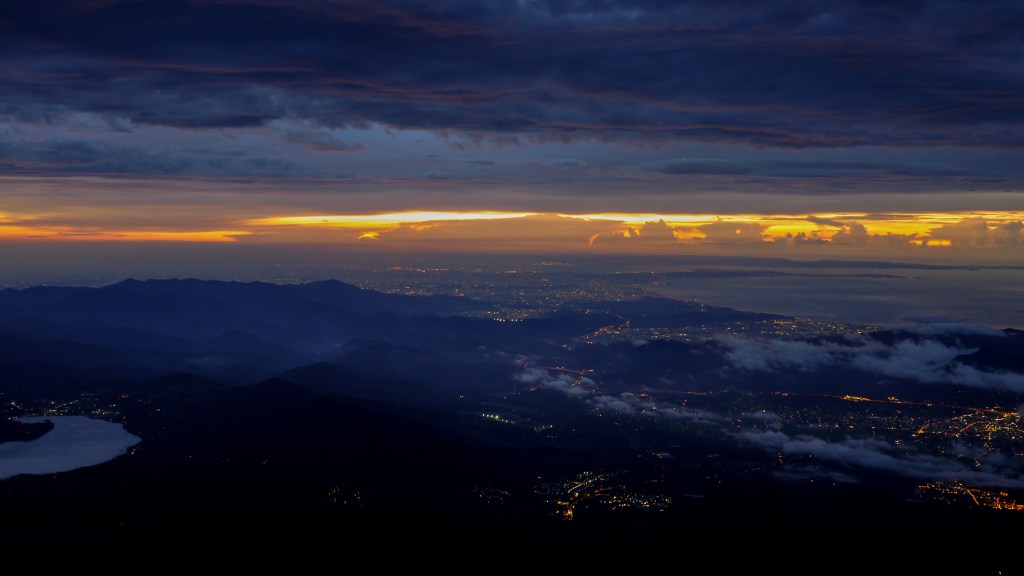
The classic plan is to start at the fifth station in the morning, reach a hut in the afternoon, sleep, leave the hut around midnight or 01:00, and reach the summit before sunrise. This is also the most crowded plan. The trail from the eighth station to the summit can be a slow queue from 02:00 onward, and the summit is packed in the hour before sunrise.
A better plan for many people is to sleep at a hut, watch sunrise from the hut or a nearby viewpoint, and climb to the summit after the first rush. You will miss the postcard moment of sunrise from the crater rim, but you will walk in daylight, avoid the worst congestion and still reach the top. The official site makes the same point: sunrise can be seen from the trail, not only from the summit.
Sunrise times at the summit range from about 04:30 in early July to about 05:20 in early September. The exact time shifts by a few minutes each day, so check a reliable almanac for your date. Do not plan to arrive at the summit ten minutes before sunrise and expect a clear view; leave at least an hour of buffer, and carry warm clothes for the wait. The wind at the summit can make a 5°C morning feel below freezing.
The summit has a weather station, a post office that opens only for part of the season, a few huts and shrines, and toilets. In 2026 the summit post office was scheduled to open from 10 July to 20 August, 06:00 to 14:00. Do not rely on it for cash or postcards outside those dates.
If you are doing the ohachi-meguri, start it before the summit crowds build, and do not attempt it in strong wind or low cloud. The rim path has exposed sections and drops. The circuit is not a casual stroll, even though it looks short on the map.
Sleeping on the mountain: huts
Mountain huts on the Yoshida Trail are basic, expensive and essential. They offer a shared futon, a simple meal, a place to get out of the weather, and a few hours of sleep. They do not offer showers, private rooms or reliable charging. Most have curfews and early lights-out, and some close their doors to non-guests during bad weather.
In 2026, prices ranged from about ¥9,000 for a bed without meals at the upper huts to ¥17,600 for a single room with two meals at Toyokan. Fujisan Hotel, at the eighth station, charged ¥9,300 without meals and ¥12,000 with two meals on weekdays; Edoya charged ¥10,000 without meals and ¥12,000 with two meals on weekdays, rising to ¥14,000 on Saturdays and peak dates. These are 2026 examples, not fixed prices. Check each hut’s own site for the current year.
Book as early as possible. Some huts open bookings in April or May, and weekend places in late July and August sell out quickly. A booking is usually made directly with the hut, often through a Japanese booking platform. You will need to pay a deposit or the full amount in advance at many huts, and cancellation fees are strict. If you cancel late, you may lose most or all of the money.
Hut bookings are separate from the ¥4,000 climbing fee. A hut booking lets you pass the gate after 14:00, but it does not pay the fee. Bring the booking confirmation on your phone and a screenshot in case the signal fails. Some huts require check-in by 18:00; if you are running late, call ahead.
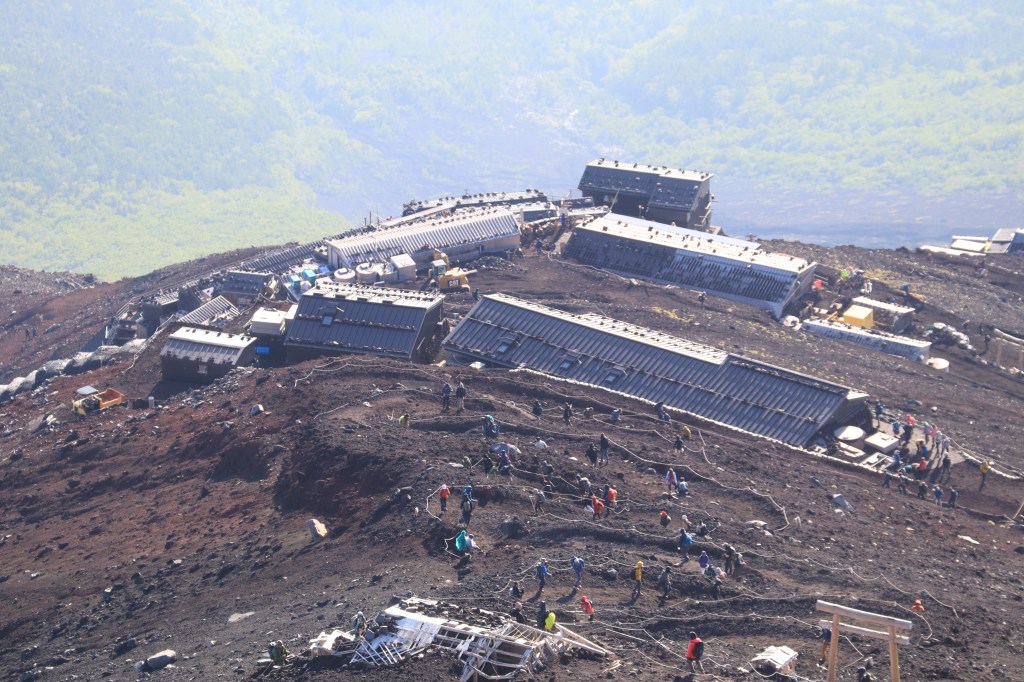
What to expect inside: a narrow futon on a shared platform, a thin blanket or sleeping bag, a simple curry or bento dinner, and a breakfast you carry with you. Lights usually go out around 20:00 or 21:00, and wake-up calls for sunrise start around midnight. Earplugs, a sleep mask and a dry change of socks make a disproportionate difference. Cash is still useful, although some huts now accept cards.
Gear that actually matters
The gate check is not a suggestion. Yamanashi prefecture lists three mandatory items: warm clothing, a jacket-and-trousers rain set, and proper hiking shoes. Everything else on this list is about comfort and safety, not style.
- Warm layers: a fleece or insulated jacket, a warm hat, gloves and a buff. The summit can be near freezing even in August.
- Rain gear: a waterproof jacket and trousers, not a poncho. A poncho flaps in the wind and leaves your legs wet.
- Boots: sturdy hiking shoes or boots with grip. Trail runners are not enough for the loose rock and long descent.
- Headlamp: with spare batteries. You will need it if you start before dawn or if the weather closes in.
- Water: at least 1.5 to 2 litres, more in hot weather. The official guideline is 1.2 litres a day, but that is a minimum for ordinary activity, not a summer ascent.
- Food: high-energy snacks, salty food and a few sweets. Do not rely on hut meals alone.
- Sun protection: sunscreen, lip balm, sunglasses and a hat with a brim. The UV at altitude is strong.
- Cash: coins for toilets and small purchases. Some huts and shops are cash-only.
- Navigation: a paper map or offline map. Phone signal is good in the season but not guaranteed.
- Health kit: blister plasters, painkillers, any personal medicine, and a pulse oximeter if your group has one.
- Pack cover or dry bags: rain can last for hours, and a wet sleeping bag is dangerous.
- Optional: trekking poles, dust mask, gaiters, and a thermos. Poles help on the long descent.
Leave cotton at home. It holds water, dries slowly and chills you when you stop. Wear synthetic or wool base layers. Pack for a cold, wet mountain, not for the temperature at the fifth station.
Altitude, health and weather
Fuji is high enough to cause altitude sickness in healthy people. The summit pressure is roughly two-thirds of sea level, and the climb from 2,305 m to 3,776 m in a day is a rapid ascent. Headache, nausea, dizziness, loss of appetite and unusual fatigue are warning signs. If they get worse, descend. Do not wait for a scheduled hut check-in or a sunrise.
Ways to reduce the risk: spend an hour or two at the fifth station before starting, walk slowly, breathe deeply, drink regularly, eat salty snacks, and sleep at a hut rather than doing a bullet climb. A bullet climb, meaning climbing overnight without a hut, is explicitly discouraged by the official site because it raises the risk of altitude sickness, hypothermia and accidents. If you have a heart or lung condition, are pregnant, or are recovering from illness, talk to a doctor before climbing.
The weather is the other variable. The summit can be 20°C colder than the fifth station, and wind chill can push it lower. Afternoon thunderstorms are common in July and August. Lightning on an exposed ridge is dangerous, and there is nowhere to hide above the tree line. Start early, watch the clouds, and be willing to turn around. The official site recommends checking the forecast before you leave and carrying equipment for sudden changes.
Heat is also a risk. The lower trail has little shade, and climbers often wear too much on the ascent and too little on the summit. Use layers you can add and remove quickly. If you feel dizzy, stop, drink, cool down and reassess.
Food, water, toilets and money
Huts sell water, sports drinks, curry, ramen, snacks and sometimes beer. Prices rise with altitude because everything is carried up by tractor or on foot. A bottle of water at the eighth station can cost several times what it costs in town. Carry enough from the fifth station, but do not carry so much that your pack becomes a burden.
Toilets are available at the fifth station, at many huts and at the summit. They are basic, and some ask for a small tip. Carry coins, especially ¥100 coins. Do not use the outdoors as a toilet; the official rules are clear about this, and the mountain is a sacred site as well as a fragile environment. If you use a portable toilet, carry out the waste.
Cash is still king on the mountain. Some huts and shops accept credit cards, but not all, and card terminals can fail in cold or stormy weather. Carry enough yen for a meal, a bottle of water, a toilet tip and an emergency taxi or bus. Do not rely on an ATM at the fifth station; there may be one, but it is not a plan.
Food strategy: eat a proper meal before you start, snack every hour, and eat something salty at the hut. Ramen and curry are popular because they are warm, salty and easy to digest. If you have dietary restrictions, check with the hut in advance; options are limited.
Crowds and when to go
The Yoshida Trail is busiest from late July through mid-August, especially on weekends and during Obon. The queue from the eighth station to the summit can add an hour or more to the ascent. If you want a quieter climb, aim for early July or the first half of September, or climb on a weekday. The trade-off is a higher chance of unstable weather and lingering snow early in the season.
The official site publishes a congestion forecast, and it is worth checking before you fix your dates. Saturday nights are the worst. If you must climb on a weekend, book a hut and start from it after the main sunrise rush, or climb to the summit in the afternoon and descend before dark. The latter requires good weather and an early start, but it avoids the worst of the crowd.
Sunrise is the main event for many people, and the summit is packed in the hour before it. If you want a quieter sunrise, watch it from the trail or from your hut. The view is not much worse, and the walk afterwards is much calmer. The official site recommends this approach, especially for people who are not confident at altitude.
Safety, emergencies and responsible climbing
Fuji is an active volcano. The official site publishes volcanic alerts, and the mountain can be closed if there is unusual activity. Check the Japan Meteorological Agency and the official Fuji site before you go. In an emergency, call 110 for police or 119 for ambulance and fire. Mobile phones work in many parts of the trail during the season, but do not assume coverage in gullies or in bad weather.
Tell someone your plan. Submit a climbing plan if your route or timing is unusual, and carry insurance that covers mountain rescue. Rescue on Fuji is expensive and slow, and it may not be possible in high wind or low cloud. The best rescue is not needing one.
Follow the rules: stay on the trail, do not remove lava or plants, do not write on rocks, carry out all rubbish, do not camp, and do not light fires. The mountain is a UNESCO World Heritage site and a place of worship. Treat the shrines and the huts with respect, keep noise down at night, and do not block the trail while taking photos.
If you are climbing with children, keep the group small and the plan flexible. Children can climb Fuji, but they are more vulnerable to altitude and cold, and they may not be able to describe symptoms clearly. A hut stay, a slow pace and a willingness to turn back are more important than the summit.
If you are not climbing
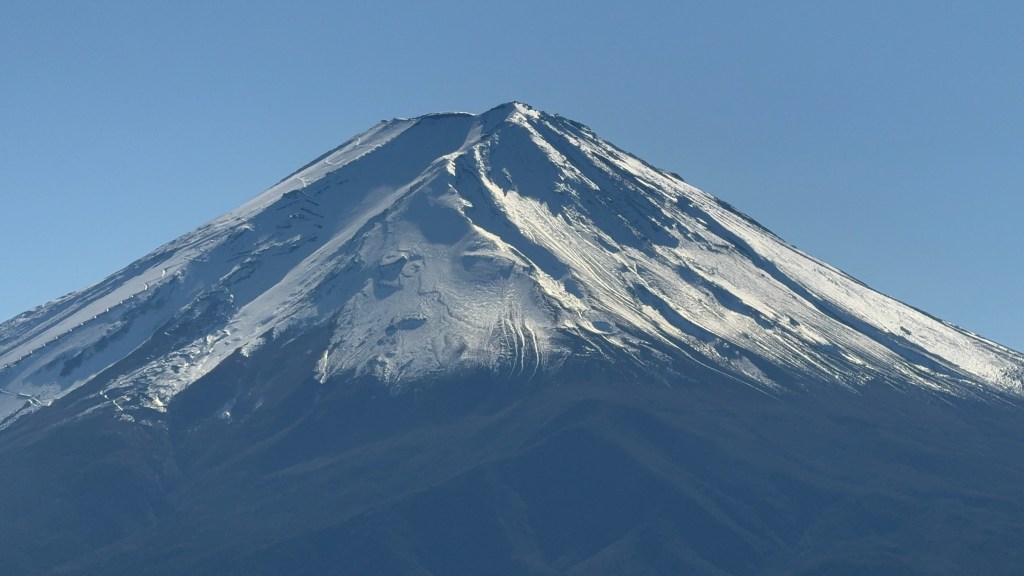
The fifth station is worth a visit even if you never go above it. At 2,305 m, it has restaurants, shops, a shrine and a viewing area, and the bus ride up the Subaru Line is a scenic introduction to the mountain. In clear weather you can see the Fuji Five Lakes and the Southern Alps. In the off-season, the road may be closed or restricted, so check before you go.
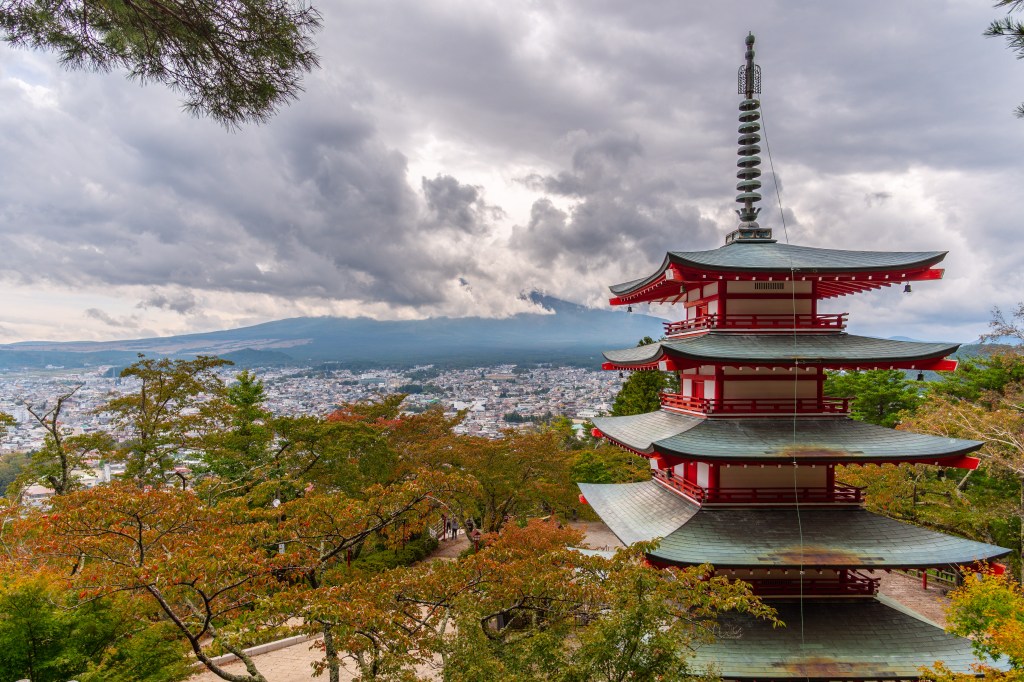
For the classic postcard view, head to the Chureito Pagoda in Arakurayama Sengen Park, above Shimoyoshida. The pagoda, the town and the mountain line up in a composition that has become one of the most photographed views in Japan. It is especially busy during cherry blossom and autumn colour, but it is a short trip from Shimoyoshida Station and does not require climbing.
Lake Kawaguchi is the easiest base for the Fuji Five Lakes. It has museums, onsen, cafes and a shoreline walk, and it is a good place to wait for a clear view. The lake is also a useful base for an early bus to the fifth station. The Kawaguchiko guide covers the lake in more detail, and the Hakone guide explains the nearby onsen and transport options.
In Fujiyoshida, the Kitaguchi Hongu Fuji Sengen Shrine is the historic starting point of the Yoshida pilgrimage route. It is a quiet, mossy complex with tall cedars and a different atmosphere from the crowded fifth station. If you have half a day before or after your climb, it is worth a visit.
Budget
A Yoshida Trail climb is not cheap, but the costs are predictable. The biggest variable is the hut. The table below assumes one person, one night in a hut with two meals, and return transport from Tokyo.
| Item | Typical 2026 cost |
|---|---|
| Climbing fee | ¥4,000 |
| Hut, two meals | ¥12,000–¥17,600 |
| Bus, Fujisan/Kawaguchiko Station to fifth station, return | ¥3,400 |
| Train, Tokyo to Fujisan/Kawaguchiko, return | About ¥4,000–¥5,500 |
| Food, water and snacks | ¥2,000–¥4,000 |
| Toilets, lockers and incidentals | ¥500–¥1,000 |
| Total, excluding gear and insurance | About ¥26,000–¥35,000 |
If you travel by direct highway bus from Shinjuku, the transport cost rises to about ¥9,600 return, but you save the train changes. If you climb without a hut, you save the accommodation cost but take on more risk and a harder night. The cheapest option is not the safest option on a 3,776 m mountain.
Before you go
- Check the official season dates and gate rules for the year you are climbing. Do not assume the 2026 dates will be repeated exactly.
- Decide whether you are climbing with a hut or as a day/night climb. If you are not sleeping on the mountain, start early and plan to descend before the weather turns.
- Book transport and a hut before you book anything else. Weekend huts sell out months ahead.
- Pay the ¥4,000 fee in advance if you want a faster gate process, and keep the QR code offline.
- Pack warm layers, jacket-and-trousers rain gear and proper boots. Test them before you leave.
- Carry cash, water, snacks and a headlamp. Do not rely on shops above the fifth station.
- Learn the signs of altitude sickness and agree with your group that anyone can call a turn-around.
- Check the weather forecast for the fifth station and the summit, not just Tokyo.
- Have a plan for the day after. A long descent can leave you tired and sore, and driving or changing trains immediately is not ideal.
Fuji is not a mountain to conquer in a single heroic push. It is a mountain to approach slowly, with a booked bed, a warm layer, and enough humility to turn back if the weather or your body says no. Done that way, the climb is one of the great experiences in Japan: a night under an enormous sky, a cold sunrise, and a view that makes the long slog worthwhile.
Sources
- Mount Fuji Official Climbing Site (season, rules, routes, safety, FAQ)
- Mount Fuji Official Site: Yoshida Trail 2026 rules and reservation
- Mount Fuji Official Site: Shizuoka-side 2026 rules
- Yamanashi Prefecture: Yoshida Trail passage rules and fee
- Yamanashi Prefecture: 2026 Mount Fuji climbing information
- Shizuoka Prefecture: 2026 climbing restrictions
- Fujikyu Bus: 2026 Subaru Line timetable and fares
- Fujikyu Travel: 2026 parking shuttle and climbing buses
- Fujisan Hotel: 2026 hut rates
- Edoya: 2026 hut rates and booking
- Toyokan: 2026 hut rates


Leave a Reply