Plan an independent visit to Nagasaki Bio Park in Nagasaki with the main sights, food ideas, access checks, and seasonal notes.
Operational details such as opening hours, admission fees, and train times can change. Prefer official pages and reconfirm before you travel (sources checked on 31 October 2026).
Why visit
- Nagasaki Bio Park is in Saikai, on the coast west of Sasebo, and it describes itself as something other than a zoo. The phrase it uses is ecological display, adopted from the day it opened: animals are not kept on show in the way a conventional zoo presents them, but are kept as close as possible to how they live in the wild, in environments built to match their ecosystems. The park has been refining that approach for more than 35 years, and the result is a place where the boundary between visitor and animal is deliberately thin rather than signed.
- The clearest evidence is the walking route. Meerkats and lemurs turn up on the path, and areas such as the flamingo and capybara enclosures have no wall between them and the visitor, so you can walk in and out freely alongside the animals. The park is explicit that this can feel frightening at first, and it addresses that directly: it asks visitors to remember that a human approaching quickly is frightening to the animal too, and to move slowly and touch gently. That is a different contract from a zoo’s glass, and it is the reason a visit here feels unlike one.
- The park is a botanical garden as well as a zoo, and it presents the whole site as a biological microcosm in which insects, trees and flowers matter as much as the large animals. That framing is not marketing: it explains why the capybara pond exists. The park says the pond was built not simply because capybaras swim well but as a safe area they can retreat to when stressed, protecting both the animals and the visitors. Small design decisions like that are the argument the place makes about itself.
- The animals are the reason most people come. The capybara open-air bath in winter is a national ritual that gets televised every year, the guinea pig bridge became a global video, and the hippo watermelon feeding is a summer event with its own following. None of these are staged performances in the way a marine park show is staged; they are the animals doing what they do, with the park’s layout letting visitors stand close enough to see it. That difference is worth understanding before you arrive, because it changes what you should expect.
- The park is open 365 days a year, from 10:00 to 17:00 with entry before 16:00, which makes it unusually reliable for a family day out. The complication is access: it is not on a railway, and the free shuttle from Huis Ten Bosch Station takes about 45 minutes and runs only three round trips a day, by reservation. That constraint is real and it shapes the whole day. The reward is a park on the Saikai coast that most foreign visitors never reach, in a part of Nagasaki that is otherwise passed through on the way to the theme park next door.
Top places and highlights
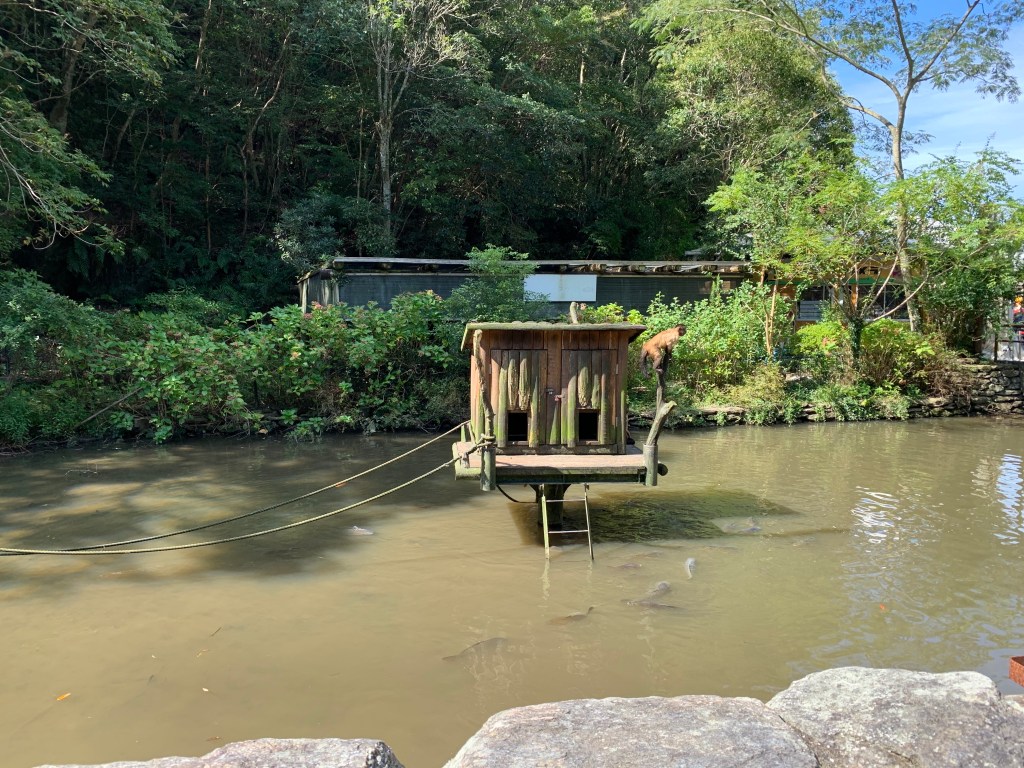
Ecological display, and the absence of fences
The park’s founding method is what it calls ecological display, and the point is that enclosures are built around the animal’s ecosystem rather than around a viewing window. The stated goal is to keep animals relaxed enough that they have no wish to escape, and the park is unusually candid that this has worked with some species, lemurs among them, and not yet with others. That honesty is more interesting than a claim of perfection: what you are walking through is a long experiment in how much restraint can be removed. Look at how the barriers that remain are made, because they tell you where the experiment is still running.
Animals on the path
Meerkats and lemurs appear on the walking route, and the flamingo and capybara areas can be entered and left freely with no boundary between the visitor and the animal. The park warns that this can feel alarming even for people who like animals, and its advice is to approach slowly, touch gently and remember that you are the large unfamiliar thing in their space. There is a quote from the late Norio Kondo of Tokyo University of Agriculture that sums up the intent: looking over the fence is not fun, touch and feel and you will learn a lot. The corollary is that these are wild animals and may bite if handled against their will.
The capybara open-air bath
This is the park’s signature winter event, held from December to February, and it has become a fixture on Japanese television. The park is precise about what it is: often called a hot spring or spa, it is in fact an open-air bath, which is a different thing. Capybaras are waterside animals from South America and find the Japanese winter cold, so they settle into the water with visible relief. Because the capybara area has no boundary, you can watch them at close range and even touch them. Around the winter solstice the park adds a citrus bath, adapting the Japanese custom of bathing with yuzu, and the smell carries across the enclosure.
The guinea pig bridge
The guinea pigs have their own bridge, and every day they cross it in a queue on their way home. A video of it circulated widely enough that the park reports more than 13 million loops and a song written about it, which is an odd kind of fame for a small rodent. What makes it worth waiting for is that it is not a performance: it is the route the animals take at the end of the day, and the queue is the natural behaviour of animals following each other. Ask staff when the crossing happens, since timing it wrong means missing the only thing you came for.
Hippo watermelon time
In summer the keepers feed whole watermelons to the hippos, and the park runs it at 11:30 and 15:30, twice a day, every day during the summer holiday period only. The mechanics are the attraction: a whole watermelon goes into an open mouth and is crushed almost instantly, with the juice running out, because a hippo’s bite is among the strongest on earth. There are five hippos at the park, so the feeding repeats down the line rather than ending after one animal. Outside the summer period this does not happen, so the season decides whether it is worth planning the day around.
The capybara pond and its purpose
The capybara pond looks like a nice piece of landscaping and is actually a piece of animal welfare design. The park explains that it was built not only because capybaras are strong swimmers but as a safe area they can retreat into when they feel stress, which protects the visitors as much as the animals. That is the park’s method in miniature: rather than separating people and animals with a barrier, it gives the animal somewhere to go. Watch what the capybaras do when a group of visitors arrives, and the design explains itself without a sign.
The garden half of the park
The park calls itself a zoo and botanical garden, and its own description treats insects, trees and flowers as part of the same biological microcosm as the large animals. That is not a decorative claim: the planting is what makes the ecological display possible, since an animal kept in a matched environment needs the vegetation that goes with it. For visitors, the practical effect is that the park rewards walking slowly even between the headline animals, and that a visit in a green season looks different from one in winter. The Andes Plaza area, with its cafeteria restaurant, is the natural midpoint of that walk.
Food and drink
- The burger shop TOTORA sits just inside the entrance beside Totora Pond, with 60 seats, and serves Sasebo burgers with food provided by Chef Shop Fujii. Its position is the useful part: it is the first thing you pass after the gate, which makes it the option for eating before the animals rather than after a long walk. Sasebo is the city that gave the Sasebo burger its name, so this is a local dish served in its own region rather than a generic park burger.
- The restaurant KENA has 120 seats, is cafeteria style, and is in the Andes Plaza area. The park notes that it is about 20 minutes on foot from the entrance gate, which is the single most practical fact about eating here: it is not a quick stop unless you are already in that part of the park. Plan lunch around where you will be at midday rather than around which menu appeals, because the walk between the two ends of the site is substantial.
- Cafe KIWI is near the Squirrel Monkey Forest and serves snacks, drinks and soft cream, with a short menu that includes a seasonal pepperoni pizza at 1,100 yen, a pizza set with potato and a drink at 1,500 yen, and a hot dog at 650 yen. It is the light-stop option rather than a meal, and its location near one of the walk-through animal areas makes it the natural break in the middle of the circuit. Prices are modest by theme park standards.
- The park is large enough that carrying water matters, and the food outlets are spread across it rather than concentrated at the gate. That means the decision about where to eat is really a decision about where you will be, and a family with small children should plan the day so that lunch falls near KENA or KIWI rather than at the far end of the route. Check the current opening hours of each outlet on the park’s shop page, since they do not all run the full length of the day.
Getting there and around
- The railway route ends at Huis Ten Bosch Station. From there the park runs a free shuttle bus that takes about 45 minutes and makes three round trips a day, and it requires a reservation. The bus starts at Hotel Lorelei, in front of the station, and also picks up at the Huis Ten Bosch main entrance. Reservation is not confirmed by submitting the form; you need a reply confirming it, and same-day or previous-day bookings require a phone call rather than the form.
- From Fukuoka, the rail route is the Limited Express Huis Ten Bosch from Hakata Station, about 1 hour 30 minutes, then the shuttle. From Sasebo, the Rapid Sea Side Liner reaches Huis Ten Bosch Station in about 20 minutes, then the shuttle. From Nagasaki Airport, a bus reaches Huis Ten Bosch Station in about 55 minutes, and there is also an Ocean Liner to Togitsu in 25 minutes followed by a bus to the Bio Park stop in about 50 minutes.
- By car from Fukuoka, the route runs on the Kyushu Expressway to the Tosu junction, then the Nagasaki Expressway to the Takeo junction, then the Nishi Kyushu Expressway to the Sasebo Daito interchange, then Route 205 and the Saikai Pearl Line to Route 202. From Sasebo, it is the Sasebo Minato interchange, the Nishi Kyushu Expressway, the Sasebo Daito interchange and then the same roads. From Nagasaki Airport, Route 34 and Route 205 lead to the Saikai Pearl Line. Parking costs 700 yen per hour.
- The shuttle has restrictions that matter. It is only for visitors who are entering the Bio Park or PAW, so it cannot be used as a general transfer. It is operated by a single driver, and the park states that it cannot carry passengers who would have difficulty walking or getting on and off without a carer’s help. During busy periods a larger or different vehicle may run. If any of those conditions apply to your group, the car route is the realistic option.
- The park is open from 10:00 to 17:00 with entry before 16:00, every day of the year including holidays. Combined with a 45-minute shuttle that runs three times a day, that means the day has to be planned backwards from the shuttle rather than forwards from opening time. Check the return departures when you arrive, because missing the last one leaves you with a long taxi ride on a coast with limited transport.
Where to stay
- Huis Ten Bosch is the practical base even if the theme park is not your destination, because the free shuttle to Bio Park starts at Hotel Lorelei in front of Huis Ten Bosch Station. Staying there removes the connection problem entirely and gives you an evening in a resort area with restaurants. It also makes the reservation requirement less risky, since a cancelled shuttle is a short walk from your room rather than a lost day.
- Sasebo is the alternative and the better base for the wider area. It is a working city with the restaurants and hotels that a resort does not have, and it connects to Huis Ten Bosch Station in about 20 minutes on the Rapid Sea Side Liner. Sasebo is also where the Sasebo burger comes from, which makes the burger shop at the park’s entrance part of a longer theme rather than a coincidence.
- Staying in Saikai itself is possible but not necessary. The park is in a coastal district rather than a resort, and the surrounding area is quiet. For a family trip built around the park, one night near Huis Ten Bosch and one in Sasebo covers both the park and the city without moving far. Nagasaki city is further east and works as a base for a longer trip rather than for this park specifically.
Best time to visit
- Winter is the park’s signature season, because the capybara open-air bath runs from December to February. The park warns that capybaras do not take a bath on a warm day, so a mild winter visit can miss the thing you came for. Around the winter solstice the bath is filled with citrus, following the Japanese custom of bathing with yuzu, and the smell is part of the experience. If the bath is the reason for your trip, come in the coldest part of the season rather than at either end of it.
- Summer brings the hippo watermelon feeding, held at 11:30 and 15:30 and only during the summer holiday period. It is the park’s other seasonal event and it works in the opposite way to the capybara bath: heat is the point, and the feeding happens every day of the holiday rather than on selected dates. Summer is also when the park is busiest and when the walk between areas is most tiring, so the 10:00 opening is worth using.
- The guinea pig bridge runs every day rather than seasonally, but the timing is not published as a fixed slot on the English pages, so ask staff on arrival. That is the one event where a missed time cannot be fixed by coming back in another season. Because the park closes at 17:00 with last entry at 16:00, the crossings are likely to be in the afternoon, but confirm rather than assume.
- The park is open every day of the year, which makes it one of the few places in this region where a holiday visit is not a gamble. The trade-off is that the animals’ behaviour is seasonal even when the gates are not: the bath in winter, the watermelon in summer, and the planting changing through the year in the garden half of the site. A visit in spring or autumn sees the park at its most comfortable in terms of weather but misses both headline events.
Practical tips
- Book the shuttle before anything else. The free bus from Huis Ten Bosch Station takes about 45 minutes and runs three round trips a day, and the reservation is only confirmed when you receive a reply. Bookings for the next day or the same day must be made by phone. The bus is for Bio Park and PAW visitors only, and because it has a single driver it cannot take passengers who need help getting on and off.
- Admission is 2,100 yen for adults, 1,500 yen for middle and high school students, 1,100 yen for children from three years old to elementary school age, and 1,500 yen for seniors. Groups of 15 or more pay 1,890, 1,350, 990 and 1,350 yen, and a combined ticket with PAW costs 2,600, 2,000, 1,600 and 2,000 yen. Parking is 700 yen per hour. US Navy personnel stationed in Sasebo and their families get 10 per cent off with ID, and teachers leading school groups enter free.
- Approach the animals slowly and touch gently. The park is explicit that these are wild animals, that they may bite if upset, and that you should not try to pet or hold an animal that resists. Because there are no barriers in several areas, the responsibility for the encounter sits with the visitor in a way it does not at a conventional zoo. Children need supervising closely here, not because the park is dangerous but because the animals are close enough to be grabbed.
- Plan the day around the walking distances. The restaurant KENA is about 20 minutes on foot from the entrance gate, and the park spreads its animals across a large site, so lunch at the wrong end means a long walk either before or after. The burger shop is beside the entrance and the cafe is near the Squirrel Monkey Forest, which gives you three points to build a route around. Arriving at 10:00 gives enough time to walk the site without rushing.
- Check the seasonal events against your dates before booking. The capybara bath runs December to February, and capybaras skip it on warm days. The hippo watermelon feeding runs at 11:30 and 15:30 during the summer holiday period only. The guinea pig bridge is daily but has no published time, so ask. A visit outside the right season still works, but it is a different park from the one in the videos.
- Consider the annual pass if you are staying nearby. The park sells a BIO PASS that allows unlimited entry to the zoo for a year from the day of purchase, and an e-ticket option is available online. For a family based in Sasebo or at Huis Ten Bosch for more than a few days, the pass turns the park into somewhere to go for two hours rather than a full-day commitment, which suits an animal park where behaviour changes with the weather.
- The park is open every day of the year, from 10:00 to 17:00 with last entry at 16:00, so a holiday visit is safe from the calendar’s point of view. What is not safe is the transport: three shuttle round trips a day is a hard limit. Confirm the return departure when you arrive, and if you are driving, note that parking is charged by the hour, which is an argument for a focused visit rather than an all-day one.
Suggested day-trip outline
- Take the Limited Express Huis Ten Bosch from Hakata, about an hour and a half, or the Rapid Sea Side Liner from Sasebo, about 20 minutes, and arrive at Huis Ten Bosch Station. The free shuttle to the park leaves from Hotel Lorelei in front of the station and takes about 45 minutes, with three round trips a day and a reservation required. Confirm your return departure on the way in.
- Enter at 10:00 and start with the burger shop TOTORA beside Totora Pond if you want to eat early, or go straight into the walking route to meet the meerkats and lemurs on the path. Approach slowly, touch gently and remember that these are wild animals. The flamingo and capybara areas have no boundary, so walk in and out rather than standing at an edge.
- Work through the capybara areas next, including the pond that was built as a retreat for stressed animals. In winter, this is where the open-air bath happens from December to February, and around the winter solstice the water is filled with citrus. Because capybaras skip the bath on warm days, a winter visit is only reliable in genuinely cold weather.
- Walk to the Andes Plaza for lunch at KENA, which is 20 minutes from the entrance gate, or take the lighter option at Cafe KIWI near the Squirrel Monkey Forest. Ask staff when the guinea pigs cross their bridge, since there is no fixed published time, and in summer plan around the hippo watermelon feeding at 11:30 or 15:30.
- Spend the rest of the afternoon on the garden side of the park, which is the half most visitors skip. The park presents itself as a zoo and botanical garden, and the planting is what makes the ecological display work. Leave enough time to reach the shuttle, because three round trips a day means the last bus is the limit of the day rather than the 17:00 closing time.
Before you go
Timetables, fares, admission fees, and seasonal access rules can change. Check the official tourism and transport sites linked below for the latest information before you travel.
Explore More of Japan
Published guides that pair with this one:
- Nagasaki Travel Guide: Harbor History, Hills, and Kyushu Flavors
- Unzen Onsen Guide: Hot Springs on an Active Volcano
- Shimabara Castle Travel Guide: A Reconstructed Keep in Nagasaki
- Karatsu Travel Guide: Pottery, a Castle, and the Saga Coast
Browse every Kyushu guide on this site for the rest of the region.
Sources
- biopark.co.jp — About the park (checked 2026-10-31)
- biopark.co.jp — Prices (checked 2026-10-31)
- biopark.co.jp — Access (checked 2026-10-31)
- biopark.co.jp — Animal encounters (checked 2026-10-31)
- biopark.co.jp — Capybara open-air bath (checked 2026-10-31)
- biopark.co.jp — Animal events (checked 2026-10-31)
- biopark.co.jp (checked 2026-10-31)
- biopark.co.jp — Shops and restaurants (checked 2026-10-31)


Leave a Reply