Unzen is a hot spring resort built at 700 metres on the flank of an active volcano, and it looks like it. Steam rises out of the ground in the middle of the village, the smell of sulphur follows you down the main street, and the mountains above are bare grey scars where the ground has been rebuilt twice in the last century. This is not a pretty onsen town in the usual sense. It is a working volcanic landscape with hotels in it.
That is also why it is worth the trip. Unzen was one of the first three national parks in Japan, designated on 16 March 1934 along with the Seto Inland Sea and Kirishima, and it became Unzen-Amakusa when the Amakusa islands were added in 1956. The mountain above the village, Mount Fugen, erupted in 1991 and buried the eastern slopes; the lava dome that grew during that eruption, Heisei Shinzan, is now the highest point of the massif at 1,483 metres and is visible from the ropeway.
Why visit
- The Jigoku — a walk through about 30 steaming vents and boiling pools in the centre of the village, free and open at all hours.
- A ropeway to 1,333 metres on Mount Myoken with a 360-degree view over the Shimabara peninsula, the Ariake Sea and, on clear days, as far as Aso and Kirishima.
- One of the cheapest onsen experiences in Japan: two of the public baths cost 200 yen.
- Real volcanic geology, including the 1991 lava dome, explained at a free visitor centre.
- Autumn colour and rime ice on the upper mountain, both of which are worth planning around.
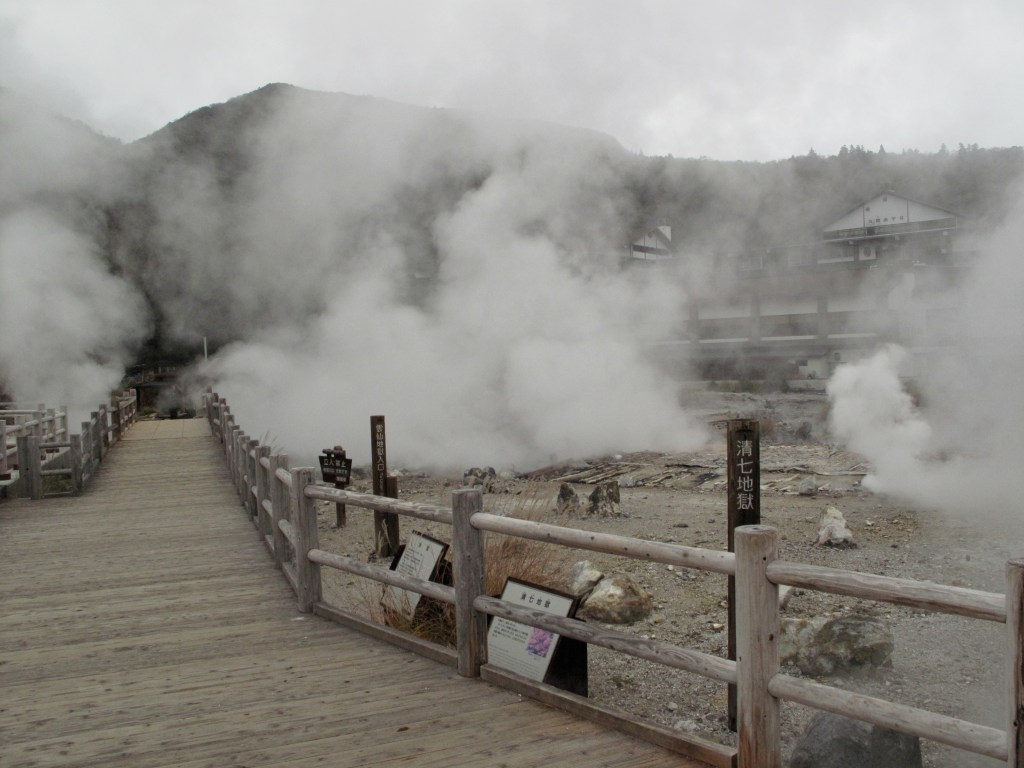
The Jigoku walk
Unzen Jigoku is a field of fumaroles and hot mud on both sides of the road at the top of the village. The walkway loops through it for about 30 to 60 minutes, past named vents with lurid names — O-jigoku, O-sakebi Jigoku, Kiyoshichi Jigoku, O-ito Jigoku — each with a small legend attached. The ground is white and yellow with sulphur deposits, the water in the pools is grey and bubbling, and in cold weather the steam swallows the path.
The renovation in autumn 2016 added a few things worth knowing about: an ashi-mushi station where you stand on a warmed platform to feel the geothermal heat through your feet, a workshop that steams eggs in the vents and sells them as onsen tamago, and a viewing deck where you can eat them while looking over the field.
The history here is not only geological. In the 1620s and 1630s this was the site of the torture and execution of Christians during the Tokugawa persecution, and a martyrs’ monument stands at the edge of the walk. Shimabara, on the other side of the peninsula, was the centre of the Shimabara Rebellion of 1637 to 1638, the last major armed uprising against the shogunate, and the two are part of the same story.
The walk is free, unlit and unstaffed. It is also slippery, and the steam makes the handrails wet, so shoes with grip matter. Do not step off the path; the crust is thin in places and the water underneath is close to boiling.
Mount Myoken and the ropeway
The Unzen Ropeway runs from Nita Pass station, about 15 to 20 minutes by car or taxi above the village, to a station just below the summit of Mount Myoken. It covers 500 metres and 174 metres of height in about three minutes, with a cabin every 12 minutes and large windows down to the floor.
From the top station, a short path leads to the summit observation point at 1,333 metres, the highest viewpoint in Nagasaki prefecture. The view takes in Mount Fugen and the raw grey dome of Heisei Shinzan across the valley, the Ariake Sea and the Amakusa islands, and on a very clear day Mount Aso and Kirishima. The upper station is 4 to 5 degrees cooler than the village and 8 to 10 cooler than the plain, which is why people carry a jacket up in summer.
- Fare — 1,500 yen return for adults, 750 for children, or 830 and 420 one way. Group and disability discounts exist.
- Hours — from 08:51, last upward run at 17:03 from April to October and 16:51 from November to March, with the last descent at 17:23 or 17:11. It stops in bad weather.
- Getting to Nita Pass — by car or taxi from the village, 15 to 20 minutes; on foot the trail is about 3 km and takes 1 to 1.5 hours uphill. The Nita Pass loop road is open 08:00 to 18:00 from April to October and 08:00 to 17:00 from November to March, and charges a small environmental cooperation fee of 100 yen or more for parking.
- Season — pink Miyama kirishima azaleas in early May, dogwood and new green in summer, and the famous Fugen-dake autumn forest, a national natural monument, in early to mid November, when the colours appear as patches inside the evergreen canopy. Rime ice on the summit trees in midwinter.
One current caveat: the trail from Nita Pass toward Mount Fugen via Azamidani has been closed by a landslide, and the ropeway operator directs hikers to the route via Mount Myoken instead. Check with the ropeway or the visitor centre before planning a summit hike rather than a viewpoint visit.
Onsen
Unzen’s water is sulphur and acid, milky white when it comes out of the ground, and it is piped directly into the baths. There are three old public bathhouses, one each at Shin-yu, Yu-no-sato and Ko-jigoku, plus the baths in the hotels.
- Unzen Shin-yu Onsenkan — 200 yen for adults, 100 for children, open 09:00 to 22:00, closed Wednesdays. A plain, old-fashioned bathhouse with a small car park.
- Yu-no-sato community bath — 200 yen for adults, 100 for children, open 09:00 to 22:00, closed Tuesdays. The oldest bathhouse in the village, in a back street behind the shops.
- Ko-jigoku Onsenkan — 500 yen for adults, 250 for children, open 09:00 to 20:00 from May to October and to 19:00 from November to April. A milky, unfiltered sulphur bath, and the one to choose if you only have time for one.
- Yokayu — 450 yen, open 09:00 to 20:00, with a small outdoor bath in the trees.
Hotel day passes are the other option, ranging from roughly 800 yen to 1,800 yen depending on the property, and several hotels open their baths to non-guests in the middle of the day. As always with day-use baths, the facilities close for cleaning at some point in the late morning, and a phone call before you go avoids a wasted trip.
The visitor centre
The Unzen Visitor Centre, near the top of the village, is free, open 09:00 to 17:00 and closed on Thursdays, with a small annex in a former park visitor centre that stays open all year. It covers the geology, the 1991 eruption, the vegetation and the history, has an English pamphlet for the walks and the baths, and shows footage of Unzen before the eruption. It is the right place to start if the weather closes in, and the free luggage storage and Wi-Fi make it a useful base.
Getting there
Unzen has no railway. Everything comes by bus or car, and the journey is the main cost of a visit.
- From Isahaya — the Shimabara Railway bus from Isahaya station takes about 1 hour 25 to 30 minutes to the Unzen stop. Isahaya is on the Nagasaki main line and the Shinkansen west Kyushu route.
- From Nagasaki — the prefectural bus from Nagasaki station takes about 1 hour 40 to 45 minutes. From Nagasaki airport, about 2 hours by bus or 1 hour 30 by car.
- From Shimabara — the Shimabara Railway bus from Shimabara station takes about 50 minutes, and about 40 from Shimabara port.
- By car — about 1 hour 15 from the Isahaya interchange, 1 hour from Isahaya station, 35 minutes from Shimabara station and 30 from Shimabara port. The village has paid car parks, and the ropeway car park at Nita Pass is free apart from the cooperation fee.
Once in the village, everything except Nita Pass is walkable. The Jigoku is at the top of the street, the baths are spread through the centre, and the visitor centre is a few minutes from the bus stop.
Where to stay
- Unzen village — the classic choice, with large ryokan and hotels around the Jigoku, most with sulphur baths and dinner included. Book well ahead in November and on public holiday weekends.
- Obama Onsen — on the coast below, 30 to 40 minutes by car, with sunset views over the Ariake Sea and cheaper rates.
- Shimabara — a castle town with more restaurants and easier transport links, 35 minutes away.
- Nagasaki city — possible as a long day trip, but the buses are infrequent and the last return leaves early.
Food
Dinner in the village is almost entirely hotel kaiseki, which is fine if you are staying but limiting if you are not. The local specialities are Shimabara somen, a thin wheat noodle served cold with a dipping sauce, and the potatoes and vegetables grown on the volcanic soil of the peninsula. Unzen’s onsen tamago, steamed in the vents, are sold at the Jigoku workshop and are the one thing to eat on the walk. Shimabara also makes castella-style cakes and kanzarashi, a starch noodle sweet, both sold in the town below.
Best time to visit
- Early May — Miyama kirishima azaleas on the upper mountain, and the start of the walking season.
- Late October to mid November — the Fugen-dake autumn forest, the best month for the ropeway.
- January to February — rime ice above and the cheapest hotel rates, with the Jigoku at its most dramatic in cold air.
- June to August — cool compared with the plain, but the mountain is often in cloud and the views disappear.
Avoid weekends in November if you can. The ropeway queue at Nita Pass in the autumn colour season can take an hour.
Practical tips
- Check the ropeway’s live status before travelling. It stops for wind and cloud, and in winter the Nita Pass road can close.
- Bring a jacket for the summit even in August, and shoes with grip for the Jigoku.
- Carry cash for the public baths; the 200-yen bathhouses do not take cards.
- The smell of sulphur will stay in your clothes. Pack them separately if you are moving on the same day.
- Buses are infrequent. Check the last departure from Unzen before you set out, and treat the timetable as the constraint on the day.
- Do not walk off the paths in the Jigoku, and keep children close; the ground is hot and thin.
- If you are coming for the ropeway and the Jigoku only, a car is far more efficient than the bus.
Suggested itineraries
One day from Nagasaki or Isahaya
- Morning bus to Unzen, arriving late morning.
- The Jigoku walk, with an onsen egg at the deck.
- Lunch, then a taxi to Nita Pass for the ropeway and the summit view.
- One public bath before the bus back.
Two days, with the peninsula
- Day one: Unzen village, the Jigoku and a long soak, overnight in a ryokan.
- Day two: the ropeway in the morning, then down to Shimabara for the castle and the samurai district, and the ferry across to Kumamoto if you are continuing west.
Before you go
Fares, bus times, ropeway hours and bath prices at Unzen change with the season and with the weather, and the mountain closes without notice when the wind picks up. The figures above were taken from the Shimabara peninsula tourism site, the Unzen ropeway operator, the Unzen tourism bureau, the Unzen visitor centre and the Nagasaki prefectural bus information, checked on 26 October 2026. Two things are worth reconfirming before you travel: whether the Azamidani trail to Mount Fugen has reopened, since a landslide has kept it closed, and the last bus back to Isahaya or Nagasaki on your date, because missing it means a taxi down the mountain.
Sources
- Shimabara Peninsula tourism: Unzen Jigoku (checked 2026-10-26)
- Shimabara Peninsula tourism: Unzen Ropeway, fares and hours (checked 2026-10-26)
- Unzen Ropeway official site: operation status and access (checked 2026-10-26)
- Unzen Tourism Bureau: day-use bath list and prices (checked 2026-10-26)
- Unzen Visitor Centre: opening days, facilities and access times (checked 2026-10-26)
Explore More of Japan
- Shimabara Travel Guide — the castle town on the other side of the peninsula
- Nagasaki Travel Guide — the nearest city, and the bus you arrive on
- Kurokawa Onsen Travel Guide — the other great hot spring town in Kyushu
- Beppu Onsen Travel Guide — the other volcanic steamscape, on the other side of the island
- Mount Aso Travel Guide — the caldera you can see from the summit on a clear day


Leave a Reply