Plan an independent visit to Hiroshima City Museum of Contemporary Art in Hiroshima with the main sights, food ideas, access checks, and seasonal notes.
Operational details such as opening hours, admission fees, and train times can change. Prefer official pages and reconfirm before you travel (sources checked on 31 October 2026).
Why visit
- Hiroshima City Museum of Contemporary Art opened on 3 May 1989 as the first public museum in Japan to take contemporary art seriously as its whole programme. That timing matters: Japanese public galleries were still mostly showing modern painting, and a city museum dedicated to contemporary work was a statement. The collection has been built since then around domestic and international contemporary art, with one specific axis that no other museum in the country shares, the theme of Hiroshima.
- The building is by Kisho Kurokawa, one of the architects of Japanese metabolism, and it sits in Hijiyama Park on a hill looking over the city. The museum describes the design as changing material along the vertical axis, natural stone at the bottom, then tile, then aluminium, which it reads as the development of civilisation and the flow of time from past to future. Whatever you make of that, the effect is a building that looks like it is stratified, and it is set into a wooded park rather than onto a street.
- The Hiroshima dimension is the reason this museum is different from any other contemporary art museum in Japan. When the museum was planned, the city commissioned 78 artists from Japan and abroad to make work on the Hiroshima theme, and the resulting body of commissioned pieces is the core of the collection. The list is not a regional roster: it includes Sam Francis, Lee Ufan, Nam June Paik, Ikeda Masuo, Inoue Bukichi, Saito Yoshishige and Shimizu Kyuhei alongside Japanese painters and printmakers. Seeing that programme as a single decision rather than a series of acquisitions is the thing to hold in mind while you walk the collection galleries.
- The museum is cheap enough to visit casually, which changes how you use it. The collection exhibition is 350 yen for adults and 150 yen for high school students and visitors aged 65 and over, and it is free on the third Sunday of every month. That is a price that supports an hour-long visit on a hot afternoon rather than a commitment. The special exhibitions are priced separately and vary, so the expensive part is optional and the permanent programme is not.
- Hijiyama Park is part of the visit rather than a way in. The museum sits in a green hill park with a view over Hiroshima, the approach from the Danbara side uses a moving walkway called the Hijiyama Skywalk, and the cafe faces a sculpture plaza. That combination makes it a place to spend an afternoon rather than tick off, and it pairs naturally with the wider park. It is also the opposite experience to the Peace Memorial Museum: same city, same century, completely different register.
Top places and highlights
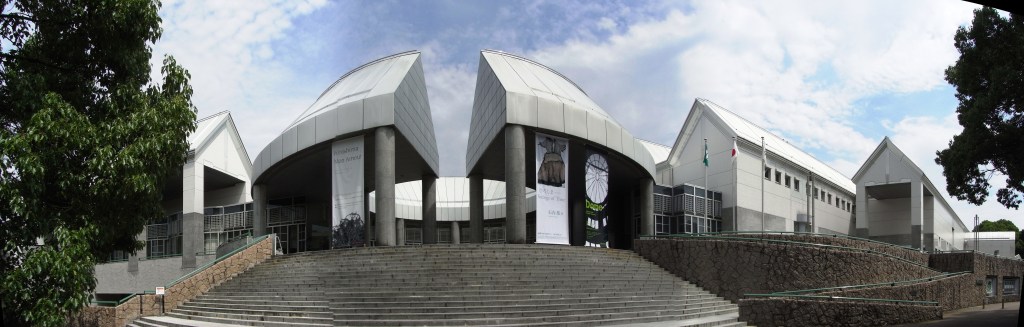
The Kurokawa building
Kisho Kurokawa designed the museum, and the building is presented as an argument rather than a container. Its materials change as you go up, from natural stone at the base through tile to aluminium at the top, and the museum reads that sequence as civilisation developing from past to future and as the flow of time. The architect’s own idea of symbiosis is cited as the concept behind the design, which in practice means the building is meant to sit with the park rather than against it. Look at the exterior before you go in, from the park side, and the material bands are obvious.
Theme Hiroshima: the commissioned works
At the planning stage, the city decided to commission artists at home and abroad to make work on the theme of Hiroshima, and 78 artists produced pieces under that programme. The museum’s own account frames it around the nuclear age that began on 6 August 1945 and the wish for peace and the value of life that Hiroshima represents. What makes it unusual is the range: painters, printmakers and sculptors from Japan, Korea, the United States, Britain and elsewhere, working on the same brief. The result is a collection axis that could not be assembled by buying at auction, and it is the museum’s clearest claim to be more than a regional gallery.
The collection exhibition
The collection galleries rotate between two kinds of show: highlight displays that present the strengths of the holdings, and thematic exhibitions built around Hiroshima as the central collecting axis. On top of those, the museum stages projects that start from the collection and reach into current practice, so the same objects reappear in different arguments. Because the collection is shown in selections rather than permanently, what is on the wall is always a curatorial position rather than an inventory. Check the current collection exhibition before you go, since the difference between a highlight show and a themed one is the difference between two museums.
Special exhibitions
The special exhibitions are where the museum shows individual artists and groups, and they are the reason the admission price is not fixed. The programme runs solo shows and group exhibitions across the widening field of contemporary expression, and the museum describes its aim as letting visitors meet the diversity of contemporary culture and encounter values they did not arrive with. These are separately ticketed, with advance tickets sold through the museum’s online shop and at the first-floor counter until the day before opening. If a specific exhibition is the reason for your visit, book ahead rather than assuming a ticket at the door.
The sculpture plaza and cafe KAZE
The cafe KAZE faces the museum’s sculpture plaza, and the museum describes it as bright and open, with an outdoor terrace used on fine days. That arrangement makes the plaza part of the building’s social space rather than a plinth for objects: you sit at the edge of it with a coffee, and the sculptures are what you look at. Because Hijiyama Park is wooded and the museum sits on a hill, the terrace is the part of the visit most dependent on weather and most rewarding when the weather is good. Use it as the break between the collection and the special exhibition.
Mocamoca
Mocamoca is a multifunctional space added when the building was renovated, and it is where the museum’s participatory programme happens. The museum runs a Mocamoca workshop every Sunday, and uses the space and the public areas for a varied programme of workshops and projects intended to open art and the museum to participants rather than visitors. For families this is the part of the building that works when the galleries do not, and for adults it is where the museum shows what it thinks a contemporary art museum is for. Check what is scheduled for the day you plan to visit.
Hijiyama Park and the Skywalk approach
The museum is inside Hijiyama Park, on ground that overlooks the city, and the museum notes that the walk to it passes through scenery that changes with the seasons. From the Danbara side the approach uses the Hijiyama Skywalk, a moving walkway, followed by about 700 metres of walking. That makes the arrival part of the trip rather than a transfer: you come up through a park on a hillside rather than off a street. The park also gives the visit somewhere to go afterwards, which is useful because the museum closes at 17:00 and the day rarely ends there.
Food and drink
- Cafe KAZE is inside the museum, facing the sculpture plaza, and it is described as bright and open with an outdoor terrace for fine weather. It is the obvious place to eat during a visit, and because the museum runs from 10:00 to 17:00 with last entry at 16:30, lunch fits naturally between the collection galleries and a special exhibition. Sitting on the terrace with the sculptures in front of you is the version of the museum that the building was designed around.
- The museum shop, called 339, sits towards the back of the building, and the museum notes that there is a space behind it where parents and children can spend time together. That detail is worth knowing if you are visiting with a child: the shop is not only a retail counter but a place to pause. The same shop runs an online store, which matters for anyone who sees an exhibition catalogue and does not want to carry it around Japan for the rest of the trip.
- Hijiyama Park is a park rather than a restaurant district, so eating beyond the museum means going down into the city. The museum is a bus ride or a 25-minute walk from Hiroshima Station, and the Danbara area at the foot of the hill has the commercial facilities, including the shopping centre whose car park serves museum visitors. The practical arrangement is to eat in the city and use the museum cafe for coffee rather than expecting a full meal at the top of the hill.
- Hiroshima’s own food is the reason to plan the meal outside. Okonomiyaki in the Hiroshima style, layered with noodles rather than mixed, is the city’s signature dish, and the concentration of restaurants is in the city centre rather than on Hijiyama. Oyster season on the Hiroshima coast runs through the colder months. None of this needs a specific recommendation, but it does argue for a museum visit in the morning and a proper lunch in the city afterwards rather than the other way round.
Getting there and around
- From Hiroshima Station, the bus takes about 10 minutes and walking takes about 25. The museum also sits on the city loop bus, Hiroshima Maple Loop, and on services bound for Daigaku Byoin, Asahimachi or Kenbyoin, where you get off at Danbara Chuo. That last part is the important detail: almost no bus drops you at the museum, so the stop is Danbara Chuo and the final approach is on foot.
- The walk from Danbara Chuo uses the Hijiyama Skywalk, a moving walkway, followed by about 700 metres of path through the park. The moving walkway is the reason the hill is manageable on foot at all, and it is worth knowing that the museum is at the top rather than at the roadside. Allow for the walk in your timing, particularly in summer, since the last stretch is outdoors.
- By car, there is no car park dedicated to the museum. The practical option is the Hiroshima Danbara Shopping Centre car park, which has 107 spaces, is free, and operates from 9:00 to 19:00, a short walk from the museum. The museum also issues proof of admission that you can take to the MaxValu service counter on the shopping centre’s first floor, so keep the ticket. Confirm the current arrangement at reception rather than assuming it is unchanged.
- There is on-site parking for visitors who have difficulty getting in or out of a car or walking, including people with physical, mental or intellectual disabilities, intractable diseases, older visitors, injuries and pregnancy, and for wheelchair and stroller users. This has to be arranged in advance by telephone, so call before you travel rather than arriving and asking. The number is published on the museum’s access page.
- The museum is open from 10:00 to 17:00, with entry until 30 minutes before closing. It is closed on Mondays and from 27 December to 1 January, with the exception that if a Monday is a public holiday, or falls on 6 August, the museum opens and closes on the following weekday instead. That exception around 6 August is specific to Hiroshima and worth knowing if you are planning around the anniversary.
Where to stay
- Hiroshima city centre is the practical base. The museum is a 10-minute bus ride or a 25-minute walk from Hiroshima Station, and the centre has the hotels, restaurants and tram network that make the Peace Memorial Park, the castle and the museum reachable without a car. Staying near the station puts the bus to Danbara within walking distance, which is the simplest version of the visit.
- Staying near the Peace Memorial Park is the alternative, and it suits anyone whose main reason for being in Hiroshima is that site rather than the contemporary art museum. From there the museum is a tram and bus combination across the city, which takes longer but puts the two halves of a Hiroshima visit in a logical order: the historical site one day, the contemporary response to it the next.
- Hijiyama itself has little accommodation, and that is fine, because the park is a daytime destination. What the hill gives you is a museum, a park and a view, not an evening. Plan to sleep in the city and treat the museum as a half-day, then use the remaining time on Miyajima or the Peace Memorial Park, both of which are the reasons most people come to Hiroshima in the first place.
Best time to visit
- The museum keeps a standard schedule of 10:00 to 17:00 with last entry at 16:30, and closes on Mondays and over the New Year period from 27 December to 1 January. If a Monday is a public holiday, or is 6 August, the museum opens instead and closes on the following weekday. The 6 August exception is the one date in the year when Hiroshima’s calendar and the museum’s calendar are explicitly connected.
- There are two free or reduced days worth planning around. The third Sunday of every month is Hello! Collection Day, when the collection exhibition is free. On 5 May, Children’s Day, admission is free for high school students and younger, and on 3 November, Culture Day, the whole museum is free. These are the days when the galleries are busiest, so the trade-off is obvious: free entry or a quiet room.
- The museum participates in a mutual discount with two other Hiroshima museums. Showing a ticket or stub from a special exhibition running at the same time at the Prefectural Art Museum, the Hiroshima Museum of Art or this museum gets 100 yen off the same-day admission at the other two. The discount does not apply to collection exhibitions and cannot be combined with other discounts, so it is worth checking only if you are already planning to visit two of the three.
- Spring and autumn are the comfortable seasons for the park, and the museum notes that the walk to it passes scenery that changes with the seasons. Summer in Hiroshima is hot and humid, and the final approach from Danbara Chuo is outdoors, which makes the moving walkway and the cafe terrace the parts of the day to time carefully. The museum is a good wet-day or hot-day destination because the galleries and the cafe are indoors, with the park as an optional extra.
Practical tips
- Admission to the collection exhibition is 350 yen for adults, 250 yen for university students, and 150 yen for high school students and visitors aged 65 and over, with group rates of 250, 150 and 100 yen for parties of 30 or more. Junior high school students and younger enter free, as do international students, residents on a family-stay status, and holders of the atomic bomb survivor certificate or various disability and specified-disease certificates, together with an attendant. Bring the certificate; it is checked at reception.
- Special exhibitions are priced separately and vary, so check the exhibition page before you budget the visit. Advance tickets are sold through the museum’s online shop and at the first-floor ticket counter until the day before the exhibition opens. If a particular show is your reason for coming, buy in advance and confirm the dates, because the museum’s collection galleries and its special exhibition hall run on different schedules.
- Photography rules are not uniform across the building, and the museum does not publish a single blanket rule on its visitor page, so ask at reception before you shoot. What is certain is that the special exhibitions often restrict photography and that borrowed works are frequently off-limits. The exterior, the park and the sculpture plaza are the safe subjects. If you are photographing for publication rather than for yourself, contact the museum in advance.
- There is no museum car park. Use the Hiroshima Danbara Shopping Centre car park, 107 spaces, free, open 9:00 to 19:00, and keep your admission proof for the MaxValu service counter. Visitors who cannot easily walk or get in and out of a car, and wheelchair or stroller users, can use the on-site parking but must arrange it by telephone beforehand. Arriving without a call and expecting a space is the mistake to avoid.
- The bus does not stop at the museum. Get off at Danbara Chuo and take the Hijiyama Skywalk moving walkway plus about 700 metres of walking through the park. The city loop bus Hiroshima Maple Loop also serves the area. Build the walk into your timing, especially in summer, and note that the uphill approach is the reason the museum feels removed from the city even though it is only ten minutes by bus from the station.
- Check the closing-day exception before you book. Mondays are closed, except when Monday is a public holiday or 6 August, in which case the museum opens and the following weekday closes. The New Year closure runs from 27 December to 1 January. Since the museum is small enough to visit in two hours, a wasted trip is a real cost, and the calendar changes more often than the standard Monday rule suggests.
- Pair the museum with the rest of Hijiyama Park rather than treating it as a standalone stop. The park is wooded, the walk up is part of the experience, and the museum’s own account emphasises the seasonal scenery on the way. That makes the museum a half-day: galleries, cafe terrace, then a walk in the park. It also softens the subject matter, which for the Hiroshima commissions is heavy, and gives you somewhere to think afterwards.
Suggested day-trip outline
- Take the bus from Hiroshima Station, about 10 minutes, or the city loop bus, and get off at Danbara Chuo. Walk the Hijiyama Skywalk moving walkway and then about 700 metres through Hijiyama Park to the museum. The uphill approach is the arrival, so allow time for it rather than treating it as a transfer.
- Look at the building from the park side before going in. The material bands from natural stone at the base through tile to aluminium at the top are the architect’s argument about time and civilisation, and they are only legible from outside. Kisho Kurokawa’s design is meant to sit with the park rather than compete with it, which is easier to see before you are inside the galleries.
- Start with the collection exhibition, which is the cheapest part of the visit at 350 yen and the part that makes this museum distinctive. Look for the Theme Hiroshima commissioned works, made by 78 artists from Japan and abroad under a single brief at the museum’s founding. If the current rotation is a highlight show rather than a themed one, adjust expectations: the same collection is being used to make a different argument.
- Take the special exhibition if one is on and interests you. It is separately ticketed, so decide at the desk rather than assuming it is included. Then stop at cafe KAZE, which faces the sculpture plaza and has an outdoor terrace, and take the break there rather than in the city. Mocamoca is worth a look if a workshop is running, particularly on a Sunday.
- Finish in the park, which is the part of the visit that costs nothing and takes as long as you want. If you are visiting on the third Sunday of the month the collection exhibition is free, and on 3 November the whole museum is free, so those are the days to combine the museum with a longer walk. Otherwise leave by bus for the city centre, where Hiroshima’s okonomiyaki is the natural end to the day.
Before you go
Timetables, fares, admission fees, and seasonal access rules can change. Check the official tourism and transport sites linked below for the latest information before you travel.
Explore More of Japan
Published guides that pair with this one:
- Hiroshima Peace Memorial Travel Guide: The Park, the Dome, and the Museum
- Miyajima Travel Guide: Itsukushima Shrine, the Floating Torii, and a Hiroshima Day Trip
- Onomichi Travel Guide: Temple Walks and the Shimanami Kaido Gateway
- Kintaikyo Bridge Travel Guide: Iwakuni’s Five Arches
Browse every Chugoku guide on this site for the rest of the region.
Sources
- hiroshima-moca.jp — About the museum (checked 2026-10-31)
- hiroshima-moca.jp — Visitor guide (checked 2026-10-31)
- hiroshima-moca.jp — Access (checked 2026-10-31)
- hiroshima-moca.jp — Floor guide (checked 2026-10-31)
- hiroshima-moca.jp — Collection (checked 2026-10-31)


Leave a Reply