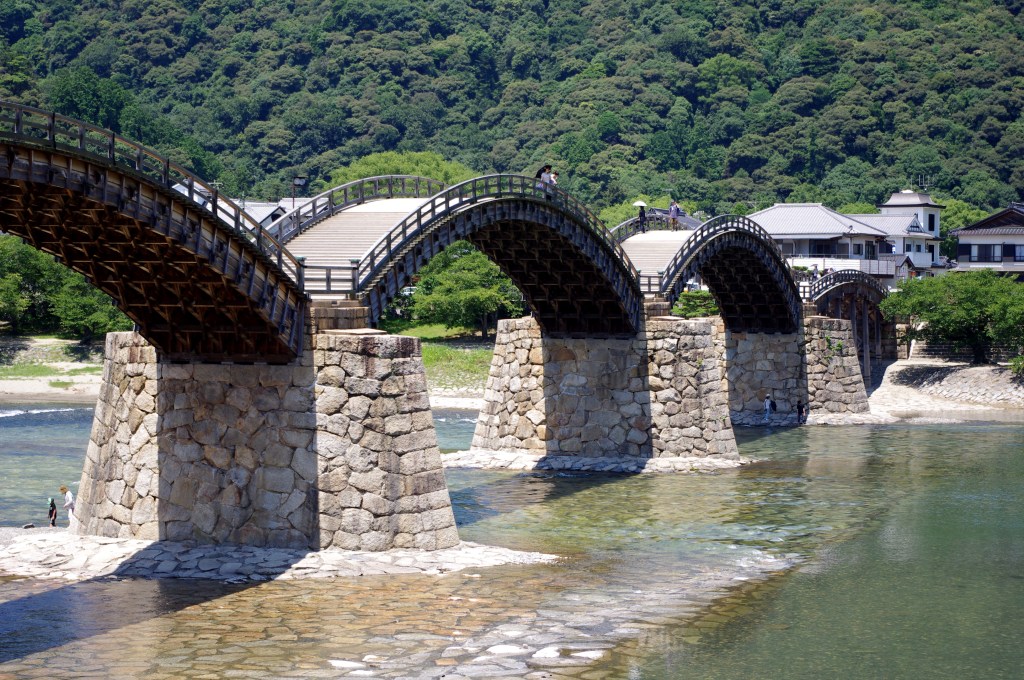
Kintaikyo is a wooden bridge with five spans, three of them arches, crossing the Nishiki River at Iwakuni in Yamaguchi Prefecture. It is not a relic: the structure standing today was completed in 1953, and the timbers were largely replaced between 2002 and 2004. What makes it worth the trip is that it is a working reconstruction of an Edo-period design, rebuilt each time by the same methods, on the same stone piers, in the same place.
That distinction matters when you plan the visit. Iwakuni is a small city with one famous bridge, a hilltop castle that is a 1962 reconstruction, and a park between them. The bridge is the reason to come; everything else is a two-hour add-on. This guide covers what is actually there, what the crossing costs since the fees changed on 1 September 2026, and how to reach it from Hiroshima or the Shinkansen.
Why visit
- The bridge is one of the few in Japan built as a series of timber arches, using a technique the city calls the voussoir arch method: overlapping beams, wedges and iron hoop binders rather than a truss.
- Because it is crossed on foot for a fee, you get the upstream view from the bank and the view down the deck, which are two different photographs.
- Iwakuni Castle sits on Mount Shiroyama above the town, reached by a three-minute ropeway, with the bridge and the river laid out below it.
- It fits a half day from Hiroshima, or a stop between Hiroshima and Yamaguchi, without a car.
- The town has two things you will not find elsewhere in one place: a protected population of white snakes, and a square pressed sushi that is made in layers.
The bridge: four structures on one set of piers
The Kikkawa family ruled Iwakuni from a castle on the mountain, with the Nishiki River acting as an outer moat. The river curves around the hill, which made the site easy to defend and awkward to live in: the warrior residences and the merchant town ended up on opposite banks. Ferries crossed for years. The first bridge on the site was an ordinary girder bridge with many piers, and it washed away.
1673: three months to build, one flood to lose
The first Kintaikyo was begun on 10 August 1673 and opened on 11 November the same year, a construction period of about three months under the lord Kikkawa Hiroyoshi. It lasted less than a year. On 1 July 1674, a storm took out three of the piers, the riverbed around them having eroded, and the arches came down with them.
The rebuild that followed is the one that mattered. Work started within days, the footings of the piers were strengthened, and the second bridge opened on 30 November 1674. That structure stood for 276 years.
1950: the typhoon that ended it
The second bridge survived wars, fires and floods until Typhoon Kezia on 14 September 1950. At the bridge the river ran at about 3,700 cubic metres per second, well above the 2,470 cubic metres per second the design allowed for, and the bridge went. When reconstruction was discussed, concrete was proposed. Iwakuni argued for timber, and the third bridge opened in 1953 to the original profile.
The bridge you cross today
The present bridge is the fourth. Between 2002 and 2004 the weakened members were replaced with Japanese cypress, following the methods used in the Edo period, and the city’s stated policy is not to harden the bridge but to keep the craft of rebuilding it alive. The numbers describe a specific structure rather than a generic “old bridge”:
- Total length 193.3 m, with a walking surface of 210 m; deck width 5 m, of which 4.3 m is usable.
- Three central arch spans of 35.1 m each, and two end spans of 34.8 m.
- Piers 6.6 m tall, built of stone.
- Timber in cypress, chestnut, zelkova, pine and oak, depending on the member.
The arches are not formed by curved beams. Each span is built from eleven numbered girder members laid from both ends, each overlapping the one below by about a third of its length, with a thin wedge driven between them so the ends bend down and the chain of beams becomes an arch. Dowels stop the members sliding, and pairs of C-shaped hoop irons clamp them at the sides. In 1683, ten years after the first bridge, V-shaped saddle bars were added over the arches; they are still part of the design.
Top places and highlights
Kintaikyo from the bank, then on foot
Walk the bank first. From the downstream side you see all five spans and the whole profile at once, which is the view that made the bridge famous and the one Hokusai drew. Then pay at the booth and cross. On the deck the arches read as a series of rises and dips rather than a smooth curve, and the gaps between the pier tops and the timber make the structure legible in a way a photograph does not.
Crossing is by ticket, return only, with no one-way fare. Since 1 September 2026 the adult fare is 500 yen and the elementary-school fare 250 yen; groups of fifteen or more pay less. The booth operates 8:00 to 17:00, later in the sightseeing season and until 19:00 in summer, but the bridge itself is open around the clock: outside staffed hours you pay into a box at the entrance. Lights go off at 22:00. Because the timbers are bare and the deck is stepped, the surface is slippery in rain and snow, and the bridge is closed when the river is in flood. Eating on the bridge is not allowed.
Kikko Park
Kikko Park occupies the ground at the foot of the castle hill, on the far side of the bridge from the bus stop. It holds three museums, including the Kashiwabara Art Museum with its collection on samurai life and armour, and two former samurai houses that can be seen from outside. The park is the town’s cherry-blossom ground, and in early April the combination of blossom, bridge and castle hill is the reason most photographers come.
Iwakuni Castle and the ropeway
The original castle was built in 1608 by Kikkawa Hiroie on Mount Shiroyama, about 200 m above the river, and demolished seven years later under the Tokugawa rule of one castle per domain. The keep you see is a 1962 reconstruction, moved about 50 m east of the original keep base so that it could serve as a viewing platform; the stone walls of the old keep platform survive and can be walked.
The ropeway base station is in front of Kikko Park, and the ride to the summit takes about three minutes in a 25-person gondola with a recorded commentary. From the summit station it is roughly ten minutes on foot to the castle. The top floor is an observation deck: Kikko Park, the bridge, the old castle town, the airport and, on a clear day, the islands of the Seto Inland Sea. Inside are a scale model of the bridge, armour and weapons.
Prices are separate: the ropeway is 900 yen return for adults and 400 yen for children, the castle 350 yen and 200 yen, and a set ticket covering bridge, ropeway and castle is 1,550 yen for adults and 700 yen for children against 1,750 yen and 850 yen bought separately. The castle is open 9:00 to 16:45. Allow 1.5 to 2 hours for the bridge, park, ropeway and castle together.
The white snakes
Iwakuni’s shirohebi are albino Japanese rat snakes, protected as a national natural monument and bred in the city. They were treated as messengers of the deity and as a sign of good fortune, and the White Snake Museum near the bridge is where you see them without waiting for a chance encounter on a riverbank.
Food and drink
Iwakunizushi is the local dish and it is not Nigiri. It is pressed in a square mould and built in layers: vinegared rice with fish, sliced egg, shiitake, chrysanthemum leaves and lotus root, cut into blocks so that the cross-section is the point. The lotus root is a local crop, and the town’s version is prized for the clean holes through the slice. Buy it near the bridge or at the station and eat it on the train; it travels better than most sushi.
Around the bridge approach there are ice-cream shops in numbers that surprise first-time visitors, with flavours that run from matcha and sakura to seasonal experiments. The station area has the more dependable sit-down restaurants; the riverside is for snacks. Note that many riverside places keep seasonal hours and close earlier outside blossom and autumn weekends.
Getting there and around
There are two stations and they are not interchangeable.
From Iwakuni Station
This is the local station on the JR Sanyo Line, about 50 minutes from Hiroshima and 15 minutes from Miyajimaguchi, which makes it the natural stop if you are combining Iwakuni with Miyajima. Buses leave from stop 1 outside the station every 10 to 15 minutes for the Kintaikyo bridge, take roughly 15 to 20 minutes and cost 350 yen. Pay on the way out, by cash or by Suica, PASMO or ICOCA; cards and QR payments are not accepted on board.
From Shin-Iwakuni Station
This is the Shinkansen station and it sits away from the town and the bridge. Hiroshima to Shin-Iwakuni is 16 minutes, Shin-Osaka about two hours, Tokyo about four. Buses to the bridge leave from stop 1 every 20 to 30 minutes and also cost 350 yen. If your pass is a rail pass and you are coming from far away, this is the fast option; if you are coming from Hiroshima or Miyajima, Iwakuni Station is simpler.
On foot and around town
The bridge, Kikko Park and the ropeway are a compact cluster and are walked, not driven. Kintaikyo bus centre is about a minute from the bridge, which makes the bus the practical arrival point. Iwakuni Kintaikyo Airport is on the edge of town with a bus timed to flight arrivals.
Iwakuni works well as a stop between Hiroshima and Yamaguchi, or as a half-day add-on to the Miyajima ferry and shrine; the two are close enough on the Sanyo Line to pair in one day if you start early. If you are giving Hiroshima a full day, the Peace Memorial Park and museum take the morning, and Iwakuni fits the afternoon.
Where to stay
Iwakuni has business hotels around Iwakuni Station and a smaller number of options near the bridge, which is enough for one night but not a destination in itself. Most travellers base in Hiroshima, where the choice is far wider, and come out for the day; the last trains back are early enough that an evening on the river is not realistic unless you stay.
Staying in Iwakuni has one advantage: the bridge at first light, before the bus parties arrive, when the water is still and the deck is empty. If you want that photograph, stay locally rather than commuting.
Best time to visit
- Early April, for cherry blossom along both banks and in Kikko Park. This is also the busiest week of the year.
- Late November, for autumn colour on the hills behind the castle and low, clear light on the timber.
- Summer, for long evenings and the river at its liveliest; the trade-off is heat and humidity, and the bridge deck in full sun.
- Winter, for bare trees, sharp structure and few visitors; the deck can be icy.
The bridge is a photograph in every season, but the composition changes: blossom frames it, summer foliage hides the far bank, autumn gives colour behind it, and winter strips it back to timber and stone.
Practical tips
- Buy the set ticket at the bridge if you intend to do the ropeway and castle; it cannot be added afterwards at the discounted price.
- Bring cash for the night box if you cross outside staffed hours, and expect the lights to be off after 22:00.
- The deck is stepped and unroofed. Wet timber is genuinely slippery, so shoes matter more than they usually do.
- Do not plan to eat on the bridge; there are benches in Kikko Park instead.
- Check the river level after heavy rain. Flood closures happen, and the bridge is the whole reason for the trip.
- Weekend car parks fill by mid-morning in blossom season. The bus avoids the problem entirely.
- If you are combining Iwakuni with Miyajima, do Iwakuni first: the light on the bridge is better in the morning and the island is busier in the afternoon.
Suggested day-trip outline
- Take an early train from Hiroshima to Iwakuni Station, then the bus from stop 1 to the Kintaikyo bus centre.
- Walk the downstream bank for the full five-span view before crossing.
- Cross the bridge, then walk through Kikko Park to the ropeway base station.
- Ride up, walk the old keep platform, and take the observation floor in the castle.
- Come down, see the white snakes if the museum is open, and buy Iwakunizushi for the train.
- Return by bus to Iwakuni Station, and either continue to Yamaguchi or double back to Hiroshima.
Before you go
Bridge tolls, ropeway hours, museum opening days and bus timetables change, and Iwakuni changed its bridge fee on 1 September 2026. The figures in this guide reflect the official pages checked on 26 October 2026; reconfirm the fare and the ropeway schedule before you travel, particularly if you are visiting on a public holiday or in the first week of April.
Sources
- Iwakuni City: Kintaikyo summary, fees and set ticket (checked 2026-10-26)
- Iwakuni City: Kintaikyo history (checked 2026-10-26)
- Iwakuni City: Kintaikyo structure and dimensions (checked 2026-10-26)
- Iwakuni City: bridge fee revision notice, September 2026 (checked 2026-10-26)
- Iwakuni tourism: access from Iwakuni and Shin-Iwakuni stations (checked 2026-10-26)
- Iwakuni tourism: Iwakuni Castle (checked 2026-10-26)
- Iwakuni tourism: Iwakuni Castle Ropeway (checked 2026-10-26)
- JNTO: Iwakuni destination guide (checked 2026-10-26)
- JNTO: Kintaikyo Bridge (checked 2026-10-26)
Explore More of Japan
- Miyajima Travel Guide — the floating torii and the ferry, 15 minutes down the line
- Hiroshima Peace Memorial Travel Guide — the park, the dome and the museum
- Iwami Ginzan Travel Guide — the silver mine town further along the Chugoku coast
- Japan’s Old Towns — the preserved castle towns and post towns this site covers by type


Leave a Reply