Planning a visit to Okayama Korakuen? This English guide covers the garden’s layout, the castle next door, access from Okayama Station, and what to reconfirm before you go.
Operational details such as opening hours, admission fees, and train times can change. Prefer official pages and reconfirm before you travel (sources checked on 26 October 2026).
Why visit
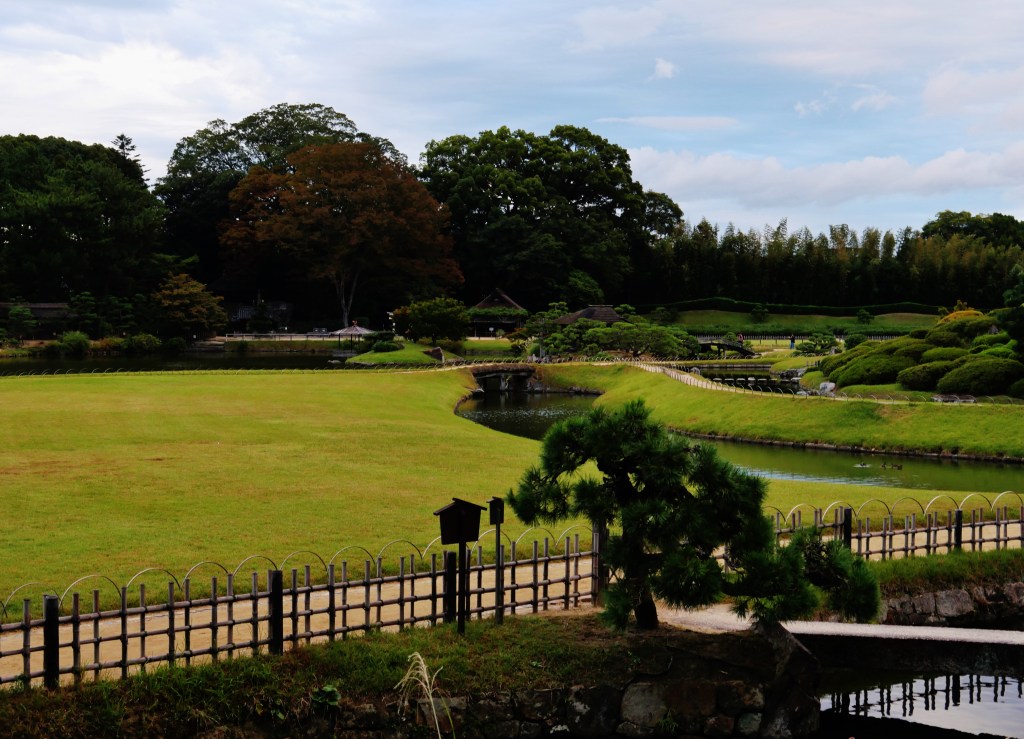
Korakuen is a daimyō garden, not a temple garden: broad lawns where you would expect raked gravel, open water instead of a hidden pond, and a borrowed view of Okayama Castle that was designed into the planting. The second lord of Okayama, Ikeda Tsunamasa, ordered it in 1687 and put his senior retainer Tsuda Nagatada in charge of the works; the ground was finished by 1700.
The site explains the shape. The Asahi River flood works upstream had turned a large gravel riverbed behind the castle into land that could be used, so the garden was laid out on a sandbank rather than cut out of a hillside, and the reclamation of Kojima Bay was paused while the digging was done. What resulted is about 144,000 square metres, with 19,600 square metres of lawn and a winding stream of roughly 640 metres threading through the ponds, hills and tea houses — the opposite of a garden built to be seen from one veranda.
It has been a public garden for longer than most: the Ikeda family handed it to Okayama Prefecture in 1884, it was designated a Place of Scenic Beauty in 1922 and a Special Place of Scenic Beauty in 1952. Almost all the buildings burned in the 1945 air raid and were rebuilt afterwards — the main pavilion was reconstructed in 1960 from an Edo-period plan — so what you walk through is an accurate garden with honest twentieth-century carpentry in it.
- One of Japan’s great stroll gardens, built in 1687–1700 and designed to borrow Okayama Castle as scenery.
- Open lawns and wide water make it feel different from the enclosed temple gardens of Kyoto.
- Okayama Castle stands directly across the river, so garden and castle fit a single half-day.
- The easiest garden of this quality to reach from a Shinkansen stop in western Japan.
Top places and highlights
The garden paths
Korakuen is a circuit garden: you walk, and the view rearranges itself. Tsunamasa’s son Tsugumasa added the height that makes this work, raising the six-metre Yuishin-zan and running water around its foot to link the two main ponds. The route is deliberately unmonumental — a low hill, a bridge, a stretch of lawn — and each turn opens a view of the next.
Enyō-tei
The pavilion was the lord’s living room when he visited, positioned so that the main room looks across Sawa-no-ike to Yuishin-zan and out to Mount Sō beyond the garden wall. That borrowed scenery is the point of the whole composition. Enyō-tei is normally closed and opens to the public only a couple of times a year, so treat an interior visit as a bonus rather than the plan.
The Noh stage
Tsunamasa built the stage in 1707; he was a keen and capable performer who left a collection of fine costumes, and the household and sometimes ordinary people of the domain were allowed to watch. The present stage is a post-war reconstruction, and performances still take place on it.
Rice, tea and the working garden
This was never only a pleasure ground. Rice has been planted and harvested inside the garden since the 1680s, tea was grown, and there were archery and horsemanship grounds with stands for the lord to watch from — the martial half of a domain lord’s education, kept inside the same walls. In 1771, with the domain’s finances squeezed, the fields were grassed over; two years later they were put back. The paddies you see now are a continuation of that argument, not a decoration.
Okayama Castle
The black-walled keep across the river is the reason the garden’s borrowed view exists. The original was lost in the same 1945 raid and rebuilt in concrete in 1966, so go for the exterior, the site and the view back over the lawns rather than for the interior. Combined tickets are often available; confirm the current arrangement at the gate instead of assuming it.
Seasonal plantings
Plum comes first, then cherry, then the iris beds in early summer, then autumn colour — and the open layout means the change is visible across the whole garden rather than in one corner. The garden also runs evening openings and illumination in some seasons. Dates move every year, so check what is actually on before you book around a flower.
Tea houses
Small tea houses inside the garden serve matcha and sweets at set times, and some interiors require you to take your shoes off. The paths are gravel and largely unshaded, which matters more than the tea stop.
Food and drink
Okayama’s signature dish is barazushi, and its origin is a tax story. The first lord, Ikeda Mitsumasa, ordered frugality — one soup and one dish at a meal — and the townspeople answered that fish and vegetables scattered over rice still counted as one dish, because they were part of the rice. The result is a vinegared rice with a dozen or more toppings, seasonal and different in every household; in spring it runs to sawara and bamboo shoots, in autumn to mushrooms.
The other local fish is mamakari, a small herring-family fish (sappa) cured in vinegar. The name means “borrow the rice” — it is said to be good enough that you eat your own rice out and go next door for more. It is fattest in autumn, and it turns up as sushi, as a topping on barazushi, and as an everyday vinegar cure in supermarkets. Both dishes are celebration food that has become lunch food, and Okayama Station has sold a barazushi ekiben under the name Momotarō no Matsuri-zushi for more than fifty years.
For sweets, kibi dango is the Momotarō dumpling, and its modern commercial life is surprisingly recent: a local confectioner is said to have sold it dressed as Momotarō around the time of the Russo-Japanese War. Okayama is also the country’s leading producer of white peach, Muscat of Alexandria and Pione grapes, which is why the station and the department stores are full of fruit rather than the garden.
- Eat barazushi at a sushi shop or department-store basement; it travels well for a train.
- The station area has the widest choice. Inside the garden, expect light refreshments rather than a meal.
- Fruit is seasonal and expensive; a single perfect peach is the local luxury purchase.
Getting there and around
- From Okayama Station it is about a 25-minute walk, a bus to Korakuen-mae, or a tram to Shiroshita followed by a ten-minute walk. The tram is the more interesting approach.
- Okayama is on the Sanyō Shinkansen, so the garden can be a stop between Hiroshima and Osaka rather than a separate trip.
- The garden and castle are joined by a bridge over the Asahi River; once inside, the visit is entirely on foot.
- Allow two to three hours for the garden, more with a tea stop and the castle.
- A car is a liability here: parking is limited and the one-way streets around the castle are slow.
- Kurashiki is roughly fifteen to twenty minutes away by local train, which makes a two-part day easy.
Where to stay
- Hotels around Okayama Station are the practical choice — restaurants, trams and the Shinkansen on the doorstep.
- Kurashiki is a better base if you want an evening in the canal district, and still close enough for a morning here.
- The garden has no accommodation of its own; the nearest rooms are in the city, a tram ride away.
- Staying the night in Okayama rather than day-tripping from Osaka buys you the first hour after opening, when the lawns are empty and the light is low.
Best time to visit
- Spring blossom and autumn colour are the peak windows and the busiest weekends.
- Early summer brings the iris beds; summer itself is hot and humid, with the garden at its greenest.
- Winter is quiet and bare, with clear views of the castle through the trees and fewer visitors.
- Check for evening openings and illumination, which are seasonal and not year-round.
Practical tips
- The garden opens earlier in summer and closes earlier in winter; confirm the current hours before a late visit.
- Admission is charged, and the ticket is separate from the castle unless a combined ticket is on offer.
- Wear shoes you can slip off if you plan to enter a tea house.
- The lawns are open sun in July and August. Bring water and a hat; shade is scarce by design.
- Mosquitoes are active near the ponds in summer evenings.
Suggested day-trip outline
- Take the tram from Okayama Station to Shiroshita and walk to the garden gate.
- Walk the loop slowly, climbing Yuishin-zan for the view back over the ponds.
- Stop for matcha at a tea house, then leave by the north gate.
- Cross the bridge to Okayama Castle for the view back over the garden.
- Lunch on barazushi near the station, then take the train to Kurashiki for the afternoon, or return on an evening Shinkansen.
Before you go
Timetables, fares, admission fees, and seasonal access rules can change. Check the official tourism and transport sites linked below for the latest information before you travel.
Sources
- Okayama Korakuen (official) (checked 2026-10-26)
- Okayama Korakuen: history and overview (checked 2026-10-26)
- Okayama Prefecture: Korakuen designation sheet, hours and access (checked 2026-10-26)
- Okayama Tourism: Okayama barazushi (checked 2026-10-26)
- MAFF: matsuri-zushi / barazushi (checked 2026-10-26)
Explore More of Japan
If you are planning a wider Japan itinerary, these guides pair well with this destination:
- Bitchu-Matsuyama Castle Travel Guide: The Mountain Keep above Takahashi — Stay in the same region with Bitchu-Matsuyama Castle Travel Guide.
- Kurashiki Travel Guide: Bikan Canal District — Stay in the same region with Kurashiki Travel Guide.
- Matsue Castle Travel Guide: A National Treasure Keep under Repair — Stay in the same region with Matsue Castle Travel Guide.
- Japan’s Twelve Original Castles — every surviving Edo-period keep, plus the rebuilt ones
- Japanese Gardens — groups them by garden type, and by season


Leave a Reply