Ouchi-juku is a single street, about 450 metres long, lined with thatched houses that face the road with their gable ends and open straight onto it. There is no pavement, no fence, no interpretive centre at the entrance. The valley closes in on both sides, the road runs through the middle, and the village simply is what it was.
That is rarer than the guidebook language suggests. Japan has three post towns preserved as districts of this kind, and Ouchi-juku was the third, listed in 1981 after Tsumago and Narai in the Kiso valley. Unlike those two, which sit on the Nakasendo between Kyoto and Edo, this one is on a mountain road in southern Fukushima that almost nobody uses any more — which is exactly why it survived.
Why visit
- It is a working village, not a reconstruction: the thatched houses are homes and shops, and the residents still cut and rethatch their own roofs.
- The composition is unusual. Thirty-odd houses of the same construction, on one straight street, with rice fields behind and mountains above, is a landscape that no other preserved district has.
- The negi soba — soba eaten with a whole leek instead of chopsticks — is a genuine local habit rather than a tourist invention.
- Two hours from Aizu-Wakamatsu and reachable by a rural railway line with a thatched station, which is half the pleasure of getting here.
- In February the snow festival lights the street with lanterns and puts fireworks over the roofs, which is the image most photographs of the village come from.
How a post town ended up preserved
The road here is the Aizu-nishi kaido, also called the Shimotsuke kaido, which ran about 32 ri — roughly 130 kilometres — from Aizu-Wakamatsu to Imaichi, the post town just north of Nikko. It was the shortest route from Aizu to Edo, and the domain used it for the alternate-attendance journeys to the capital and for shipping rice.
The street was laid out in the early seventeenth century, and the settlement grew as a half-farming, half-innkeeping post town, with a honjin for senior lords and officials and a wakihonjin as a reserve. It sat about five ri, or twenty kilometres, from Wakamatsu castle, which made it the first stop out of Aizu and a natural place for a midday meal.
Then two things went wrong, in the way that preserves places. In 1680 the shogunate tightened control of traffic on the roads that were not among the five official highways, and Aizu’s processions stopped coming through. The town faded back to farming and innkeeping. In 1884 the railway reached the Nikko road, and what traffic remained went by train. The village was left in a valley too steep to be worth redeveloping, and the thatch survived because nobody could afford to replace it.
By the 1970s that neglect had become valuable, and the argument turned to preservation. In 1981 the old post-town area and the ground around Takakura shrine — 11.3 hectares in all — were designated an Important Preservation District for Groups of Historic Buildings. The residents adopted a charter with three principles: do not sell, do not lend, do not destroy. The houses stayed in family hands, and the village kept living in them.
Top places and highlights
The street itself
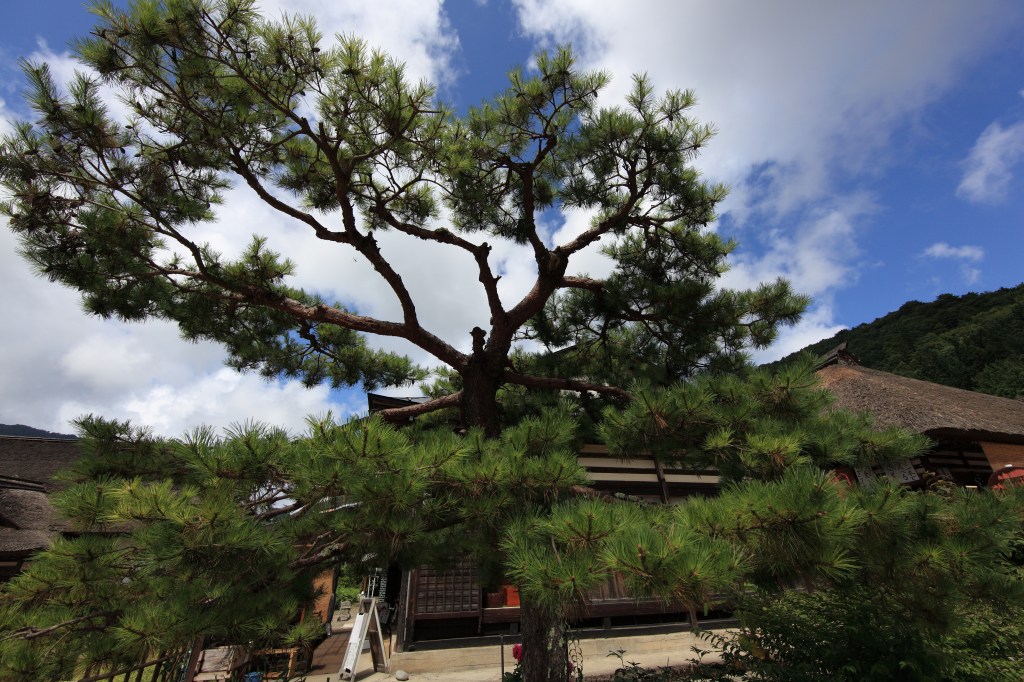
Walk it slowly, in both directions. The houses are built with the ridge parallel to the road and the gable facing it, a style that gives the street its rhythm of triangles, and most of them are open at the front as shops, soba restaurants or inns. The upper floors are dark, the lower ones bright with goods, and in summer the eaves are hung with gourds and wind chimes.
Because people live here, the etiquette matters: do not walk into gardens, do not photograph through windows, and do not stand in a doorway to frame a shot while the owner is trying to work. The village asks visitors to treat it as a neighbourhood, which it is.
The viewpoint
At the far end of the street, behind the last houses, a path climbs for about five minutes to a small platform above the village. From there the whole street lies below you in perspective, thatch upon thatch, with the valley behind. It is the photograph everyone comes for, and it is worth the climb in any season. In winter the path ices over, and the local advice is to fit simple spikes or at least to carry a torch if you go up at dusk.
The machiya museum
In the middle of the street, the townscape museum occupies a reconstruction of the former wholesale honjin. Inside there are period rooms, photographs and household tools, and it explains the road and the post-town system in more detail than the street itself can. It is 250 yen for adults and 150 for schoolchildren, open 9:00 to 16:30, closed from 29 December to 3 January, cash only.
Takakura shrine and the Hange festival
The shrine at the top of the village is dedicated to Prince Mochihito, and its festival falls on 2 July, the day of hangesho in the old calendar. The date was moved in the Meiji period because the original one collided with the planting season. It is a small local festival, not a spectacle, but if you happen to be here for it you will see the village at its most itself.
The fire drill
On 1 September every year, 28 water cannons along the street fire into the air at once. It is a drill, not a festival, and it exists because a single spark in a thatched village is a catastrophe. Visitors are welcome to watch. If you are here in early September, it is worth arranging the day around.
Food and drink
The dish is negi soba, also called Takato soba, and the method is the point: instead of chopsticks you are given a long white leek, and you use it to lift the noodles and then bite the leek as you go. It is said to have come from the Takato domain in Shinano, whose lords passed through on the way to Edo. Expect around 1,000 to 1,300 yen for a bowl.
The rest of the street sells soba, rice bowls, grilled fish, pickles, dango and soft cream, and the shops are small family operations that open late and close early. Most are trading between about 9:00 and 16:00; outside those hours the village is a village again. If you want a proper meal rather than a snack, eat before two o’clock.
There is no bar scene and no evening restaurant. If you stay overnight in one of the minshuku, dinner is served at the inn, and afterwards the street is dark and silent except for the river.
Getting there and around
This is the part that needs planning, because the last leg is a rural bus with six departures a day.
- By train — the Aizu Railway from Aizu-Wakamatsu to Yunokami-Onsen station. The station building itself is thatched, rebuilt in 1987, and is worth ten minutes before the bus.
- By bus — the Saruyu-go minibus runs from Yunokami-Onsen station to the Ouchi-juku entrance in about 20 minutes, six times a day from 9:45 to 14:55, with returns between 10:25 and 15:35. Reservations the day before take priority, on 0242-75-2321.
- Tickets — a two-day bus pass is 1,100 yen, and the common discount ticket combining the Aizu Railway and the bus is 2,200 yen for adults from either Nishi-Wakamatsu or Aizu-Tajima.
- By car — about 35 kilometres from the Aizu-Wakamatsu interchange via route 118, or 50 from Shirakawa via routes 289 and 121. Parking is 500 yen a day, cash, and cars are not allowed into the village.
- From Tokyo — Shinkansen to Koriyama, then the Ban-etsu West line to Aizu-Wakamatsu, then the Aizu Railway. Allow four to five hours.
A taxi from Yunokami-Onsen station takes about 11 to 15 minutes and is the sane option if the bus times do not fit, particularly in winter.
Once here, everything is on foot and the street is flat. The only climb is the viewpoint path. In winter, snow boots and a check on the road conditions matter more than any other preparation; the approach road ices, and the pass over the mountain is the first thing to close.
Where to stay
The village has a handful of minshuku in the thatched houses, which is the reason to stay: you get the street after the last bus has gone and before the first one arrives.
- Ouchi-juku minshuku — a few houses take guests, with dinner and breakfast and futon on tatami. Book well ahead, especially for the snow festival.
- Yunokami-Onsen — about 30 ryokan and hotels in a small hot spring town on the river below, 20 minutes away by bus. The practical choice if the village is full, and it adds a bath to the trip.
- Aizu-Wakamatsu — the city has the full range of hotels, and works if you are combining the village with the castle and the samurai district.
Best time to visit
- February — the snow festival, with lanterns along the street from 18:00 to 20:00 for three nights and fireworks on the Saturday. Cold, crowded and the best version of the place.
- Late April to May — fresh green, the rice fields flooded, and comfortable walking. The quietest good season.
- August — hot and green, with the street at its busiest and the mountains hazy.
- Late October to early November — autumn colour on the valley sides, and the last of the year’s comfortable weather.
Winter outside the festival is beautiful and much quieter, but the buses are thin and the road can close. Check the forecast and the bus before committing.
Practical tips
- Go early. Coach parties arrive from late morning, and before 10:00 the street belongs to the residents.
- Check the Saruyu-go timetable before you book the train, and reserve the day before if you can.
- Bring cash. Parking, the museum and most shops do not take cards.
- Eat lunch before two o’clock; the kitchens close early.
- Do not drive into the village. The car park is 500 yen and outside the street.
- Treat the street as a neighbourhood: no tripods across doorways, no entering gardens.
- In winter, add spikes for the viewpoint path and allow extra time for the pass.
Suggested itineraries
Half day from Aizu-Wakamatsu
- Morning train to Yunokami-Onsen, then the 10:30 or 11:30 Saruyu-go.
- Walk the street, climb to the viewpoint, visit the museum.
- Negi soba for lunch.
- Return on the 13:55 or 14:15 bus and be back in the city by late afternoon.
One night, with the hot spring
- Arrive in the early afternoon and leave your bag at a minshuku in the village.
- The street in the late light, then dinner at the inn.
- Next morning, walk the empty street before breakfast.
- Bus down to Yunokami-Onsen for a bath and the thatched station, then the train back.
Before you go
Bus times, museum hours and the snow festival dates all change, and the figures above come from the Ouchi-juku Conservation Foundation, the Shimogo town tourism office, Aizu Railway and the festival organiser, checked on 26 October 2026. Two things are worth reconfirming before you travel: the Saruyu-go timetable, which is revised with the railway timetable each March, and the winter road conditions, since the pass can close in heavy snow. The festival is held on the second Saturday and Sunday of February, which will be 13 and 14 February in 2027.
Sources
- Ouchi-juku Conservation Foundation: history and roof preservation (checked 2026-10-26)
- Ouchi-juku Tourist Association: opening hours and parking (checked 2026-10-26)
- Shimogo town: townscape museum hours and admission (checked 2026-10-26)
- Aizu Railway: Ouchi-juku common discount ticket (checked 2026-10-26)
- Shimogo town: Ouchi-juku snow festival programme (checked 2026-10-26)
Explore More of Japan
- Aizu-Wakamatsu Castle Travel Guide — the castle town at the other end of this road
- Oze National Park Travel Guide — the marshland and mountains to the south
- Ginzan Onsen Travel Guide — another street of old wooden buildings, further north
- Komine Castle Travel Guide — the Shirakawa end of the same old road
- Day Trips from Tokyo — what fits a single day from the city


Leave a Reply