Kinosaki is the onsen town that behaves the way people imagine onsen towns should. There is a shallow river running through the middle, willows along both banks, stone bridges at short intervals, and the bathhouses are not inside the hotels but out in the street, which is the entire point: you put on the yukata and the wooden sandals provided by your inn and walk from one bath to the next in public.
The town has been doing this for a long time. It was opened, by its own account, about 1,300 years ago by a monk named Dochi Shonin, and the spring that started it is now the Mandara-yu bath. What makes it work today is the density: the station, the canal, the seven bathhouses, the inns and the two ropeway stations all sit inside a rectangle you can cross in fifteen minutes.
Why visit
- Bathing is a walk rather than a facility. The public baths are spread along the canal, and going to three of them in an evening is the standard way to spend it.
- Yukata and geta are provided by the inns and worn in the street, which sounds like a gimmick and is not: it changes the whole feel of an evening.
- The water is a sodium-calcium chloride spring at about 42 degrees, and the seven baths differ in building, water and outdoor setting rather than in chemistry.
- Snow crab from the Sea of Japan is landed nearby, and from November the inns serve it as kaiseki.
- It is a direct train from Kyoto or Osaka, with no change, which makes it the easiest traditional onsen town in Kansai to reach.
The seven baths, and what is actually open
Kinosaki is sold as seven public baths, and the number is real, but not all of them are usable at any given time. This matters more than any other detail in this guide.
In late 2026, two of the seven were out of service. Kono-yu, the bath with the stork legend and the oldest of the group, closed in May 2026 for structural repairs and was scheduled to reopen on 30 October. Sato-no-yu, the bath beside the station, has been shut since 31 March 2024 with no reopening date announced. The remaining five — Mandara-yu, Gosho-no-yu, Ichi-no-yu, Yanagi-yu and Jizo-yu — were open. Check the association’s page on the day, because the count changes.
Each bath also closes one day a week, and the days do not line up, so a Thursday visit has fewer options than a Saturday one:
- Ichi-no-yu — 7:00 to 23:00, closed Wednesday. The most central, with a cave-style bath carved to look like a grotto.
- Gosho-no-yu — 7:00 to 23:00, closed Thursday. The grand one, built like a Kyoto palace with a waterfall in the outdoor bath.
- Jizo-yu — 7:00 to 23:00, closed Monday. The one near the station end, with a wooden interior.
- Mandara-yu — 15:00 to 23:00, closed Wednesday. The original spring, with a curved Chinese-style gable and an outdoor bath facing the hill.
- Yanagi-yu — 15:00 to 23:00, closed Thursday. The smallest, tucked under a willow, and the one locals use.
- Kono-yu — 7:00 to 23:00, closed Tuesday. The open-air bath among trees, closed for repairs through October 2026.
A single entry is 800 yen for adults and 400 for children from three to elementary age. If you are going to more than one, the day pass called Yumepa is the answer: 1,500 yen for adults and 750 for children, sold at the window of any bath, unlimited entry for the day. Two baths and it has paid for itself.
Last entry at every bath is 30 minutes before closing. That catch is easy to forget after dinner, when the town is at its best and the clock is against you.
Top places and highlights
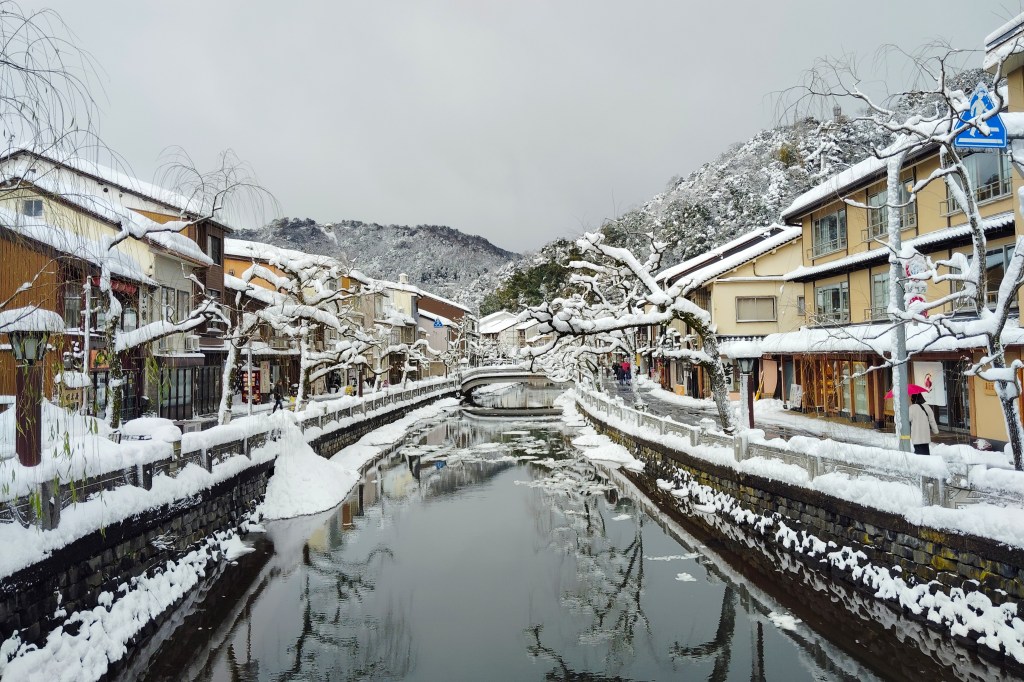
The Otani river and the canal street
The town’s spine is a straight channel lined with willows, crossed by small stone bridges every hundred metres or so. The best of the wooden architecture faces it: two-storey inns with latticed fronts, a few shops, and the bathhouses set back behind small gardens. It is not long — perhaps a kilometre from the station to the far end — and it is at its best twice a day, in the early morning before the shops open and after dark when the lamps are lit and everyone is in yukata.
There is a small detail worth knowing: the willows were planted deliberately, and the town still prunes them to a height that frames the buildings rather than hiding them. In late March and early April the same banks are in cherry blossom, which is the busiest week of spring.
The ropeway to Mount Daishi
A cable car climbs about 200 metres to the summit of Mount Daishi in roughly seven minutes, with a stop halfway at Onsenji temple. The round trip to the summit is 1,200 yen for adults, or 750 yen if you only go as far as the temple, and it leaves every 20 minutes at :10, :30 and :50 from 9:10, with the last ascent at 16:30 and the last descent at 17:10. It closes on the second and fourth Thursday of each month.
From the top, the town, the Maruyama river and the Sea of Japan line up in one view, which is why the view has a Michelin green guide star. At the temple station you can get off for Onsenji, a 1,300-year-old temple with several important cultural properties and a 300 yen admission, and the summit has a small terrace cafe.
Crab season
Kinosaki is a crab town from the start of the winter season until spring, and the ryokan menus change accordingly: snow crab boiled, grilled, as sashimi, and in the hotpot. Prices rise with the season and the rooms book out months ahead for weekends. If crab is the reason for the trip, book the meal with the room — you cannot order it on arrival.
Off-season, the local speciality shifts to Tajima beef, which is the same wagyu lineage as Kobe and is served in most inns year-round.
The side streets
Behind the canal there are small museums, a craft shop or two, and the sort of alleys where a shop sells one thing well. There is also a shooting gallery and a few old-fashioned game parlours that open in the evening, which is a small thing that children and adults both enjoy and that most spa towns lost decades ago.
Food and drink
Dinner is usually included in the room rate, and it is the main meal: a kaiseki sequence built around crab in winter and Tajima beef or local fish the rest of the year. Breakfast is also usually included, which makes the town’s restaurant scene thinner than its size suggests.
At lunch, the canal street has a handful of places doing seafood bowls, crab croquettes and soba, plus stands selling onsen eggs cooked in the hot spring water and soft cream. The crab croquette is the standard walk-and-eat item, and it is worth the 300 or so yen.
For drinking, there is local sake from the Toyooka area and a couple of small bars, but Kinosaki is not a nightlife town. The evening entertainment is the baths.
Getting there and around
The great advantage of Kinosaki is that it needs no car and no bus.
- From Kyoto — the limited express Kinosaki runs direct in about 2 hours 35 minutes, at around 5,370 yen for a reserved seat.
- From Osaka and Shin-Osaka — the limited express Konotori runs direct via the Fukuchiyama line in about 2 hours 40 minutes.
- From Tokyo — Shinkansen to Kyoto, then the Kinosaki limited express; roughly 5 hours in total.
- By car — about 2 hours 30 minutes from Kobe via the Chugoku, Maizuru-Wakasa and Kita-Kinki-Toyooka expressways, leaving at the Toyooka-Deai exit.
From Kinosaki Onsen station, the canal is a two-minute walk and the far bathhouses are 15 minutes away. Everything in the town is flat, and the only uphill is the ropeway, which is the point of it. Note that the limited expresses are all-reserved, so a seat reservation is not optional on a busy weekend.
For a wider loop, the same line continues to Toyooka, and buses run to the Genbudo basalt caves and to the Kinosaki Marine World aquarium, both about 10 to 15 minutes away. Both are half-day add-ons rather than reasons to come.
Where to stay
There are perhaps 70 inns and hotels in the town, and the choice matters less than the location: anything on or near the canal is within walking distance of everything.
- Traditional ryokan — the classic option, with dinner and breakfast and a bath pass for the public baths included. Most are on the canal or one street back.
- Modern hotels with private baths — quieter, often with a room bath, and a reasonable choice if you would rather not walk between baths in the cold.
- Guesthouses and hostels — a few near the station, cheaper, and a good fit if you plan to use Yumepa rather than an inn’s own bath.
Book early for crab season weekends and for the cherry blossom week. Outside those periods, midweek rooms are noticeably cheaper and the baths are empty.
Best time to visit
- November to March — crab season, cold nights, and the best excuse to stay in a bath. Snow on the willows is the image most people have of the town.
- Late March to early April — cherry blossom along the canal, and the busiest week of the year.
- May to June — green, mild and quiet, with the hills behind the town at their best.
- October to November — autumn colour on Mount Daishi and comfortable walking, before the crab crowds arrive.
August is hot and humid, and the outdoor baths lose some of their appeal. Midweek in any month is calmer than the weekend, and the difference in the evening is considerable.
Practical tips
- Check which baths are open before you plan the evening. Two of the seven have been out of service, and each of the rest closes one day a week.
- Buy Yumepa at the first bath you enter; it is 1,500 yen and pays for itself at the second.
- Remember the 30-minute cut-off before closing, especially for the 23:00 baths after dinner.
- Wear the geta carefully. The stone bridges and the canal path are uneven, and the wooden sandals are slippery when wet.
- Tattoos can be refused at some baths. Check before paying, and ask your inn if you are unsure.
- Book crab dinners with the room, months ahead for weekends.
- Bring a small towel and a bag for your things; the baths have lockers but not much space.
Suggested itineraries
One night, the classic version
- Arrive in the early afternoon and leave your bag at the inn.
- Ride the ropeway to the summit and stop at Onsenji on the way down.
- Change into yukata and do two baths before dinner.
- Eat crab or Tajima beef at the inn, then walk to a third bath in the lamplight.
- One more bath before breakfast, when the town is empty.
Day trip from Kyoto or Osaka
- Take the morning limited express, about 2 hours 40 minutes.
- Lunch on the canal street, then buy Yumepa.
- Two or three baths in the afternoon, with a walk to the ropeway in between.
- Take a late afternoon train back, or stay one night and return the next morning.
A day trip works, but the town is designed for the evening and the early morning. If you can only do one, do the overnight.
Before you go
Bath opening days, the ropeway timetable and the crab season all change, and the figures above come from the Kinosaki Onsen Tourism Association and the ropeway operator, checked on 26 October 2026. Two of the seven baths were out of service at that time, with one due to reopen at the end of October and one with no date — reconfirm both before you build an evening around them. The limited expresses are reserved-seat only, and the last trains out are earlier than the baths close.
Sources
- Kinosaki Onsen Tourism Association: the public baths, hours, fees and Yumepa (checked 2026-10-26)
- Kinosaki Onsen Tourism Association: access by rail and road (checked 2026-10-26)
- Kinosaki Onsen Ropeway: fares, timetable and Onsenji (checked 2026-10-26)
Explore More of Japan
- Dogo Onsen Travel Guide — the other great historic bathhouse town, in Matsuyama
- Noboribetsu Onsen Travel Guide — sulphur baths and volcanic scenery in Hokkaido
- Kusatsu Onsen Travel Guide — the other famous hot spring town within reach of the same region
- Amanohashidate Travel Guide — the sandbar view on the same line north of Kyoto


Leave a Reply