Nara Park and Naramachi fit one walking day from Kyoto or Osaka: temple approaches, shrine forest paths, and the old merchant lanes south of Kintetsu-Nara Station. This English guide uses official tourism, prefecture, temple, and venue pages for access and deer manners. It does not invent fares, minutes, or a personal visit.
Operational details such as opening hours, admission fees, and transit times can change. Prefer official pages and reconfirm before you travel (sources checked on 18 October 2026).
Why visit
- Nara Park holds Todai-ji, Kofuku-ji, and Kasuga Taisha in one green area, with deer that are wild animals and a national natural monument—not pets.
- Kintetsu-Nara Station sits beside both the park edge and Naramachi, so a day can be mostly on foot once you arrive.
- Visit Nara’s access page lists separate JR and Kintetsu rides from Kyoto and Osaka. Use those line items, then reconfirm the live train before you leave.
Top places
Nara Park
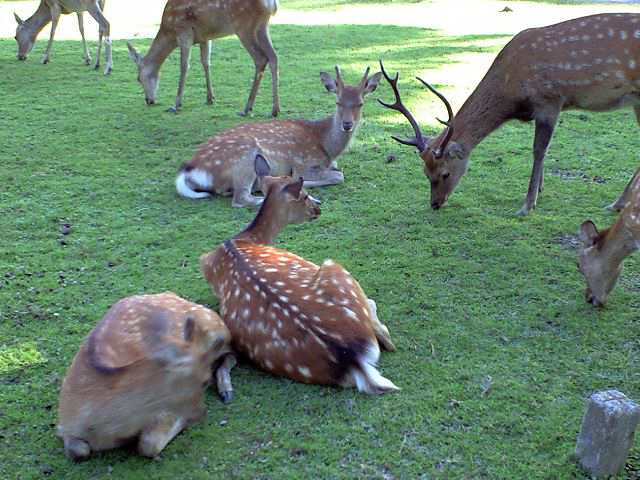
Visit Nara describes Nara Park as what many people mean by “Nara”: about eight square kilometers that include Todai-ji, Kofuku-ji, Kasuga Taisha, museums, and almost 1,200 deer. The address on that page is 469 Zoshicho, Nara. It places the park about a 5-minute walk from Kintetsu-Nara Station and about a 15-minute walk from JR Nara Station. Treat those walks as orientation and follow signs on the day.
The same page retells the legend that a Kasuga deity arrived at Mount Mikasa on a white deer in 768, after which the deer were treated as sacred. It also says that after World War II they were officially stripped of sacred status and remain protected. Spring paths are known for plum and cherry blossom; autumn for colored leaves. Sarusawa Pond, at the top of Sanjo-dori, looks toward the Kofuku-ji pagoda—especially near sunset, according to Visit Nara. That view is a landmark, not a ticketed stop by itself.

Photo: asanopiyo · CC BY-SA 2.1 JP · Wikimedia Commons · Modification: none intentional
Deer manners
Nara Prefecture’s park page (updated 27 February 2026) is the rule sheet to follow. The deer are used to people and are still wild. Their behavior is unpredictable. They can charge, strike with antlers, bite, or kick. Do not touch them carelessly, and do not let a child approach a deer alone. Spring, when does guard fawns, and autumn, when stags are in the mating season, need extra distance.
The prefecture prohibits feeding anything except deer crackers (shika senbei). The deer live on plants in the park—grass, leaves, acorns, and similar food. Sweets, bread, vegetables, and leftovers can make them ill or lead to accidents. Crackers are the stated exception: an Edo-period custom, made as a safer snack, with part of the sales used for protection. The page also links an English caution flyer and a cracker how-to sheet. Use those, not a social-media ritual.
Dogs must stay on a leash and away from deer. Hold maps, plastic bags, and pamphlets so a deer cannot take them, and keep straps clear of antlers. There are no trash bins in the park. Take litter with you. The prefecture says deer have died after eating rubbish. The deer are a national natural monument: do not hit or chase them.
Todai-ji
Visit Nara’s Todai-ji page centers on the Great Buddha Hall. The approach passes the Nandaimon (Great Southern Gate) and the Nio guardian figures associated with the sculptors Unkei and Kaikei around the 12th century. In front of the hall is a large octagonal bronze lantern, described as one of the temple’s older treasures. The page dates the hall’s completion to about 752 in the Nara period, commissioned by Emperor Shomu, and calls the Daibutsu Japan’s largest at 15 meters, cast from over 400 tons of bronze and originally gilded. It suggests walking behind the statue to see models of the earlier temple site.
The grounds also include gardens, museums, and treasure halls. Nigatsu-do, to the right of the main hall on that page, has carvings and a view over the city, and the path continues toward Kasuga Taisha. Isuien garden, Kofuku-ji, and the Nara National Museum are named as nearby—each is optional. Do not assume one admission covers all of them.
The venue page gives the address as 406-1 Zoshicho, Nara, and a walk of about 19 minutes from Kintetsu-Nara Station. It publishes seasonal opening windows, a note that the temple is open all year, admission by age group, and a remark that credit cards are accepted at the souvenir shop in the museum inside the Great Buddha Hall. Those details change. Reconfirm on Visit Nara’s Todai-ji page and the temple’s English site before you go. Information may be in English even when spoken guidance is Japanese only—that is how Visit Nara phrases the language note.

Photo: ONO Masanobu · CC0 1.0 · Wikimedia Commons · Modification: none intentional
Kasuga Taisha
Visit Nara describes a forest approach lined with hundreds of stone lanterns, then vermilion columns, white walls, and cedar-bark roofs. A paid inner area lets you see bronze lanterns in the cloister more closely, including Fujinami-no-ya behind the main shrine. The page says visitors may join morning prayers; the listed time is on that page—reconfirm, and do not treat a festival night as an ordinary afternoon.
The shrine page dates the founding to 768 by the Fujiwara clan and names four main deities, including Takemikazuchi-no-Mikoto, whose legend is the white deer and Mount Mikasa. Wisteria, the Fujiwara crest, is a May draw; the page mentions more than 200 wisteria trees. The Mantoro lantern festival, in February and August on that page, lights on the order of 3,000 lanterns from sunset. Kasugayama Primeval Forest, behind the shrine, is described as untouched for over 1,000 years. Paths also lead toward Mount Wakakusa, Todai-ji, and Kofuku-ji. Mount Wakakusa is a different walk—do not add it late in the day without checking return time.
Address on the page: 160 Kasuganocho, Nara. Access: about 25 minutes on foot from Kintetsu-Nara Station, or a bus bound for Kasuga Taisha Honden, getting off at the Kasuga Taisha Honden stop. Seasonal hours, inner-sanctuary admission, garden hours, and irregular closures (including ceremony days) are published there. Reconfirm on Visit Nara’s Kasuga Taisha page.
Kasuga Ninai Jaya, a garden cafe managed by the shrine, sits by the Man’yo Botanical Garden gate. Visit Nara says it serves tea, coffee, sweets, kakinoha sushi, and a rice porridge called manyo-gayu, and that payment there is cash only. The shrine’s own page places it a short walk east of the Kasuga Taisha Omotesando bus stop. Hours and closures are on the venue page—reconfirm on the shrine tea-house page.
Naramachi
Visit Nara’s Naramachi guide calls the district one of the city’s main walking areas: narrow lanes, machiya townhouses, sweet shops, galleries, cafes, and small inns, compact enough to cover on foot (about one kilometer across). Getting there, the same guide says Naramachi is a short walk south of Kintetsu-Nara Station and roughly 20 minutes on foot from JR Nara Station. City loop buses, including services toward Nara Hotel and Gango-ji, also stop around the edge. The guide’s map of the streets is a grid. Pick up a paper map at Nara Visitor Center & Inn by Sarusawa Pond if you want to find a shop again later.
Gango-ji sits in the heart of the district. The area guide says the temple was first built in Asuka and relocated here around 718, and that fires in the 15th and 19th centuries, plus housing demand, reduced the old precinct. Machiya were built with narrow frontages because tax followed the width of the street face. Red-and-white migawarisaru charms hang from eaves; the guide traces them to the Edo period. Shop hours along these lanes are not listed here—read the sign or the shop’s own page.

Photo: Maarten Heerlien · CC BY 2.0 · Wikimedia Commons · Modification: none intentional
Short mention: Kofuku-ji
Kofuku-ji stands inside the park area Visit Nara describes, and its pagoda is the view across Sarusawa Pond. If you go inside halls or the treasure museum, reconfirm admission on the temple’s own information. This day outline does not depend on it.
Getting there and around
Nara has two central stations. Visit Nara’s access page says Kintetsu Railway and JR West both serve the city: Kintetsu-Nara Station and JR Nara Station. For this park-and-Naramachi day, Kintetsu-Nara is the closer stop to the park edge and to the southward walk into Naramachi. JR Nara is the better match if your pass or hotel is on the JR side. Do not merge the two into one timetable.
From Kyoto (Visit Nara access page): JR Rapid Express from Kyoto Station to JR Nara Station, listed as about 41 minutes. Kintetsu limited express from Kyoto Station to Kintetsu-Nara Station, listed as about 34 minutes. Those are different operators and different arrival stations.
From Osaka (same page): JR Rapid Express from Osaka Station to JR Nara, about 52 minutes; from Shin-Osaka, about 69 minutes; from Namba, about 49 minutes. Kintetsu express from Osaka-Namba to Kintetsu-Nara, about 34 minutes. Reconfirm which Namba station your ticket actually uses.
The page’s opening line says Nara is just over 30 minutes from Kyoto and Osaka. The line-by-line rides above are longer on several routes. Use the specific ride, not the slogan. Fares, limited-express supplements, and which rail pass covers which company are not repeated here. The same page says IC cards such as Suica and ICOCA can be used across the two operators, and that restrictions apply to rail passes. Confirm pass coverage with JR West or Kintetsu before you travel.
On foot after arrival: park edge about 5 minutes from Kintetsu-Nara and about 15 minutes from JR Nara; Todai-ji about 19 minutes from Kintetsu-Nara; Kasuga Taisha about 25 minutes from Kintetsu-Nara, or by bus toward Kasuga Taisha Honden. Naramachi is the short southward walk from Kintetsu-Nara, or roughly 20 minutes from JR Nara. Hills and steps show up at the temples and on the shrine approach.
Buses: Visit Nara names Nara City loop buses and routes toward Nara Hotel and Gango-ji for Naramachi. Kasuga Taisha’s page names a bus bound for the Honden stop. Live route numbers and payments belong on the bus operator’s board that day.
Horyu-ji and Nishinokyo are a different district. Hotel Nikko Nara’s English pages describe Horyu-ji as a train ride from the JR station hotel, not a next-door gate. Leave it for another day.
Suggested itinerary
One flexible Nara day
- Ride to Kintetsu-Nara if you want the shorter walk into the park and Naramachi. Use JR Nara when your ticket or hotel is there, and add the longer walk or a bus.
- Enter Nara Park and keep the prefecture’s deer rules. Do not plan the day around feeding.
- Visit Todai-ji (Nandaimon and the Great Buddha Hall) while the published window is still open. Reconfirm that window in the morning.
- If energy remains, continue toward Kasuga Taisha along the park path, or ride the bus named on the shrine page. Nigatsu-do can sit on that walk; Mount Wakakusa should not.
- Return toward Kintetsu-Nara and walk south into Naramachi. If you reserved lunch or dinner, go then.
- Leave time for the train back to Kyoto or Osaka. This outline is pacing, not a timetable.
Where to Eat
A short list of places with official pages. Menus, hours, and closed days change—reconfirm before you go.
Kakinohazushi Tanaka (Nara main shop)
Budget fit: Budget-friendly Cuisine: Kakinoha sushi and a small tea room
The company’s Nara shop page places the main store at the entrance of Higashimuki shopping street, just outside Kintetsu-Nara Station, with an attached tea room (Kakinoha Chaya) for sushi and Nara products. Visit Nara describes the same shop, including luggage holding, charging, and an accessible toilet. There is no shop parking on the official page.
What to try:
- Kakinoha sushi (persimmon-leaf sushi) from the counter or tea room
- The shop’s own sushi set when it is listed that day (confirm)
Address: 5-2 Higashimuki-nakamachi, Nara (official page: 奈良県奈良市東向中町5番地2) Access: The shop page says it is immediately outside Kintetsu-Nara Station. Visit Nara says about a 2-minute walk—reconfirm. Hours (confirm): Shop and tea-room windows are on the official page and can change without notice. Booking tip: Takeaway can be reserved online for pickup. Tea-room seating is small—ask on the day if you need a table. Official site: https://www.kakinohasushi.co.jp/shop/nara/
Hiyori (旬彩ひより)
Budget fit: Midrange Cuisine: Yamato traditional vegetables
Hiyori’s official site presents a Naramachi restaurant built around Yamato vegetables, on the ground floor of Uzurya Club. The homepage says the shop opened in 2007 and publishes lunch and dinner service plus regular closed days, including a holiday substitute. Read the current notice before you detour.
What to try:
- A vegetable-focused set or course listed that day (confirm)
- Seasonal Yamato vegetables named on the menu (confirm)
Address: 26 Nakashinyacho, Nara, Uzurya Club 1F (official page: 奈良県奈良市中新屋町26 鶉屋倶楽部1F) Access: The homepage says about a 10-minute walk from Kintetsu-Nara Station. Hours (confirm): Service windows and closed days are on the official homepage—reconfirm, especially around holidays. Booking tip: The page accepts inquiries for group meals. Phone on the site: 0742-24-1470. Official site: https://naramachi-hiyori.jp/
Awa Naramachi (粟 ならまち店)
Budget fit: Upscale Cuisine: Nara beef and Yamato vegetable courses
The company’s shop page describes a 140-year-old machiya serving Nara ingredients, including Yamato beef, local sake, and traditional vegetables. It states the restaurant is reservation-only, with no parking of its own. Course names and prices are on that page—reconfirm, and do not assume a walk-in table.
What to try:
- A Yamato vegetable course, or a course that adds Yamato beef, if it is still offered (confirm)
- Seasonal sweets only when the page says they can be reserved with a meal
Address: 1 Shonanincho, Nara 630-8363 (official page: 〒630-8363 奈良県奈良市勝南院町1番地) Access: Official page: about a 10-minute walk, or about 4 minutes by car, from Kintetsu-Nara Station. Use a paid lot nearby if you drive. Hours (confirm): Lunch and dinner windows, a weekly closed day, and last-entry notes are on the shop page—reconfirm when you reserve. Booking tip: Reserve by phone (0742-24-5699) or the online form linked from the official page. The page says some private-room courses need a week’s notice. Official site: https://www.kiyosumi.jp/naramachiten
Where to Stay
These three properties have official pages in or beside the areas this guide walks. Many travelers day-trip from Kyoto or Osaka instead. Rates and room types change—reconfirm on each site.
Nara Hotel
Budget fit: Upscale Stay type: Historic hotel beside Nara Park
The official English site traces the hotel to 1909. It describes a main building in Momoyama-palace style, associated with the architect Kingo Tatsuno, and a west wing renewed in 2026. Restaurants named on the site include the French dining room Mikasa and the teppanyaki room Hanagiku. The hotel is a place to sleep or dine, not a casual walk-through: the site posts a notice about visits that are only for looking around the building. Read that notice if you are not staying or eating there.
Why stay here:
- Beside Nara Park, so the morning walk starts at the gate
- Historic main building and a renewed west wing
- Official English pages for rooms and restaurants
Address: 1096 Takahatacho, Nara 630-8301 (access page: 〒630-8301 奈良市高畑町1096) Access: The access page says about 8 minutes by taxi from JR Nara Station, about 5 minutes by taxi from Kintetsu-Nara Station, and that the hotel adjoins Nara Park. Reconfirm the taxi line. Booking tip: Book on the official site when you can. Restaurant reservations use the phone window published on the restaurant pages. Official site: https://www.narahotel.co.jp/eng/
Kazeno Naramachi
Budget fit: Upscale Stay type: Eight-room hotel in a former brewery residence
The official English page describes eight rooms in the former residence of the Meiji-era Nara Toyosawa Sake Brewery, in the Naramachi streets. It states that Nipponia Hotel Nara Naramachi changed its name to Kazeno Naramachi on 3 June 2026, with space and service updates planned gradually after 17 July 2026. An on-site counter restaurant is described for Nara ingredients and Toyosawa sake. Whether non-guests can book it after the rename is not assumed here—ask the hotel.
Why stay here:
- Inside Naramachi, so the lanes are outside the door
- Small property (eight rooms, up to three guests in a room on the overview)
- Official English pages after the 2026 name change
Address: The overview says 4 Nishikidocho, Nara City. The directions block writes the front desk as Nishijodocho 4. Use the map pin on the official page and match it to 西城戸町 before you navigate. Access: The directions page lists rail approaches from Kyoto and walks from the stations. Read that page carefully and reconfirm the live route; do not stitch station names into your own connection. Guest parking behind the hotel is described as free for overnight guests who tell the hotel in advance, with limited spaces. Pets are not permitted, and the overview says the building is not barrier-free. Booking tip: Book on the official site. The hotel has also posted warnings about messages that impersonate the property—use the site you opened yourself. Official site: https://www.kazenoheritage.jp/en/hotels/naramachi/
Hotel Nikko Nara
Budget fit: Midrange Stay type: Station hotel at JR Nara
The English pages say the hotel is directly connected to the west exit of JR Nara Station, with the lobby reached via the upper floor after the ticket gate, and a covered walk if you drop to the lower level in the rain. They also say it is about a 12-minute walk from Kintetsu-Nara Station. Walking times to Nara Park, Naramachi, Todai-ji, and Kasuga Taisha are the hotel’s own estimates—use them as a base comparison, then reconfirm.
Why stay here:
- JR arrival without a taxi
- Convenient when your train arrives at JR Nara Station
- English access page with airport and rail sketches
Address: 8-1 Sanjo-hommachi, Nara-shi, Nara 630-8122 Access: Connected to JR Nara Station’s west exit. From Kintetsu-Nara, follow the hotel’s walking note of about 12 minutes. Room reservations phone on the English homepage: +81-742-35-6812. Booking tip: Municipal parking under the hotel is described on the access page, with guest conditions and hours. Read those before you drive; this guide does not repeat the tariff. Official site: https://www.nikkonara.jp/en/
Day-trip alternative: stay in Kyoto or Osaka
Budget fit: Varies Stay type: City hotel near Kyoto Station, Osaka Station, or Osaka-Namba
If Nara hotels are full, sleep in Kyoto or Osaka and ride in the morning. Match the station to the line you will actually take: Kyoto Station for the JR or Kintetsu rides above, Osaka-Namba for the Kintetsu express, Osaka or Namba stations for the JR rapids. Reconfirm the last useful train if you book a late dinner in Naramachi.
Practical tips
- Deer first: Read the prefecture manners page before you enter the park. Distance, no feeding except deer crackers, no dogs off leash, and no litter.
- Admission and hours: Todai-ji and Kasuga Taisha publish seasonal windows and fees on Visit Nara. Reconfirm the morning you go. Inner shrine areas and museums are separate from walking the public paths.
- Crowds and seasons: Cherry blossom and autumn color fill the park paths. Kasuga’s wisteria is a May draw on the shrine page. Naramachi’s guide says the lanes work in hot or wet weather because shops give you somewhere to step inside—shop hours still vary.
- Cash: Kasuga Ninai Jaya is listed as cash only on Visit Nara. Do not assume every Naramachi counter takes cards.
- Shoes and quiet: Temple and shrine buildings often require shoe removal where signed. Keep voices low in halls.
- Photography: Follow posted rules inside halls. Do not block the gate or surround a deer for a portrait.
- Mobility: The shrine approach and temple grounds include slopes and steps. Kazeno Naramachi states that it is not barrier-free. Naramachi lanes are narrow.
- Separate days: Horyu-ji, Mount Wakakusa, and a full Kyoto district do not belong on the same ticket as a Todai-ji and Naramachi walk.
- If you are adding an evening in Osaka, the Umeda Sky Building travel guide covers the observatory north of the stations.
Where to Go Next
These are separate days, not add-ons after Todai-ji.
- Kyoto Higashiyama Travel Guide: Kiyomizu-dera, Gion Streets, and Walking Routes — an eastern Kyoto walking day through Kiyomizu-dera and Gion. Keep it separate from this Nara day.
- Arashiyama and Sagano Travel Guide: Bamboo Grove, Tenryu-ji, and Quieter Temple Paths — a western Kyoto day of river, bamboo, and temples. Plan it on its own day.
- Fushimi Sake District Travel Guide: Breweries, Canals, and a Kyoto Day Trip — southern Kyoto sake-brewery streets along the canal. Plan it on its own day.
- Ohara and Sanzen-in Day Trip from Kyoto: Mountain Temples and Village Paths — a northern Kyoto hills day by bus. Plan it on its own day.
- Koyasan Travel Guide: Temples, Cedars, and a Night on the Mountain — a temple mountain in Wakayama. It is another day, not a stop after Todai-ji.
- Uji Travel Guide: Matcha, Byodo-in Temple, and a Day Trip from Kyoto — matcha town south of Kyoto, on its own day.
- Kurama and Kibune Day Trip from Kyoto: Temples, Forest Trails, and Mountain Air — another northern Kyoto day, not a stop on the way back from Nara.
Explore More of Japan
Published guides beyond this Nara day:
- Miyajima Travel Guide: Itsukushima Shrine, the Floating Torii, and a Hiroshima Day Trip
- Naoshima Travel Guide: Art Islands, Museums, and the Seto Inland Sea
- Kanazawa Travel Guide: Kenrokuen and Teahouse Districts
A rail pass for the Nara day trip
Nara sits on the Kintetsu network rather than the JR one, and the Kintetsu Rail Pass is the ticket most day-trippers weigh against a plain return fare.
The 1-day pass covers unlimited rides between Osaka-Namba and Kintetsu-Nara, between Kyoto and Tsutsui, and on designated Nara Kotsu buses around Nara Park. Klook sells the digital version, with 1-day, 2-day, and 5-day options, and the listing shows current prices. A limited express still needs a separate reserved seat ticket, so price that in if you want the faster train.
Affiliate disclosure: This article contains an affiliate link. We may earn a commission if you book through it, at no extra cost to you.
Check the Kintetsu Rail Pass on Klook
Before you go
Nara Park and Naramachi are one walking day from Kyoto or Osaka, not a quick add-on after a full Kyoto temple route. Reconfirm the JR or Kintetsu train, Todai-ji’s and Kasuga Taisha’s published windows, and any restaurant reservation the day before. Read the prefecture’s deer page again if children are with you. Timetables, fares, admission fees, and seasonal access rules can change. Check the official tourism, prefecture, temple, and venue sites linked below before you travel.
Sources
- Visit Nara — home (checked 2026-10-18)
- Visit Nara — Nara Park (checked 2026-10-18)
- Visit Nara — Todai-ji (checked 2026-10-18)
- Todai-ji official (English) (checked 2026-10-18)
- Visit Nara — Kasuga Taisha (checked 2026-10-18)
- Kasuga Taisha — Ninai Jaya (checked 2026-10-18)
- Visit Nara — Naramachi area (checked 2026-10-18)
- Visit Nara — travel to Nara (checked 2026-10-18)
- JNTO — Nara (checked 2026-10-18)
- Nara Prefecture — how to treat the deer in Nara Park (checked 2026-10-18)
- Nara Hotel official (English) (checked 2026-10-18)
- Nara Hotel access (checked 2026-10-18)
- Kazeno Naramachi official (English) (checked 2026-10-18)
- Hotel Nikko Nara official (English) (checked 2026-10-18)
- Kakinohazushi Tanaka — Nara shop (checked 2026-10-18)
- Hiyori official (checked 2026-10-18)
- Awa Naramachi official (checked 2026-10-18)


Leave a Reply