Geibikei is a crack in the limestone, about two kilometres long and barely wider than a river, cut by the Satetsu river through the hills east of Ichinoseki. The cliffs on both sides run to around 100 metres. There is no road through it and no path along it, so the only way in is the way people have always gone in: a flat wooden boat, pushed upstream by a boatman with a single bamboo pole, then drifted back down with the current.
The round trip takes about 90 minutes, including a 20-minute stop at the far end. It is one of the very few river journeys in Japan that functions as a proper sight in its own right rather than a ride to somewhere else, and it is unusually easy to reach: the station is a five-minute walk from the landing, and the station is 30 minutes from a Shinkansen stop. That combination makes it the best half-day in Tohoku for anyone travelling by train.
Why visit
- The gorge is a national Place of Scenic Beauty, designated in 1925, and one of the Japan Hundred Views.
- The 90-minute boat trip is the attraction, not a transfer: cliffs, overhangs, waterfalls and a rock that gave the gorge its name.
- It is genuinely car-free access. JR Geibikei station is five minutes from the ticket counter.
- In winter the boats are fitted with kotatsu, and you ride through a monochrome landscape under a heated table.
- It pairs cleanly with Hiraizumi, 25 minutes away by car, so a single day can carry both a landscape and a World Heritage site.
What the gorge is
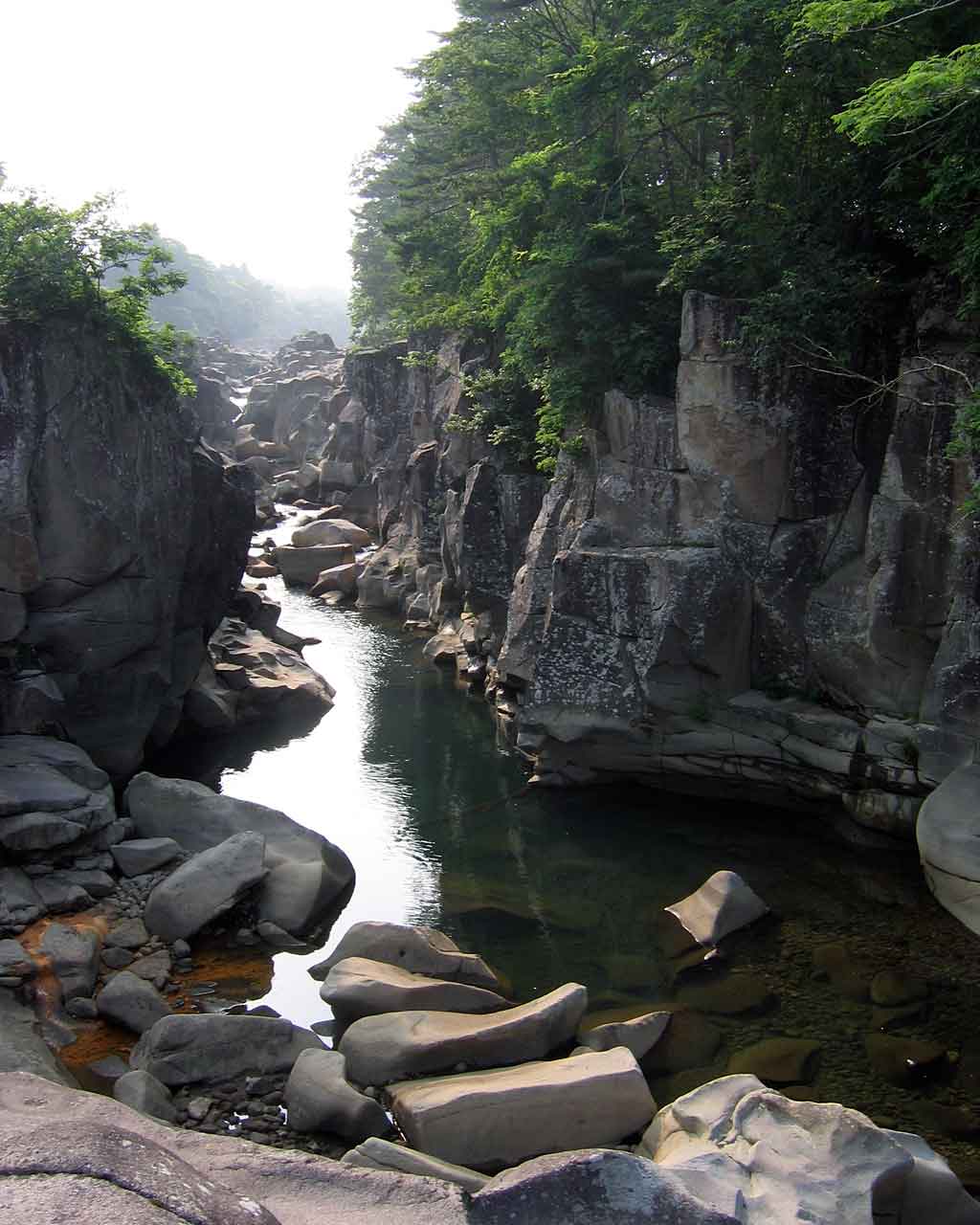
The Satetsu river rises in the mountains of the Kitakami range and cuts east through a band of limestone before joining the Iwai river. Limestone dissolves rather than erodes, so the valley it makes is steep-sided and narrow, with undercut walls, potholes and caves rather than the smooth boulder bed of a granite river. The result is a corridor of pale grey rock, with vegetation clinging to ledges and the water running green and shallow beneath it.
The name needs explaining. Geibi is written with a character for a lion-like mythical beast, and the gorge is named after a rock near its mouth that is said to look like a lion’s nose — shishi-ga-hana. The rock at the far end of the navigable section, dai-geibi-iwa, is 124 metres high and is the wall you are looking at when the boat turns around.
The Japanese state designated the gorge a Place of Scenic Beauty in 1925, during the period when the national park and scenic-site system was being assembled, and it has been on the standard Tohoku itinerary ever since. In practice that means the infrastructure is old and settled: a landing, a rest house, a car park, and boats that have been running for generations.
The boat ride
Boarding is at the Geibi sightseeing centre in Higashiyama, at the end of a short lane from the station. The boats are open, flat-bottomed wooden craft with low benches along both sides and no roof, apart from the winter boats. You sit low, which is the point: the cliffs look considerably taller from 40 centimetres above the water.
The outbound leg is the work. The boatman stands at the stern and poles against the current, using the river bed and the rock walls, and the boat moves at walking pace past one named formation after another — a rock face called Ryoun, a waterfall, a stretch where two cliffs lean toward each other. Commentary runs through the trip, in Japanese, and the details are mostly geological and folkloric rather than historical.
At the turnaround, everyone gets off at a small landing called Miyoshi-ga-oka and walks about 20 minutes to a viewpoint facing the great rock wall. This is where the lucky stones come in. Small clay balls called undama are sold at five for 100 yen in ten varieties, each labelled with a different wish — luck, longevity, fortune, matchmaking, health, money — and the game is to throw one across the river into a hole in the opposite cliff. Most people miss. The hole is small, the distance is real, and the activity has the great virtue of being funny whether you succeed or not.
The return leg is the reward. The current carries the boat, the boatman stops poling, and he sings the Geibi Oiwake, a local boatmen’s song that fills the gorge and comes back off both walls. It is a slightly theatrical touch and it works completely.
Reading the cliffs
The formations are named, and the names are half the pleasure. A mirror-clear rock face and a high cloud-piercing wall come early, where the cliffs are tallest and the light is weakest. Further up, a pair of rocks stand on opposite banks so that their profiles face each other across the water, the taller one read as a man and the smaller as a woman — a husband-and-wife pair in stone. Near the turnaround, the great wall of Dai-Geibi-iwa closes the view. The boatmen point each one out as you pass, and the commentary is worth following even with limited Japanese, because the shapes are genuinely there once they have been named.
The boats themselves are worth a look. They are carvel-built of local timber, wide and shallow-draught so they can pass over gravel bars at low water, with a flat transom and no keel to catch on the bed. A single bamboo pole does the work: the boatman plants it, walks it back along the gunwale and pushes, and the boat slides upstream without an engine. It is quiet enough that you can hear water dripping off the pole, which is the actual reason the ride feels the way it does.
Winter and the kotatsu boat
From 1 December to the end of February the open boats are replaced by roofed ones with kotatsu set into the floor, and the ride becomes a different experience: snow on the ledges, grey water, no leaves, and a heated table over your legs. No reservation is needed for the kotatsu boat, though the versions with a hotpot meal or kamameshi do require booking, and pets are not carried in winter.
The local dish served on those boats is kizukuri nabe, a hotpot in the style of the loggers and charcoal burners who worked these hills, and eating it while the boat moves through a snowbound gorge is the reason people make the trip in February. If you want the meal, book ahead; if you only want the ride, turn up.
The seasons, honestly
- Late April and May — fresh green on the cliffs and wisteria hanging over the water, the most photogenic combination.
- June to August — lush but hot and humid, and the gorge holds the heat. The morning departures are much more comfortable.
- Late October to early November — the classic season, with maples and beeches on the walls and the busiest boats of the year.
- December to February — the kotatsu boats, snow, and by far the quietest rides.
Weather matters more here than at most sights. The river rises fast after heavy rain, and the operator suspends service when the water is too high; in July 2026 the company was posting exactly that kind of warning. Check the official site or the operator’s social media on the morning of your visit if there has been a storm, and build in a plan B such as Hiraizumi.
Food and the landing
The rest house at the landing serves hand-made soba from local buckwheat, and grilled sweetfish from the Satetsu river, salted and cooked over charcoal, is sold near the boat dock in season. It is simple food and it is the right food: you are in a river valley, and the menu reflects it. There is also a souvenir hall with the usual Tohoku range, and a small shop for drinks.
Beyond the landing, Ichinoseki is the place to eat properly. The city is known for mochi cuisine — a whole repertoire of pounded rice dishes, sweet and savoury, built on local rice and the area’s long history as a post town on the Oshu road — and there are specialists near the station. It is a better lunch than anything at the gorge, and it is 30 minutes away by train.
Getting there and around
- By train — Tohoku Shinkansen to Ichinoseki, then the JR Ofunato line to Geibikei, about 30 minutes, then a five-minute walk to the landing. This is the simplest approach and the one to use if you are travelling without a car.
- By bus — Toban Kotsu runs from Ichinoseki station bus terminal, stop 3, to Geibikei-guchi in about 42 minutes. Departures are sparse — the useful ones leave in the late morning and early afternoon — and the bus does not run over the New Year holiday.
- By car — about 25 to 30 minutes from the Ichinoseki interchange on the Tohoku expressway, following route 19 east. There is paid parking near the landing at 500 yen and free parking at the rest house and the hotel opposite.
One 2026 caveat: JR East has scheduled partial suspensions of the Ofunato line for maintenance on 15 to 17 September, 6 to 9 October and 8 to 10 December 2026, and the boat operator runs a free shuttle bus on those dates. If your dates land on them, check the company’s notice before you plan the train.
Pairing it with Hiraizumi and Genbikei
Geibikei sits in a triangle with two other excellent sights, all within half an hour of Ichinoseki.
- Hiraizumi — the World Heritage temple town with Chuson-ji’s golden hall and Motsu-ji’s garden, about 25 minutes by car or 35 by bus. Doing Hiraizumi in the morning and Geibikei in the afternoon is the standard full day, and it works because the boat runs on a fixed hourly schedule.
- Genbikei — a shorter, faster gorge on the Iwai river west of Ichinoseki, where dango are sent across the water to you in a basket on a rope. It is a 20-minute visit and a good contrast: Geibikei is silent and grand, Genbikei is noisy and playful.
- Ichinoseki itself — a compact city with a good station, mochi restaurants and hotels, and the practical base for all three.
Where to stay
- Ichinoseki — business hotels around the station, the most practical base, with restaurants and the Shinkansen on the doorstep.
- Higashiyama — a small onsen hotel opposite the boat landing, for a quiet night within walking distance of the first departure.
- Hiraizumi — a handful of inns and guesthouses in the temple town, which is atmospheric but very quiet in the evening.
- Sendai — possible as a day trip, about 40 minutes by Shinkansen to Ichinoseki, but it makes for a long day.
Suggested itineraries
Half day from Ichinoseki, by train
- Take a morning Ofunato line train to Geibikei and walk to the landing.
- Ride the boat, allowing 90 minutes plus boarding time.
- Eat soba or grilled sweetfish at the rest house.
- Return to Ichinoseki for a late lunch of mochi cuisine and continue to Hiraizumi or Sendai.
Full day with a car
- Hiraizumi early, at Chuson-ji before the tour buses.
- Drive to Geibikei for a midday or early afternoon boat.
- Stop at Genbikei on the way back for the flying dango.
- Dinner in Ichinoseki.
Practical tips
- Arrive 15 to 20 minutes before the departure you want in autumn and on holidays. Boats leave hourly and fill in leaf season.
- Carry cash for the lucky stones, the rest house and the parking.
- Sit on the left going out if you want the shade in summer, and dress warmer than the valley temperature suggests in winter — the kotatsu warms your legs, not your face.
- The stop at Miyoshi-ga-oka involves a short uphill walk. Wear shoes you can climb in.
- Do not plan a tight connection back to the Shinkansen: boats can run late, and the Ofunato line is infrequent.
- Check the operating status after rain. High water closes the ride, and refunds are handled at the counter.
Before you go
Fares and departure times above come from the Geibi Sightseeing Centre and Ichinoseki city tourism, checked on 26 October 2026. The adult fare rose to 2,000 yen on 1 April 2026, so older guides quoting 1,800 yen are out of date. Reconfirm the day’s first and last departures — the timetable changes four times a year, with the last boat leaving as early as 15:00 from late November — and check the Ofunato line for maintenance suspensions and the boat company’s shuttle bus. The boat runs in light rain but not in flood, and the decision is made on the morning.
Sources
- Geibi Sightseeing Centre: fares, timetable and access (checked 2026-10-26)
- Geibi Sightseeing Centre: route, undama stones and boat details (checked 2026-10-26)
- Geibi Sightseeing Centre: service notices and shuttle bus information (checked 2026-10-26)
- Ichinoseki city tourism: Geibikei access, hours and fares (checked 2026-10-26)
- Ichinoseki city tourism: Geibikei feature, undama and local food (checked 2026-10-26)
Explore More of Japan
- Hiraizumi Travel Guide — the World Heritage temple town 25 minutes away
- Oirase Gorge Travel Guide — the other great northern river valley
- Matsushima Travel Guide — the coastal counterpoint in Miyagi
- Yamadera Travel Guide — cliff temples on the same Shinkansen line
- Nyuto Onsen Travel Guide — a hot spring stop further north


Leave a Reply