Uchiko is a town that got rich twice from the same tree, and then stopped. The haze tree, whose berries yield a vegetable wax, grew in the hills behind it; from the late Edo period the merchants of the Yokaichi quarter learned to bleach that wax to a hard white block, and for about forty years they supplied much of the world’s finest candle and polish material. The money went into the street you still walk today, about 600 metres of white plaster and dark timber, with shopfronts wide enough for a cart and eaves deep enough for rain.
Then paraffin arrived, the trade died in the 1920s, and nobody had the money to knock the houses down and build again. That is the accident that makes Uchiko worth a day. It also has one of the best small theatres in Japan, a wooden playhouse of 1916 — though, as of 2026, that building is closed for repairs and you visit its backstage instead. Plan around that and the town delivers.
Why visit
- The Yokaichi and Gokoku street is a genuine preservation district, selected in 1982 as the first in Shikoku and the 18th in Japan, with 93 designated buildings along its length.
- The wax trade is explained better here than almost anywhere: a merchant house with its boiling sheds intact, and 1,444 original tools.
- It is 25 minutes by limited express from Matsuyama, so it works as a half-day out of the city or a stop between Matsuyama and Uwajima.
- The town is quiet. There are no tour buses in the street, because cars are discouraged, and the crowds are a fraction of Takayama or Kawagoe.
- One shop still pulls candles by hand in the old way, and you can watch.
The white wax that built the street
The raw material is not beeswax. It comes from the berries of the haze tree (Toxicodendron succedaneum), which were steamed, pressed and boiled down into a yellow-green mass called ki-ro. That alone was useful for polish and waterproofing. The valuable product was sarashi-ro, bleached wax, made by pouring the melted wax into shallow boxes and standing them in the sun for two weeks, reheating and repeating the process three times until the colour went. The result was a hard, clean white block that could travel.
The technique is credited to the Haga family, the merchants whose name recurs all over the town. Haga Yahei is usually named as the man who worked out the box-bleaching method in the late Edo period, and the family’s advantage was industrial rather than agricultural: they did not grow the trees, they bought raw wax from a wide area, refined it at scale and sold it on. The Hon-Haga main family became the largest wax refiner in Japan, with thirteen branch houses, and exported under the trademark Kyokukaku — an auspicious combination of crane and tortoise, still visible in plaster relief on their storehouse.
The numbers explain the street. In 1895 the Kikuchi district, which is Uchiko and its neighbours, produced around 40 per cent of Japan’s bleached wax, and about half of Ehime’s. At the peak, around 1906, the district counted 330 raw-wax producers and 74 bleaching works, handling roughly 2,000 tonnes of each grade. Uchiko wax went to the Paris exhibition in 1900 and came back with a commendation, and it was sold into European and American textile and cosmetics industries, where it was used to finish cloth, dress leather and give cream its body.
What killed it was chemistry. Paraffin, a by-product of the oil industry, did most of the same jobs more cheaply, and the domestic chemical industry grew up around coal tar and imported fats. Uchiko’s wax was a premium product in a market that had stopped paying for premium. The bleaching works folded one after another through the 1910s, and in July 1924 the last one, run by a man named Asano Zensaku, closed. The trade was over in a generation, and the town has been small ever since.
Top places and highlights
Yokaichi and Gokoku, the merchant street
The preserved street runs roughly north to south for 600 metres, and it is not a museum set. Most of the houses are still homes, which is why there are no cars and why you should keep your voice down in the lanes. The walls are the signature: a pale yellow-ochre plaster made with local earth, laid over dark timber frames, with white plaster above and namako-kabe tilework on the storehouses. The narrow gaps between buildings, called sedawa, run back to courtyards and are one of the reasons the street photographs so well in low sun.
Walk it slowly and look up. The details that reward attention are the heavy timber lintels, the deep eaves with their rafters, the plaster reliefs on the storehouse gables and the wooden rain doors slid back into their pockets. Three of the buildings on the street are National Important Cultural Properties. Yokaichi was the merchant quarter and Gokoku the temple end, clustered around Kotaka-ji, and the two names are usually run together because the street is continuous.
Two houses on the street are viewable from the outside only: the Hon-Haga main house, where the family still lives, and the Omura house. Both are worth the stop. Hon-Haga has a tortoise-shell pattern of dark tiles on white plaster across its front, a garden you can see into, and the Kyokukaku crane-and-tortoise relief on the storehouse. The Omura house predates the wax boom and belonged to a merchant dealing in sundries, dyeing and later silk; repairs between 2009 and 2012 turned up the remains of eleven indigo vats in the grounds, which is a neat illustration of how the town made its money before wax.
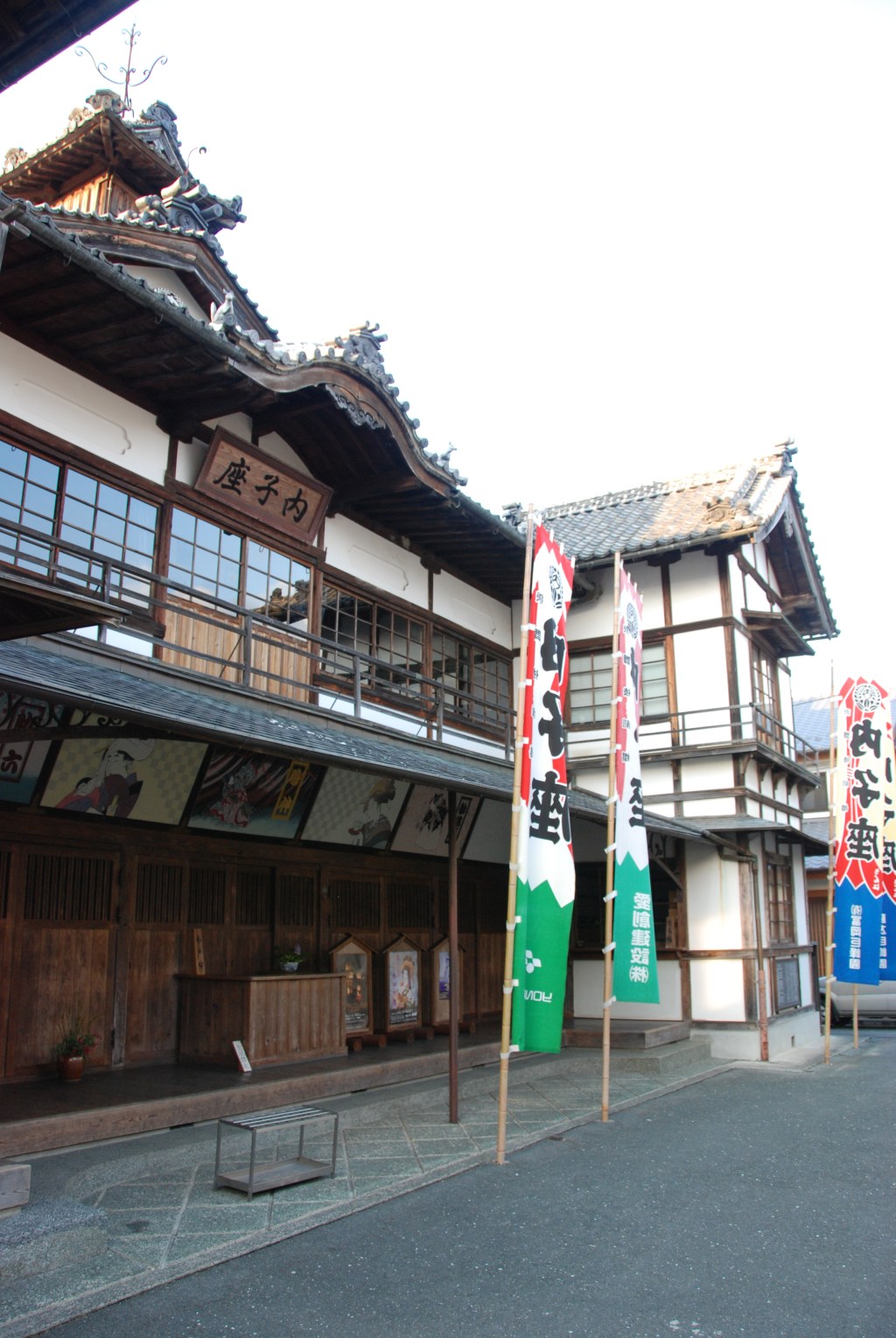
Uchiko-za, the wooden playhouse
Uchiko-za is the building everyone comes for, and in 2026 you cannot go inside the auditorium. The theatre was put up in 1916 by the town’s leading merchants, a two-storey wooden structure with a tiled hip-and-gable roof, box seats called masu, a raised walkway through the audience and a trap cellar under the stage. It was nearly demolished in the 1970s for a car park and was saved by a local campaign, then restored and reopened in the 1980s. It is a National Important Cultural Property.
In September 2024 it closed for a four-year programme of seismic reinforcement, roof-tile replacement and partial repair, with reopening planned for spring 2029. During the closure the town opens the gakuya, the backstage dressing rooms, which is a more interesting substitute than it sounds: the walls are covered with the signatures and graffiti of actors who performed here, and there are displays on the building’s history and on the tiles taken off the roof. You can see the theatre’s rear exterior from the gakuya entrance.
Practical detail: the gakuya is open 09:00 to 16:30, closed only from 29 December to 2 January, and the normal adult admission of 400 yen is halved to 200 yen until the end of 2028 (children 100 yen). Do not arrive expecting a full theatre tour, and do not trust older guidebooks that describe walking the hanamichi.
Kami-Haga residence and wax museum
The one interior you should not skip is the Kami-Haga house, the head branch of the Haga family, now run as the Wax Museum. It is a 10-building Important Cultural Property complex on a site of about 1,300 tsubo, and the main house was raised in 1894, at the height of the boom. What makes it unusual is that the production buildings survive with it: the boiling shed where the berries were steamed and pressed, the front shop warehouse, the storehouses, the well and the kitchen are all in place, which is rare anywhere in Japan for a domestic industry of this kind.
Inside, a modern exhibition building walks through the process with models and video, and part of the town’s collection of 1,444 wax-making tools — an Important Tangible Folk Cultural Property in its own right — is on display. Outside, look for the slim boat-shaped ornament on the ridge of the gate roof and the heavy vermilion lattice on the street front. Admission is 500 yen for adults and 250 yen for children, 09:00 to 16:30, closed 29 December to 2 January, and parts of the grounds can be seen for free. It is a 20-minute walk from JR Uchiko station.
Shops and Life Museum
A short walk away, a former pharmacy has been turned into the Shops and Life Museum. The main building recreates a merchant household of about 1921, using the original fittings and a cast of life-size dolls posed in the middle of meals, business calls and laundry, and the storehouse holds the local history collection. It is small, cheap and unexpectedly effective, especially with children. Admission is 200 yen for adults, 100 for children, 09:00 to 16:30, closed only over New Year.
If you plan to see all three — the theatre’s backstage, Kami-Haga and this museum — buy the common ticket. It is 700 yen for adults and 350 for children while the theatre is closed, down from the normal 900 yen, and it pays for itself immediately.
Omori Warosoku, the candle workshop
The last business of its kind in Ehime is on the street, and it has been in the same family for seven generations. The candles are made by the ikigake method: wax is melted over charcoal, scooped up by hand and layered around a rush wick, again and again, until the candle has growth rings like a tree. No colour or painting is added; the pale olive tone, called uguisu after the bush warbler, is the natural colour of the wax. The candles are wind-resistant and drip little, and the flame is bigger and softer than a paraffin candle’s.
The shop sells them at prices that reflect the labour — a small box runs into the thousands of yen — and on some days you can watch the work through the glass. Opening is roughly 09:00 to 12:00 and 13:00 to 17:00, closed on Tuesdays and Fridays, though the family sometimes opens on a closed day, so check the website before making a special trip.
Food and drink
Uchiko eats simply. The landmark is Shimohaga-tei, a soba restaurant in a Meiji-era merchant house belonging to yet another branch of the Haga family, where the menu is soba with wild herbs gathered from the surrounding hills. It serves 11:00 to 15:00 and closes on Wednesdays; in January and February it opens only at weekends and on holidays, so a winter weekday visit needs a backup plan. The building alone justifies the stop, with its inner garden and dark timber interior.
At the other end of the scale is Fresh Park Kari, the roadside station on the edge of town, which is where local families actually shop. It sells produce from the surrounding farms, gelato in more than twenty flavours made with local fruit, and a burger made with Uchiko pork. It is the reliable option when everything in the street is shut, and it is a five-minute drive from the interchange.
Cafes in the old houses are numerous but eccentric: several open only two or three days a week, one only on the second and fourth Sunday of the month. Do not build a day around a specific cafe without checking its calendar. For dinner, the choice inside the town is thin and mostly early; Matsuyama or Ozu is the sensible base if you want a full evening.
Getting there and around
- By train — JR Yosan line to Uchiko station. Limited expresses from Matsuyama take about 25 minutes; from Uwajima it is a longer run up the coast. The station is on the line’s inland cut-off, so all limited expresses pass through it.
- From the station — the street’s south entrance is about 1 km, or 15 minutes on foot, along a signed route. Local buses also run, but the walk is flat and pleasant.
- From Matsuyama airport — limousine bus to Matsuyama station, about 15 minutes, then the train.
- By car — Matsuyama interchange to the Uchiko-Ikazaki interchange is about 25 minutes on the Matsuyama expressway, then five minutes to the town. From Kochi it is roughly two hours via route 33 and route 56.
- Parking — use the town car park at the north end of the street, 300 yen a visit, open 08:30 to 18:00 (to 17:00 from October to March). Cars are not allowed into the preserved street itself.
Once you are in the street everything is walkable. A town bus, the Oda line, connects the town hall, the station and the Oda district for 150 to 500 yen, and taxis wait at the station. For the outlying sights a car or a taxi is effectively required.
Beyond the street
Uchiko is a small town inside a large, empty municipality, and the outskirts are worth half a day if you have a car.
- Ikazaki Kite Museum — 15 minutes north, in the paper-making district, with about 400 kites from Japan and abroad, including the fighting kites used in the town’s 5 May battle. Open 09:00 to 16:30, closed Mondays except holidays, 300 yen for adults, 150 for children. Kite-making workshops cost 2,000 yen including admission.
- Ishitatami — a hamlet of stone-paved lanes and terraced fields in the hills, with three restored waterwheels at the Seiryu-en garden and the Yuge shrine, founded in 1396, whose approach is a 22-metre roofed drum bridge over a pond.
- Tamaru bridge — a wooden covered bridge over the Fumoto river, rebuilt by local hands after the 1943 flood and later used as a location for the television adaptation of Saka no Ue no Kumo.
- Oda mountain valley — a forested gorge at the southern edge of the municipality, cool in summer and a local autumn-leaf destination.
- Takahashi villa — the house of Takahashi Ryutaro, the Asahi Beer president and owner of the Takahashi Unions baseball team, now a guesthouse and cafe with memorabilia on display. Closed Tuesdays.
Where to stay
- In the street — a handful of small guesthouses and renovated merchant houses, with very few rooms. Book early for autumn weekends.
- Matsuyama — the practical base, 25 minutes away by limited express, with hotels at every price and Dogo Onsen in the evening.
- Ozu — a smaller historic town 30 minutes west with its own preserved street and castle, and a quieter alternative to Matsuyama.
- Ishitatami — a farmhouse guesthouse in the hills for a slow night, but rooms are limited and you need a car.
Best time to visit
- Late March to early April — cherry blossom along the street and in the temple grounds, and the busiest fortnight.
- 5 May — the Ikazaki kite battle, when two teams fly large fighting kites and try to cut each other’s lines. It is the one day the district is genuinely crowded.
- October and November — the best light on the plaster walls, and soba flowers in the Ishitatami fields.
- December to February — cold, very quiet, and some restaurants open only at weekends. The upside is that you will have the street to yourself.
Summer is hot and humid, and the street has little shade at midday. The town is a walking destination, so spring and autumn carry most of the value.
Suggested itineraries
Half day from Matsuyama
- Morning limited express to Uchiko, then walk into the street from the station.
- Kami-Haga residence first, while it is quiet, then the shops and life museum.
- Lunch at Shimohaga-tei, or at Kari if it is a Wednesday.
- Walk the street north, look at Hon-Haga from outside, and visit the theatre’s backstage.
- Buy candles at Omori Warosoku and take the afternoon train back.
Full day with a car
- Start at the Ikazaki Kite Museum when it opens.
- Drive to Ishitatami for the waterwheels, the shrine bridge and Tamaru bridge.
- Lunch in the street, then the wax museum and the theatre backstage.
- Finish with the Oda valley, or drive on to Ozu for the evening.
Practical tips
- Assume the theatre auditorium is closed until spring 2029, and treat the backstage as the visit.
- Carry cash. The small museums and the candle shop take cards, but many restaurants and cafes do not.
- Check restaurant closing days before you travel: Wednesday is the common day off, and winter hours are shorter.
- Do not drive into the preserved street. Park at the north car park and walk.
- The street is residential. Keep noise down, and do not photograph into open doorways.
- Combine the town with Ozu or Uwajima on the same rail line rather than making a separate trip.
- If you want the candle workshop, avoid Tuesday and Friday.
Before you go
The figures above come from Uchiko town, the Uchiko tourism association and Ehime prefecture’s tourism site, checked on 26 October 2026. Three things are worth reconfirming before you travel: the theatre’s repair schedule, since a spring 2029 reopening is a target rather than a fixed date; the reduced admission and common-ticket prices, which are described as limited to the end of 2028; and restaurant closing days, which in this town change with the season. The wax museum and the shops museum keep the same hours year-round apart from the New Year holiday, which makes them the safe anchors for a day built around a train timetable.
Sources
- Uchiko town: Uchiko-za backstage opening, hours and admission (checked 2026-10-26)
- Uchiko town: admission prices and three-facility common ticket (checked 2026-10-26)
- Uchiko town: Kami-Haga residence and wax museum (checked 2026-10-26)
- Uchiko town: Shops and Life Museum (checked 2026-10-26)
- Uchiko town: Yokaichi-Gokoku preservation district (checked 2026-10-26)
- Uchiko tourism association: access by train, car and bus (checked 2026-10-26)
- Uchiko tourism association: Omori Warosoku candle workshop (checked 2026-10-26)
- Uchiko town: Ikazaki Kite Museum (checked 2026-10-26)
- Uchiko tourism association: the Yokaichi-Gokoku street (checked 2026-10-26)
- Nihon Jitsugyo Publishing: Uchiko, the white wax town, and the Haga family (checked 2026-10-26)
Explore More of Japan
- Ozu Travel Guide — the next preserved town west along the same line
- Dogo Onsen Travel Guide — the bath you can pair with a Matsuyama base
- Matsuyama Castle Travel Guide — the city you will travel through
- Iya Valley Travel Guide — the mountain interior beyond the rail line
- Uwajima Castle Travel Guide — the other end of the Yosan line


Leave a Reply