Shimonoseki is the last city on Honshu, and the sea decides everything here. The Kanmon Strait is 600 metres wide at its narrowest, funnels tides between the Sea of Japan and the Seto Inland Sea, and has been a choke point for trade, war and ferries for a thousand years. Honshu and Kyushu face each other across it, close enough to walk between.
Most travellers pass through on the Shinkansen without stopping. That is a mistake. Shimonoseki has the best fugu in Japan, a market that opens before dawn, a battle site from 1185, the room where Japan’s modern borders were drawn in 1895, and a bridge to a white-sand island that looks like the Caribbean. It is also small, walkable in the centre, and easy to combine with Moji across the water.
This guide covers the 2026 state of the sights, including the tunnel, the market hours, the fugu season, the closed ropeway on Hinoyama, and how to reach Tsunoshima without a car.
Why Shimonoseki
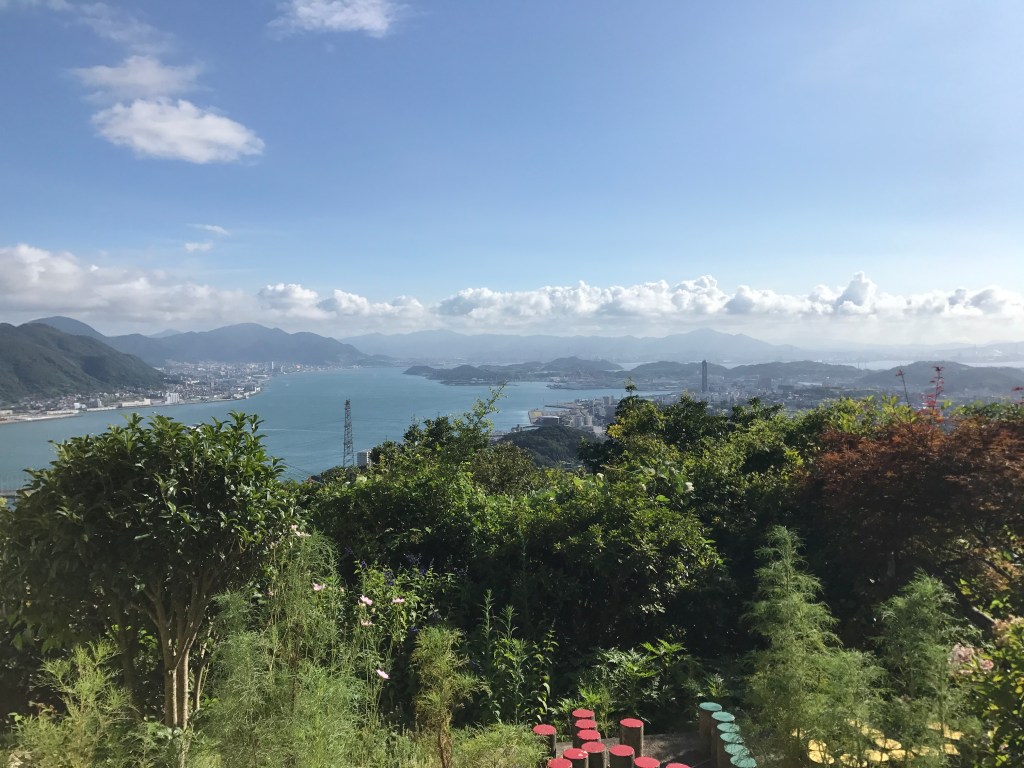
Because it is where Japan’s geography becomes visible. Stand at the strait and you can see two islands of the Japanese archipelago separated by a channel you could swim, with ships from Korea and China queuing through it. The city grew on that traffic and on the fish that gather in the current.
Because the food is a destination in itself. Shimonoseki lands more fugu than any other port in Japan, and the restaurants around Karato serve it at every price, from a lunch set to a full course with hire-zake. The market is a working one, not a tourist reconstruction, and the whale and fugu counters are the real thing.
Because the history is unusually dense for a city this size: the Genpei War’s last battle, the treaty that ended the first Sino-Japanese War, the Chofu castle town of the Mori clan, and the Meiji Restoration’s young radicals, all within a few kilometres.
The strait and the city
Shimonoseki sits at the western tip of Yamaguchi Prefecture, on the Honshu side of the Kanmon Strait. Across the water is Kitakyushu’s Moji district, connected by the Kanmon Bridge, a road tunnel, a railway tunnel and a pedestrian tunnel under the seabed. The city itself spreads west along the coast toward Tsunoshima and north into the hills, but the sights that matter to a short visit are clustered between Shimonoseki Station and the strait.
The centre has three parts. Karato, on the waterfront, holds the market, the aquarium, the ferry terminals and the Shunpanro restaurant. Akama Jingu and the Dannoura battle site sit just west of it. Chofu, the old castle town, is a short bus ride east, and Shimonoseki Station is the transport hub between them. Everything in that triangle is 10 to 20 minutes apart by bus.
A short history
The strait was a boundary from the beginning. In 1185 the Genpei War ended in the Battle of Dannoura, fought on the water just off the city, where the Taira fleet was destroyed and the child emperor Antoku drowned. The story of his grandmother leaping into the sea with him is one of the founding tragedies of Japanese literature, and Akama Jingu was built to enshrine him.
In the Edo period the area was the castle town of the Mori clan at Chofu, a domain that later produced some of the Meiji Restoration’s most active young men. In 1863, during the push to open Japan, foreign warships bombarded Shimonoseki after the domain fired on shipping in the strait; the battery sites are marked along the coast.
In 1895 the peace conference that ended the first Sino-Japanese War met at the Shunpanro inn above the strait. The Treaty of Shimonoseki ceded Taiwan and the Liaodong peninsula and imposed a huge indemnity, and the room and furniture used in the talks are preserved next door. The city that had been a battlefield became a treaty port, then an industrial port, and today a fishing and ferry city of about 250,000 people.
Getting there
The Shinkansen stops at Shin-Shimonoseki, on the hill above the city. From Tokyo it is about 4 hours 20 minutes, from Osaka about 2 hours 10, and from Hakata about 20 minutes. Shin-Shimonoseki is not the centre: a local train on the Sanyo line takes about 10 minutes to Shimonoseki Station, and buses run from both stations to Karato.
From Shimonoseki Station, buses to Karato take about 10 minutes, and the ride to Chofu about 20. A taxi from the station to Karato is short and cheap if you have luggage. The Kanmon ferry from Shimonoseki to Moji takes 5 minutes and costs 400 yen one way, which is the fastest way to cross to Kyushu on foot.
For Tsunoshima, the drive from Shimonoseki Interchange is about 1 hour 10 minutes. By train, take the San’in line to Kottoi and then a bus for about 15 minutes to the Hotel Nishi-Nagato Resort entrance, a short walk from the bridge viewpoint; services are thin, so check the return times before you go.
Getting around
Sanden Kotsu buses cover the city, with Karato, Akama Jingu, Chofu and the station all on routes. A one-day pass is available as a mobile ticket and pays off after three or four rides. The centre is also flat enough to walk: the station to Karato is about 25 minutes on foot, and Karato to Akama Jingu another 10.
A rental car is only necessary for Tsunoshima, Chofu’s outer temples and the western coast. For a two-day city visit, buses and the ferry are enough, and parking around Karato is expensive and crowded at weekends.
The Kanmon pedestrian tunnel
This is the thing to do first, because it is unlike anywhere else in Japan. The Kanmon road tunnel is a double-deck structure opened in 1958: cars on top, pedestrians underneath, 780 metres of walking tunnel under the strait, 55 to 60 metres below the surface. You enter by elevator on the Shimonoseki side, walk to Kyushu, and come back up in Moji.
It is free for walkers, open from 6:00 to 22:00, and takes about 15 minutes each way. Bicycles and small scooters pay 20 yen and must be pushed. The prefectural border runs through the middle, marked by a line and a sign, and the tradition is to straddle it for a photograph. Stamp sheets at both elevator halls make a combined stamp, and the certificate you get for collecting both is a small, silly, genuinely good souvenir.
Do it as a loop: walk under, come up in Moji, look at the Mojiko Retro warehouse district and the Kanmon Bridge, then take the 5-minute ferry back to Shimonoseki for 400 yen. That gives you both crossing methods and a view of the strait from the water in under two hours.
Karato market
Karato is the city’s kitchen and the best breakfast in town. The wholesale market runs on a normal schedule from Monday to Saturday, 5:00 to 15:00, and from 8:00 to 15:00 on Sundays and holidays, though individual stalls vary. The famous part is the weekend event, Ikiiki Bakangai, when the fishmongers sell sushi, seafood bowls, fried fish and fugu soup from stalls: Fridays and Saturdays from 8:00 to 15:00, Sundays and holidays from 7:00 to 15:00.
Arrive early. By 11:00 on a holiday the queues at the popular stalls are long, and the best shellfish is gone. The market also holds a morning market on the second and fourth Thursday of each month from 7:00 to 10:00, where the public can buy at wholesale prices.
Inside, look for the whale and kamaboko corner, which is a reminder that Shimonoseki has a long whaling history and still sells whale meat openly. The fugu stalls sell sashimi, hotpot sets, dried fins and fugu fish cakes. There is a food court upstairs, and a parking building next door with 523 spaces, free for the first hour.
Fugu, and how to eat it
Shimonoseki calls fugu fuku, fortune, and the local trade has been the largest in Japan for generations. The fish is landed at Haedomari, a dedicated fugu port on Hikoshima, where the auction is still conducted by the traditional bag method: buyer and auctioneer put a hand into a cloth bag and negotiate the price with finger grips, invisible to the room.
Fugu is a winter fish. The wild season runs from October to March, with the peak in December and January, when the torafugu is fattest and most expensive. Farmed fugu is available all year and is cheaper and milder; many restaurants serve it in summer. If you want the real thing, come between November and February.
The standard course moves through stages. Tessa is the sashimi, sliced thin and arranged like a chrysanthemum, eaten with ponzu and chives. Tecchiri is the hotpot, with the fish, tofu, Chinese cabbage and mushrooms simmered in kombu stock. Karaage is the fried version, and the meal ends with rice cooked in the remaining broth, then hire-zake, hot sake with a grilled fin. Prices in Shimonoseki run from about 2,000 yen for a lunch set to 10,000 to 20,000 yen for a full course at a famous house.
If you are nervous, book a place with a set course rather than ordering individually, and say if you want the skin or the milt (shirako); both are delicacies and both are an acquired texture. The risk in licensed restaurants is minimal: only licensed chefs may prepare fugu, and the poisonous parts are removed at the market.
Haedomari and the fugu festival
Haedomari market, on Hikoshima, is where the fugu trade is concentrated. It is a working market, not a visitor attraction, and general tours are limited; the reliable chance to see it is the annual Fugu Day festival, held on 11 February, which in 2026 was the 30th edition, with free fugu soup, stalls, a lottery and a bag-auction demonstration.
If you are in the city in February, it is worth planning around. Otherwise, the market view is from the outside, and the fugu restaurants and Karato stalls are the practical way to meet the fish.
Akama Jingu and Dannoura
Akama Jingu is a bright vermilion shrine on the hill above the strait, dedicated to the child emperor Antoku. The present hall dates from the 1960s, rebuilt after a fire, and the gate and the approach are photogenic in a way that most war memorials are not. Behind it is the Hoichi Hall, named for the blind biwa player of Lafcadio Hearn’s ghost story, whose ears were torn off by spirits.
Below the shrine, the Dannoura battlefield park marks the site of the 1185 naval battle. There is a small museum, a statue of the emperor, and a view over the water where the Taira fleet sank. The whole visit takes an hour, and it pairs naturally with Shunpanro next door.
Shunpanro and the treaty museum
Shunpanro is a ryokan and restaurant on the hill above the strait, famous for two things: it was the first restaurant licensed to serve fugu after Ito Hirobumi lifted the ban in the Meiji era, and it was the venue for the 1895 peace conference. The building that hosted the talks burned in the 1945 air raid, but the Meiji-era furniture was saved, and the small museum next door reconstructs the conference room with the original chairs and documents.
The museum is free, open from 9:00 to 17:00 with last entry at 16:30, and has no closing days. It is unstaffed, quiet and strangely moving: a room with a long table, heavy chairs, and the maps of a treaty that changed the map of East Asia. The restaurant itself is expensive and needs a reservation; lunch is the cheaper way in.
Chofu, the castle town
Chofu was the castle town of the Mori clan, and its street plan survives. The castle ruins are now a park on the hill, with stone walls, a moat and a view over the town. Below them, the Chofu Mori residence is a restored Edo-period mansion with a garden, and the Chofu Garden is a small landscaped garden with a pond and tea house.
Kozanji temple is the reason many Japanese visitors come: it is where Takasugi Shinsaku, the Choshu radical who helped topple the shogunate, is buried, and the temple holds his relics. The lane of old shops and walls around it, Kozanji-dori, is the prettiest street in the city.
Chofu is quiet, and that is the point. Allow two hours, take the bus from Shimonoseki Station, and walk between the castle park, the residence, the garden and the temple. Most sites charge a small admission and close around 17:00.
Hinoyama and the view
Hinoyama is the mountain above the strait, and the view from the top is the classic image of Shimonoseki: the strait, Hikoshima island, the Kanmon Bridge and Kyushu on the far side. The catch is that the ropeway is not running. It closed for redevelopment, and the replacement pulse gondola is scheduled for 2027 or later, so the summit is reached by road or taxi for now.
The park itself is partly restricted during the works. A new ring-shaped observation deck, the Hinoyama Ring, opened in April 2026, and a campsite opened at the foot of the mountain in September 2026, but other areas, including the tulip garden, may be closed. Check the city’s page before you go, and do not promise yourself a ropeway ride.
If the summit is hard to reach, the view from the Kanmon Bridge approach or from the Moji side is nearly as good, and the bridge is illuminated at night.
Across the water: Moji and the bridge
Moji is a five-minute train ride or a five-minute ferry from Shimonoseki, and it feels like a different city. The Mojiko Retro district has restored early twentieth-century warehouses, the old Moji customs house, a blue-and-white station building from 1914, and a waterfront promenade with views back to Honshu.
The Kanmon Bridge itself, opened in 1973, carries the expressway and the railway across the strait. You cannot walk it, but the ferry passes underneath, and the view of the bridge from the Moji side at sunset is the best free sight in the area.
Ganryujima, the small island where Miyamoto Musashi fought Sasaki Kojiro in 1612, lies in the strait and is visible from the water. Landing there depends on seasonal boats, so treat it as a view rather than a destination unless you have checked the schedule.
Tsunoshima and the northwest
Tsunoshima Bridge is the reason people rent a car. The 1,780-metre bridge runs straight across water that shifts from emerald to cobalt, and because its piers are kept low, you drive almost at sea level. It opened in 2000, is free, and is open 24 hours. The island at the far end has a lighthouse, a beach, and a small fishing village, and the whole loop takes two to three hours.
Go early or on a weekday. On summer weekends and holidays the approach road jams, and the 50-space car park on the Honshu side fills. The best light for photographs is the morning, with the sun behind you.
The northwest coast around Kottoi is also squid country: Kottoi squid is the local catch, served as sashimi, tempura and dried strips. Roadside stations along the route sell it, along with fresh fish and soft ice cream.
Where to stay
The station area is the practical base: business hotels from about 8,000 to 14,000 yen, with the usual chains, plus a few older hotels with larger rooms. Karato has the best views and the highest prices, including Shunpanro itself and the Grand Hotel facing the strait; a room with a strait view is worth one night if the budget allows.
For a quieter stay, Chofu has small inns and guesthouses, and the western coast has onsen ryokan around Kawatana and Toyoura. Kawatana Onsen, about 40 minutes by bus or train, is a hot-spring village with foot baths and the birthplace of kawara soba, which makes it a good second night if you have a car.
Food and drink beyond fugu
Whale is the other local speciality, and Shimonoseki is one of the few places in Japan where it is openly served. Look for harihari hotpot, whale sashimi and fried whale at the market and in the izakaya around Karato. It is a polarising food, and the ethics are contested; if you want to understand the city’s history, it is part of the story.
Kawara soba is the regional dish: green tea soba with beef, egg and leek, cooked on a hot roof tile and eaten with a dipping sauce. It was invented at Kawatana Onsen, and the restaurants there are the original. Kottoi squid, Tsunoshima salt, and the local sake of Yamaguchi round out the menu.
For a cheap and excellent meal, the market food court and the stalls do seafood bowls and sushi at half the price of a fugu restaurant. For dinner, the lanes between Karato and the station have yakitori, izakaya and a couple of good standing bars. Book fugu in advance in December and January.
Seasons
Shimonoseki has a mild Seto Inland Sea climate, with hot, humid summers and cool, windy winters. Spring is the best walking weather, with cherry blossom around Akama Jingu and Chofu in late March and early April. The rainy season runs from early June to mid-July, and typhoons can affect the region in August and September.
Summer is festival season: the Kanmon Straits Fireworks on 13 August, when about 18,000 shells are launched from both shores, is one of the biggest in western Japan and fills every hotel. Autumn is clear and comfortable, and the fugu season opens in October. Winter is cold but rarely freezing, and December and January are the peak for fugu.
Two days in Shimonoseki
Day 1: the strait
Start at Karato market for breakfast, then walk to Akama Jingu and the Dannoura site, and visit the treaty museum at Shunpanro. In the afternoon, walk the Kanmon pedestrian tunnel to Moji, look around the retro district, and take the ferry back. Finish with fugu dinner near Karato, booked ahead.
Day 2: Chofu and the west
Take the bus to Chofu in the morning and walk the castle park, the Mori residence and Kozanji. After lunch, either continue west to Tsunoshima by car, or take the train to Kawatana Onsen for a bath and kawara soba. Return to the station in the evening.
With a third day, add Akiyoshidai and the Akiyoshido cave, about 1 hour 30 minutes by car, or cross to Mojiko for a slower morning.
Budget
A city break here is moderate. Business hotels are 8,000 to 14,000 yen, a market breakfast 1,000 to 2,000 yen, a fugu lunch set 2,000 to 4,000 yen, and a full fugu dinner 8,000 to 20,000 yen. The tunnel is free, the treaty museum is free, and the ferry is 400 yen.
Tsunoshima needs a car: about 6,000 to 9,000 yen for a day, plus fuel. Trains and buses are cheap but slow, and a rental car for one day is the better value if two or more people are travelling.
Practical tips
- Do the tunnel before 10:00, when it is quiet and the light in the undersea section is at its best.
- The market is a working place: keep out of the way of pallets and forklifts, and ask before photographing stalls.
- Weekend market crowds peak between 10:00 and 12:00; go at opening.
- Book fugu restaurants in December and January, and expect to pay a deposit at the famous houses.
- Check Hinoyama’s access before planning the view; the ropeway is out of service.
- Carry cash for the market, the ferry and small restaurants.
- If you walk the tunnel, allow 40 minutes including the elevators and the photo stop.
- Do not cross to Moji on the last ferry without checking the return time; the train is the reliable option.
- Tsunoshima is a 24-hour bridge, but the island’s restaurants close in the afternoon.
- Whale meat is legal but controversial; decide before you order, not at the table.
Before you go
Decide what the trip is for. If it is food, come between November and February, book one serious fugu dinner and spend the rest of the budget at the market. If it is history, come in spring or autumn, when walking between the shrine, the treaty museum and Chofu is pleasant, and give the city two nights. If it is the coast, rent a car and make Tsunoshima the centre of a day, with the Kottoi squid and the northern fishing villages as stops.
Whichever it is, keep one morning free for the strait. The city is at its best early, when the market is loud, the ferries are loading, and the water between Honshu and Kyushu is doing the thing it has done for a thousand years. Everything else in Shimonoseki is a consequence of that channel.
Sources
- Kanmon Straits Navi: pedestrian tunnel hours and fares (checked 2026-10-26)
- Karato market: 2026 Bakangai opening times (checked 2026-10-26)
- Yamaguchi tourism: Karato market hours and access (checked 2026-10-26)
- Shimonoseki fishing port: the Haedomari fugu bag auction (checked 2026-10-26)
- Shimonoseki Fugu Day festival 2026 (checked 2026-10-26)
- Shimonoseki City Museum: the Treaty of Shimonoseki memorial hall (checked 2026-10-26)
- Yamaguchi tourism: Hinoyama Park redevelopment status (checked 2026-10-26)
- Yamaguchi tourism: Kanmon Straits Fireworks 2026 (checked 2026-10-26)
Explore More of Japan
- Akiyoshidai and Akiyoshido — the limestone plateau east of the city
- Hagi Travel Guide — the castle town of the Choshu domain
- Kintaikyo and Iwakuni — the five-arch bridge
- Miyajima Travel Guide — the floating torii
- Onomichi Travel Guide — hills and the Shimanami road
- Hiroshima Peace Memorial Guide — the next stop east


Leave a Reply