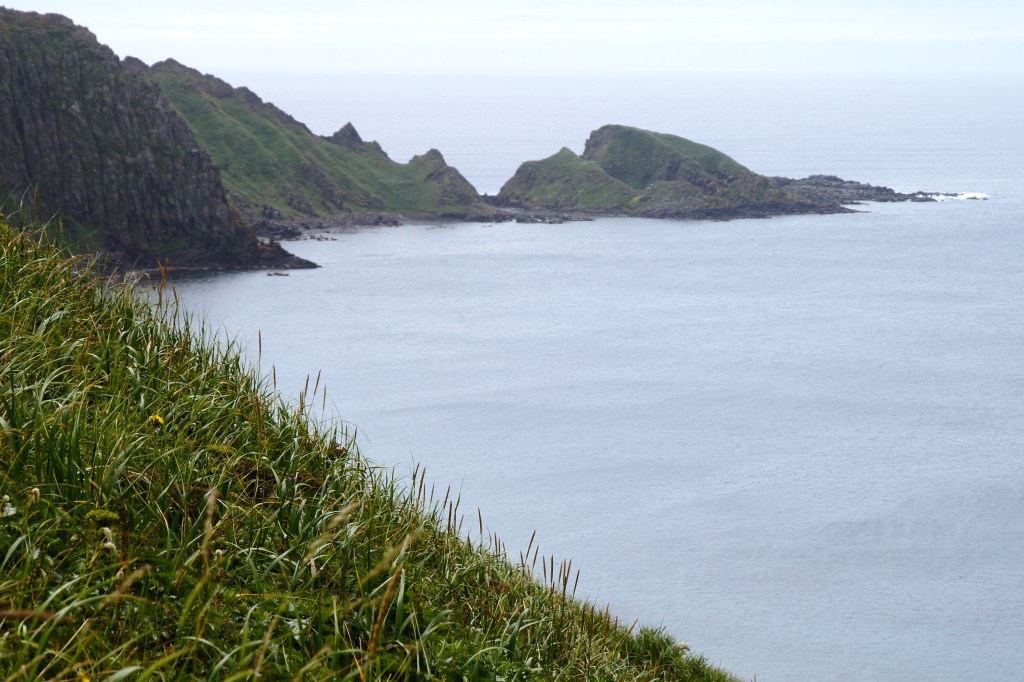
Rebun is the island at the end of Japan, and it does not look like the rest of Hokkaido. A thin ridge of rock 60 kilometres west of Wakkanai, it rises to 490 metres and catches the cold current from the north, so plants that normally grow above 2,000 metres in the Alps flower here almost at sea level. In late June the clifftop paths are a garden, the sea below is a hard blue, and Rishiri’s cone sits across the strait like a cut-out.
The island is small, but it is not a simple day trip. Ferries run a few times a day, buses are thin, the west coast has no road, and the weather can cancel a sailing. This guide covers the 2026 ferry timetable and fares, which trail to choose, when the flowers actually open, the onsen, the sea urchin, and where to sleep if you want more than an afternoon ashore.
Why Rebun
Because the walking is extraordinary for the effort. The classic route follows the northwest coast from the northern tip to a fishing village, passing three capes, sea cliffs, and a boardwalk through the island’s rarest flower. It takes about five hours and never goes above 200 metres. Very few places in Japan give that much coastal drama for that little climbing.
Because the flowers are a genuine event, not a marketing line. Rebun has more than 200 alpine species, and one of them, the Rebun atsumorisou, grows nowhere else in the world. The island opens its colony for a few weeks each spring, with wardens and a boardwalk, and people plan whole trips around it.
Because it is quiet. There is no resort strip, no chain hotel, no nightlife beyond a couple of izakaya. In the evening the ferry leaves, the day visitors go with it, and the island belongs to the few hundred people staying over.
The island at a glance
Rebun measures about 81.6 square kilometres: 29.8 kilometres from north to south and only 7.9 across, with a coastline of 72 kilometres. The highest point, Rebun-dake, is 489.8 metres. The east coast slopes gently to the sea and carries the villages, the road and the bus. The west coast is a line of sea cliffs with no coastal road at all, which is why the western trails exist and why they feel remote.
The northern third is different again: low, rolling, boggy hills around Kutsuko Lake, formed by ancient periglacial action and looking more like Sarobetsu than like the sharp south. Kafuka, the port and main village, is in the south; Funadomari is the northern village; Hamana, Sukai and Gorota are hamlets along the northwest.
There are no bears, no deer and no foxes on Rebun, which is one reason the trails are open to anyone. There are also no snakes. That absence is worth knowing if you are used to hiking in Hokkaido with a bell on your pack: here the dangers are wind, fog, slippery boardwalk and the cold sea, not wildlife.
A short history
The name comes from Ainu: repun-sir, the island in the offing. Japanese records wrote the sound as Rebun. For centuries the island was a seasonal fishing ground for Ainu and, from the late seventeenth century, for Japanese fishermen working the rich kelp and herring grounds under the Matsumae domain, which attached Rebun to its Soya territory in 1685.
Permanent villages followed in the Meiji period, when Kafuka became the administrative centre and the two villages of Kafuka and Funadomari were organised into modern municipalities. The island became a town in 1959. Fishing is still the main industry: kelp, sea urchin, abalone and hokke, with tourism filling the summer months. Rebun kombu, dried and sold in thick bundles, is one of the reasons the island’s name appears on restaurant menus as far away as Kyoto.
The other modern date that matters is 1974, when the Rishiri-Rebun-Sarobetsu National Park was established. The park covers the whole island, which limits development and explains why a place this accessible still looks unfinished in the best sense.
Getting there
There are no scheduled flights to Rebun. The only public route is the ferry from Wakkanai, run by Heart Land Ferry, and it takes 1 hour 55 minutes to Kafuka. In summer the crossing is usually calm; in autumn and winter it can be rough, and sailings are cancelled when the strait is bad.
For 2026 the timetable has three round trips a day from 1 June to 30 September: departures from Wakkanai at 06:30, 10:30 and 14:50, arriving at 08:25, 12:25 and 16:45; returns from Kafuka at 08:55, 14:20 and 17:10. In October the pattern narrows to 06:30, 10:10 (that one runs via Rishiri and takes 2 hours 50 minutes) and 14:45, with returns at 08:55, 13:25 and 17:05. From 1 November to the end of December there are two round trips: 06:35 and 14:10 out, 09:00 and 17:05 back.
Fares for 2026 are listed in two seasonal bands. Economy class is 2,990 yen in one band and 3,950 yen in the other; business class is 3,650 or 4,610 yen, and first class 5,620 or 7,270 yen. A bicycle costs another 1,890 yen. The difference between the bands is worth checking before you budget, and the fare table on the operator’s site is the only reliable source.
Wakkanai is the gateway. Flights from Sapporo’s New Chitose take about an hour, and there are direct flights from Tokyo Haneda in some seasons. From Wakkanai Airport a bus reaches the city centre in about 30 minutes, and the ferry terminal is a short walk or taxi from Wakkanai Station. If you are coming by train, the Soya Line from Asahikawa is a long, slow, beautiful ride along the northern coast.
There is a second, cleverer route in summer. Rishiri Island, across the 8-kilometre strait, has an airport with flights from New Chitose, and the ferry from Oshidomari to Kafuka takes about 45 minutes. That lets you combine the two islands without backtracking to Wakkanai; see the note on Rishiri below.
Getting around
Buses on Rebun are run by Soya Bus and all start from the ferry terminal at Kafuka. There are three directions: north along the east coast to Sukoton, southeast to Shiretoko, and west to Motoi. No route crosses the island, so you always return to Kafuka to change. The timetable was revised on 1 October 2026.
On the summer sheet, five buses a day run north toward Sukoton, leaving Kafuka at 06:30, 07:45, 10:40, 15:15 and 17:00. The 15:15 service stops at Funadomari Hospital and does not reach the cape, and the last bus back from Sukoton leaves at 17:58. From October the frequency drops and weekend services differ, so check the winter sheet before planning a late return. The fare from Kafuka to Sukoton is 1,400 yen one way; a one-day pass for all island buses costs 3,000 yen and pays off as soon as you add a second direction.
A sightseeing shuttle runs from 1 June to 30 September, timed for the morning ferry, and it is the only bus that stops at the alpine botanical garden. Reserved guided coaches are the other option: the A course circles the northern sights in about 3 hours 50 minutes for 3,600 yen, and the B course covers Skai and Sukoton in the afternoon for 3,300 yen. Both need booking, and both are guided in Japanese.
A rental car is the simplest way to see the whole island. Offices for Nissan, Toyota and Nippon Rent-A-Car sit at or beside the ferry terminal in Kafuka, and a car lets you reach the trailheads, the northern lake and the sunset without watching the clock. Roads are narrow in places, and the Edo-ya mountain road between Edo-ya and Sukoton is effectively one-way from south to north. Rental bicycles and scooters are available in Kafuka in season; the island is hilly and windy, so an electric-assist bicycle is the realistic choice.
One thing to plan around: the west coast has no road at all. Sukai, Gorota and the flower colony are reached on foot along the trail, or by the few buses that stop at Hamana and Sukoton. That is the reason the cape walk is the centrepiece rather than an optional extra.
The flowers
Rebun is called the floating island of flowers, and the season runs from the first saxifrages in May to the last autumn gentians in September. The peak is late May to early August, when the alpine meadow species open in sequence: Rebun kinsho, Rebun usuyukisou, Ezono hakusanichige, Rebun kozakura and the star of them all, the Rebun atsumorisou.
The atsumorisou is a slipper orchid with a cream-coloured, inflated lip, and it is endemic to Rebun. It is also rare enough that the colony is fenced and wardened. For 2026 the Funadomari coast site opened on 11 May, from 7:00 to 17:00, and the Tefu boardwalk and viewpoint areas opened on 15 May, from 8:30 to 17:00 with last entry at 16:30. Tour buses may only use the Tefu side. The flower itself peaks from late May to mid-June, and the opening dates shift with the season, so check the town’s notice in the week you travel.
The Rebun town alpine botanical garden, halfway up the east coast, is the insurance policy. It holds about 50 species and 10,000 plants in a small space, opens from early May to late September, charges 310 yen for entry between 20 May and 31 August, and is open 9:00 to 16:30. It is the one stop where the shuttle bus calls, which makes it practical without a car.
Later in the summer the Rebun usuyukisou, a white edelweiss relative, covers the forest road from June to August. That is the other flower people come for, and it is easier to see than the orchid because it grows in sheets along an 8-kilometre road walk.
The cape walk: Sukoton to Hamana
This is the walk to do if you do one. The cape circuit starts at Sukoton, the northern tip, and follows the west coast south over Gorota Pass to Sukai Cape, then through the atsumorisou colony to Hamana. It is about 12.4 kilometres and five hours at an easy pace, with roughly 400 metres of cumulative climbing.
The first section crosses the shoulder of Gorota-yama on a narrow path with the cliff dropping to your left. Sukoton and Todo Island stay behind you, then the coast opens into a series of headlands. Gorota Cape is the high point of the walk, with a view back to Sukoton and forward to the cliffs beyond. After that the path drops to a small fishing port and climbs again to Sukai Cape, where the water is the clearest on the island and a set of steps leads down to a tiny cove.
From Sukai the path runs through the flower colony on a boardwalk, then descends to Hamana. Buses stop at both Sukoton and Hamana, which makes a one-way walk possible: take the early bus north, walk south, and catch an afternoon bus back from Hamana. Do not attempt it in fog or after heavy rain; the cliff sections are exposed, the wind is constant, and there is no shelter or phone signal for long stretches.
Shorter versions exist. The Sukai Cape out-and-back from Hamana takes about 90 minutes and gives you the best water without the full traverse. The Gorota out-and-back from Sukoton is about two hours and is the steepest part of the route.
The seven trails
Rebun markets seven footpaths, and they are genuinely different. The Momoiwa viewpoint course is the most popular short walk: 5.3 kilometres from the Momoiwa trailhead to Shiretoko, about three hours, with most of the island’s flowers and a view of Rishiri for the whole ridge. The Rebun-dake course climbs 4.5 kilometres one way to the 490-metre summit in about two hours, with a 360-degree view and a wet, slippery upper section.
The Rebun forest road course runs 8 kilometres between Motoi and Kafukai and is the usuyukisou walk. The Rebun Falls course branches from it for a 4-kilometre round trip to the island’s main waterfall, a quiet green detour that feels more like England than Japan. The Kutsuko lakeside course circles Japan’s northernmost lake in 4.2 kilometres, about 1 hour 40 minutes, with wetland plants and migrating birds.
Then the two long ones. The cape circuit is the 12.4-kilometre west coast route described above. The eight-hour course is the island traverse: about 16.5 kilometres from Hamana through Nishikamidomari and the west-coast hamlets of Amanai and Uennai to Kafukai, with a long stretch between the last houses and the road. It is for fit walkers with food, water and a booked pickup, not for a first visit.
Sukoton and the northern end
Sukoton Cape is the northernmost point of Japan that you can reach on a scheduled ferry, and the stone marker says as much: the northern limit, not the northernmost point of the country, which belongs to an uninhabited rock further out. On a clear day you see Todo Island a kilometre offshore and the whole curve of the northern coast. There is a small shop and a restaurant in season, a lighthouse, and a short path along the clifftop.
Todo Island is a haul-out for seals and, occasionally, Steller sea lions. You cannot land, and the boats do not circle it; bring binoculars and watch from the cape. The animals are most often seen in the morning.
Funadomari, the northern village, has the ferry pier for the Rishiri crossing in some seasons, a small fishing harbour, and the road to Kutsuko Lake. The lake is Japan’s northernmost, shallow and reedy, with a campsite and a 4-kilometre path around it. In spring and autumn it is a stopover for migrating birds, and on a still morning the reversed reflection of Rebun-dake is the photograph everyone tries to take.
Rebun Falls, on the west side reached from the forest road, drops off the cliff line into a gorge of ferns and moss. The walk in is about an hour each way and the falls are modest by mainland standards, but the forest is the point: old, wet, and full of the sound of water.
Momoiwa and the south
Momoiwa, the peach rock, is a 250-metre block of pinkish rock above the south coast, and the ridge behind it is the best short flower walk on the island. The trailhead is a short bus ride from Kafuka, and the path climbs gently through meadows to a viewpoint with Rishiri across the water. Continue to Shiretoko and you come out above a tiny fishing hamlet with a cluster of houses and boats.
The nearby Momodai and Nekodai viewpoints look onto Momoiwa and Cat Rock, a pointed sea stack with a hole through it. The names are literal; the resemblance is best from the road. Only the shuttle bus stops there, so without a car you need to time it or walk from the trailhead.
Skai Cape, west of Kafuka, is a low headland with a view back to the port and a small shrine. It is the easiest sunset spot on the island and a ten-minute drive from the ferry.
Onsen
Rebun has one public hot spring, Usuyuki-no-Yu, a short walk from the ferry terminal in Kafuka. It is a sodium chloride and sulfate spring, clear and hot, with an indoor bath, a jacuzzi, a sauna and an open-air pool facing Rishiri. Admission is 600 yen for adults and free for primary school children, and a private family bath costs 1,000 yen for 50 minutes on top of admission, booked in advance.
Hours change with the season: from April to September it opens at noon, from October to March at 13:00, and it closes at 21:00 all year with last reception at 20:30. There is no closing day. Shampoo and body soap are provided, which is unusual for a small island bath, and towels are available for a fee.
Several hotels and ryokan also have hot-spring baths, and some allow day use in the afternoon. Hotel Rebun, directly opposite the ferry terminal, has a view bath on an upper floor; the large hotels are seasonal and close in winter, so the public bath is the reliable option outside summer.
Where to stay
Kafuka is the practical base: the ferry, the buses, the onsen, the restaurants and the rental cars are all there. Hotel Rebun and Rebun Kanko Hotel Saryo are the big seasonal hotels, open from mid-May to late September and priced from about 16,500 to 35,000 yen for two meals. Hanarebun, five minutes from the terminal, is the upmarket option, with open-air baths and rooms from 22,000 yen.
Ryokan Sakurai is the year-round traditional choice, with two meals from about 14,300 yen outside the summer peak, and there are pensions and minshuku in the 9,000 to 15,000 yen range. Guesthouse Nonno and a handful of small lodges offer room-only stays from around 6,000 yen, which suits walkers who want to eat out. In Funadomari, Hotel Rebunso is a simple 11,000 to 15,000 yen inn with two meals, useful if you want to be in the north for sunrise.
Book early for the atsumorisou season and for the Obon week in August. Many small places close in winter, and the ones that stay open have fewer rooms. Cash is still common; some places take cards, some do not.
Food and drink
Sea urchin is the reason many Japanese travellers come. Rebun’s kombu-fed uni is landed from late spring to early autumn, and the season is usually quoted as June to August, with the best quality in the first half of summer. It arrives as a bowl of rice with a heap of orange lobes, or as unigiri, a rice ball topped with uni and wrapped in nori. Prices are high and vary with the catch; ask before ordering.
Hokke, the Okhotsk atka mackerel, is the other local fish, and the island version of chanchan-yaki is a foil parcel of hokke with miso, spring onion and butter, cooked fast and eaten from the tail end. It is a fishing-village dish rather than a restaurant invention, and it appears on most set menus.
Rebun kombu, dried in thick folds, is the island’s export and its souvenir. Buy it at the shops around the ferry terminal or at the fishing co-operative, and remember that Japanese customs rules on plant products apply if you take it home.
Restaurants are few and close early. In Kafuka there are a handful of seafood places, two sushi counters, an izakaya or two and a bakery; in Funadomari there is essentially one canteen. Most ryokan include dinner, which solves the problem. If you are self-catering, buy food in Kafuka before you head north, and carry cash for the small shops.
Seasons and weather
Rebun’s climate is not Hokkaido’s interior. The sea keeps winter mild, and summer is cool, wet and foggy. Average highs run from about 6 to 12 degrees in May, 10 to 16 in June, 15 to 20 in July, 17 to 22 in August, 14 to 20 in September and 8 to 14 in October. The fog is the defining summer feature: it can swallow Rishiri for days, then lift in an hour.
Spring is the driest and sunniest season, which is why the flower weeks in late May and June are so good. Summer is green and misty, with the warmest sea and the uni season. Autumn brings clear air, turning grasses and the last flowers, and the first big storms. Winter is quiet, cold and windy, with most tourist facilities shut and the ferry reduced to two round trips.
Whatever the season, carry a windproof layer and rain gear. The island’s exposure means a sunny morning at Kafuka can be a wet, freezing afternoon at Sukoton, and the cliffs give no shelter. Fog is a navigation problem on the west-coast trails, not just a view problem.
Two days on Rebun
Day 1: the north and the cape
Take the 06:30 ferry from Wakkanai and be at Kafuka by 08:25, or arrive the night before and start early. Leave your bag, take the bus north to Sukoton, walk the clifftop and look for seals around Todo Island, then walk the cape circuit south to Hamana if the weather is clear and you have five hours. Take the bus back, check in, and finish with the onsen and dinner.
Day 2: flowers and the south
In late May or June, take the first bus to the atsumorisou colony or the botanical garden, then walk the Momoiwa ridge in the afternoon and catch the 17:10 ferry. Outside the flower season, replace the colony with the Rebun forest road and the falls, or climb Rebun-dake if the cloud is high.
With three days, add Kutsuko Lake at dawn, the Funadomari harbour, and a slow afternoon at Skai Cape. The island rewards staying still more than it rewards coverage.
Rishiri, and the other island
The cone you see from every point on Rebun is Rishiri, a separate island with its own mountain, its own ferry and a very different character. The crossing from Kafuka to Oshidomari takes 45 minutes, and in summer there is also a link to Kutsugata at the western end. Rishiri is for climbing and for the view back; Rebun is for walking and for flowers. Doing both in one trip is easy from Wakkanai, and the ferries are timed to allow it.
Do not try to see both in one day. The crossings, the buses and the mountain each take time, and a missed connection means a night you did not plan.
Budget
A two-night trip from Wakkanai costs roughly 40,000 to 60,000 yen per person: 6,000 to 8,000 yen for the return ferry, 12,000 to 30,000 yen for two nights with meals, 3,000 yen for a bus pass or 8,000 to 12,000 yen a day for a rental car, plus food and the onsen. The uni bowl is the wildcard, at 3,000 to 6,000 yen depending on the day and the catch.
Getting to Wakkanai is the bigger cost if you are coming from Tokyo. Flights, or a rail pass and a long ride up the Soya Line, will dominate the budget; the island itself is modest once you are there.
Practical tips
- Check the ferry status on the morning of travel. Wind cancels sailings, and the next boat may be tomorrow.
- Do not book a flight out of Wakkanai on the same afternoon as a return ferry. Leave a night.
- Buy the one-day bus pass only if you are using two directions; a Sukoton round trip is cheaper at 2,800 yen.
- Carry cash. Not every restaurant, bath or bus counter takes cards.
- Wear shoes with grip for the boardwalk and the cliff paths; sandals are a bad idea.
- Take water and food on the west-coast trails. There are no shops between Sukoton, Sukai and Hamana.
- Fog moves fast. If the path disappears, turn back rather than following the cliff edge.
- Do not pick the flowers, and stay on the boardwalk at the atsumorisou colony.
- Keep your distance from seals and sea lions, and never approach them on the rocks.
- Book accommodation and rental cars before the flower season and Obon.
- Many facilities close at the end of September; check winter openings before a cold-season trip.
- Take your rubbish with you. The island has few public bins.
Before you go
Decide first whether you are coming for the flowers or for the walking, because the timing is different. The atsumorisou window is late May to mid-June and cannot be moved; the cape walk is best from June to September, when the buses run and the ferries are frequent. If you want both, the first half of June is the answer, and you should book the ferry, the room and the car as soon as the dates are fixed.
Second, accept the pace. Rebun is not a place to tick off four sights in a day. One good walk, one bath, one long dinner and an early night is the shape of a good visit, and the island’s weather will rearrange anything tighter. The people who love Rebun tend to be the ones who went for a specific flower or a specific path and let the rest of the day happen around it.
Third, reconfirm. Ferry times, bus times, the colony’s opening dates, the onsen hours and the hotel season all change, and some of them change every year. The official pages listed below are the ones to check in the week before you travel, not a guide written months earlier.
Sources
- Heart Land Ferry: 2026 Wakkanai-Rebun timetable (checked 2026-10-26)
- Heart Land Ferry: 2026 fares (checked 2026-10-26)
- Ministry of the Environment: the 2026 Rebun atsumorisou season (checked 2026-10-26)
- Rebun Island tourism: the seven trails (checked 2026-10-26)
- Soya Bus: Rebun routes and one-day pass, revised 1 October 2026 (checked 2026-10-26)
- Rebun Town: Usuyuki-no-Yu onsen hours and fees (checked 2026-10-26)
- Rebun Town: island geography and name origin (checked 2026-10-26)
- Hokkaido: Rebun alpine botanical garden (checked 2026-10-26)
Explore More of Japan
- Asahikawa Travel Guide — the gateway to northern Hokkaido
- Biei and Furano Travel Guide — flower fields and hills
- Sapporo Travel Guide — the city at the start of the journey
- Abashiri Drift Ice Guide — the other northern edge
- Shiretoko Travel Guide — the wildest coast in Japan
- Niseko Travel Guide — snow and hot springs


Leave a Reply