Minakami is where the Tone river starts, and almost everything worth doing there follows from that. The river that supplies Tokyo begins as snowmelt in the mountains around Tanigawa, runs through a deep valley of hot springs, and gives the town the two things it sells: water hot enough to bathe in and water fast enough to raft. It is also, by Japanese standards, absurdly close to the capital — about an hour from Tokyo station on the Joetsu Shinkansen.
The result is a mountain town that works in every season without ever being crowded in the way that Hakone or Nikko are. In summer people come for the river; in autumn for the leaves; in winter for skiing and for sitting in an outdoor bath while it snows. The onsen are the constant, and one of them is famous enough to have been photographed to death for fifty years.
Why visit
- Takaragawa Onsen has four open-air baths totalling about 470 tatami mats beside a mountain stream, and it is open to day visitors.
- The Tanigawa ropeway climbs to 1,319 metres in about 15 minutes, with a chairlift continuing to a 1,500-metre viewpoint.
- Rafting on the Tone river here is among the best in Japan, with a season from late April to early November.
- Doai station, one of the strangest in the country, has a platform 70 metres underground reached by 462 steps.
- It is an hour from Tokyo, which makes it the most efficient mountain-and-onsen fix on the Joetsu line.
The onsen villages
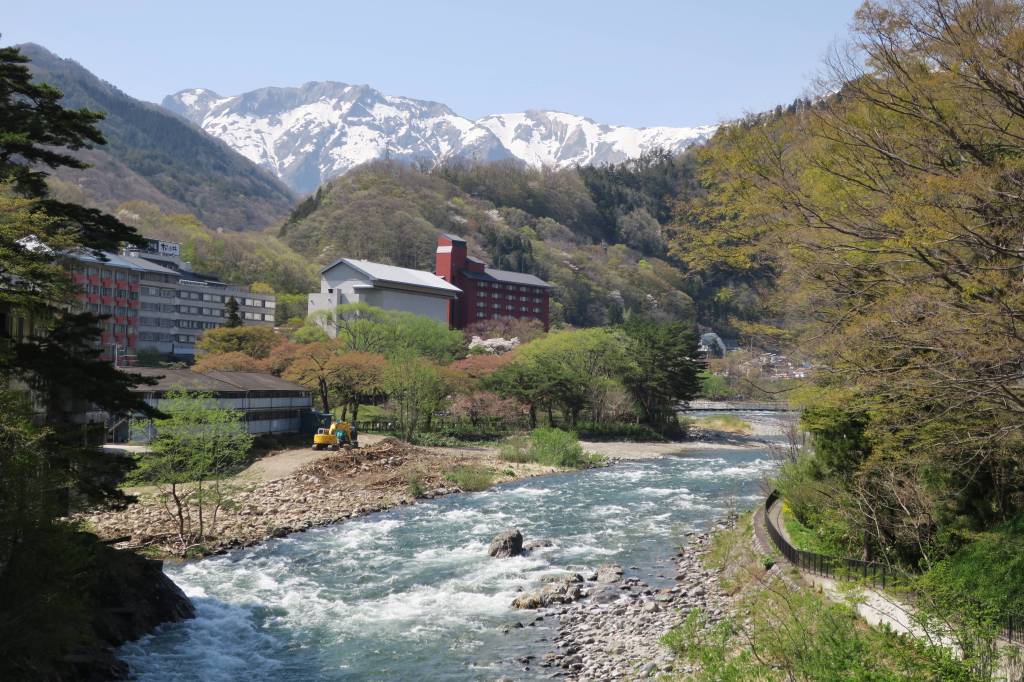
Minakami is not one town but a string of settlements along the valley, each with its own spring and its own character. Minakami itself, around the station, is the practical base with hotels and restaurants. Yubiso, further up, is quieter and more wooded. Tanigawa, at the foot of the mountain, has ryokan with views. Takaragawa is a single inn at the end of a side valley. Sarugakyo, downstream, has a lake and a bigger resort feel.
The water is generally simple alkaline spring, clear and soft, at high temperature — the Takaragawa source runs at about 70 degrees and is cooled with water before it reaches the baths. It is not the sulphur-heavy water of Kusatsu or the iron water of the Japan Sea coast; it is the kind you can sit in for an hour.
Takaragawa Onsen
Takaragawa is the reason many people come, and it deserves the reputation. The baths sit along the Takaragawa river at the bottom of a valley, framed by huge boulders, with a suspension bridge crossing to one of them. There are four: Maka-no-yu, the 120-tatami bath that appears in every photograph, Hannya-no-yu at about 50 tatami, Kodakara-no-yu at about 200 tatami on the far bank, and Maya-no-yu, a 100-tatami bath reserved for women. Three are mixed, and everyone wears a bathing suit — the rental is included in the day ticket, and you cannot use your own.
Day visitors use the Takaragawa Sanso building rather than the main inn: 1,500 yen for adults, 1,000 for primary school children, 10:00 to 16:30 with the last entry at 16:00, and a four-hour limit. Towels are extra — 100 yen to rent a bath towel, 200 to buy a face towel. There is no soap or shower at the open-air baths, only in the indoor bath, so wash there first and then go down to the river.
Two practical warnings. First, day visitors are not covered by the inn’s shuttle, so confirm the final approach from the bus stop when you book. Second, the site is a riverbank with stone steps and a suspension bridge, not a spa complex: wear shoes you can walk in wet, and hold the handrail.
The Tanigawa ropeway
The ropeway runs from Doai-guchi to Tenjindaira in about 15 minutes, rising roughly 570 metres, and it is the easiest way to get high on Tanigawa without climbing. The top station is at 1,319 metres, with a cafe and a short loop walk; from there a chairlift continues to the Tenjin pass observation deck at about 1,500 metres, where the ridge of Tanigawa fills the view.
Fares are 3,000 yen for an adult round trip and 1,500 for a child, or 3,600 / 2,000 with the chairlift included; one way is 1,800. The green season in 2026 runs from 18 April to 15 November, with the ropeway closed entirely from 16 November to 4 December before the winter season begins on 5 December. Hours are 08:00 to 17:00 on weekdays and 07:00 to 17:00 at weekends, with the last ascent at 16:30.
Above the tree line the weather is different from the valley: five to ten degrees cooler, often in cloud, and windy. This is bear country, and the local advice is to carry a bell on the trails. The autumn colour arrives at the top around early October and takes about a month to descend to the valley floor.
Doai station
Doai is a small unmanned station on the JR Joetsu line with one feature that has made it famous: the southbound platform is 70 metres underground, reached by a staircase of 462 steps that takes about ten minutes to descend. It was built that way in 1967 when the new Shimizu tunnel was bored through the mountain and there was no room at the surface for a second platform.
The result is a cold, dim, concrete corridor that ends in a platform in the rock, and it is genuinely worth the detour if you like infrastructure, tunnels or the strange. The station is free to enter with a platform ticket of 150 yen bought at a neighbouring staffed station, and it does not accept IC cards, so bring cash. The climb back up is the part people remember.
Doai is also the stop for the ropeway, 20 minutes on foot along a road with a narrow shoulder, or a short bus ride. Combining the two is the standard half-day: descend into the station, come back up, then ride the ropeway.
Rafting and the river
The Tone river upstream of Minakami is fast, cold and heavily dammed for hydroelectricity, which means the release schedule can be predicted and the rapids are reliable. Spring, when the snow is melting, is the biggest water; summer is lower and gentler, with rock jumps and swimming; autumn is cold but clear.
Half-day tours run about three to three and a half hours and cost roughly 6,000 to 8,800 yen depending on the operator and the day, with the cheapest weekday rates around 6,600 yen including tax. The season is broadly late April to early November, and several companies run from March to December. In spring the minimum age is usually 13; from July, primary school children can join when the water level allows, and the operator decides on the day.
You need a swimsuit, a towel and shoes that stay on your feet and can get wet — sandals that slip off are not allowed, and shoe rental is a few hundred yen. Wetsuits, helmets and life jackets are provided. Most companies pick up from Jomo-Kogen station, Minakami station or local hotels, which is what makes a car-free rafting day possible.
If you would rather not be in the water, the Suwakyo gorge downstream of Minakami has a walking path along the river with bridges and rock formations, and it is free. The Sasabue bridge is the classic view of Tanigawa over the water.
Food and drink
This is mountain food: soba, river fish, wild vegetables, mushrooms and local pork, with rice from the valley. Minakami also has a small sake brewing tradition, and the local water is the reason it works. Around Minakami station there are a few restaurants and cafes, several attached to hotels; in the up-valley villages the food is mostly at the inns, and independent restaurants are scarce.
Lunch is the reliable meal. Dinner needs planning: either book half board at your accommodation or eat in Minakami before 19:00. The train station area has a shop for supplies, and the roadside station further down the valley is a good stop for local produce and ice cream.
Getting there and around
- From Tokyo — Joetsu Shinkansen to Jomo-Kogen, about 50 minutes to an hour, then a bus to Minakami station in about 25 minutes. Some trains continue to Ueno and Tokyo directly.
- By conventional line — JR Joetsu line from Takasaki up the valley, slower but cheaper, with stations at Minakami, Yubiso and Doai.
- By car — Kan-etsu expressway to the Minakami interchange, then route 291 up the valley. From Tokyo it is about two hours outside holiday traffic, and the interchange is close to the town.
- Local transport — buses run from Jomo-Kogen and Minakami stations to the ropeway, Takaragawa and Sarugakyo, but they are infrequent and stop early. A car makes the valley much easier, especially for the onsen villages.
Where to stay
- Takaragawa — the inn itself, for the baths at dawn and dusk without a day-visitor crowd.
- Tanigawa — ryokan with mountain views and private open-air baths, the most scenic option.
- Minakami and Yubiso — hotels and guesthouses around the stations, the practical base without a car.
- Sarugakyo — larger hotels on the lake, good for families and for skiing in winter.
Best time to visit
- Late April to June — the biggest rafting water, fresh green, and fewer people than autumn.
- July and August — warm river days and canyoning, but the valley is at its busiest in Obon week.
- October — autumn colour from the ropeway down to the valley, and the best month for photographs.
- December to March — skiing, snow, and the onsen at their best; the ropeway switches to its winter operation and some roads close.
Rain is frequent in every season, and the rivers rise quickly. Rafting companies cancel when the water is too high, and the ropeway stops in strong wind. Build a flexible day.
Suggested itineraries
Day trip from Tokyo
- Early Shinkansen to Jomo-Kogen, bus to Minakami.
- Local train or bus to Doai, descend the 462 steps and come back up.
- Ropeway to Tenjindaira and the observation deck.
- Bus back to Minakami for a bath and an early dinner before the train.
Two days with the river
- Day one: rafting in the morning, onsen in the afternoon, night in Yubiso or Tanigawa.
- Day two: Takaragawa in the morning when it is quiet, then the ropeway or Suwakyo, and back to Tokyo in the evening.
Practical tips
- Book the ropeway and rafting around the weather, not the other way round.
- Cash is still needed at Doai and at some of the smaller baths.
- Buses are sparse. Check the last departure before you commit to a late soak.
- Bring a towel and a bag for wet clothes if you are rafting and moving on by train.
- Wear shoes with grip for Takaragawa’s stone steps and the Doai staircase.
- In winter, check road closures and tyre requirements before driving up the valley.
Before you go
Fares, hours and season dates above come from the Takaragawa Onsen inn, the Tanigawa ropeway operator, JR East and Minakami tourism, checked on 26 October 2026. Three things are worth reconfirming: the ropeway’s seasonal shutdown, which runs from mid-November to early December and catches people out; the rafting minimum age, which changes with the water level and the month; and access to Takaragawa for day visitors, since the inn’s shuttle does not cover them. The onsen and the river are reliable; the transport between them is what needs planning.
Sources
- Takaragawa Onsen: day bathing hours, prices and baths (checked 2026-10-26)
- Takaragawa Onsen: the four open-air baths and spring details (checked 2026-10-26)
- Tanigawa ropeway: season, hours and fares (checked 2026-10-26)
- Minakami tourism association: activities, access and local information (checked 2026-10-26)
- Minakami tourism association: access by Shinkansen, train and road (checked 2026-10-26)
- Doai station: underground platform, steps and access (checked 2026-10-26)
Explore More of Japan
- Kusatsu Onsen Travel Guide — the other great Gunma hot spring town
- Oze Travel Guide — the marshland national park above the valley
- Nikko Travel Guide — shrines and mountain roads to the east
- Hakone Travel Guide — the classic onsen trip from Tokyo, for comparison
- Chichibu Travel Guide — another mountain escape on the same side of Tokyo


Leave a Reply