Hateruma is the last inhabited piece of Japan. It sits at 24 degrees 3 minutes north, about 60 kilometres south-west of Ishigaki, and beyond it there is nothing but open sea until you reach the Philippines. Roughly 450 people live on 12.8 square kilometres of coral limestone, most of them growing sugar cane, and the island has exactly one village, one port, one small airport and one road that runs around the coast.
People come for two things. The first is Nishi-hama, a kilometre of white sand and shallow turquoise water that is the most beautiful beach in the Yaeyama group and possibly in Japan. The second is the night sky: with almost no street lighting and a southern horizon clear of land, this is the best place in the country to see the Southern Cross. Everything else — the sugar fields, the awamori distillery, the cliff at the southern tip — fills the hours between the ferry arriving and leaving.
Why visit
- It is the southernmost inhabited island in Japan, and the monument at Kona-zaki is the country’s southern extreme.
- Nishi-hama has water clarity and colour that most of Okinawa’s main-island beaches cannot approach.
- The Southern Cross is visible here, and the island’s darkness makes it a serious stargazing destination rather than a marketing claim.
- It still runs on sugar. The cane fields, the winter harvest and the small distillery are the island’s actual economy, not a performance for visitors.
- It is small enough to see properly in a day and quiet enough to justify a night.
The island itself
Hateruma is flat, low and roughly oval, ringed by reef, with a low hill in the middle and the village on the west side. The name is usually explained as coming from hate no uruma — the last of the coral islands. The coastline runs about 14.8 kilometres, which is a comfortable half-day on a bicycle, and the interior is almost entirely cane, broken by limestone walls and the occasional stand of trees.
The southern tip, Kona-zaki, is a cliff of raised coral where the Pacific swell hits without anything to break it. The monument marking the southernmost point of Japan stands here, and it is 25 minutes from the port by scooter or car. The view is not a tropical postcard: it is grey rock, white spray and a very large amount of ocean. That is the point.
In the centre of the island, on the low hill, stands the Hateruma lighthouse, 16 metres tall, first lit in 1959, and the southernmost lighthouse on inhabited Japanese soil. It is a working light rather than an attraction, but the road up to it gives you the only elevated view of the island, with the reef edge visible in the water all the way round.
Nishi-hama
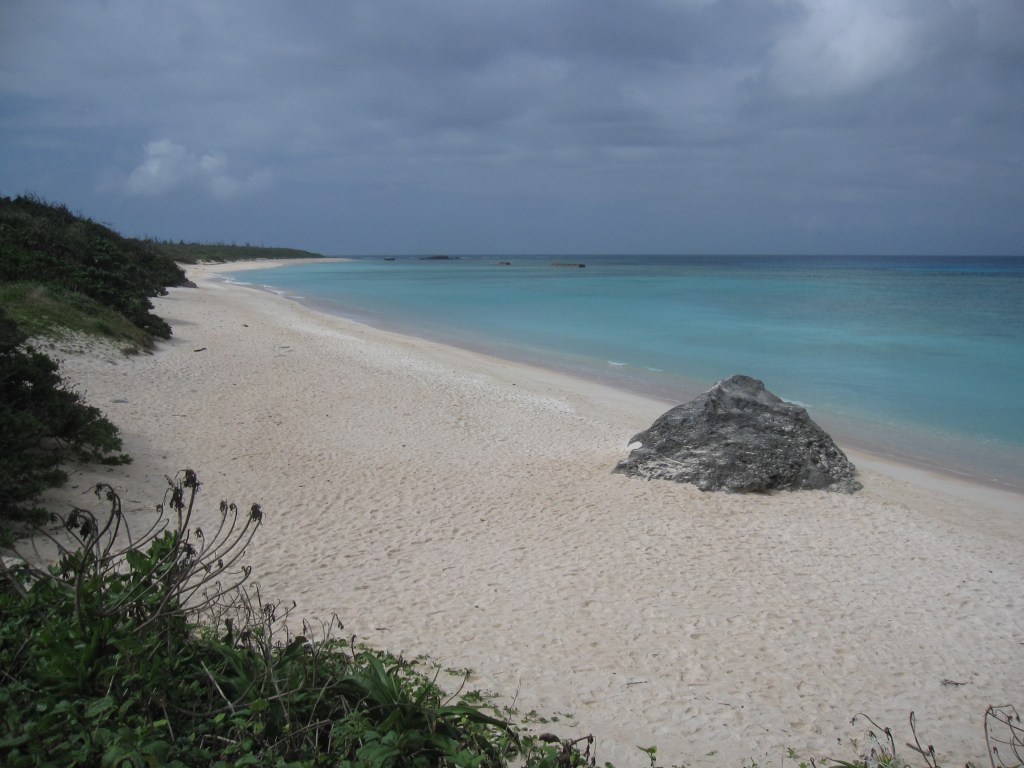
Nishi-hama — also called Kita-hama — is on the north-west shore, about ten minutes by bicycle from the port. It is a long curve of fine white coral sand with a shallow shelf of turquoise water, then a band of deeper blue where the reef drops away. The colour is what people mean by Hateruma blue: not the milky green of a lagoon but a hard, transparent cyan that photographs without a filter.
There are no buildings on the beach, no sunbeds and no beach bars. What there is: a car park, a toilet and shower block, and a lot of space. Bring shade, because the beach faces west and has almost none of its own, and bring water. The shelf is shallow for a long way out, which makes it safe for children close in, but the current at the reef edge is not something to test.
The other beaches, Pemuchi on the east and the small coves around the north, are quieter and more rocky. Nishi-hama is where everyone goes, and even in August it does not feel crowded by Okinawan standards, because there are only so many people on the island at any one time.
Stars
The southern sky is the reason to stay overnight. Hateruma has very little light pollution, a flat horizon to the south and, in winter and spring, a clear view of the constellation Crux — the Southern Cross — which cannot be seen from most of Japan. The island once had a stargazing tower; it is currently closed, so the practical approach is to find a dark stretch of coast road, or the beach after dark, and look up.
Best months are December to May, when the air is drier and the cloud cover lower. Bring a red torch, a blanket and insect repellent, and check the moon phase — a full moon over the reef is beautiful and completely ruins the stargazing.
Sugar, brown sugar and awamori
The island’s economy is sugar cane. The fields run across the interior in long rows, the harvest happens in winter, and the small factory near the village presses the cane into brown sugar during the season. You will see the cut cane stacked at the roadside and the trucks moving it, and the smell of the boil hangs over the village in the harvest months.
Hateruma also has a distillery, Hateruma Shuzojo, making awamori from Thai rice in the Okinawan way. The island’s brown sugar turns up in sweets, in coffee and in a local liqueur, and the shops near the port sell it in blocks and in bags. It is a better souvenir than anything made of shells.
The Mushama festival, held over the lunar Obon in the seventh month, is the island’s biggest event: a procession, dances and a general homecoming, with the whole village involved. If your dates happen to coincide, go, but check the lunar calendar rather than assuming a fixed date.
Getting there
There is no direct route from anywhere except Ishigaki, and the crossing is the part of the trip that needs planning.
High-speed ferry
Anei Kanko runs the fast boat from Ishigaki’s remote island terminal to Hateruma port. In the winter timetable (October to March) there are two round trips a day: 08:00 and 14:30 from Ishigaki, 09:50 and 16:20 from Hateruma. In summer there are three. The crossing takes 60 to 90 minutes depending on the vessel; the large jet foil is slower than the small one.
The fare is around 5,000 yen one way for an adult, including the fuel surcharge, with a round trip around 9,700 yen; surcharges move with fuel prices, so check the operator’s current table rather than an older guidebook. Booking online and paying before 18:00 the day before gets a small discount, and the ticket is a QR code at the terminal.
Car ferry
The Ferry Hateruma 2 runs on Tuesdays, Thursdays and Saturdays, leaving Ishigaki at 09:00 and taking about two hours, for roughly 3,400 yen one way. The return leaves Hateruma at 14:00 from April to September and 13:30 from October to March. It carries cars, scooters and bicycles, which the fast boat does not, and it is the cheaper option if your dates fit.
By air
First Flying operates a small DHC-6 twin otter between Ishigaki airport and Hateruma airport, about 30 minutes, 14,000 yen one way for adults, roughly three times a week on Mondays, Wednesdays and Saturdays: 10:00 out, 11:30 back. The route has had a rough 2026, with repeated maintenance and crew-training suspensions, including 2 to 18 December. Treat it as a bonus rather than a plan, and always hold a ferry alternative.
The crossing itself
This is open ocean, not a sheltered bay, and the channel between Ishigaki and Hateruma is exposed. Cancellations happen, and in bad weather they can last several days. Build a buffer at the end of your trip, keep your return ticket flexible, and if you are flying out of Ishigaki, do not schedule the flight for the same day as your return crossing.
Getting around
The island has one main road and very little traffic. Rental bicycles and scooters are available near the port, and a scooter is the sensible choice if you want to reach Kona-zaki and the lighthouse without spending the day pedalling in the sun. Rental cars exist but are limited. There is no train and no meaningful public bus service, so unless you are on a tour, you will be renting something.
A bicycle will get you to Nishi-hama in ten minutes and around the island in two or three hours with stops. Fuel is available at a single station in the village; fill up early, because the hours are short.
Where to stay and what to eat
Accommodation is minshuku and small pensions, perhaps a dozen of them, with a few rooms each. Most include dinner and breakfast, and you should take that option: the village has only a handful of restaurants and they close early. Book well ahead for July and August, and expect simple rooms rather than resort facilities.
Food is island food: Yaeyama soba, rice dishes, grilled fish, island vegetables and pork, with brown sugar in the sweets. Near the port there are a few lunch places that serve day visitors, and a shop or two for water and snacks. There is no convenience store in the usual sense, so arrive with what you need.
Best time to visit
- April to June — warm sea, clear water and the best balance of weather and quiet before the summer rush.
- July and August — the classic beach season, hot and bright, but also typhoon season and the busiest ferries.
- September and October — still warm, fewer people, but the highest typhoon risk of the year.
- December to March — dry, cooler and the best stargazing, with the sugar harvest running; swimming is for the hardy.
Rainfall is high in May and June, and the island has little to do in bad weather. Flexibility matters more here than on a city trip, because a cancelled ferry rewrites the itinerary.
Suggested itineraries
Day trip from Ishigaki
- Take the 08:00 fast boat and rent a bicycle or scooter at the port.
- Ride to Nishi-hama for the morning, while the light is best.
- Lunch in the village, then ride south to Kona-zaki and the monument.
- Return the rental and take the 16:20 boat back.
Overnight, with the stars
- Arrive on the afternoon boat, settle into a minshuku and eat dinner there.
- After dark, go out to the coast road or the beach for the southern sky.
- Next morning, Nishi-hama before breakfast crowds, then the lighthouse road and the distillery shop.
- Take the midday boat back with time to spare in Ishigaki.
Practical tips
- Book the ferry before you book accommodation, and confirm the day before departure.
- Carry cash. The island has few ATMs and some shops do not take cards.
- Bring reef-safe sunscreen, a hat and shade; the beach has no natural cover.
- Do not plan a same-day flight connection in Ishigaki after the ferry.
- If you are prone to seasickness, take something before boarding; this is a long, exposed crossing.
- Keep the island’s quiet hours. This is a residential village, not a resort.
Before you go
Fares, timetables and crossing times above come from Anei Kanko, First Flying and Taketomi town, checked on 26 October 2026. The things most likely to change are the ferry timetable, which switches between a two-boat winter schedule and a three-boat summer one, the fuel surcharge, and the status of the flight, which was suspended for part of 2026. Reconfirm all three before you commit, and keep a spare day at the end of the trip for weather.
Sources
- Anei Kanko: Ishigaki to Hateruma timetable and fares (checked 2026-10-26)
- Ishigaki-Hateruma ferry: seasonal timetable and fare table (checked 2026-10-26)
- First Flying: Ishigaki to Hateruma flights and suspension notices (checked 2026-10-26)
- Taketomi town: Hateruma island overview (checked 2026-10-26)
- Okinawa tourism: Hateruma beaches and Southern Cross (checked 2026-10-26)
- National Institute for Environmental Studies: Hateruma island geography (checked 2026-10-26)
Explore More of Japan
- Ishigaki Island Travel Guide — the gateway island you cross from
- Taketomi Island Travel Guide — the same municipality, a very different island
- Iriomote Island Travel Guide — jungle and mangrove rivers to the north
- Kume Island Travel Guide — another small Okinawan island worth the ferry
- Okinawa Travel Guide — the main island and how the archipelago fits together


Leave a Reply