Churaumi is the reason most travellers drive to the north of Okinawa. The aquarium holds whale sharks and manta rays in a tank the size of a small sea, and the surrounding national park adds dolphin shows, turtle pools, a beach and a reconstruction of a Ryukyu village, most of it free. It is also the most visited paid attraction on the island, so the difference between a great day and a frustrating one is mostly timing and knowing what the ticket does and does not cover.
This guide covers the aquarium itself, the free parts of Ocean Expo Park, the 2026 prices and hours, the new Wednesday closures that catch visitors out, and how to reach Motobu from Naha without a car. The details were checked against the aquarium and park’s official pages in October 2026.
Why visit
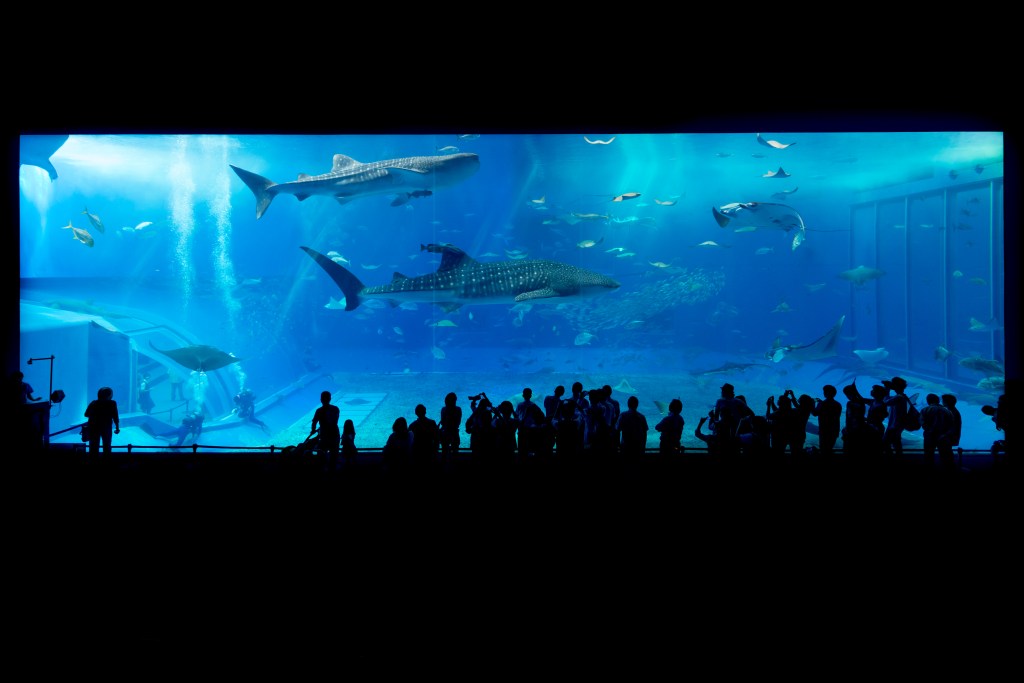
Because the Kuroshio Sea tank is genuinely exceptional. The acrylic panel is 8.2 metres high and 22.5 metres wide, the tank behind it holds 7,500 cubic metres of water, and the whale sharks that cruise past the glass are the largest fish in the sea. Very few aquariums anywhere can put that in front of you.
The second reason is the setting. Ocean Expo Park occupies the coast where the 1975 Okinawa International Ocean Exposition was held, and the aquarium opened here in 2002 as the successor to the expo’s smaller aquarium. The park is free to enter, the parking is free, and the dolphin theatre, turtle pools, manatee pool and beach cost nothing. A family can spend a full day here and pay only for the aquarium and lunch.
The caveat is crowds. Churaumi receives large tour groups and school trips, especially in the morning, and the main tank gets busy. It is still worth it, but go early or late and plan the rest of the park around the peak.
Inside the aquarium
The building is arranged as a descent. You enter on the fourth floor, move down through the reef and the open ocean, and finish in the deep sea on the first floor, which mirrors diving from the shallows into darker water. The route is one-way in practice, though you can go back up if you want to.
The fourth floor: shallow water
The top floor is the introduction: open tanks, touch pools where you can handle starfish and sea cucumbers under supervision, and exhibits on the reef flat that surrounds Okinawa. It is aimed at children and works well as a warm-up, but do not linger too long; the main tank is below.
The third floor: coral reef
The coral reef floor recreates the shallow lagoon with living coral and the small, bright fish that live in it. The tanks are lit from above to imitate sunlight through water, and the effect is convincing. This is also where the aquarium explains its coral breeding work, which matters because Okinawa’s reefs have suffered from bleaching in warm summers.
The second floor: the Kuroshio Sea
This is the tank everyone comes for. It is 10 metres deep, 35 metres wide and 27 metres from front to back, and holds about 80 species, with whale sharks and Nanyo manta rays as the headliners. There are 56 seats facing the panel, and a separate viewing area called the Aqua Room lets you look at the tank from the side. Feeding takes place at set times and draws a crowd; ask at the entrance for the day’s schedule.
The manta programme here is a serious research effort rather than a display. The aquarium succeeded in breeding Nanyo manta rays in captivity for the first time in the world in 2007, and in August 2024 it announced the world’s first captive birth of a black manta, a dark colour variant of the same species. Whale sharks have been kept here since 1995, when the predecessor aquarium was still operating, one of the longest records for the species.
The tank is not guaranteed. Animals are sometimes removed for treatment or die, and the aquarium posts notices when a whale shark is off display. Check the day’s information board at the entrance before you buy a ticket if the whale sharks are the main reason for your visit.
The first floor: the deep sea
The lowest floor is darker and quieter, with deep-sea creatures from the waters around Okinawa, including species that are rarely displayed anywhere else. It is the part most tour groups skip, which makes it the calmest place in the building. The shark research corner, labelled the Shark Doctor’s Room, explains the aquarium’s breeding work with rare sharks.
Allow two to three hours for the aquarium at a normal pace, more if you have children or read the Japanese panels in detail. English signage is present throughout the main exhibits.
Tickets and hours in 2026
Admission is 2,180 yen for adults, 1,440 yen for high school students and 710 yen for elementary and junior high school students. Children under six are free. An annual passport costs 4,360 yen for adults and pays for itself in two visits. Visitors with a disability certificate enter free, and one accompanying person is also free.
The aquarium is open 8:30 to 18:30, with the last entry at 17:30. There are no scheduled closure days through 31 March 2027, and it stays open over New Year on the normal timetable. It does close at short notice in typhoons, so check the official site on the day if a storm is forecast.
Hours are extended at busy periods, and the pattern changes each year. In 2026 the aquarium opened until 20:00 during Golden Week and from 18 to 31 July, and until 21:00 through August, with a one-off late opening for the summer fireworks on 4 July. Do not assume those dates will repeat; the official hours page publishes the current schedule.
Buying online in advance saves the ticket queue, which can be long at midday. Re-entry is allowed on the same day if you keep your ticket and show it at the entrance. There is no evening discount at the time of writing; the old after-16:00 ticket ended in 2023, although a late-entry web ticket has appeared during summer extensions.
The Wednesday change
From 1 July 2026 the park has been running a trial that makes every Wednesday a partial opening day, and it lasts until 31 March 2027. On those days the aquarium, the dolphin lagoon, the turtle and manatee pools, Churaumi Plaza and Emerald Beach stay open, but the Tropical Dream Center, the Oceanic Culture Museum, the Native Okinawan Village and the arboretum close.
If a Wednesday is a public holiday, the partial opening moves to the next weekday. This matters if you are planning to combine the aquarium with the botanical garden or the museum, which is a common plan for a full day in the park. Check the park’s information page before you set the date.
Park hours also changed in the trial. From March to September the park now closes at 18:00 rather than 19:30, while the aquarium keeps its 8:30 to 18:30 day. In practice, the aquarium is the last thing open, and the outdoor facilities wind down earlier than they used to.
Ocean Expo Park beyond the aquarium
The park is large, free to enter and free to park, with nine car parks. A trolley bus runs between the gates and the aquarium for a fee, which saves a 15-minute walk in the heat.
Okichan Theater and the dolphin lagoon
The dolphin show at Okichan Theater is free and runs several times a day, with a shallow lagoon next to it where dolphins come close to the edge. It is a proper show rather than a token demonstration, and it is the best free attraction in the park. Note that the theatre is scheduled to close for maintenance from 4 to 9 January 2027, so check the schedule if you are travelling then.
Sea turtles and manatees
The sea turtle pool holds several species, including the loggerhead and green turtle, and runs a breeding programme that releases hatchlings. The manatee pool next door is smaller and quieter, and both are free. They are a short walk from the aquarium and make a good break between the indoor tanks and the beach.
Emerald Beach
The beach inside the park is free, with changing rooms and showers, and the swimming season usually runs from April to October. The water is calm and shallow, which suits families, and the view north along the coast is the classic Okinawa postcard. Outside the season the beach is still open for walking.
Tropical Dream Center and Oceanic Culture Museum
The Tropical Dream Center is a large glasshouse of orchids, tropical fruit trees and water lilies, with an observation tower. Admission is 760 yen for adults and free for children, and it is open 8:30 to 17:30 with last entry at 17:00. The Oceanic Culture Museum next door covers the history of Pacific voyaging, with a planetarium included in the 190 yen adult ticket; children are free. Both are closed on the trial Wednesdays described above.
Native Okinawan Village
The village is a reconstruction of a traditional Ryukyu settlement, with thatched houses, a sacred grove and craft displays, and it is free. It is also closed on the partial-opening Wednesdays. Allow 30 to 45 minutes if it is open.
Around Motobu and Nakijin
The northern part of Okinawa’s main island, known as Yanbaru, is greener and less developed than the south, and the aquarium is the gateway to it.
The Bise Fukugi avenue is a short drive or a 15-minute walk north of the park: a lane of old fukugi trees planted as a windbreak around the village, with cafes and small guesthouses behind them. It is free and best in the early morning.
Nakijin Castle ruins are about 15 minutes away by car and are a UNESCO World Heritage site, with long limestone walls on a ridge above the sea. Admission is 1,000 yen for adults, 500 yen for junior high and high school students and free for elementary students, and the site is open 8:00 to 18:00, until 19:00 from May to August, with last entry 30 minutes before closing. The view from the walls is worth the trip on its own.
Kouri Island, connected by a long bridge, is about 25 to 30 minutes north-east and has clear water, a small beach and the heart-shaped rock that appears in every Okinawa guide. It is crowded at sunset and on weekends. Sesoko Island, connected by bridge just west of Motobu, is closer and quieter, with a beach and a handful of cafes.
From January to March, humpback whales pass the coast and boats leave from Motobu port for watching trips. Seas can be rough, and sightings are not guaranteed; book with an operator that cancels safely in bad weather.
Getting there
By car, the aquarium is about two hours from Naha Airport using the Okinawa Expressway and Route 58, and about 90 minutes from Naha city in good traffic. The last stretch through Nago and Motobu is slow on holiday weekends. Parking in the park is free, and the north gate multi-storey car park, P7, is the closest to the aquarium.
By bus, express services run from Naha Airport and the Naha bus terminal to the park in about two and a half hours; the Yanbaru Express Bus is the fastest of them at roughly two hours and 15 minutes. The bus stop is at the park entrance, and the aquarium is a 10-minute walk from there. Local buses are cheaper and much slower, with changes at Nago.
A rental car is the practical choice if you want to see Nakijin, Kouri and the Bise lanes in the same trip. Driving in Okinawa is on the left, roads are generally wide, and English signage is good on the expressway. Taxis from Naha are possible but expensive for the distance.
Where to eat
Inside the park, Churaumi Plaza has a food court and a restaurant with ocean views, and there are cafes and snack stands near the beach and the dolphin theatre. The food is adequate rather than memorable, and the queues peak between 12:00 and 13:30; eat at 11:30 or after 14:00.
Motobu town has better options: Okinawa soba shops, seafood restaurants serving the day’s catch, and small cafes along the coast. Nago, 30 minutes south, has the widest choice in the north, including local chains and a farmers’ market. If you are staying in a holiday house, the supermarkets in Motobu and Nago are well stocked for self-catering.
The park allows re-entry, so a picnic at Emerald Beach is a reasonable way to avoid the lunch rush. Bring water; the sun is strong even on cloudy days.
Where to stay
Motobu has resort hotels and guesthouses within a short drive of the park, which is the best base if the aquarium is your priority and you want to arrive at opening. Nago, half an hour south, is cheaper and has more restaurants, and Onna, on the west coast an hour away, has the densest cluster of resort hotels.
Staying two nights in the north is worthwhile if you want Nakijin, Kouri and the Yanbaru forest without a long drive each day. The alternative is a day trip from Naha, which works but means four to five hours in the car or bus.
Suggested itineraries
Half day, aquarium only
Arrive at opening, go straight down to the Kuroshio tank before the tour groups, then work back up through the reef and touch pools. Finish with the dolphin show and the turtle pools, which are free, and leave by early afternoon.
Full day in the park
Aquarium in the morning, lunch at Churaumi Plaza, then the dolphin show, turtle and manatee pools, a swim at Emerald Beach and the Native Okinawan Village if it is open. Allow seven hours and check the Wednesday closures first.
Rainy day
The aquarium and the Oceanic Culture Museum are both indoor, and the museum’s planetarium is a good extra. Skip the beach and the village. Rain also empties the outdoor areas, so the aquarium is more comfortable than usual.
Two days in the north
Day one: the aquarium and the park, then Bise at sunset. Day two: Nakijin Castle in the morning, Kouri Island for lunch and a swim, and Sesoko on the way back. This is the version that makes the drive from Naha worthwhile.
Practical tips
- Buy the aquarium ticket online before you go, especially at weekends and in school holidays.
- Arrive at 8:30 or after 15:00. The middle of the day is when tour buses and school groups overlap.
- Check the Wednesday partial-opening schedule before planning a day that includes the botanical garden or the culture museum.
- Parking is free, but the closest lots fill by mid-morning in summer; P7 is the one to aim for.
- Bring a hat, water and sunscreen for the walk between the aquarium and the outdoor facilities.
- The park is exposed; there is little shade between the gates and the beach.
- Re-entry to the aquarium is allowed on the same day, so keep your ticket.
- Photography is allowed in most areas, but flash is restricted near some tanks and tripods are not practical in the crowds.
- Do not tap the glass or touch the animals outside the designated touch pools.
- If a typhoon is approaching, check the official site before setting out; the park closes at short notice and buses stop.
Before you go
Confirm the day’s opening hours and the Wednesday closure schedule on the official pages, and check whether the whale sharks are on display if they are your reason for visiting. Book the ticket online and arrive at opening, or come after 15:00 when the groups have gone. If you are relying on the bus, check the timetable for the day you travel, because services are limited and change seasonally. Keep the rest of the day flexible: the northern coast is at its best when you can stop at Bise or Nakijin on the way back rather than rushing to a schedule.
Sources
- Churaumi Aquarium: opening hours and closures (checked 2026-10-26)
- Churaumi Aquarium: admission prices (checked 2026-10-26)
- Churaumi Aquarium: access and parking (checked 2026-10-26)
- Churaumi Aquarium: first captive birth of a black manta (checked 2026-10-26)
- Ocean Expo Park: partial opening days and hours (checked 2026-10-26)
- Tropical Dream Center: admission and hours (checked 2026-10-26)
- Oceanic Culture Museum: admission (checked 2026-10-26)
- Nakijin Castle: admission and hours (checked 2026-10-26)
Explore More of Japan
- Nakijin Castle Travel Guide — World Heritage walls above the sea
- Okinawa Travel Guide — planning the whole island
- Ishigaki Island Travel Guide — the Yaeyama islands
- Zamami and the Kerama Islands Travel Guide — clear water near Naha


Leave a Reply