Kumano Hongu Taisha sits at the end of a stone staircase in a cedar wood, above a village where three rivers meet. It is the first of the three great Kumano shrines that a pilgrim walking the Nakahechi route reaches, and for centuries it was the destination of an imperial pilgrimage that people travelled for weeks to complete. Then, in August 1889, a flood took most of it away.
The shrine you visit now is a survivor, rebuilt on higher ground from the four buildings that escaped the water. The site of the old one, a sandbank 500 metres away where three rivers join, is now an empty sacred field with Japan’s largest torii in front of it. Between the two you get the whole story of this place in an hour’s walk: what was lost, what was moved, and what people still come to do.
Why visit
- It is a UNESCO World Heritage site, part of the Sacred Sites and Pilgrimage Routes in the Kii Mountain Range, inscribed in 2004.
- The setting is genuinely remote — deep in the mountains of southern Wakayama, reached by a long bus ride or a long walk, which is why it still feels like a destination rather than an attraction.
- Oyunohara, the old shrine site, has Japan’s biggest torii at 34 metres, and it is free and open at all hours.
- The surrounding villages have three of the best hot springs in the region, including one that is itself a World Heritage site.
- It is the natural end point of a two- or three-day walk on the Kumano Kodo, one of only two pilgrimage routes in the world with World Heritage status alongside the Camino de Santiago.
The shrine
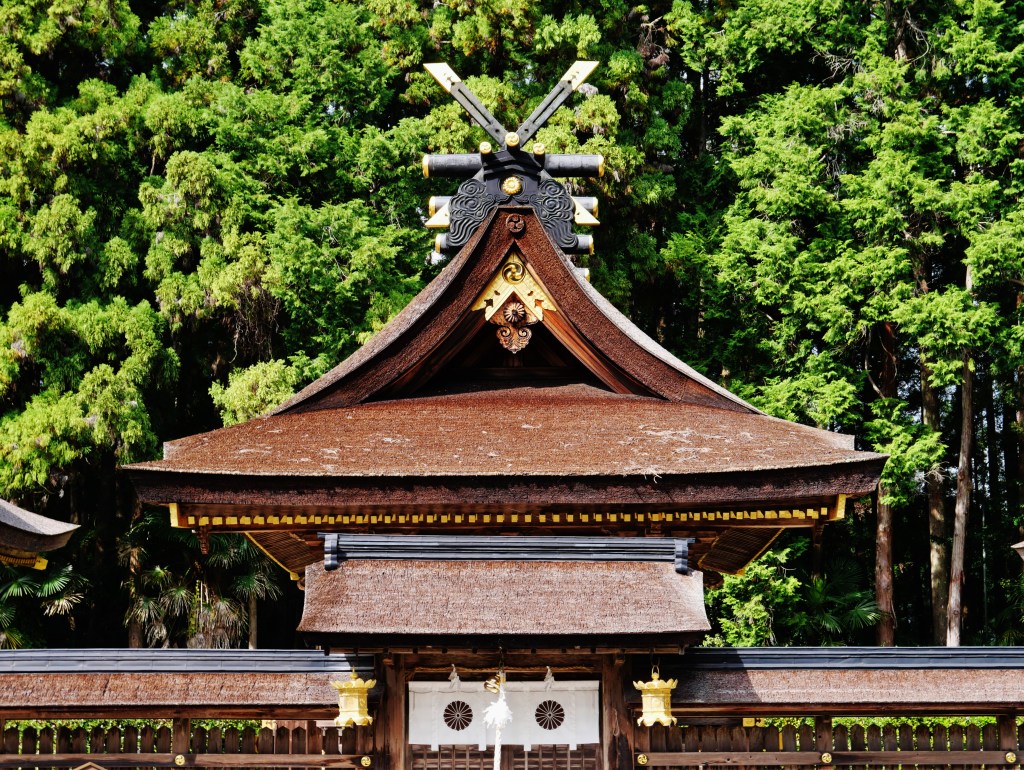
Kumano Hongu Taisha is the head of the Kumano Sanzan, the three shrines of Kumano: Hongu here, Hayatama in Shingu, and Nachi south along the coast. Together they form a single pilgrimage circuit, and the traditional order is Hongu first.
The approach sets the tone. From the road, a torii, then 158 stone steps under cedars, with banners bearing the words Kumano Gongen hanging along the way. The etiquette is specific and worth knowing: walk up the right-hand side of the steps and down the left, because the centre is the path the gods use. Halfway up, on the left, is a small shrine to the purification deities — stop there first — and above it a water basin for washing hands and mouth before you reach the main courtyard.
The courtyard holds four main buildings in a row, and the order of worship is fixed. Start on the left with the Shoshoden, which enshrines Ketsumiko no Okami, the main deity, identified with Susanoo. Then the Naka-goten for Hayatama, the Nishi-goten for Fusumi, and the Higashi-goten for Amaterasu. The fifth stop is the Manzan-sha, where the eight million gods are gathered, and it doubles as a matchmaking shrine. The clap is the usual two bows, two claps, one bow.
Architecturally the buildings are restrained to the point of austerity: unpainted wood, cypress bark roofs, deep eaves, no gold. The colour is in the details — the rope, the paper streamers, the votive plaques. It is a shrine that assumes you have arrived by walking, and it does not try to impress you quickly.
Admission is free, the precinct is open from early morning to early evening, and there is free parking in front of the shrine and across the road at the World Heritage centre. The shrine office sells amulets and, in recent years, a range of goods built around the three-legged crow, the yatagarasu, which guided the mythical first emperor through these mountains and is now the emblem of the Kumano Kodo.
The flood and Oyunohara
Until 1889 the shrine stood on a sandbank at the confluence of the Kumano, Iwata and Otonashi rivers, a site called Oyunohara. It was vast: about 11,000 tsubo, several times the size of the present precinct, with five main buildings, twelve shrines, a tower gate, a kagura hall and a Noh stage. Pilgrims did not cross a bridge — there wasn’t one until the Edo period — but waded the river and entered with wet hems, a rite called nure-warouzu, the wet straw sandals.
In August 1889 the Kumano river flooded and took almost all of it. The four upper shrines survived, and in 1891 they were dismantled and rebuilt on the hill where they stand today. Everything else — the middle and lower shrines — is now remembered by two small stone shrines on the old site.
Oyunohara is a ten-minute walk from the present shrine, across the road and past a small shrine to Izanami. You see the torii before you see anything else: 34 metres high, 42 metres wide, 172 tonnes of steel, erected in 2000. It is the largest in Japan and it is completely out of scale with the village around it, which is exactly the point — it marks a sacred site that has almost nothing left to see. Beyond it is a grove and a flat field, and that is all. Stand there for a few minutes; it is one of the few places in Japan where an absence is the attraction.
The Kumano Kodo
The pilgrimage routes of the Kii peninsula were inscribed with the shrines in 2004, and the Nakahechi route — the old imperial road from Tanabe over the mountains to Hongu — is the one most walkers take. It is roughly 40 kilometres, usually done in two or three days, with overnight stops at Yunomine, Kawayu or the small guesthouses along the way.
The final stage into Hongu is the most popular day section: from Hosshinmon-oji, a shrine at the top of the last ridge, it is about 7 kilometres down to the shrine, through forest and past a few farmhouses, with the valley opening below you. Buses connect Hongu to Hosshinmon-oji, so you can walk it one way without carrying a pack. The route is well marked, but it is a mountain path: proper shoes, water and a check of the weather are not optional.
Even if you do not walk, the infrastructure of the pilgrimage is part of the visit. The Kumano Hongu Heritage Centre near the shrine entrance explains the routes, the gods and the history with good English signage, and it is free. It is also where the buses stop and where you can leave luggage.
The onsen villages
Three hot spring villages sit within 15 minutes of the shrine by bus, and they are the reason most people stay the night rather than rush back.
Yunomine
Yunomine is the oldest and the strangest: a narrow valley village built around a stream of hot water, with steam rising between the houses. Its public bath is the social centre. The general bath costs 400 yen, the medicinal bath 600 yen and a private family bath 700 yen, open 06:00 to 21:00 with the last entry at 20:30, and it closes occasionally for cleaning — a full closure is scheduled for 7 December 2026, with 8 December as the backup date.
The famous bath here is Tsuboyu, a tiny rock-cut tub in a wooden hut, about the size of a cupboard, which is the only hot spring in Japan inscribed on the World Heritage list as a site you can actually bathe in. It is timed in 30-minute slots at 800 yen for adults, and the ticket also includes one entry to the public bath. The catch, as of late October 2026: Tsuboyu was listed as closed, so check the tourism association’s daily bathing status before you build a day around it. Even when it is open, you may queue.
Yunomine is also where the pilgrims of the past stopped to purify themselves before the final approach, and the village still has a small shrine, a shop selling hot spring water, and a handful of inns.
Kawayu
Kawayu is the simplest idea in Japanese bathing: in winter, the Oto river is dammed and a section of the riverbed becomes a huge open-air bath called Sennin-buro, the bath of the sages. It is free, unroofed, screened only by reed panels, and open from 06:30 to 22:00 with last entry at 21:30.
It operates from December to the end of February, and the season is weather-dependent — the river level and temperature decide whether it opens at all. You must wear a swimsuit; soap and shampoo are not allowed, and the water is a river, not a treated pool. The village also has a small public bath, Yakushi-no-yu, which is open year-round in the evenings except Tuesdays.
Watarase
Watarase, a little further down the valley, has a large open-air bath and a day-visit centre with long hours, and it is the fallback when the more famous baths are crowded or closed. It is less atmospheric than Yunomine and less unusual than Kawayu, but it is reliable.
Food and drink
The local food is mountain food. Mehari-zushi is the signature: a rice ball wrapped in a pickled mustard leaf, made for carrying on the pilgrimage, sold at shops around the shrine and in the villages. Kumano beef is the other local pride, served grilled or in a bowl. River fish, tofu and mountain vegetables fill out the menus, and there is a local sake brewed in the valley.
Restaurants are few and close early. The cluster in front of the shrine serves lunch until mid-afternoon and then shuts; the villages have a handful of places attached to inns, mostly for guests. If you are arriving in the evening, eat before you come or book half board at your accommodation — this is not a town where you can count on finding dinner at eight.
Getting there and around
- From Tanabe — JR Kisei line to Kii-Tanabe, then the Ryujin bus to Hongu Taisha, about two hours. This is the route most walkers use, and the bus passes the trailheads.
- From Shingu — bus to Hongu Taisha in about 70 minutes, which is the quicker approach if you are coming down the coast.
- By car — about 75 minutes from the Kamitonda interchange on the Kisei expressway via routes 42, 311 and 168. From Nagoya it is a long day’s drive; from Osaka it is around three hours.
- Local buses — the buses that link the shrine, the heritage centre, Yunomine, Kawayu and Hosshinmon-oji are infrequent but do run, and they are timed loosely around the walking routes. Check the timetable at the heritage centre when you arrive rather than assuming hourly service.
Parking at the shrine and at the heritage centre is free, which makes a car convenient for the onsen villages. Without one, base yourself in a village within walking distance of a bus stop.
Where to stay
- Yunomine — small ryokan and minshuku, some with their own spring, in the most atmospheric village.
- Kawayu — inns facing the river, convenient for the Sennin-buro in winter.
- Hongu — guesthouses and a few hotels near the shrine, the easiest for an early start on the Kodo.
- Watarase — larger hotels with big baths, the most comfortable option, a short bus ride away.
- Shingu or Tanabe — possible, but the bus times make a day trip long and a night in the mountains much better.
Best time to visit
- April and May — fresh green, mild walking weather, and the shrine’s spring festival season.
- October and November — the best combination of colour and temperature, and the busiest time on the Kodo.
- December to February — cold and quiet, and the only season for the Sennin-buro river bath, but some village businesses close and the mountain paths can be icy.
- June to September — hot, humid and wet, with typhoon risk; the forest is at its densest but the walking is hard work.
Rainfall here is among the highest in Japan, and the rivers that made the shrine also destroyed it once. Carry a shell layer whatever the forecast says.
Suggested itineraries
One day, shrine and old site
- Morning bus from Tanabe or Shingu to Hongu Taisha.
- Climb the 158 steps, worship in order, then walk to Oyunohara and the great torii.
- Lunch at the shrine entrance, then the heritage centre for the context.
- Bus to Yunomine for a bath, then back to the coast.
Two days with a walk
- Day one: bus to Hosshinmon-oji, walk the 7 kilometres down to Hongu, visit the shrine and Oyunohara in the afternoon, sleep in Yunomine.
- Day two: morning bath, bus to Kawayu for the river or the village bath, then the bus out.
Practical tips
- Carry cash. The villages are small, ATMs are rare and several baths and shops take coins only.
- Buy bus tickets or a pass at the heritage centre if one is on offer; the fares add up on this route.
- Wear shoes with grip for the Kodo. The stone steps are worn and slick in the wet.
- Do not plan a tight connection. Buses here run a few times a day, not every 20 minutes.
- If Tsuboyu matters to you, check its status the day before and have the public bath as a fallback.
- Eat lunch by 14:00 or bring food. Evening dining is limited to inns.
Before you go
The details above come from Kumano Hongu Taisha, the Hongu tourism association, Tanabe city’s Kumano tourism bureau and Wakayama prefecture, checked on 26 October 2026. Three things are worth reconfirming: the Tsuboyu bathing status, which was listed as closed on the date of checking; the Sennin-buro season, which starts in December and depends on the river; and the local bus timetable, which is sparse and changes seasonally. The shrine itself is free and open daily, and it is the one part of this trip that will not let you down on the day.
Sources
- Kumano Hongu Taisha: worship order, steps and etiquette (checked 2026-10-26)
- Hongu tourism association: Oyunohara and the great torii (checked 2026-10-26)
- Tanabe city Kumano tourism bureau: Hongu Taisha and Oyunohara (checked 2026-10-26)
- Wakayama prefecture: Kumano Hongu Taisha (checked 2026-10-26)
- Hongu tourism association: Yunomine public bath and Tsuboyu (checked 2026-10-26)
- Hongu tourism association: Kawayu Sennin-buro (checked 2026-10-26)
- Hongu tourism association: daily bathing status (checked 2026-10-26)
Explore More of Japan
- Koyasan Travel Guide — the other great mountain sanctuary of the Kii peninsula
- Kinosaki Onsen Travel Guide — another hot spring town worth the journey
- Amanohashidate Travel Guide — the pine-covered sandbar on the Japan Sea side
- Nara Park Travel Guide — the old capital you pass through on the way south
- Himeji Castle Travel Guide — the castle to see if you extend the trip


Leave a Reply