Asakusa is the part of Tokyo that still feels like the old city. Senso-ji, the temple at its centre, is the oldest in Tokyo and receives around 30 million worshippers and visitors a year, and the approach through the Kaminarimon gate and the Nakamise shopping street is the most famous short walk in the capital. It is also free, open early and easy to reach, which makes it the best first stop for anyone landing in Tokyo.
The problem is that everyone knows this. Between 10:00 and 15:00 the street is a slow-moving river of tour groups, and the photographs you came for are full of other people’s selfie sticks. The solution is timing, and a little knowledge of what you are looking at. This guide covers both, along with the 2026 opening hours, the festivals worth planning around, and where to go after the temple.
Why visit
Because the temple is genuinely old in a city that lost most of its old buildings. Sensoji was founded in the seventh century, and although the current buildings are postwar concrete reconstructions, the site, the route and the rituals have been continuous for more than a thousand years. The main hall is a working place of worship, not a museum, and that changes the atmosphere.
It is also the most convenient sight in Tokyo. There is no ticket, no reservation and no closing time for the grounds. You can arrive at 6:00, walk the temple in near silence, eat a melonpan at 8:00 and be on the subway to Ueno by 9:00. Few sights in Japan reward an early start so well.
The surrounding district adds a second day if you want it: the Sumida River, Tokyo Skytree across the water, the kitchen shops of Kappabashi, the old izakaya alley of Hoppy Street and a dense grid of temples, shrines and coffee shops behind the main street.
The story of Senso-ji
According to the temple’s own account, in 628 two fishermen, Hinokuma Hamanari and his brother Takenari, pulled a small statue of Kannon from the Sumida River. The village headman, Haji no Nakatomo, recognised it as an image of the bodhisattva and converted his house into a temple. In 645 a priest named Shokai built a hall for the statue and, following a dream, hid it from view. It has never been shown publicly since.
The temple grew with Edo. Tokugawa Ieyasu designated it as the place where shogunate prayers would be offered in 1590, and successive shoguns visited. As the city became one of the largest in the world in the eighteenth and nineteenth centuries, Sensoji became its popular temple, and the surrounding streets filled with theatres, teahouses and shops.
Most of that was destroyed in the firebombing of Tokyo in March 1945, which burned the main hall, the five-storey pagoda and the library. The temple was rebuilt in the postwar decades: the main hall in 1958, the Kaminarimon gate in 1960 with a donation from the founder of Panasonic, and the Hozomon gate in 1964. The buildings are modern, but the proportions and the details follow the Edo originals, and knowing that helps explain why the place feels both old and slightly new.
Walking the temple grounds
Kaminarimon
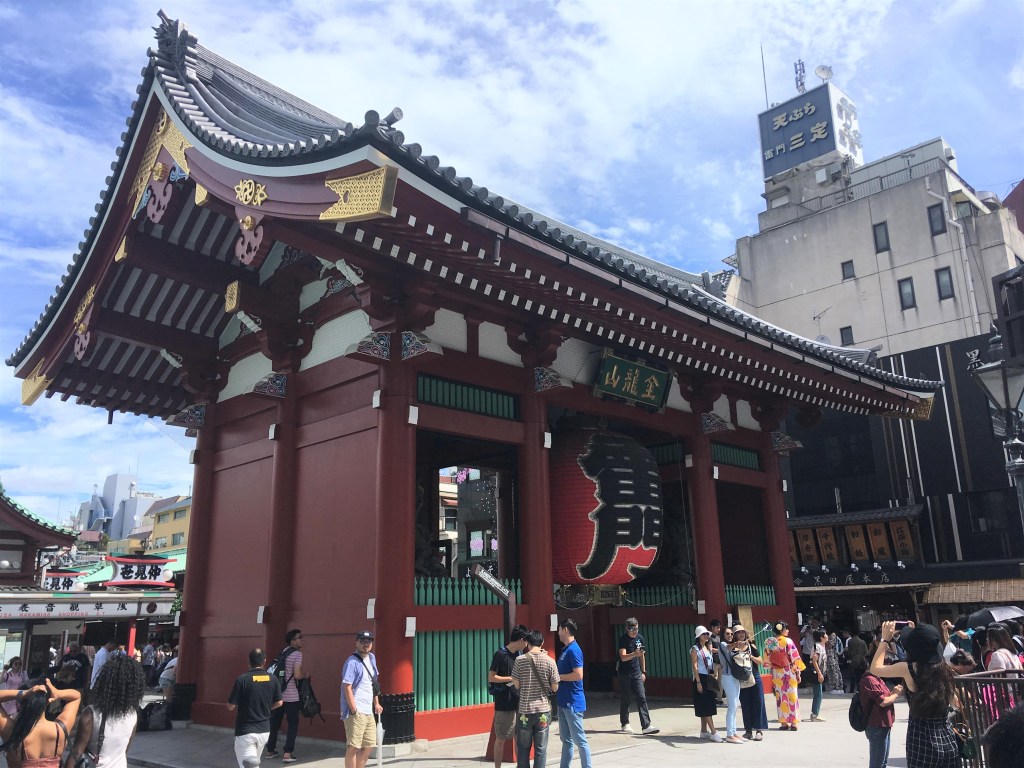
The route starts at Kaminarimon, the gate with the enormous red lantern. The current gate dates from 1960, and the lantern is 3.9 metres high, 3.3 metres across and weighs 700 kilograms. On either side stand the thunder god and the wind god, and on the back of the gate are two dragon reliefs. Everyone stops for a photograph here, so if you want the gate without a crowd, this is the place to be at 6:30.
Nakamise
The 250-metre street from Kaminarimon to Hozomon is one of the oldest shopping streets in Japan, with 87 shops split between the east and west sides. It sells souvenirs, snacks and temple goods: ningyo-yaki cakes filled with bean paste, senbei, melonpan, soft serve and small charms. Most shops open around 10:00 and close in the late afternoon, and a few take a weekday off. Bring cash for the smaller stalls.
Nakamise is often described as a tourist trap, and it is, but it is also a pleasant one. The scale is human, the shopfronts are uniform in a way that dates from the Meiji period, and the food is cheap. Buy something, eat it standing at the side rather than walking, and keep the centre of the street clear for people going to pray.
Hozomon
At the end of Nakamise, Hozomon is the temple’s inner gate, rebuilt in 1964 in reinforced concrete in the style of the original. The upper floors store the temple’s treasures, including a nationally important set of Chinese Buddhist scriptures. On the front hangs a giant straw sandal, 4.5 metres high, 1.5 metres wide and 500 kilograms in weight, made from 2,500 kilograms of rice straw and donated by people from Murayama in Yamagata. It is meant to show the strength of the guardian figures, and the story is that demons see it and leave.
The gate also has a large lantern of its own, smaller than the one at Kaminarimon, and two fierce guardian figures in the side bays. Look up at the sandal, then walk through into the courtyard.
The main hall
The main hall, or Hondo, is the centre of worship. The current building was rebuilt in 1958, and the statue of Kannon is kept in an inner sanctum that is never opened. Visitors pray at the front, throw a coin into the offering box, bow twice, clap twice and bow once. The hall is open from 6:00 to 17:00, or from 6:30 from October to March, and the grounds remain open around the clock.
In front of the hall is the incense burner, where people wave smoke over themselves for health, and the purification fountain where you rinse your left hand, then your right, then your mouth, using the ladle. The water is not for drinking. The rituals are simple and nobody will mind if you watch first.
The five-storey pagoda and the other halls
The pagoda beside the main hall was rebuilt in 1973 and stands about 53 metres tall. It is not usually open inside, but it is the best vertical element in the temple’s skyline and worth a photograph from the courtyard. Around the compound are smaller halls: the Yogodo for the healing Buddha, the Awashimado, the Chingodo for the raccoon dog spirit, and the Nitenmon gate, which dates from 1649 and is an important cultural property.
Asakusa Shrine sits to the right of the main hall, reached through its own torii. The current building was donated by Tokugawa Iemitsu in 1649 and is also an important cultural property. It is the site of Sanja Matsuri, and on ordinary days it is a quiet contrast to the crowds a hundred metres away.
When to come
The single best piece of advice is to arrive before 8:00. The grounds are open, the main hall opens at 6:00, the lanterns are lit, the shops are shut and the street belongs to people walking their dogs and a few other early visitors. By 9:30 the first tour groups arrive; by 11:00 the Nakamise is packed.
The second-best time is after 17:00. The main hall closes, but the grounds stay open, the buildings are lit, and most of the crowd disappears. The temple at night, with the pagoda and the main hall illuminated, is one of the best free sights in Tokyo.
Spring brings cherry blossom along the Sumida River and in nearby parks. Summer is hot and humid, and the temple has little shade; go early and carry water. Autumn is comfortable. New Year is the busiest period of the year, with millions of people making the first visit of the year in the first three days of January, and the temple sets up crowd controls. If you want the ceremony rather than the crush, avoid 1 to 3 January.
Festivals
Sanja Matsuri, held by Asakusa Shrine in the third week of May, is one of Tokyo’s three great festivals. In 2026 it ran from 15 to 17 May, with the main procession of the three portable shrines on the Sunday, and about 1.8 million visitors over the three days. The streets around the temple are closed to traffic, the shrines are carried through the neighbourhood, and the atmosphere is entirely different from a normal sightseeing day.
The Sumida River Fireworks Festival is held on the last Saturday of July; in 2026 it was on 25 July, with about 20,000 shells fired from two sites on the river. The best views are from the Sumida Park riverbank, which fills early. The temple itself is not the place to watch from, but it is a good starting point for the walk to the river.
Smaller events run through the year: the hozuki (ground cherry) market in July, the chrysanthemum display in autumn and the hagoita market in December. The temple’s English site lists the yearly events with dates.
Nakamise and what to eat
The food on Nakamise is snack food rather than a meal. Ningyo-yaki, small sponge cakes shaped like dolls and lanterns, are the classic souvenir. Melonpan, a sweet crusted bun, has a cult following at one shop near the end of the street, and the queue is part of the experience. Senbei, rice crackers brushed with soy sauce and grilled, are made in front of you at several shops.
For a proper meal, walk one street back from the temple. Asakusa is known for tempura, unagi and soba, and the oldest shops have been running since the nineteenth century. Daikokuya, founded in 1887, serves tempura in a dark, crowded room near the temple and is the best-known of them. Unagi restaurants grill eel over charcoal and serve it in lacquered boxes; expect to pay accordingly. Soba shops are cheaper and quicker, and there are good ones on the back streets toward Kappabashi.
Hoppy Street, a narrow alley west of the temple, is a line of tiny izakaya with outdoor tables. It is at its best in the evening, when the lanterns are on and the office workers arrive, and it is a good place to eat without a plan. Asakusa is also a coffee district, with old kissaten and newer roasters mixed together.
Beyond the temple
The Sumida River
Walk west from the temple for five minutes and you reach the Sumida River and the Azumabashi bridge. The riverbank has a promenade, cherry trees and a view of Tokyo Skytree on the far side. River cruises leave from the Asakusa pier, including boats to Odaiba and the Hama-rikyu garden, and the trip is a pleasant way to see the city from the water if you have a spare hour.
Tokyo Skytree
Skytree is about 20 minutes on foot across the river, or one stop on the Tobu Skytree line. The tower is 634 metres tall, with an observation deck at 350 metres and a higher gallery at 450 metres. Since April 2026 the tickets use dynamic pricing: the 350-metre deck costs from 1,800 to 3,600 yen for adults depending on the day, and the deck plus gallery from 3,000 to 4,800 yen. Children aged 6 to 14 pay roughly half, and under-fives are free. Buying at the counter adds 500 yen per ticket. The observatory is open 10:00 to 22:00 with last entry at 21:00.
On a clear day the view is superb, but the price on a busy weekend can be steep. Check the official calendar for the day’s price before deciding, and compare it with the free view from the Asakusa riverside.
Kappabashi Kitchen Town
Ten minutes west of the temple, Kappabashi is an 800-metre street of about 170 shops selling kitchen equipment, ceramics, knives and the plastic food models you see in restaurant windows. It is where Tokyo’s chefs shop, and it is a good place to buy a knife or a bowl that will last longer than a souvenir. Many shops open around 10:00 and close at 17:00, and some close on Sundays.
Hanayashiki and the back streets
Hanayashiki, next to the temple, claims to be Japan’s oldest amusement park, with a small roller coaster and old-fashioned rides. It is a modest place, but it suits families with small children and it is a reminder that Asakusa was an entertainment district long before it was a tourist one.
The streets behind the temple, known as Rokku, were one of Japan’s first cinema districts and are now full of restaurants, bars and small theatres. They are worth an hour of aimless walking, especially in the evening.
Getting there and around
Asakusa Station is served by four lines, and all of them are within five minutes of Kaminarimon. The Ginza line connects directly to Ueno, Nihombashi and Shibuya. The Toei Asakusa line runs to Nihombashi, Shimbashi and the airport-bound Keikyu line. The Tobu Skytree line goes to Skytree and on to Nikko. The Tsukuba Express station is a few minutes west of the temple.
From Tokyo Station, take the JR Yamanote or Keihin-Tohoku line to Kanda and change to the Ginza line, which takes about 15 minutes in total. From Shinjuku, take the JR Chuo line to Kanda and change. From Narita and Haneda, the Keikyu and Keisei lines connect through the Asakusa line or at Nihombashi.
The temple has no car park, and driving in Asakusa is not worth the stress. Use the Taito Ward underground car park near Kaminarimon if you must, or park at Skytree and walk across the river.
Where to stay
Asakusa has a wide range of hotels, from capsule and hostel beds to mid-range hotels and a few traditional inns. Staying here gives you the temple at dawn and a quieter evening than Shinjuku or Shibuya, and the subway connects to the rest of the city without much trouble.
The trade-off is that Asakusa is not central for nightlife, and the streets empty early. If you want restaurants after 22:00, stay closer to Ueno or in the centre. If you want the temple to yourself, stay here and set an alarm.
Suggested itineraries
Three hours, first morning
Arrive at 6:30, walk Kaminarimon and Nakamise while they are empty, pray at the main hall, and photograph the pagoda in the morning light. Have breakfast at a coffee shop in the back streets, then walk to the Sumida River and cross to Skytree if the day is clear.
Half day
Start early as above, then add Asakusa Shrine, the Nitenmon gate and a slow walk through Rokku. Eat tempura or soba for lunch, then spend an hour in Kappabashi before taking the subway to Ueno.
Full day
Temple in the morning, lunch in the back streets, Skytree in the afternoon and the Sumida River promenade at sunset. In the evening, eat on Hoppy Street and walk back through the illuminated grounds.
Rainy day
The temple is outdoors, but the covered arcades of nearby shopping streets and the Skytree complex give you somewhere to shelter. Kappabashi is partly covered and mostly indoor shops. A rainy morning is also the quietest time to see the temple, provided you have an umbrella.
Practical tips
- The temple is free and the grounds are open 24 hours; the main hall is open 6:00 to 17:00, or 6:30 to 17:00 from October to March.
- Arrive before 8:00 or after 17:00. The middle of the day is the worst time for crowds and photographs.
- Dress respectfully and keep your voice down in the main hall; this is an active place of worship.
- Do not photograph people praying at close range, and do not block the centre of Nakamise for a portrait.
- Carry cash for small shops and food stalls; not every stall takes cards.
- Eat at the side of the street rather than walking with food in the crowd.
- Sanja Matsuri in May and New Year are extremely busy; check the dates before booking if you want a quiet visit.
- Skytree prices vary by day since April 2026; check the official site before buying.
- The area is flat and walkable, with good pavement, but the temple gets crowded and pushchairs are difficult in Nakamise.
- Toilets are available in the temple grounds and at the stations, but not inside the main hall.
Before you go
Check the temple’s official site for the main hall hours and the yearly events, and confirm the date of Sanja Matsuri if you are travelling in May. Decide whether you want the temple quiet or in festival mode, because the two are completely different experiences and the second one requires patience. If Skytree is on your list, look up the day’s ticket price before you go, and book online to avoid the counter surcharge. Finally, set an alarm for one early morning: Asakusa before 8:00 is the version of the place that people remember.
Sources
- Senso-ji: history and main hall hours (checked 2026-10-26)
- Senso-ji: Hozomon gate and straw sandal (checked 2026-10-26)
- Nakamise: shops and length (checked 2026-10-26)
- Asakusa Shrine: Sanja Matsuri 2026 (checked 2026-10-26)
- Sumida City: Sumida River Fireworks 2026 (checked 2026-10-26)
- Tokyo Skytree: ticket prices (checked 2026-10-26)
- Tokyo Skytree: opening hours (checked 2026-10-26)
Explore More of Japan
- Tokyo Skytree Travel Guide — the view across the river
- Shibuya Travel Guide — the other side of Tokyo
- Tsukiji Outer Market Travel Guide — breakfast and seafood
- Kamakura Travel Guide — temples and the sea, an hour away


Leave a Reply