Osaka is the most sociable city in Japan. It is louder than Kyoto, cheaper than Tokyo, and built around eating, drinking and standing at a counter with strangers. The famous sights are concentrated in two centres, Kita and Minami, which makes the city easy to learn, and the food is the main event rather than an afterthought.
This guide explains the two halves of the city, where to stay, how to get in from the airports, what to eat and where, a three-day plan, the festivals worth planning around, and the day trips that make Osaka a better base than most visitors realise.
Why Osaka
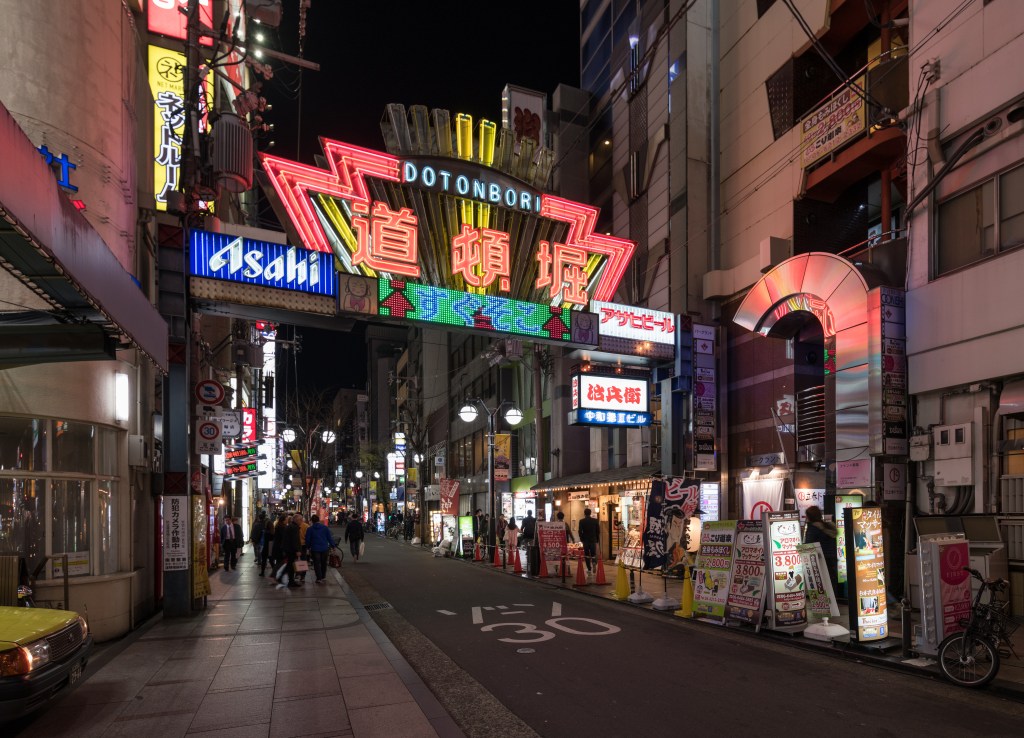
Because it is fun without trying. Dotonbori’s canal is lined with neon, takoyaki stalls and crowds, and the backstreets of Namba are full of tiny izakaya that seat eight people. The city has a genuine street-food culture, a comedy tradition, and a merchant history that values a good deal over formality.
It is also practical. Osaka is compact, the subway is excellent, and Kyoto, Nara, Kobe and Himeji are all within an hour. Kansai International Airport is a direct train ride away, and Shin-Osaka connects to the rest of Japan by Shinkansen. For many travellers, Osaka is the best base in Kansai, with Kyoto as a day trip rather than the other way round.
A short history
Osaka was known as Naniwa and was an early imperial capital before Kyoto. In the 16th century Toyotomi Hideyoshi built Osaka Castle and made the city the political centre of a newly unified Japan, and after his death the Tokugawa shogunate turned it into a merchant city. That merchant character stuck: Osaka became known as the kitchen of Japan, a place where rice, fish and sake were traded and where money and food were taken seriously.
The modern city was rebuilt after the bombing of 1945 and grew into an industrial and commercial centre. It hosted the 1970 World Expo, which left the parks and infrastructure of the bay area, and the 2025 Expo, held on the artificial island of Yumeshima, brought another round of investment before it closed in October 2025. The city’s identity today is a mix of commerce, comedy and food.
The shape of the city
Osaka has two main centres. Kita, around Umeda and Osaka Station, is the transport and business side, with department stores, the Umeda Sky Building and the Shinkansen at nearby Shin-Osaka. Minami, around Namba, Shinsaibashi and Dotonbori, is the food and nightlife side, and it is where most visitors spend their evenings.
South of Minami are Tennoji and Shinsekai, older and scruffier, with Tsutenkaku tower and a strong retro atmosphere. The bay area, around Tempozan and Universal Studios, is family territory, with the aquarium and the theme park. The castle sits in the middle, in a large park north-east of the centre.
Where to stay
Namba and Shinsaibashi are the best choice for a first visit: Dotonbori, Kuromon Market, the nightlife and the Nankai airport train are all within walking distance. It is busy and noisy, which is the point.
Umeda suits travellers who prioritise transport: JR, the subway, Hankyu and Hanshin all meet here, and the airport limousine bus stops at major hotels. It is more businesslike and slightly quieter at night.
Tennoji is good value, with fast access to the airport and Nara, and a more local feel. Osaka Bay is for families visiting Universal Studios or the aquarium, with large hotels and space, but long rides to the centre.
Getting in
From Kansai International Airport, the Nankai Rapi:t limited express reaches Namba in about 38 minutes, and the JR Haruka runs to Tennoji and Shin-Osaka. From Itami Airport, buses and the monorail connect to the centre in about 30 minutes. Shin-Osaka is the Shinkansen station, a short subway ride from Umeda.
If you are arriving late, check the last train times: Kansai airport is far from the city, and a taxi is expensive. The Nankai and JR trains are the reliable options.
Getting around
The subway is the city. The Midosuji Line runs north-south from Umeda through Shinsaibashi and Namba to Tennoji, and it is the line you will use most. The JR Loop Line circles the centre, and the Hankyu, Hanshin and Nankai lines connect to Kyoto, Kobe and the airport.
An IC card covers everything and is simpler than buying tickets. A one-day subway pass can be good value if you are making four or more journeys, but most visitors do not need to plan that carefully. Taxis are plentiful and not as expensive as Tokyo’s, but traffic in Minami is slow at night.
Walking is the best way to see Dotonbori, Shinsaibashi and Namba, and the streets are flat. A bicycle is useful along the river, less so in the crowded shopping districts.
Getting to Osaka
From Tokyo, the Tokaido Shinkansen runs to Shin-Osaka in about two and a half hours. From Kyoto, the JR Special Rapid takes about 30 minutes to Osaka Station, and the Hankyu and Keihan lines connect the city centres. From Kansai International Airport, the Nankai Rapi:t is the fastest route to Namba, and the JR Haruka serves Tennoji and Shin-Osaka. Overnight buses from Tokyo are cheaper but arrive early and are tiring.
Beyond the food
Osaka Castle is the city’s best-known monument: a reconstructed keep from 1931, a museum inside, and stone walls and moats that survive from the Toyotomi and Tokugawa periods. The park is free and the castle grounds are a good place for a slow walk, especially in cherry blossom season.
The Umeda Sky Building is a pair of towers joined at the top by a floating garden observatory, with a view over the city and the Yodo River. The Abeno Harukas tower near Tennoji is the tallest building in Japan and has an observatory, a department store and a hotel. The Kaiyukan aquarium at Tempozan is one of the largest in the world, with whale sharks in a huge central tank, and it is a good rainy-day option.
Shitenno-ji, founded in 593, is one of Japan’s oldest Buddhist temples, and Sumiyoshi Taisha is one of the oldest shrines, with a distinctive straight-line architecture and a quiet grove. Both are away from the main tourist flow and reward an hour. Shinsekai’s Tsutenkaku tower and the surrounding retro arcades are more atmosphere than sight, but the area is worth a walk before or after kushikatsu.
With children
Universal Studios Japan is the big draw, and it needs a full day and a plan: buy tickets in advance, arrive before opening and decide on the priority rides. The Kaiyukan aquarium is calmer and closer to the centre, and the Osaka Science Museum and Kids Plaza Osaka are good for younger children. The castle park has space to run, and the subway is stroller-friendly at most stations, though not all exits have lifts.
A three-day plan
Day 1: Minami
Start at Kuromon Market in the morning, then walk to Namba and Dotonbori. In the afternoon, cross to Shinsaibashi for shopping and coffee, and return to Dotonbori at dusk for the neon and the canal. Dinner at a takoyaki or okonomiyaki counter, then a bar in Ura-Namba.
Day 2: Castle and north
Visit Osaka Castle at opening, walk the park and the stone walls, then take the train to Umeda for lunch. In the afternoon, see the Umeda Sky Building observatory and the department stores, and finish with yakitori or kushikatsu in Tenma, a short walk from Umeda.
Day 3: South and bay
Start at Shitenno-ji, one of the oldest Buddhist temples in Japan, then walk through Shinsekai for kushikatsu and Tsutenkaku. In the afternoon, choose the aquarium at Tempozan or Universal Studios if you have children, or Sumiyoshi Taisha and the tram for a quieter side of the city.
With a fourth day, take a day trip to Kyoto, Nara or Himeji rather than adding another district.
Food: the main event
Osaka’s food culture is built on cheap, strong flavours and a preference for eating out. The classics are takoyaki, octopus in a batter ball, sold everywhere and best eaten hot at the stall; okonomiyaki, the savoury cabbage pancake, cooked on a griddle at your table; and kushikatsu, deep-fried skewers of meat, fish and vegetables, with a strict rule against double-dipping in the shared sauce.
Kitsune udon, thick noodles topped with sweet fried tofu, is the local comfort food, and Osaka-style sushi is pressed and vinegared rather than hand-formed. Yakiniku, grilled beef, is a staple of the city’s nightlife, and izakaya in Ura-Namba and Tenma serve small plates at prices that encourage a second order.
Kuromon Market is the best single stop for grazing, with seafood, wagyu skewers, fruit and sweets, but it is busy and not the cheapest. Dotonbori is for the atmosphere and the classics; the side streets behind it are better value. For a serious meal, book a counter restaurant in Namba or a yakiniku place in Tsuruhashi, the Korean district, which has its own food scene.
Osaka is also a drinking city. Sake, highballs and beer are cheap in izakaya, and the standing bars around Namba and Tenma are friendly to solo travellers. Tipping is not practised.
Breakfast, coffee and sweets
Osaka has a strong kissaten, the old-fashioned coffee shop, culture, and a morning set is often good value: thick toast, a boiled egg and coffee for a set price. The chains are everywhere, but the independent shops around Tenma, Nakazakicho and Shinsaibashi are more interesting. Nakazakicho, north of Umeda, is a low-rise neighbourhood of old houses turned into cafes, galleries and bars, and it is a good escape from the crowds.
Sweets are part of the food scene too. Mochi, taiyaki and soft cream are sold at stalls in Dotonbori, and the department store basements in Umeda have the best range of cakes and gifts. For a sit-down break, the cafes in the Umeda Sky Building and the Abeno Harukas tower come with views.
Rainy days
Osaka is well set up for rain. The Kaiyukan aquarium, the Osaka Museum of History, the Science Museum and the Umeda Sky Building are all indoor, and the covered shopping arcades of Shinsaibashi and Tenjinbashisuji let you walk for kilometres without an umbrella. Department stores and the station complexes at Umeda and Namba can absorb a wet afternoon. Avoid the castle park in heavy rain; the stone paths get slippery.
Nightlife
Minami is the centre of it. Dotonbori and the streets around Namba Station are loud and bright; Ura-Namba, west of the station, is smaller bars and restaurants in low buildings. Shinsaibashi has clubs and music venues, and Tenma, near Umeda, is a more local bar district with a reputation for cheap food and good company.
Osaka’s comedy tradition is part of the nightlife: the Namba Grand Kagetsu theatre hosts manzai and rakugo shows, and some venues have English-friendly performances. Check schedules locally.
Seasons and events
Cherry blossom peaks in late March to early April, and Osaka Castle Park is one of the best places to see it. Autumn colour arrives in November, and the castle park and the rivers are pleasant then. Summer is hot and humid, with the Tenjin Matsuri on 24 and 25 July, one of Japan’s great festivals, with boats on the river and fireworks. The Osaka basho, the March sumo tournament, is held at the Edion Arena in Osaka.
Winter is mild and quiet, with illuminations in Umeda and Namba. Golden Week in late April and early May is busy; book trains and hotels ahead.
Day trips
Kyoto is 30 minutes by JR or Hankyu, Nara is 40 minutes by Kintetsu, and Kobe is 25 minutes by Hankyu or JR. Himeji Castle is about an hour by Shinkansen or JR Special Rapid, and Koyasan is around two hours by train and cable car. Universal Studios is 20 minutes from Namba by JR and subway, and the aquarium at Tempozan is 20 minutes by subway.
Osaka works well as a base for all of these, and it is often cheaper than Kyoto. The trade-off is that Kyoto’s early mornings are harder to reach from Osaka, so if a dawn visit to Fushimi Inari matters, stay a night in Kyoto.
Osaka on a budget
Osaka is one of the best-value big cities in Japan. Street food, standing bars and set lunches keep food costs down, and the subway is cheap. The castle park, Sumiyoshi Taisha, Shitenno-ji’s grounds and the Dotonbori walk are free or nearly so. Hostels and business hotels in Tennoji and Namba are good value, and the bay hotels are cheaper outside weekends.
Avoid the most touristy restaurants in the middle of Dotonbori, where prices are higher for the same food. One street back, the menu is often cheaper and better. Convenience stores and supermarkets are reliable for breakfast.
Practical tips and etiquette
Osaka is casual, but the food rules are real: kushikatsu sauce is shared, so dip once, and takoyaki is eaten at the stall rather than carried through the crowd. In Dotonbori, keep moving in the middle of the street and step to the side if you stop for a photograph; the lane is narrow and busy at night. In bars, pour for your companions rather than yourself, and wait for the toast before drinking.
- Do not double-dip kushikatsu in the shared sauce; it is a serious rule.
- Eat takoyaki at the stall rather than walking through the crowd with it.
- Stand on the right of the escalator in Osaka, the opposite of Tokyo.
- Smoking is restricted on many streets; use designated areas.
- Carry cash for small bars and stalls.
- Book Universal Studios and popular restaurants in advance.
- Use the Midosuji Line for the main sights and the JR Loop for the castle and Tennoji.
- Check the last train time if you are out late in Minami.
Before you go
Decide whether you want food and nightlife (Namba) or transport and calm (Umeda), because the two are 15 minutes apart and the choice shapes your evenings. Check the dates of the Tenjin Matsuri and the March sumo tournament if you want them, or avoid those weeks if you want quiet. Book the airport train and any theme park tickets ahead, carry cash for small places, and arrive at Kuromon Market before 10:00 if you want to eat without queues. Osaka rewards appetite more than planning, but a little planning gets you to the right counter.
Sources
- Osaka Convention & Tourism Bureau: official city guide (checked 2026-10-26)
- Japan National Tourism Organization: Osaka and Kansai (checked 2026-10-26)
- Osaka Metro: subway map and fares (checked 2026-10-26)
- Nankai Electric Railway: airport access (checked 2026-10-26)
Explore More of Japan
- Osaka Castle Travel Guide — the keep, the park and the stone walls
- Osaka Neighborhoods Food Guide — street food by area
- Umeda Sky Building Travel Guide — the rooftop observatory
- Kyoto Travel Guide — 30 minutes away
- Nara Park and Naramachi Travel Guide — deer and temples
- Himeji Castle Travel Guide — the original keep


Leave a Reply