Lake Towada sits high in the mountains on the border of Aomori and Akita, a deep blue caldera lake ringed by forest and reached by a road that follows a stream the whole way. It is the calm counterpart to the busy sightseeing circuit of southern Japan: no castle, no shopping street, just water, trees and a small settlement at the southern shore.
Most visitors see the lake as the end point of the Oirase Stream walk, stay an hour and leave. That is a mistake. The lake rewards a night, a boat ride and an early morning, when the water is still and the tour buses have not arrived. This guide covers how to get there on public transport, what to do at the lake itself, the 2026 boat schedule, the best seasons, and where to sleep in an area with very few beds.
Why Lake Towada
Because it is one of the few large lakes in Japan that still feels wild. The shoreline is mostly forest, the water is clear and deep, and the surrounding mountains are part of Towada-Hachimantai National Park, designated in 1936. The lake and the Oirase Stream together were designated a Special Place of Scenic Beauty and a Natural Monument.
It is also unusually easy to combine with a city. The Shinkansen stops at Shichinohe-Towada and Hachinohe, buses run to the shore, and the Towada Art Center in Towada city is a serious contemporary art museum in a small town. You can be in a forest in the morning and in front of a Yayoi Kusama work by lunchtime.
The shape of the lake
Lake Towada is a double caldera lake: a large caldera with a smaller one inside it, formed by repeated eruptions. It sits at about 400 metres above sea level, measures roughly 46 km around, and reaches 326.8 metres at its deepest point, the third deepest lake in Japan. That depth is why the water holds such a strong blue even under cloud.
The lake has two peninsulas, Nakayama and Ogura, that reach into the water and create the coves and islands you see from the boat. The southern shore at Yasumiya is the main settlement, with the bus terminus, the boat pier, hotels and the trailhead for the shrine. Nenokuchi, at the north-east corner, is where the Oirase Stream leaves the lake. Yakeyama, further down the stream, is the gateway for drivers and the start of the Oirase walk from that end.
A short history
The lake is the product of volcanic activity over tens of thousands of years, and a major eruption in 915 is recorded in Japanese chronicles, spreading ash across the region. The Oirase gorge below the lake was cut by water released from the caldera, and the stream has been a travel route and a place of mountain ascetic practice for centuries.
Towada Shrine, on the Nakayama peninsula, is said to have been founded in 807 by Sakanoue no Tamuramaro, and it developed as a training site for mountain ascetics before becoming a regional shrine in the Edo period. The bronze Otome-no-Zo statue on the lakeshore, 2.1 metres tall and unveiled in 1953, is the last work of the sculptor and poet Takamura Kotaro and has become the symbol of the lake. The national park designation came in 1936, and the area has been managed for walking and quiet ever since rather than for large-scale development.
Getting there
Public transport is better than most guides suggest. From Hachinohe Station, JR Bus Tohoku runs the Oirase-go directly to the lake, with departures at 10:00 and 13:30 for the 2026 season, taking about two hours and twenty minutes to Yasumiya and stopping at Ishigedo, Makadoiwa, Kumoi Falls, Choshi Otaki and Nenokuchi on the way. A seat reservation is required only if you board at Hachinohe, costs 300 yen on top of the fare, and opens three months before departure.
From Aomori Station, the Mizuumi-go runs over the Hakkoda mountains to the lake in about two hours and twenty minutes, with several morning departures. This route is scenic and passes Sukayu Onsen, but it is slower in bad weather. From Shichinohe-Towada Station on the Tohoku Shinkansen, take a local bus to Towada city and change for the lake or for Yakeyama, which takes a little over an hour in total plus the wait.
By car, the lake is about 50 minutes from Kosaka Interchange and about an hour from Towada city via Yakeyama. Note that the Oirase section of Route 102 is narrow and congested in autumn, and parking at the popular falls is tiny.
Getting around
The JR bus along the Oirase Stream is the practical way to move between trailheads, and it stops at the main falls and at Nenokuchi. Between Nenokuchi and Yasumiya there is no bus along the shore, so you either walk the lakeside path, take the boat, or drive. At the lake itself, everything in Yasumiya is within a few minutes on foot.
A rental car gives the most freedom, especially for the northern and western shores, which have few buses. Roads are good but narrow, and in winter the Oirase section closes entirely. If you are relying on public transport, plan around the bus timetable rather than the other way round; the last bus leaves the lake in the late afternoon.
Lake Towada by boat
The cruise is the best value hour on the lake. In 2026 the A course runs one way between Yasumiya and Nenokuchi in about 50 minutes, from 24 April to 5 November, and the B course loops from Yasumiya around the Ogura and Nakayama peninsulas in about 50 minutes, from 24 April to 16 November. Fares are 1,760 yen for adults and 880 yen for primary school children, with a green room supplement of 550 yen.
The B course is the easier choice if you are arriving by bus, because it returns to the same pier. The A course is useful if you want to combine the lake with a walk down the Oirase Stream: take the boat to Nenokuchi and walk back along the water, or walk first and return by boat. Tickets are sold at the counter inside the Towada Lake Tourism Exchange Center, which opens at 9:00, and the first boat of the day can be busy in autumn.
Yasumiya and the southern shore
Yasumiya is small: a pier, a row of hotels and shops, a shrine trail and a beach. Gozen-ga-hama, the beach in front of the Otome-no-Zo statue, is a quiet place to sit in the morning, and the forest path behind the statue leads to Towada Shrine through old broadleaf trees.
Towada Shrine is free to visit and open from 8:00 to 17:00, with shrine seals issued from 9:00 to 16:30. The approach climbs a steep stone stairway under cedars, and the atmosphere is closer to a mountain sanctuary than a city shrine. The old fortune-telling spot below the cliff, reached by an iron ladder, is closed for safety; the shrine suggests using the beach in front of the statue instead.
The lakeside path from Yasumiya towards the western shore is flat and quiet, and it is the best place to watch the light change in the late afternoon. There is no lighting, so bring a torch if you walk back after dusk.
The Oirase Stream connection
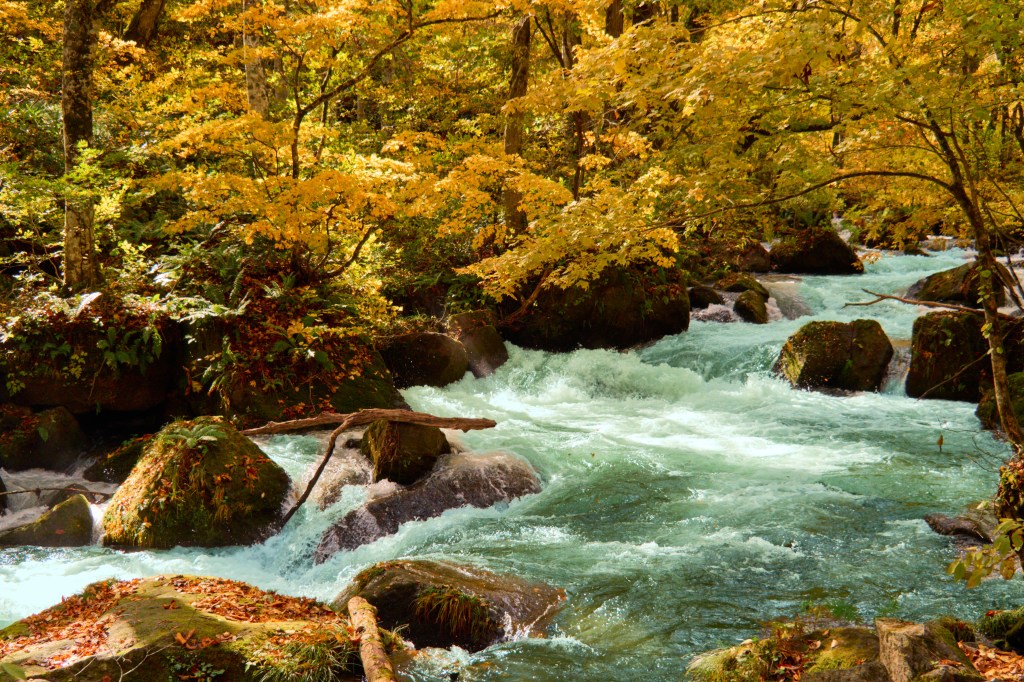
The stream that drains the lake is a 14 km walk through forest, past a dozen waterfalls and rapids, from Nenokuchi to Yakeyama. It is one of Japan’s best-known autumn walks, and it deserves its own day. The full walk takes about four hours at an easy pace, and there are buses at both ends and at Ishigedo in the middle, so you can shorten it.
If you only have an afternoon, walk the upper section from Nenokuchi to Choshi Otaki and back, which covers the most dramatic water in about 90 minutes. For the full route, bus stops, and the best short sections, see our Oirase Gorge travel guide.
Autumn colour
Autumn is the reason most people come, and the timing differs between the stream and the lake. The Oirase Stream usually peaks from late October, and the lake follows at about the same time or slightly later, with the beech and maple on the surrounding mountains turning first. In 2026 the Aomori prefecture foliage report listed both Oirase and Lake Towada as at their best in late October.
Expect crowds at Choshi Otaki and at the Ishigedo parking area, and expect the road to be slow. The Aomori side runs a car-free week on the Oirase section in autumn in most years, with shuttle buses from Yakeyama; in 2026 it was held from 7 to 13 September instead, so check the current year’s dates before planning around it. Early morning is the difference between a quiet path and a queue.
Winter, spring and summer
Winter closes the Oirase road, usually from mid-November to mid-April, and the boats stop. The lake itself is spectacular under snow, but access is limited and the buses are few, so check the current road and bus status before committing. Winter visitors should expect cold, deep snow and short days.
Spring arrives late at this altitude. The snow in the forest can last into April, and the fresh green appears in May and June, which is when the stream is at its most powerful with meltwater. Summer is cool by Japanese standards, good for walking, but the lake can be covered in mist in the morning. There is no swimming beach culture here; the water is cold even in August.
Where to stay
Accommodation around the lake is limited and books out early in autumn. Yasumiya has the largest cluster of hotels and ryokan, all within walking distance of the pier, which makes it the best base for a one-night stay. Oirase Keiryu Onsen, a few kilometres down the stream, has hot-spring hotels in the forest and is ideal if you want to walk Oirase at dawn. Towada city is cheaper and has more choice, but it is an hour away and the first bus leaves before breakfast.
Staying in Hachinohe or Aomori is possible as a day trip, but the round trip takes four to five hours, which leaves little time at the lake. If you want to see the lake without crowds, one night at Yasumiya is worth the cost.
Food and local specialities
This is not a food destination, and that is part of the appeal. The local dish is Towada barayaki, beef and onions grilled with a sweet soy sauce and eaten with rice or in a bowl, and it is the thing to order in Towada city. Around the lake, hotels serve set meals built on lake fish, mountain vegetables and Aomori rice, and the hime-masu, a small landlocked salmon, is the traditional catch.
Aomori apples appear everywhere in autumn, in juice, sweets and cider. For coffee, the lakeside hotels are the main option, and the shops near the pier close early. If you are self-catering, buy food in Towada city or Hachinohe before the bus; there is no supermarket at Yasumiya.
Two days around the lake
Day 1: stream to lake
Take the early bus from Hachinohe or Aomori and get off at Ishigedo. Walk upstream to Choshi Otaki, then continue to Nenokuchi, where the stream meets the lake. Take the boat across to Yasumiya in the afternoon, check in, and walk to the Otome-no-Zo statue and Towada Shrine before dinner.
Day 2: the lake and the art
Walk the shore in the morning, take the B course cruise if the weather is clear, and catch an afternoon bus back towards Hachinohe, stopping at the Towada Art Center for two hours. The art center’s collection of site-specific works, including Yayoi Kusama’s outdoor plaza Love Forever Singing in Towada and its polka-dotted sculptures, is worth the stop, and the town has cafes and a small shopping street.
With a third day, add Sukayu Onsen and the Hakkoda ropeway on the Aomori side, or drive the northern shore of the lake for viewpoints that almost no bus passenger sees.
Day trips
Hirosaki, with its castle park and old samurai district, is about an hour and a half from Towada city by train and bus; see our Hirosaki travel guide. Kakunodate, the preserved samurai town, is a similar distance via Shinkansen and local line, covered in our Kakunodate guide. The Hachinohe coast and its morning market are an easy add-on from the Hachinohe side, and Nyuto Onsen, deeper in the mountains, pairs well with a Lake Tazawa loop.
Drivers can continue west into Akita via the Towada-Hachimantai park roads, or north to Tsuta Onsen, whose pond is famous for autumn reflections. Note that Tsuta requires a reservation and shuttle in foliage season.
Budget
The lake is not expensive once you are there: the shrine, the walks and the viewpoints are free, and the boat is under 2,000 yen. The cost is transport and accommodation. A bus return from Hachinohe is roughly 4,000 to 5,000 yen, and lakeside hotels in autumn can be double their off-season rates.
Staying in Towada city or Hachinohe and visiting as a day trip cuts the accommodation cost but adds four hours of travel. A JR East pass can cover the Shinkansen and some buses, but check whether the bus route is included before relying on it.
Practical tips and etiquette
- Carry cash. Small shops and some buses do not take cards.
- Wear shoes with grip. The stream path is wet, and the shrine stairs are steep.
- Bring rain gear rather than an umbrella; the wind on the lake is strong.
- Carry out your rubbish. There are few bins in the national park.
- Do not feed the wildlife, and keep food sealed; this is bear country.
- Carry a bear bell when walking early or late, and make noise on quiet trails.
- Drone use in the national park needs permission; do not fly without it.
- Check the last bus time before starting a walk, and carry a torch in autumn.
- Do not swim from the piers; the water is deep and cold.
- Book the boat and the bus seat in foliage season, and arrive early for the first departure.
Before you go
Decide first whether you are a stream walker or a lake person, because the two need different bases. If the walk matters most, sleep at Oirase Keiryu Onsen and start at dawn. If the lake does, sleep at Yasumiya and take the first boat. In autumn, book accommodation months ahead, reserve the Hachinohe bus seat, and plan to arrive before 9:00. Check the road and bus status in winter, when the Oirase section is closed and services are thin. And leave time to do nothing: the lake is at its best when you stop walking and just sit by the water.
Sources
- Aomori Prefecture: Oirase Route 102 management and car-free week (checked 2026-10-26)
- Amazing AOMORI: 2026 autumn colour report (checked 2026-10-26)
- Towada Kanko Electric Railway: Lake Towada cruise 2026 timetable and fares (checked 2026-10-26)
- JR Bus Tohoku: Oirase-go and Mizuumi-go (checked 2026-10-26)
- Towada Shrine official site (checked 2026-10-26)
Explore More of Japan
- Oirase Gorge Travel Guide — the full stream walk
- Hirosaki Travel Guide — castle park and old town
- Kakunodate Travel Guide — samurai streets
- Hachinohe and Tanesashi Coast — the Pacific edge
- Nyuto Onsen Travel Guide — mountain baths
- Sendai Travel Guide — the gateway to Tohoku


Leave a Reply