Plan an independent visit to Fukui Prefectural Dinosaur Museum in Fukui with the main sights, food ideas, access checks, and seasonal notes.
Operational details such as opening hours, admission fees, and train times can change. Prefer official pages and reconfirm before you travel (sources checked on 31 October 2026).
Why visit
- The Fukui Prefectural Dinosaur Museum opened in 2000 in Katsuyama, a town in the mountains of Fukui that has become one of Japan’s most productive dinosaur fossil areas. The museum presents itself as one of the leading dinosaur museums in the world, and the permanent exhibition is built inside a dome-shaped hall divided into three zones: the World of Dinosaurs, Earth Science and the History of Life. The main gallery is a vast space without pillars, so the skeletons stand in the open rather than in bays, and the effect is closer to a hangar of animals than a museum of specimens.
- The numbers behind the main gallery are the reason to come. It holds 51 mounted dinosaur skeletons, and the museum states that ten of them are built with real fossil material rather than casts. That distinction matters more than it might seem: a cast shows you a shape, a real specimen shows you what survived 100 million years in the rock. The same hall contains a full-scale diorama reconstructing the Mesozoic of Sichuan in China, and a Dino Theater where screens face each other across the space.
- Fukui’s own excavations are the second argument. The museum displays six new dinosaur species discovered through prefectural digs, alongside other plant and animal fossils from the same work, and it sets those against dinosaur fossils found elsewhere in Japan and in China and Thailand. This is not a museum that imported a collection and put a regional label on it. The research programme runs from the mountain dig site at Kitadani through preparation in the building, and you can watch the preparation happening.
- The Field Station is the part that changes the visit from a museum trip into a day out. It is a separate outdoor museum at the Kitadani excavation site, reachable only by the museum’s own bus tour, with three zones including a fossil excavation experience area. The site is Japan’s largest dinosaur fossil excavation, the geology is the Early Cretaceous Kitadani Formation of the Tetori Group, and part of the excavation was designated a national Natural Monument in 2017. Tours run from spring to early November and are booked through the museum.
- Katsuyama is not on a main rail line, which keeps the crowds manageable on ordinary days and makes the planning matter. The route is JR Fukui, then the Echizen Railway to Katsuyama Station at the end of the line, then a taxi or the community bus, roughly ten minutes for the taxi. In Golden Week and the summer holiday the surrounding Katsuyama Dinosaur Forest runs park-and-ride from temporary car parks, and in winter the road needs winter tyres. None of that is difficult, but none of it is optional either.
Top places and highlights
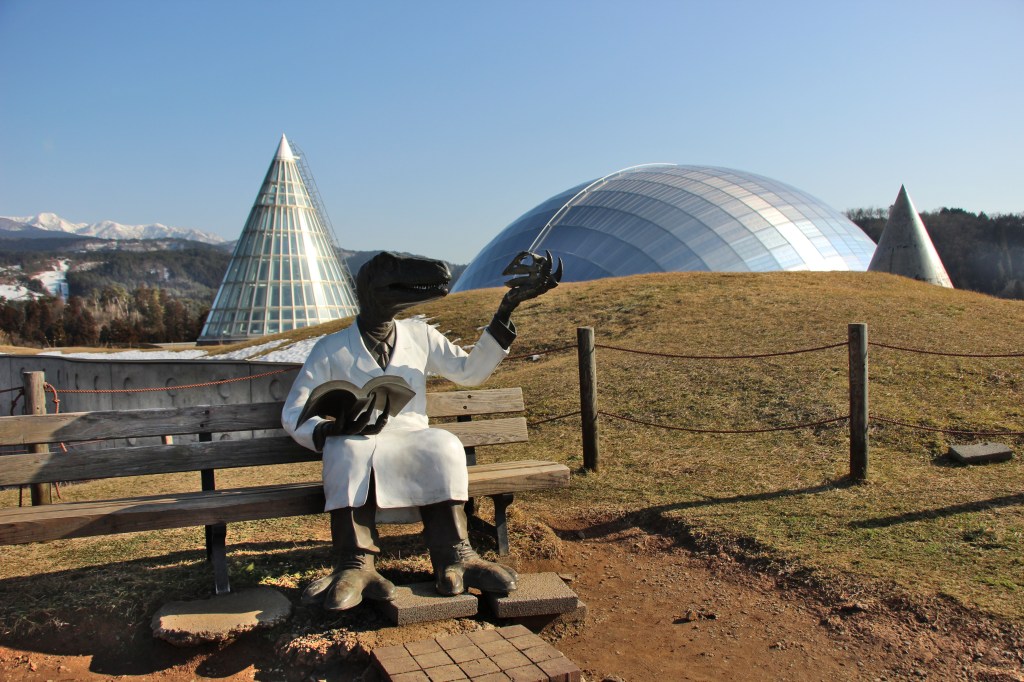
The World of Dinosaurs
This is the zone with the 51 mounted skeletons, ten of them incorporating real fossils, standing in an unbroken pillar-free hall. The scale is the point: because nothing interrupts the space, the mounts can be grouped as an assembly rather than lined up against walls, and you can walk around them and look up. The same zone holds a full-scale diorama reconstructing the Mesozoic landscape of Sichuan in China, and the Dino Theater, where screens facing each other let the museum run a presentation across the space. Budget more time here than the rest of the museum combined.
Fukui’s own dinosaurs
The museum displays six new dinosaur species discovered through Fukui Prefectural excavations, along with other fossil plants and animals from the same work. It also shows dinosaur fossils found elsewhere in Japan and material from China and Thailand, which puts the local finds in a wider Asian context rather than treating them as a local curiosity. Because the specimens come from the prefecture’s own dig programme, the labels carry the excavation history with them. For anyone who has followed Japanese dinosaur research, this is the room where the names on the papers are on the floor.
Earth Science and the History of Life
The third zone runs the 4.6-billion-year history of the Earth as a sequence: the origin of life, repeated evolution and extinction under a changing environment, and the arrival of humans. It is the section that turns a dinosaur museum into a natural history museum, and it gives the dinosaurs a setting rather than leaving them as spectacle. The museum singles out a newly added large mosasaur, Tylosaurus, as a must-see, which is a change from the dinosaur-dominated galleries. Read the sequence in order; the panels are doing more work than the mounts here.
Dino Lab and the T. rex
Dino Lab is a separate room built around a full Tyrannosaurus skeleton, and it is used to teach how the animal’s body worked and how it lived rather than simply to display it. The feature worth knowing about is a projection mapping inside a cast of the skull, which shows the internal structure of the head as an image on the surface. It is the kind of display that works for children and adults at the same time, and it is the part of the museum most likely to be remembered by a child who has seen dinosaur skeletons before.
The fossil preparation room
One wall of the museum is given over to the work behind the collection: the preparation of fossils, where rock is removed from specimens. The museum states that fossils recovered from Fukui’s dig sites are cleaned here, which means the material on display and the material being worked on come from the same programme. It is a small exhibit that changes the meaning of everything else in the building, because it shows that the skeletons are the end of a process rather than objects that arrived finished. Look for it before you leave the permanent galleries.
The Field Station at Kitadani
The Field Station is the museum’s outdoor site in the mountains of Kitadani, Katsuyama, and it can only be visited on the museum’s dedicated bus tour. It has three zones, an observation plaza, an exhibition area and a fossil excavation experience area, and the site itself is Japan’s largest dinosaur fossil excavation, in the Early Cretaceous Kitadani Formation. Digging began with trial trenches in 1988 and full excavation in 1989, and part of the site became a national Natural Monument in 2017. The season runs from mid-April to early November with closed dates in between, and heavy rain can cancel tours.
The symbol monument
Outside the exhibition halls stands a monument about 13 metres long, assembled from the five dinosaur species and one bird species discovered in Fukui. It is a deliberate summary of the museum’s research programme in sculptural form, and the museum runs several different lighting sequences through it depending on the time of day. Most visitors photograph it on the way in and ignore it. Look at it on the way out instead, once you know which animals it is made of, and it reads as an index of everything you have just seen rather than as a logo.
Food and drink
- The museum’s restaurant is on the third floor, beside the entrance, the shop and the Dino Library. That location matters because eating and drinking are not allowed inside the exhibition areas, so the restaurant is the place to sit down rather than a corner of the gallery. The third floor is also where you arrive: the museum entrance is up there rather than at ground level, which makes the restaurant convenient for a meal before or after the galleries rather than in the middle of them.
- The museum shop is on the same floor as the restaurant and the entrance, which puts the shopping at the start and end of the visit rather than in the middle. Dinosaur merchandise is the obvious stock, and for children it is the part of the trip that lasts longer than the skeletons. Because the shop is outside the exhibition areas, you can use it without a ticket, which makes it a reasonable stop if you are passing through Katsuyama with limited time.
- Outside the museum, eating is a Katsuyama matter rather than a museum one. The town is small and the museum sits within the Katsuyama Dinosaur Forest park, so there is no restaurant strip at the gate; the practical pattern is to eat in Katsuyama town or in Fukui city around the rail journey. That is worth planning because the museum’s opening hours run straight through lunch, and a visit that starts late will have you eating at an odd hour.
- Fukui’s local food is worth the detour on the way. The prefecture is known for soba, for sake from its own breweries, and for seafood from the Sea of Japan coast, none of which needs a specific recommendation because the stations and the city centre both serve it. If you are arriving by Echizen Railway from Fukui, eating before you leave the city is the simplest arrangement, since the return trip after a long museum visit tends to land after the kitchen has closed.
Getting there and around
- The rail route is JR Fukui Station, then a change to the Echizen Railway and the Katsuyama-Eiheiji Line to Katsuyama Station, which is the end of the line. From Katsuyama Station, a taxi takes about ten minutes, and a community bus also runs to the museum. The museum publishes a set ticket that combines the Echizen Railway and the Katsuyama city buses for one day, which is worth asking about at the station if you are doing the round trip.
- By car, the museum is reached from the Fukui-kita junction and interchange on the Hokuriku Expressway, then via the Chubu Jukan Expressway to Katsuyama. From the Maruoka Interchange on the Hokuriku Expressway the drive is about 40 minutes, and there is a route from the Shirotori junction on the Tokai-Hokuriku Expressway through Ono. The approach is mountain road rather than motorway for the last stretch, which matters in winter.
- Winter driving needs real preparation. The museum warns that the area gets snow and that normal tyres are dangerous, and asks drivers to fit winter tyres. This is not a caution aimed at foreign visitors; it is the museum’s standard advice for its own local road. If you are renting a car in Fukui in winter, confirm the tyre specification at the counter rather than assuming the car is prepared for the mountains.
- In busy periods the park runs park-and-ride. During Golden Week, from 26 April to 6 May, and in the summer holiday from 9 to 17 August, Katsuyama sets up temporary car parks and runs free shuttle buses because the Katsuyama Dinosaur Forest car park cannot absorb the traffic. On specific peak days the park entrance is closed to cars for a period and drivers are directed to the temporary lots, so the free shuttle is the way in rather than an alternative.
- There is a Heartful parking area on the left as you face the museum entrance, reserved for visitors who need it, and the museum asks general visitors not to use it or to drop off there. Inside, the museum publishes barrier-free information separately, covering lifts, slopes, multi-purpose toilets, a first-aid room, a nursing room, and wheelchair and stroller availability. Ask at the third-floor entrance if you need any of these, since that is where the museum begins.
Where to stay
- Fukui city is the practical base. It is on the JR line and at the start of the Echizen Railway route to Katsuyama, and it has the hotels and evening restaurants that Katsuyama does not. Staying in Fukui also lets you combine the museum with the prefecture’s other sights, including Eiheiji and the coast, without moving hotels. The cost is a longer day out, since the rail and bus combination to the museum is a couple of hours each way.
- Katsuyama itself is an option if the museum is the whole reason for the trip. Staying in the town removes the rail leg and puts you close to the Katsuyama Dinosaur Forest for an early start, which is the difference between arriving at opening and arriving with the school groups. The town is small, so the choice of accommodation is limited compared with Fukui, and the evening options are fewer. Book well ahead for weekends and school holidays.
- For a wider Hokuriku trip, Fukui is the natural overnight stop between Kanazawa and the Kansai region. The Hokuriku Shinkansen has changed the journey times, and the museum is reachable from Fukui as a day trip rather than requiring its own night. If you are travelling between Kanazawa and Kyoto or Osaka, one night in Fukui with the museum on the middle day is the arrangement that wastes least time, provided you check the reservation slot before you commit.
Best time to visit
- The museum’s hours change with the school calendar. Normally it opens from 9:00 to 17:00 with no entry after 16:30; during the summer holidays it runs from 8:30 to 18:00 with no entry after 17:30. The summer extension is real and worth using, because it gives an evening slot that ordinary days do not have. Outside those dates, arriving after half past three in the afternoon means you will not get in.
- Closing days are the second and fourth Wednesday of each month, except during the summer holidays, plus the year-end and New Year holidays. That is an unusual pattern and easy to get wrong, since a first or third Wednesday is fine while a second or fourth is not. Check the calendar for your dates rather than reasoning from the day of the week, especially if you are building a trip around a single museum day.
- The Field Station runs on a season rather than a calendar year. The 2026 season runs from 17 April to 3 November, with closed dates in between, and the tour departure times shift between weekdays, weekends and the extended summer period, with earlier departures during the July and August extension. It is closed entirely outside that window, so anyone visiting in winter should plan the museum only. Tours run in light rain but may be cancelled in heavy rain for safety.
- Reservations are part of the system rather than a suggestion. The museum has introduced advance booking and states that for the time being there are no free admission days, which reverses the earlier practice of free entry on designated dates. Book a slot before you travel, especially in Golden Week and the summer holiday when the park runs traffic restrictions and park-and-ride. The comfortable season for the outdoor site is late spring to autumn; the museum itself is a good wet-day or winter destination.
Practical tips
- Book before you go. The museum now operates on advance reservations, and it states that free admission days are suspended for the time being, so the old advice about third Sundays and Dinosaur Day no longer applies. Reserve a time slot through the official ticket page and keep the QR code, because admission is checked at the third-floor gate. For the Field Station, the booking is separate and includes the bus.
- Admission is 1,000 yen for adults, 800 yen for high school and college students, 500 yen for primary and secondary students, and 500 yen for visitors aged 65 and over; pre-school children are free. Groups of 30 or more paying visitors get 800, 640, 400 and 400 yen, and an annual pass costs 3,000, 2,400, 1,500 and 1,500 yen. Special exhibitions are priced separately, and the Field Station admission is not included in the museum ticket.
- Payment is flexible in the building and restricted online. The ticket machine at the main building takes cash, credit cards, electronic money and QR code payments, and the online ticket page accepts cards, Paidy and PayPay. Tickets bought at convenience store terminals can be used directly at the gate without exchange, but they cannot be refunded, so a change of plan costs you the ticket. Reconfirm the current prices on the official page before you travel.
- Photography rules inside are strict: flash and tripods are prohibited throughout the museum. Eating, drinking and smoking are also not allowed inside, which is why the restaurant is on the third floor outside the exhibition areas. Pets are not admitted, with the exception of service dogs. For photographers, the practical consequence is that the galleries need high ISO and a steady hand, and the symbol monument outside is the place for a tripod.
- Visitors with a disability certificate, whether physical, mental-health or rehabilitation, are admitted free with one carer, and the Mirairo ID app screen is accepted in place of the paper certificate. There is a Heartful parking area on the left as you face the entrance; the museum asks general visitors not to use it. Barrier-free information covers lifts, slopes, multi-purpose toilets, a first-aid room, a nursing room and wheelchair or stroller loans.
- Plan the Field Station separately, because it can consume the afternoon. Reception opens an hour before the tour at the museum’s general counter, and check-in must be completed 30 minutes before departure; the bus leaves on time and a missed bus invalidates the booking without a refund. Departures are at 10:00 and 12:30 on weekdays, earlier at weekends and in the extended summer period. The site is in the mountains and can be cold, so bring a jacket.
- Allow for the park rather than only the museum. The building sits inside the Katsuyama Dinosaur Forest, which has its own traffic management in Golden Week and the summer holiday, with temporary car parks and free shuttle buses, and on peak days the park entrance closes to cars for a period. Arriving by train and taxi avoids all of it. If you do drive, arrive early and expect to be directed to a temporary lot rather than the museum gate.
Suggested day-trip outline
- Take the JR line to Fukui, change to the Echizen Railway and ride the Katsuyama-Eiheji Line to Katsuyama Station at the end of the line. From there a taxi takes about ten minutes, or take the community bus. Ask at Fukui about the combined one-day ticket for the railway and the Katsuyama buses, and confirm your reserved museum time slot before you set out.
- Start on the third floor, which is where the entrance, the shop, the restaurant and the Dino Library are. Go into the permanent exhibition and take the World of Dinosaurs first, while the hall is quiet: 51 mounted skeletons with ten incorporating real fossils, the Sichuan diorama and the Dino Theater. Walk the whole hall before stopping at individual mounts, because the pillar-free space is itself part of the exhibit.
- Continue into the Fukui dinosaur section for the six species discovered in prefectural excavations, then into Earth Science and the History of Life for the 4.6-billion-year sequence and the Tylosaurus. Finish with Dino Lab and its T. rex, including the projection mapping inside the skull cast, and look for the fossil preparation room where specimens from Fukui’s sites are being cleaned.
- If you have booked the Field Station, check in at the general counter 30 minutes before departure and take the dedicated bus to the Kitadani site. The three zones are the observation plaza, the exhibition area and the fossil excavation experience area, and the site is Japan’s largest dinosaur fossil excavation. Tours run in light rain but can be cancelled in heavy weather, and the site is in the mountains, so bring a warm layer.
- Back at the museum, eat on the third floor and visit the shop, then photograph the 13-metre symbol monument on the way out, when you can recognise the five dinosaurs and the bird it is built from. If you are driving, leave before the park’s traffic restrictions begin on a peak day, and if it is winter, confirm the car has winter tyres before you start the mountain road back to Fukui.
Before you go
Timetables, fares, admission fees, and seasonal access rules can change. Check the official tourism and transport sites linked below for the latest information before you travel.
Explore More of Japan
Published guides that pair with this one:
- Tojinbo Cliffs Guide: Fukui’s Basalt Coast
- Wakasa Obama Guide: Fukui’s Old Port and the Five-Colour Noodles
- Hakusan and Shirayama Hime Shrine Guide: Ishikawa’s Sacred Mountain
- Eiheiji Travel Guide: A Working Zen Monastery in Fukui
Browse every Chubu guide on this site for the rest of the region.
Sources
- dinosaur.pref.fukui.jp — Visitor information (checked 2026-10-31)
- dinosaur.pref.fukui.jp — Admission fees (checked 2026-10-31)
- dinosaur.pref.fukui.jp — Exhibition (checked 2026-10-31)
- dinosaur.pref.fukui.jp — Field Station (checked 2026-10-31)
- dinosaur.pref.fukui.jp — Access (checked 2026-10-31)


Leave a Reply