Plan an independent visit to The Museum of Art, Ehime in Ehime with the main sights, food ideas, access checks, and seasonal notes.
Operational details such as opening hours, admission fees, and train times can change. Prefer official pages and reconfirm before you travel (sources checked on 31 October 2026).
Why visit
- The Museum of Art, Ehime opened in 1998 inside the nationally designated historic site of Matsuyama Castle, on the Sannomaru, the castle’s third compound. That location is not incidental: archaeological survey found the remains of a late Edo-period road under the site, and the building was split into two wings so the road could stay in the ground. The height was kept below the surrounding buildings, and the large camphor trees already growing there were preserved, with a courtyard built around three of them. A museum that bends its plan around a buried road and three old trees is making a statement about where it sits.
- The museum describes itself as participatory and creative, and organises everything around three verbs: see, create, learn. The part that makes this unusual is the atelier, which the museum presents as rare among Japanese museums. Visitors can use the provided equipment and work at their own pace in printmaking, woodworking, dyeing, photography and clay. Most art museums offer a workshop with a scheduled class; this one offers open making space, which is why people come back with a membership rather than a single visit.
- The collection runs to about 12,000 works and is broader than a prefectural museum’s usual local-artist core. It began with the preceding Ehime Prefectural Museum of Art, which opened in 1970 and collected local artists, and after the 1998 reopening it added overseas names including Monet and Cezanne and modern Japanese painters including Yasuda Yukihiko and Nakamura Tsune. The local holdings are the real depth, though: Sugiura Hisui, Yanase Masamu, Noma Hitone, Manabe Hiroshi and Azechi Umetaro are all represented in large groups. For anyone interested in twentieth-century Japanese graphic design and printmaking, this is a destination rather than a regional stop.
- The building is worth the trip on its own if you care about post-war Japanese architecture. The main building’s exterior is monochrome and castle-like, while the individual galleries are formed from softly curved precast concrete and described by the museum as resembling jewellery boxes. The second-floor lobby looks out across Shiroyama. The South Wing, meanwhile, is the 1970 building by Tokunaga Masami, a classmate of Tange Kenzo, and it originally stood beside Tange’s Ehime Prefectural Hall of 1953, which makes the site a small anthology of mid-century Japanese modernism.
- Matsuyama is a compact city and the museum is easy to reach without a car. A city tram from JR Matsuyama Station takes seven minutes to a stop named for the museum, and the walk from there is three minutes. That puts the museum on the same line as Dogo Onsen and the city centre, so it fits a day of sightseeing without a detour. Admission to the collection is also low enough, at 340 yen for adults, that you can drop in for an hour rather than committing a whole afternoon to it.
Top places and highlights
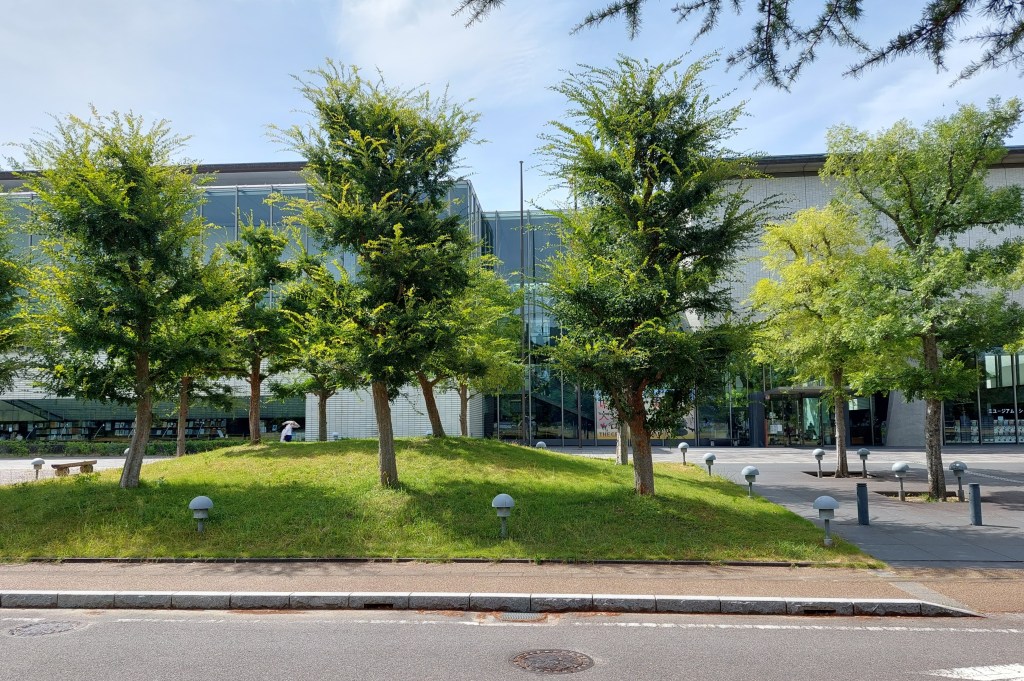
The main building and its courtyard
The museum’s plan is the exhibit. Excavation before construction found a late Edo-period road, and rather than remove it the museum divided the building into two wings east and west and kept the road in place. The height was held below the surrounding buildings so the museum would not dominate the castle site, and the large camphor trees on the land were kept, with a courtyard arranged around three of them to the south. The exterior is a monochrome that evokes a castle, and the galleries inside are formed from softly curved precast concrete. Walk the courtyard before you go in; it explains why the building is shaped the way it is.
The collection exhibition
Around 12,000 works sit behind a rotating programme of themed collection exhibitions, so what you see depends on when you come. The holdings combine European painting, including Monet and Cezanne, with modern Japanese artists such as Yasuda Yukihiko and Nakamura Tsune, and then go deep on Ehime’s own: Sugiura Hisui, Yanase Masamu, Noma Hitone, Manabe Hiroshi and Azechi Umetaro. That last group is the reason to plan a visit around a specific rotation rather than dropping in blind. Check what is on before you travel, because a collection this size is shown in selections, not in full.
The atelier
This is the museum’s signature. Two ateliers give visitors space, equipment and tools to make work at their own pace, and the museum describes the supported activities as printmaking, woodworking, dyeing, photography and clay. It is not a guided class with a fixed outcome; it is open making space of a kind the museum says is rare in Japan. The practical consequence for a visitor is that the museum can absorb a whole day rather than an hour, and that the South Wing is a working part of the site rather than an annex. If you want to use it, ask at the desk about the current arrangement before planning your day around it.
The South Wing
The South Wing is the former Ehime Prefectural Museum of Art, which opened in 1970 and now houses the atelier and the citizen gallery. It was designed by Tokunaga Masami, head of the architectural office that bore his name and a classmate of Tange Kenzo at university. The building has symmetrical galleries flanking a central staircase, and an entrance created by projecting the second floor so that it forms a piloti-like space. Galleries are arranged for circulation, and the staircases and ramps are treated as distinct from the exhibition rooms rather than hidden. It was seismically retrofitted in 2017, which is why a 1970 building is still in daily use.
The second-floor lobby and Shiroyama
The museum’s own description singles out the second-floor lobby for its panoramic view of Shiroyama, the wooded hill that the castle sits on. It is presented as a place to relax rather than as an exhibit, which is the correct way to use it: sit down after the galleries and look at the hill the museum is built into. Because the building was kept low so as not to project above its surroundings, the view from the lobby is of the castle site rather than over it. This is also where the relationship between the museum and the historic site becomes obvious without any label telling you.
Matsuyama Castle and the Sannomaru site
The museum stands on the Sannomaru of Matsuyama Castle, within a nationally designated historic site, and the castle is the reason the area is worth a full day rather than a museum stop. Entry into Shiroyama Park by car is only through the Nishihoribata gate, and there is no car park dedicated to the museum, which is the museum’s way of telling you to arrive by tram. The tram stop is named Minamihoribata, with the museum name in parentheses, which puts it on the same short line as the city centre and Dogo. Treat the museum and the castle as one outing rather than two.
The museum shop
The shop sells catalogues of the collection, postcards of works in it, catalogues from past exhibitions, art books and art-related goods. Because the collection is shown in rotating selections, the catalogue is often the only way to see what is not currently on the walls, which makes it more useful here than at a museum with a permanent display. The museum also offers mail order by cash on delivery for customers who want items sent. It is a small shop rather than a design store, and the stock reflects the collection’s strength in modern Japanese printmaking and graphic design.
Food and drink
- There is a cafe inside the museum, the park M’s coffee, and it is the obvious place to sit down during a visit. It is listed among the museum’s facilities alongside the shop, on the building map, so the location is easy to find once you are inside. Because the museum runs from 9:40 to 18:00, a coffee between the collection galleries and the atelier fits naturally into the middle of the day. Check the cafe’s current hours on the museum’s facility page before relying on it for a late lunch.
- Ehime’s own food is the reason to eat in Matsuyama rather than at the museum. Tai meshi, rice with sea bream, is the prefecture’s signature dish and appears in both a mixed style and a sashimi-on-rice style depending on where you order it. Jakoten, a fried fish paste, is sold as a snack and as a souvenir. Botchan dango, the three-coloured skewered dumpling named after the Natsume Soseki novel set in Matsuyama, is the standard sweet. None of this needs a specific recommendation: the city centre and the Dogo area both have plenty of it.
- The tram line is what makes eating easy. The stop for the museum is three minutes’ walk from the entrance and seven minutes from JR Matsuyama Station, and the same line continues to Dogo Onsen, where the concentration of restaurants and sweetshops is highest. That means the sensible pattern is museum first, then tram to Dogo or back to the city centre for a proper meal, rather than hunting for lunch around Shiroyama Park. The park itself is a historic site with limited commercial food, which is another reason the museum’s cafe matters.
- For anyone staying in the city, Matsuyama’s evening food is centred on the area around the city station and the arcades, where the local fish and the izakaya trade cluster. The museum closes at 18:00, so dinner is a separate trip whatever you do. If you are visiting in the evening, note that the collection galleries stop admitting at 17:30 and the South Wing’s citizen gallery also closes at 18:00, so a late-afternoon visit needs to start by mid-afternoon to be worth the tram fare.
Getting there and around
- From JR Matsuyama Station, take a city tram bound for Dogo Onsen or Matsuyama City Station. The ride is about seven minutes, and you get off at Minamihoribata, the stop whose full name includes the museum. From there it is a three-minute walk. This is the route the museum itself recommends, and it puts the museum on the same line as the city centre and Dogo Onsen, so the tram fare covers both if you are sightseeing rather than making a single trip.
- From Matsuyama Airport, the drive is about 15 minutes. By bus, the limousine service takes about 18 minutes to the Ehime Shinbunsha-mae stop, from which the museum is about nine minutes on foot. The bus is the cheaper option and the walk is short, but it drops you in the city rather than at the door, so allow for the last stretch with luggage. From the Matsuyama Interchange, the drive is about 20 minutes.
- By car, be aware that there is no car park dedicated to the museum inside Shiroyama Park, and the museum asks visitors to use public transport where possible. If you do drive, entry into Shiroyama Park is only through the Nishihoribata gate, and you enter the museum’s parking from the South Wing front on the NHK side and take a free space. This is more restrictive than a normal museum car park, and on a busy castle day the difference matters.
- The museum building is a steel-reinforced concrete structure with one basement floor and three above ground, split into two wings, and the route between the wings and the South Wing involves stairs, lifts and ramps. Accessibility information is published separately on the museum’s barrier-free page, and the building has a general information desk on the ground floor that handles wheelchairs and large baggage. Ask there rather than at the ticket counter if you need assistance, since the desk is the point of contact for the building as a whole.
- Inside, coin lockers and umbrella stands are provided, and luggage that will not fit in a locker can be left at the general information desk. Only drinks in containers that can be closed, such as bottles or flasks, may be brought in; the museum provides water coolers on the first floor and in the West Wing lobby, with an extra station near the entrance hall benches in summer. Pens of any kind, including ballpoints, fountain pens and brush pens, are not allowed in the galleries because they can damage works, and pencils are lent on request.
Where to stay
- Matsuyama city centre is the practical base. The tram ride to the museum is seven minutes from JR Matsuyama Station, and the same line serves Dogo Onsen, so a hotel anywhere along it keeps both the museum and the onsen within reach without a car. This is the version of the trip where the museum is one stop in a city break rather than a destination in itself, and it suits most visitors.
- Dogo Onsen is the other obvious base and the more atmospheric one. It is at the end of the tram line, which means the museum is a short ride in the opposite direction, and the evening is spent in the onsen district rather than in a business hotel. The trade-off is that Dogo is a tourist area with tourist-area prices, while the city centre is cheaper and more practical for trains. Both work; the choice is whether you want the onsen as the centre of the stay.
- Staying near Matsuyama Airport suits an early flight and nothing else. The airport is 15 minutes from the museum by car, which makes a same-day departure easy, but the area around it is not a place to spend an evening. A single night here works if the museum is the reason for the trip and the flight leaves early. Otherwise the city centre is better value for the same journey time.
Best time to visit
- The museum is open from 9:40 to 18:00, with last entry to the galleries at 17:30. Note that the South Wing’s citizen gallery also closes at 18:00, and that special exhibitions and loan exhibitions may have different entry times, which the museum says to check on each exhibition’s page. The 9:40 opening is later than many museums, so an early start elsewhere in the city before arriving is the sensible sequence rather than waiting at the door.
- Closing days follow a pattern that trips people up. The museum is closed on Mondays, but if Monday is a national holiday or a substitute holiday it closes the following day instead. On top of that, the first Monday of each month is open and the following Tuesday is closed. It is also closed from 29 December to 3 January. The museum publishes an annual closure calendar, so check it for your dates rather than reasoning from the Monday rule alone.
- The collection is shown in rotating themed selections, which means the season determines what you see as much as the weather does. The museum sets a theme for each collection exhibition and changes the works between them, and the special exhibitions run in parallel. A visit planned around one artist needs the exhibition schedule checked first. A visit without a specific target is better served by choosing a rotation that interests you than by choosing a convenient date.
- Matsuyama’s climate is mild and the museum is an indoor destination, so weather is a minor factor compared with most of this site’s subjects. The one seasonal detail the museum publishes is about water: in summer, from 1 July to 30 September, it adds an extra water station near the benches in the entrance hall in addition to the coolers on the first floor and in the West Wing lobby. Only containers with lids are allowed, so bring a bottle rather than a cup.
Practical tips
- Collection admission is 340 yen for adults and 230 yen for high school and university students, with group rates of 270 and 180 yen for parties of 20 or more. Entry is free for junior high school students and younger, for visitors aged 65 and over, for holders of a disability certificate, and for holders of a special exhibition ticket. Carers are also exempt where care is needed. Bring the certificate or pass, since the exemptions require proof, and note that the Mirairo ID app screen is accepted in place of a paper certificate.
- Photography is not allowed in the exhibition rooms. The museum states this plainly, and adds that some exhibitions may permit it in part, but that video recording, flash, tripods and selfie sticks are not to be used in any case. Commercial photography requires prior consultation with the museum about the date, place and content. For ordinary visitors the practical rule is simple: photograph the building and the courtyard, not the works. The courtyard and the exterior are the parts worth a camera.
- Bring a pencil or expect to borrow one. The museum does not allow ballpoint pens, fountain pens, mechanical pencils or brush pens in the galleries because they can damage works, and it lends pencils if you ask staff. Anyone planning to take notes should either bring a pencil or ask at the desk on the way in. This is stricter than most museums and it is easy to be caught out with a pen in a bag.
- Use the tram rather than the car. There is no museum car park inside Shiroyama Park, entry to the park by car is only through the Nishihoribata gate, and the museum asks visitors to use public transport. The tram stop is three minutes away and the ride from JR Matsuyama Station is seven minutes. Driving means finding a space in a shared park with the castle’s own visitors, which is a poor use of a short trip.
- Lockers and the information desk do double duty. Coin lockers and umbrella stands are provided, and the general information desk will hold bags that do not fit in a locker. The museum also handles wheelchair enquiries there. If you are arriving with luggage between trains, this is the place to leave it rather than carrying it up through the castle park. Drinks are allowed only in containers that close, so a flask or bottle is fine and an open cup is not.
- Check the exhibition schedule before you go. The collection is shown in rotations built around a theme, and the temporary exhibitions run alongside, so the museum you visit in one month is not the museum you would have visited in another. The museum publishes both the collection exhibition themes and the special exhibitions, and entry times can differ for special exhibitions. Ten minutes on the website before booking transport is the difference between seeing the works you came for and missing them.
Suggested day-trip outline
- Take the city tram from JR Matsuyama Station towards Dogo Onsen or Matsuyama City Station and get off at Minamihoribata after about seven minutes. Walk three minutes to the museum. If you are coming from the airport, the limousine bus to Ehime Shinbunsha-mae plus a nine-minute walk is the equivalent approach.
- Walk the courtyard and the outside of the building before buying a ticket. The two-wing plan exists because of the Edo-period road found under the site, and the three camphor trees in the courtyard were preserved rather than removed. Seeing this first makes the interior layout and the low, castle-like exterior read as decisions rather than style. It takes ten minutes and it changes how the rest of the visit looks.
- Start with the collection exhibition on the main building’s galleries. What is on depends on the current rotation, so check the theme beforehand if you have a particular artist in mind. The strength is the local group, Sugiura Hisui, Yanase Masamu, Noma Hitone, Manabe Hiroshi and Azechi Umetaro, alongside the European and modern Japanese works. Take the second-floor lobby afterwards for the view of Shiroyama.
- Cross to the South Wing for the atelier and the citizen gallery, which is the part that makes this a participatory museum rather than a display case. The 1970 building by Tokunaga Masami is worth looking at as architecture: symmetrical galleries either side of a central staircase and a second-floor overhang forming a piloti-like entrance. If you want to make something rather than look, ask at the desk about the atelier before you start the galleries, because it changes how long you need.
- Take coffee at the park M’s coffee and look at the shop for collection catalogues and postcards. Because the collection rotates, the catalogue covers what is not on the walls, which is a better purchase here than at most museums. Then leave by tram for Dogo Onsen or the city centre, where the local food, tai meshi, jakoten and Botchan dango, is the natural end to the day.
Before you go
Timetables, fares, admission fees, and seasonal access rules can change. Check the official tourism and transport sites linked below for the latest information before you travel.
Explore More of Japan
Published guides that pair with this one:
- Matsuyama Castle Travel Guide: The 1854 Keep above the City
- Dogo Onsen Travel Guide: Historic Hot Springs in Matsuyama
- Takamatsu Travel Guide: Ritsurin Garden, Udon, and Seto Sea Gateways
- Shimanami Kaido Guide: Cycling Across the Islands
Browse every Shikoku guide on this site for the rest of the region.
Sources
- ehime-art.jp — About the museum (checked 2026-10-31)
- ehime-art.jp — Visitor guide (checked 2026-10-31)
- ehime-art.jp (checked 2026-10-31)
- ehime-art.jp (checked 2026-10-31)


Leave a Reply