Noboribetsu Onsen Travel Guide: Hell Valley and Hokkaido Hot Springs
Planning a trip to Noboribetsu Onsen in Hokkaido? This English guide covers Hell Valley, hot-spring stays, access from Sapporo, and practical tips for international travelers.
Operational details such as opening hours, admission fees, and train times can change. Prefer official pages and reconfirm before you travel (sources checked on 26 October 2026).
Why visit
- Noboribetsu is one of Hokkaido’s best-known onsen towns, famous for volcanic Hell Valley scenery.
- It pairs well with a Sapporo-based itinerary as an overnight or long day trip.
- The whole resort runs on one volcanic system: Jigokudani alone releases about 10,000 tons of hot water a day, in several different spring types, and that water is piped to the hotels.
- People have bathed here since the Edo period, on a landscape shaped by an eruption roughly 10,000 years ago.
Top places and highlights
The Ainu name, and the inn that started it
The town’s name is Ainu, and the translation is more exact than the usual “dark river”. It comes from nupur-pet: pet is river, and nupur means strong spiritual power, the word used for a colour or a taste that is intense. Chiri Mashiho, the Ainu linguist from this city, translated it as the river of deep colour, and pointed at the milky water that drains from Oyunuma.
The springs were medicine before they were tourism. The city’s own record of the name notes that the Ainu valued the baths, and the earliest written notice is from 1809, which describes bathing in the hot river and calls it good for eye disease and eczema. Matsuura Takeshiro passed through in 1845 and described the patients’ huts: bamboo woven into walls, bark on the floor, and a nusa-san altar set up just across the stream. In 1858 a local operator, Okada Hanbei, put up a hut for the workers at a sulfur works, and in the same year Takimoto Kanezo and his wife, both suffering from skin disease, took the waters and recovered. He founded a small shrine in thanks, built an inn in 1888, and is remembered as the father of the onsen.
What the baths are today is a consequence of that geology. Nine different spring types rise in the resort between about 45 and 90 degrees Celsius, which the town markets as a department store of hot springs — an odd phrase that is also accurate, since sulfur, salt and iron baths really are a short walk apart.
Jigokudani (Hell Valley)
A short walk from the town center with steaming volcanic landscapes. Boardwalks can be wet—wear sturdy shoes.
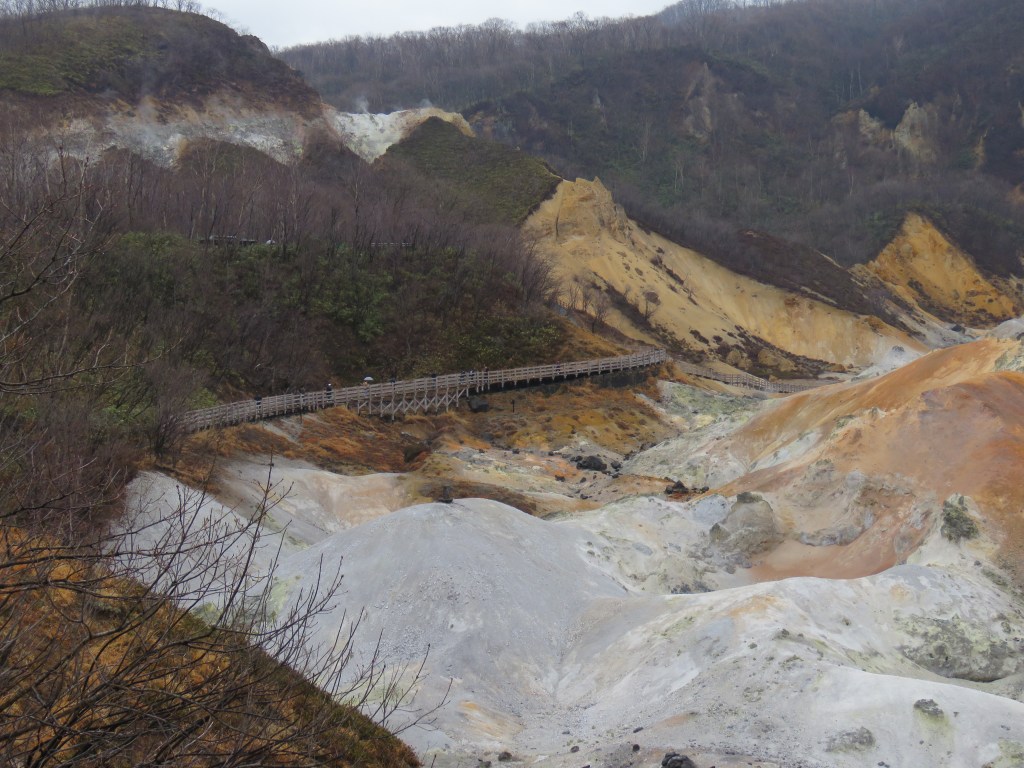
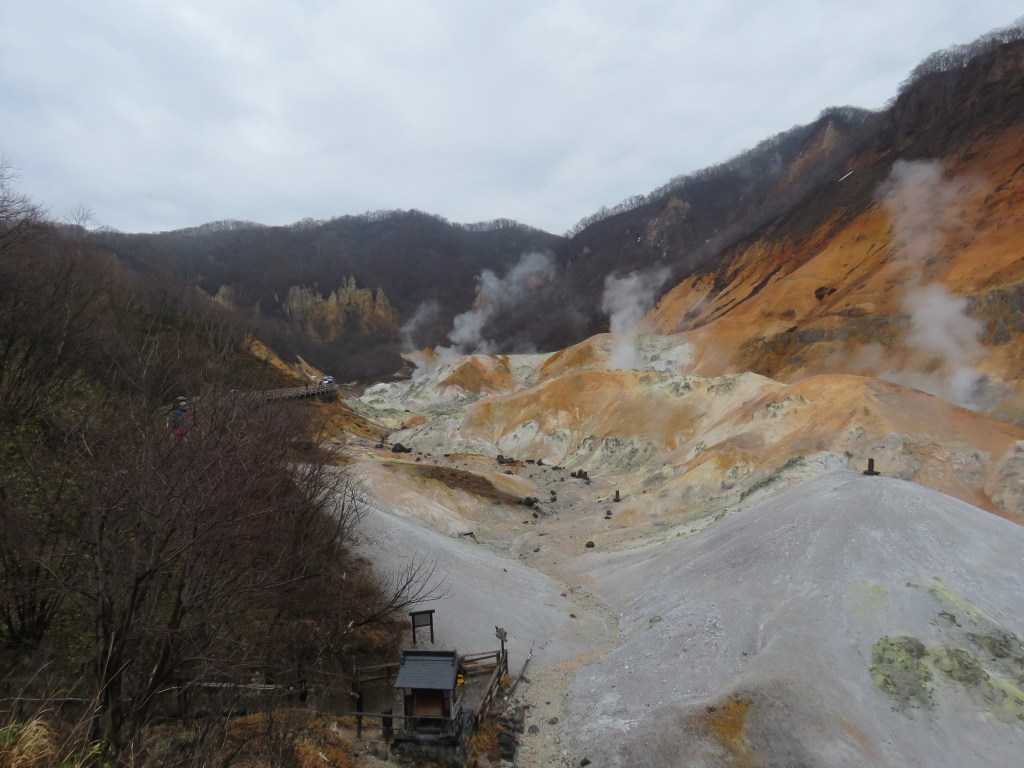
The tourism association describes Jigokudani as a crater valley of Mt. Hiyori, with fumaroles, and as the source of hot water supplied to the town’s inns. A ramp runs from the Park Service Center to the observation deck. Read the Jigokudani page for admission, the parking note, and the advice to come before sunset.
The scale is easy to underestimate from the road. The crater is about 450 metres across and 11 hectares in area, and the namesake steam comes from countless vents and fumaroles along the valley floor. It is free and open around the clock; the observation deck lights stay on until about 23:00, though the association still recommends daylight, when you can see the colour of the water rather than just the steam.
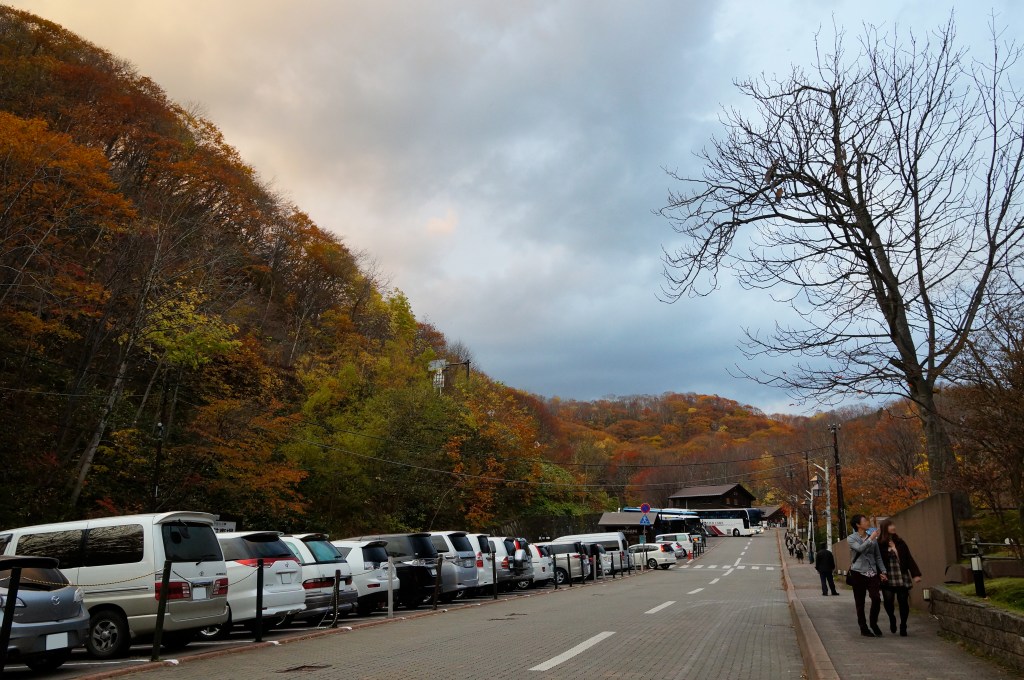
Parking is 500 yen for a car and covers one entry to the Jigokudani lot and one to the Oyunuma lot on the same day, which is the sensible way to do both. Collection runs from about 8:00 to 17:00, and outside those hours the barrier is left open, so an early or late arrival parks free. The lot is three to five minutes from the viewpoint, and half an hour is enough for the deck and the main walkway. If you continue along the trail, look for Tessen-ike, a small intermittent spring that still puffs steam on its own schedule.
Lake Oyunuma
Lake Oyunuma is a crater pond from the same mountain. The association page describes sulfur water, and a parking lot that closes in winter. Read the Lake Oyunuma page for admission and the parking note.
Oyunuma is gourd-shaped, about a kilometre around, and sits in a crater left by the same Mt. Hiyori eruptions. Sulfur springs spout at roughly 130 degrees Celsius on the lake bed, which keeps the surface at 40 to 50 degrees and gives the water its grey-black look. Entry is free, and the loop trail from the lake down to the river is the reason to come rather than just photograph it.
Getting there needs a plan. The access road is narrow, with a two-metre width limit, so buses cannot use it and you either drive or walk. The car park is 500 yen on the same combined ticket as Jigokudani, and it closes from late November to late April when the road is shut for winter.
Oyunuma River natural footbath
The footbath uses hot water overflowing from Lake Oyunuma, beside Taisho Jigoku on the river trail. Read the footbath page before you use it.
It is free, unstaffed, and about 15 minutes on foot from the Oyunuma car park, which is where you leave the car because there is no parking at the bath itself. Bring a small towel and something to sit on. Taisho Jigoku, a small pond of boiling water, is a minute away on the same trail, so the two belong in one stop rather than two.
Onsen baths
Hotels and public baths offer several mineral types. Hours and day-visit rules vary—confirm with each facility.
Daiichi Takimotokan, at Noboribetsu Onsen-cho 55, publishes its own day-bath page. That page is in Japanese. Read it for the charge, the hours, and who may enter on your date. The hotel site is where to book a room. This is one hotel in the town, not a ranking.
The association publishes the day-visit rates for the whole town, and they vary more than most travellers expect. Takimotokan charges 2,500 yen for adults and 1,500 for children, with bathing from 9:00 to 21:00 and reception closing at 18:00. Noboribetsu Grand Hotel is 1,500 yen but only from 12:30 to 16:00. Manseikaku and Sekisuitei sit around 1,200 to 1,300 yen. Yumoto Sagiriyu is the town’s only public bath, run by the hot-spring company rather than a hotel: 500 yen for adults and 180 for children, 9:00 to 21:00, with soap and towels sold at the counter because nothing is provided.
What you are choosing between is water, not decor. The resort draws on several spring types from the same volcanic field, so a sulfur bath, a salt bath and an iron bath can all be a short walk apart, and hotels advertise their own source rather than a shared one. One towel rule applies everywhere: bring one from your room or buy one at the counter.
Noboribetsu Bear Park
The ropeway station sits in the middle of the spa street, and the mountain top is the only reason to ride it: there is no road or footpath to the park. The gondola runs 1,260 metres and climbs about 300 metres in seven minutes, and the round trip is included in the entry price rather than sold separately.
Entry is 3,200 yen for adults and 1,600 yen for children aged 4 to primary school age, with under-threes free. Hours change by season: 9:30 to 16:30 with last entry at 15:50 from 21 October to 20 April, and 9:00 to 17:00 with last entry at 16:20 from 21 April to 20 October. The park closes for ropeway inspection each spring, and has announced a closure from 5 to 23 April 2027. Parking at the base station is 500 yen for a standard car, and a free shuttle runs from the onsen town on weekdays only.
Food and drink
- Ryokan meals and local restaurants around the spa street are the main options.
- The Enma-do on the shopping street is free and takes ten minutes. It houses the mechanical float built for the thirtieth Jigoku Matsuri in 1993 — 5.2 metres seated, six standing — and the face turns red and judges you on the hour several times a day. The festival itself runs on the last weekend of August and is the town’s biggest.
- Half-board is the practical choice here. The town is small, the spa street empties after dinner, and a hotel dinner saves a walk in the dark.
Getting there and around
- JR to Noboribetsu Station plus a local bus into the onsen town is a common route—confirm connections.
- Highway buses from Sapporo may also run—check current schedules.
- The association access page names limited expresses to JR Noboribetsu Station, express buses from Sapporo, and the Noboribetsu Higashi interchange on the Do-O Expressway. The interchange name does not include the word Onsen. Some of those express buses require a reservation. Read the page for the ride that is running.
- Train and bus. The onsen town is about 8 kilometres from JR Noboribetsu Station and 6 kilometres from the Noboribetsu-Higashi interchange, so the last leg is always a bus, a taxi or a car. A limited express takes about 1 hour 10 minutes from Sapporo and about 2 hours 25 minutes from Hakodate.
- Express bus. The Sapporo Onsen-go takes about 1 hour 20 minutes and requires a reservation; the unreserved Hakucho-go and Muroran-go cover the same route. From New Chitose Airport, the airport bus takes about an hour and then needs a transfer at Shiomizaka.
- By car. Sapporo is about 1 hour 40 minutes and the airport about 1 hour. Winter tyres are not optional between November and March.
Where to stay
Takimoto Kanzō’s lodging is now Daiichi Takimotokan, and it has grown into something closer to a town than a hotel: 385 rooms, a capacity of 1,200 guests, and a bathing hall of about 1,500 tsubo holding thirty-five baths across five spring types — salt, mirabilite, sulphur, acidic green vitriol and bicarbonate. It took its present name in 1903, when the original house was renamed and a second one was opened. The scale is the point: nowhere else in the resort lets you move between five chemically different waters without leaving the building, and at 45 to 90 degrees at the source, that is a real itinerary rather than a marketing line.
Beyond it the accommodation is a line of large hotels and a handful of smaller traditional inns along the gorge road, all within a short walk of the Jigokudani boardwalk and the forest footpaths. Book half board: the valley has restaurants, but the evening is when the steam is thickest and the walking is quietest, and an inn dinner is the reason not to be on a bus at six.
- Overnight stays make the most of evening baths and quieter valley walks.
- If a particular spring type is the reason for the trip, ask which baths at your hotel draw from which source. The five waters here do not feel alike.
Best time to visit
- Open year-round; winter steam against snow is atmospheric but cold.
Practical tips
- Follow posted path closures around volcanic areas.
- Carry cash for the car parks. The 500 yen charge covers both Jigokudani and Oyunuma on the same day, and is only collected during daylight hours.
- Oyunuma is closed to traffic from late November to late April. In winter, Jigokudani and the town baths are the whole trip.
- Bring a small towel if using day-visit baths.
- Travelers crossing Hokkaido can pair this with the Otaru travel guide or the Shiretoko travel guide.
- Use Sapporo as the city base: the Sapporo travel guide. Lake Toya is a separate stop in the same part of Hokkaido: the Lake Toya travel guide.
- Shiretoko, linked above, is another Hokkaido trip, not a same-day addition to Noboribetsu.
Suggested day-trip outline
- Arrive by train/bus from Sapporo area.
- Walk Hell Valley; enjoy an onsen soak.
- Overnight or return by evening transport.
Before you go
Timetables, fares, admission fees, and seasonal access rules can change. Check the official tourism and transport sites linked below for the latest information before you travel.
This guide is part of Japan’s Onsen Towns, which compares the hot-spring villages by scale and access.
Sources
- Noboribetsu Tourism (checked 2026-10-21)
- Sapporo Official Tourism (checked 2026-10-21)
- Japan National Tourism Organization (JNTO) (checked 2026-10-21)
- Noboribetsu Jigokudani (checked 2026-10-22)
- Lake Oyunuma (checked 2026-10-22)
- Oyunuma River natural footbath (checked 2026-10-22)
- Noboribetsu access (checked 2026-10-22)
- Daiichi Takimotokan (checked 2026-10-22)
- Daiichi Takimotokan day bath (checked 2026-10-22)
- Noboribetsu Tourism: one-day bathing list and rates (checked 2026-10-25)
- Noboribetsu Bear Park: hours and admission (checked 2026-10-25)
- Park Service Center: parking and Jigokudani access (checked 2026-10-25)
- Noboribetsu City: Ainu place names, nupur-pet (checked 2026-10-25)
- Noboribetsu Tourism: Enma-do (checked 2026-10-25)


Leave a Reply