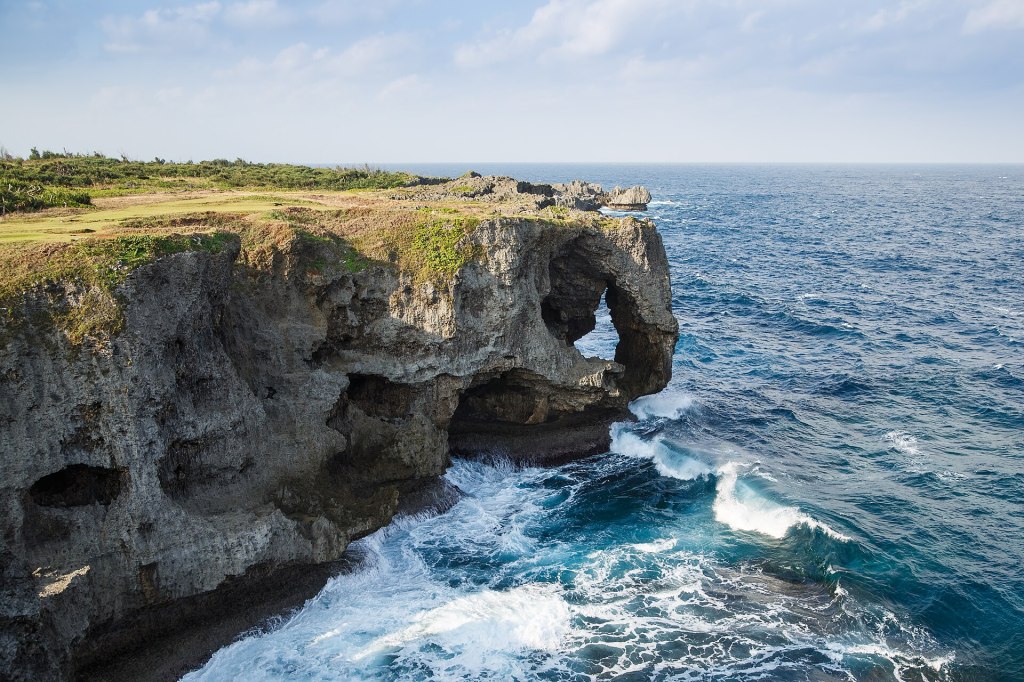
Cape Manzamo is a low, green headland on the west coast of Okinawa, and for about 1.4 million people a year it is the image of the island: a shelf of turf on top of a twenty-metre limestone cliff, a rock at the northern end that looks like an elephant’s trunk, and a sea that shifts from pale turquoise to deep blue as the light changes. It is easy to reach, cheap to enter, and almost impossible to photograph badly. It is also much more interesting than the postcard suggests.
The cape has a name given by a king, a poem written by a woman who watched him arrive, a plant community that survives on salt wind and thin soil, and a geology that records the slow uplift of an island. In 2026 it marks 300 years since that royal visit, and Onna Village has been running exhibitions and events around the anniversary. This guide covers the history, the nature, the practical details, and the places around the cape that are worth adding to the same day.
It is written for travellers who want more than a five-minute photo stop. You can see the cape in half an hour. You can also spend a full day here, walking the path, eating Okinawa soba, swimming at Manza Beach, and driving south to the Blue Grotto or north to the marine park at Busena. The choice depends on how much time you have and whether you are chasing the sunset.
Cape Manzamo at a glance
- Where: Onna Village, Kunigami District, on the west coast of Okinawa’s main island, roughly halfway between Naha and Nago.
- What it is: a Ryukyu limestone headland about 20 metres high, with a flat lawn on top and a cliff below.
- Admission: ¥100 per person for the clifftop viewing area. Preschool children are free. Visitors with a disability certificate and one accompanying carer are also admitted free.
- Hours: the viewing path is open from 8:00 until sunset. The surrounding facility is open 8:00–20:00 from March to October and 8:00–19:00 from November to February.
- Parking: free. The first car park has 97 spaces, the second has 218, for 315 cars in total, plus spaces for buses and motorcycles.
- Time needed: 30–40 minutes for the path and viewpoints; 1.5–2 hours if you eat at the food court; half a day with Manza Beach or Cape Maeda.
- Best time: 8:00–9:30 for quiet light and empty paths, or 30–60 minutes before sunset for the main event.
- Bus: routes 20 and 120 stop at Onna Village Office, about 1 km or 15 minutes on foot from the cape.
- Car: about 1 hour 15 minutes from Naha Airport on Route 58, or about 50–60 minutes using the expressway and leaving at Yaka Interchange.
- Do not miss: the elephant rock, the view north to Manza Beach, the 3rd-floor observation deck, and a bowl of soki soba at the food court.
- Accessibility: the main path is barrier-free and takes about 10 minutes to walk. Wheelchairs and strollers can be borrowed free at the information desk.
Last updated: 26 October 2026. Hours, fares and exhibition dates change; reconfirm before you travel.
Where Cape Manzamo is, and why the coast looks like this
Cape Manzamo sits in the middle of Onna Village, on the west coast of Okinawa’s main island. The village stretches along the coast from the hills above Nakadomari in the south to the border with Nago in the north. Route 58, the island’s main coastal road, runs through it. The cape is a short detour off that road, up a narrow lane signposted in Japanese and English, and then suddenly you are on top of the cliff with the East China Sea in front of you.
The setting is part of the Okinawa Coast Quasi-National Park. Behind the cape, the land rises towards Mount Onna, the ridge that runs down the centre of the village. In front, there is nothing but water until the horizon. On a clear day you can see the coast curving north towards Manza Beach and the Motobu Peninsula, with the resort hotels appearing as small white blocks among the green. To the south, the coastline runs back towards Tancha Bay and the larger resort strip around Rizzan.
Onna is one of Okinawa’s most visited municipalities, and the cape is its single busiest sight. The village’s own figures put annual visitors at about 1.4 million. That sounds overwhelming, and at sunset in August it can feel that way. But the site absorbs crowds better than its size suggests: the path is a loop, the parking is spread across two car parks, and the 2020 facility gives people somewhere to sit, eat and wait. Arrive early or late and you will have the place largely to yourself.
The village is known for its sugarcane, its limestone, its resorts, and its population of about 10,000 people spread across a long, narrow strip of coast and mountain. It is not a town in the usual sense. It is a string of settlements, beaches and hotel compounds, with the cape as its shared front garden.
A king, a poem, and 300 years of a name
The story of the name is usually told in one sentence: in 1726, the Ryukyuan king Sho Kei visited Onna during a tour of the northern part of his kingdom, was impressed by the view, and called the place “a field fit for ten thousand people to sit”. The word mou (毛) in the old name means a field or grassy plain, not hair. Manza is usually understood as “ten thousand seats” or “ten thousand people sitting”. The cape has been Manzamo ever since.
Sho Kei was the thirteenth king of the Ryukyu Kingdom, and his reign is remembered for a revival of royal ritual and learning. The northern tour was a political act as much as a sightseeing trip: the king travelled to confirm the loyalty of local officials, inspect the roads and ports, and be seen by the people. When he reached Onna, the villagers are said to have welcomed him with a dance and a feast, and the king responded to the landscape rather than the performance. The story has the quality of a founding myth, but it is recorded in local histories and repeated by the village itself, and it gives the cape a rare thing for a Japanese scenic spot: a specific date and a named author.
There is a second voice in the story. Onna Nabii, a female poet from the village, is said to have composed a poem at the same event. It is short and strange and beautiful:
Nami no koe mo tomare / kaze no koe mo tomare / Shuri tenshi mi-mikke ogama.
The usual translation is something like: “Let the sound of the waves stop; let the sound of the wind stop; I bow before the august presence of the King of Shuri.” The poem turns the landscape into an audience. The sea and the wind are asked to fall silent so that the king can be properly honoured. It is a very Okinawan image: nature is not a backdrop but a participant, and the king’s authority is acknowledged by the elements as much as by the people.
In 2026 the village marked the 300th anniversary of the naming with a panel exhibition, Manzamo: A View Praised by a King. The exhibition opened at the Onna Village Museum from 21 September to 25 October 2026, then moved to the village office from 28 October to 19 November, and to the Cape Manzamo facility from 21 November to 21 December 2026. It includes old aerial photographs, including one from around 1970, and material on the cape’s history and plant life. If you are visiting in late 2026, the facility display is a good reason to spend a few extra minutes inside.
What the anniversary makes clear is that Manzamo is not only a view. It is a named place with a documented history, a poet, a king, and a community that has been using the same grassy headland for centuries. That context makes the cliff feel less like a photo opportunity and more like a piece of public memory.
The geology: coral, uplift and an elephant’s trunk
The cliff is made of Ryukyu limestone, a rock that began as coral and shell in shallow tropical seas. Over hundreds of thousands of years, reefs grew, died, were buried, and were compressed into limestone. Then the land rose. Okinawa sits near the edge of the Eurasian Plate, where the Philippine Sea Plate is subducting, and the whole island has been lifted in steps. The flat top of Manzamo is one of those steps: an old marine terrace, now about 20 metres above the sea.
Limestone is a soft rock in the way that matters here. Rainwater, slightly acidic, dissolves it along cracks. The sea attacks the base of the cliff. The combination produces the shapes that make the cape famous: overhangs, notches, small caves and, at the northern end, the rock that everyone calls the elephant’s trunk. The “trunk” is a narrow ridge of limestone left standing while the softer rock around it was eroded away. It is not a sculpture, and it is not stable in the way a building is stable. The cliff is retreating slowly, year by year, and the fences are there for a reason.
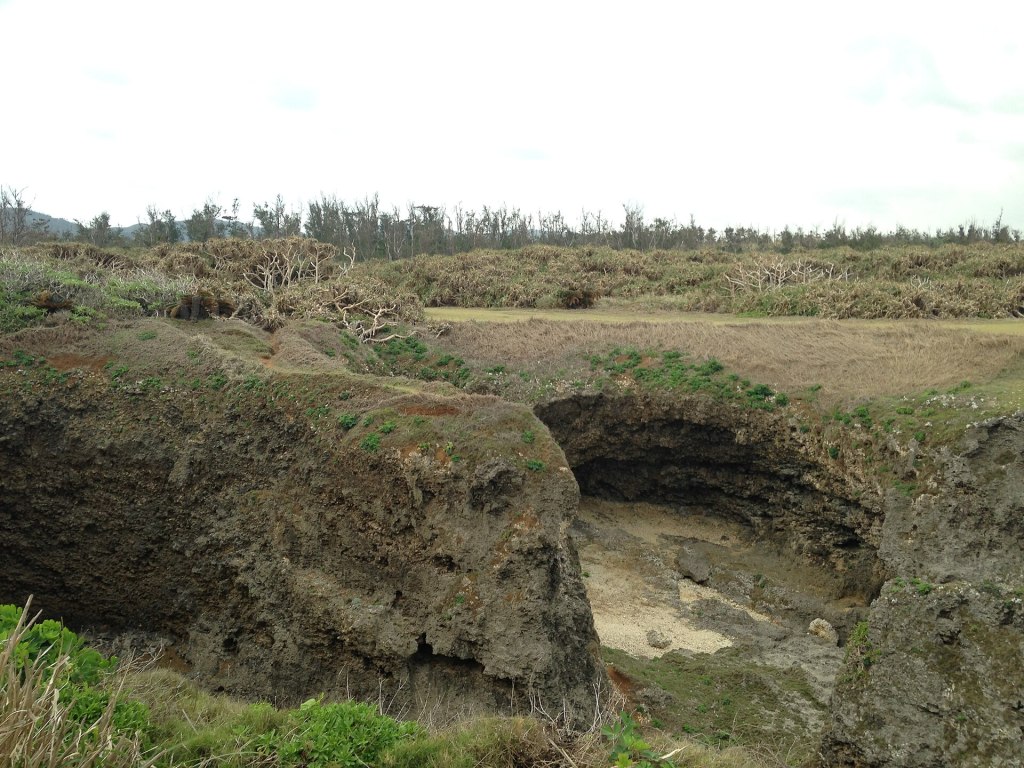
The same limestone underlies much of Onna. It is why the coast has so many small caves and springs, why the soil is thin and alkaline, and why the vegetation on the cape is different from the red-soil farmland inland. The rock drains quickly, so the surface is dry even after rain. Plants that live here have to cope with salt, wind, drought and a thin mat of soil that is more like dust and roots than earth.
The view from the top is a geology lesson in itself. To the north, the coast bends towards Manza Beach, where a sandy bay has formed between limestone headlands. To the south, the cliffs continue in a series of small points and coves. Inland, the green ridge of Mount Onna rises above the village. The sea is shallow close to shore, which is why the colour is so bright, and deepens quickly beyond the reef. On a windy day the surface is textured with white caps; on a calm morning it is almost glassy, and you can see the dark shapes of coral and rock below.
The plant community on the cliff top
In 1972, the same year that Okinawa was returned to Japan, the cape was designated both a prefectural scenic spot and a prefectural natural monument. The second designation protects the Manzamo limestone plant community, a narrow band of vegetation that has adapted to one of the harshest environments on the island. The top of the cape is not a manicured park. It is a wind-blasted grassland, and the plants that survive there are specialists.
The lawn is dominated by korai shiba, a low, salt-tolerant turf grass that spreads by runners and holds the thin soil together. Around the edges, where the limestone breaks through, you find plants that are rare in Japan and largely restricted to the Ryukyu Islands. The Okinawa violet is one of them: a small violet with pale flowers that survives in the cracks between rocks. Hanakomikanboku, a shrub with inconspicuous flowers, is another. Both are part of the reason for the natural monument designation, and both are easy to miss if you are only looking at the sea.
The cape also has a problem that many scenic sites share. Adan, a screw pine that grows along the coast, had been spreading across the open lawn and shading out the grass. In 2024 the village carried out a restoration project: adan was cut back to the boundary recorded at the time of designation, the bare ground was replanted with korai shiba taken from within the protected area, and the results are being monitored. The aim is to restore the open “field” that the king admired, not to turn the cape into a garden. When you walk the path, you are walking through a conservation area as well as a viewpoint.
Practically, this means a few things. Stay on the path. Do not pick flowers or take cuttings. Do not walk on the grass beyond the marked route, even if it looks empty. The turf is tougher than it looks, but the plant community is small and fragile, and the village is actively trying to keep it intact. The best way to see the plants is to slow down at the edges of the path and look down, not just out to sea.
Walking the cape: the path, the viewpoints and the elephant rock
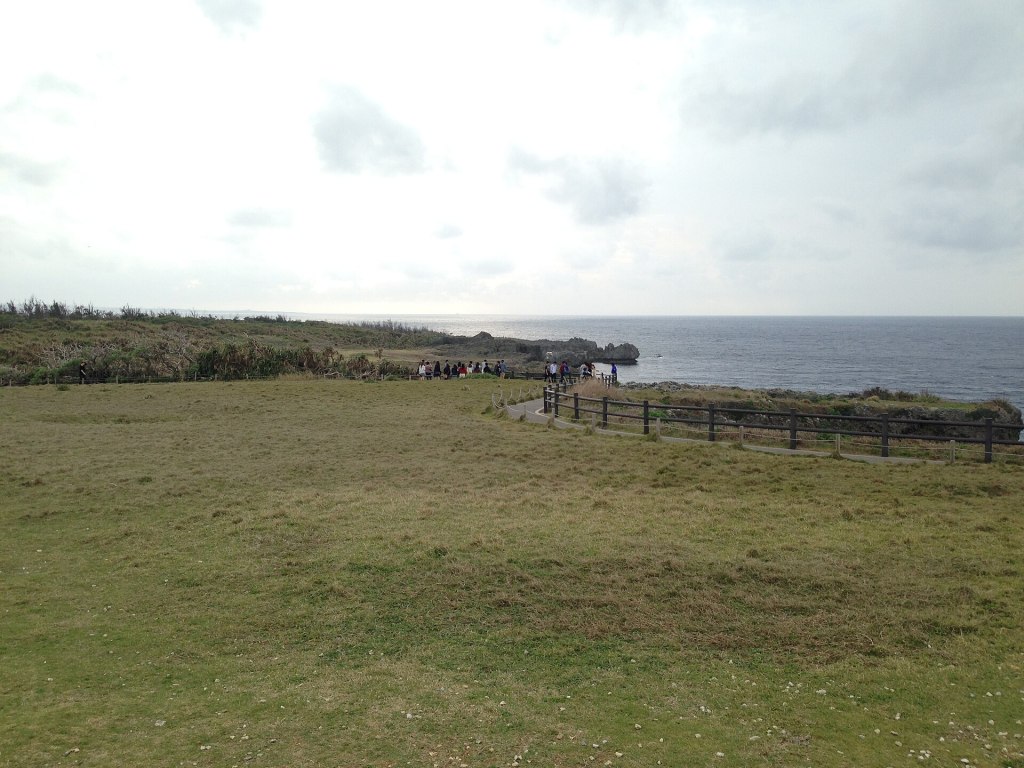
The entrance is at the back of the Cape Manzamo facility. You buy a ticket from the machine, pass through the gate, and follow a paved loop around the top of the headland. The official estimate for the walk is about 10 minutes, which is accurate if you keep moving. Most people take 20–30 minutes, and that is the right pace. There are three main places to stop.
The first is the elephant rock, at the northern end of the loop. The path brings you to a fenced viewpoint, and the rock appears below and to the left, a curved spine of limestone with a narrow “trunk” reaching into the sea. It is best in the morning, when the sun is behind you and the rock is lit from the east, or in the late afternoon, when the shadow deepens the shape. The viewpoint is also the busiest part of the cape. If you want a photograph without a crowd, go early.
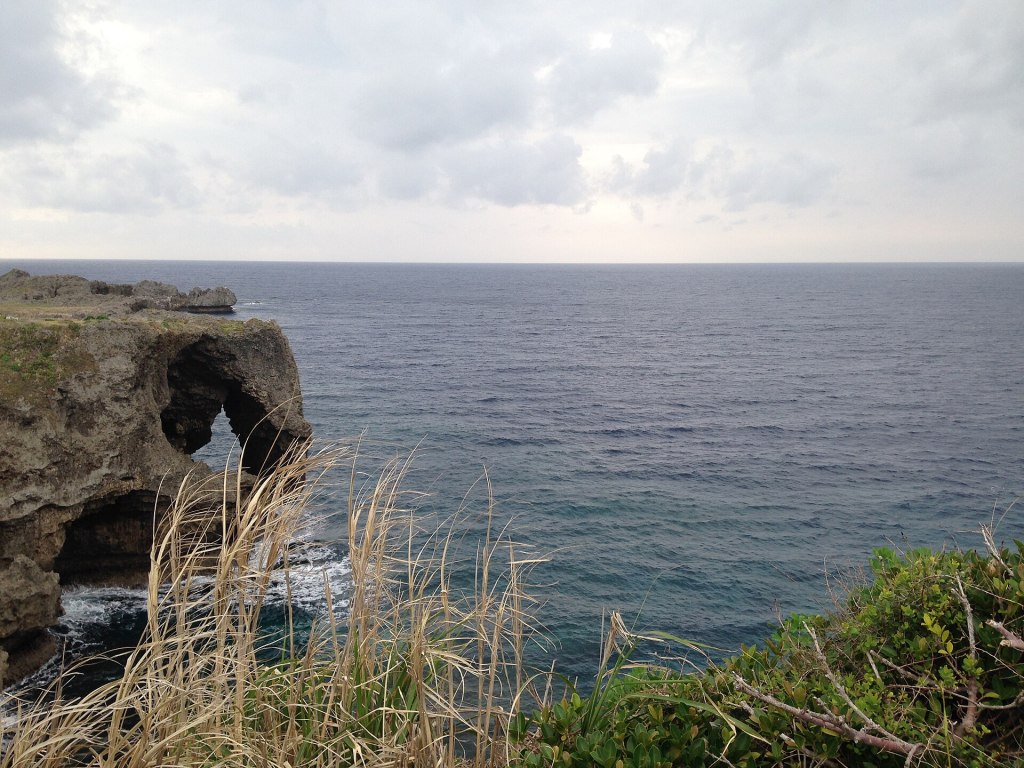
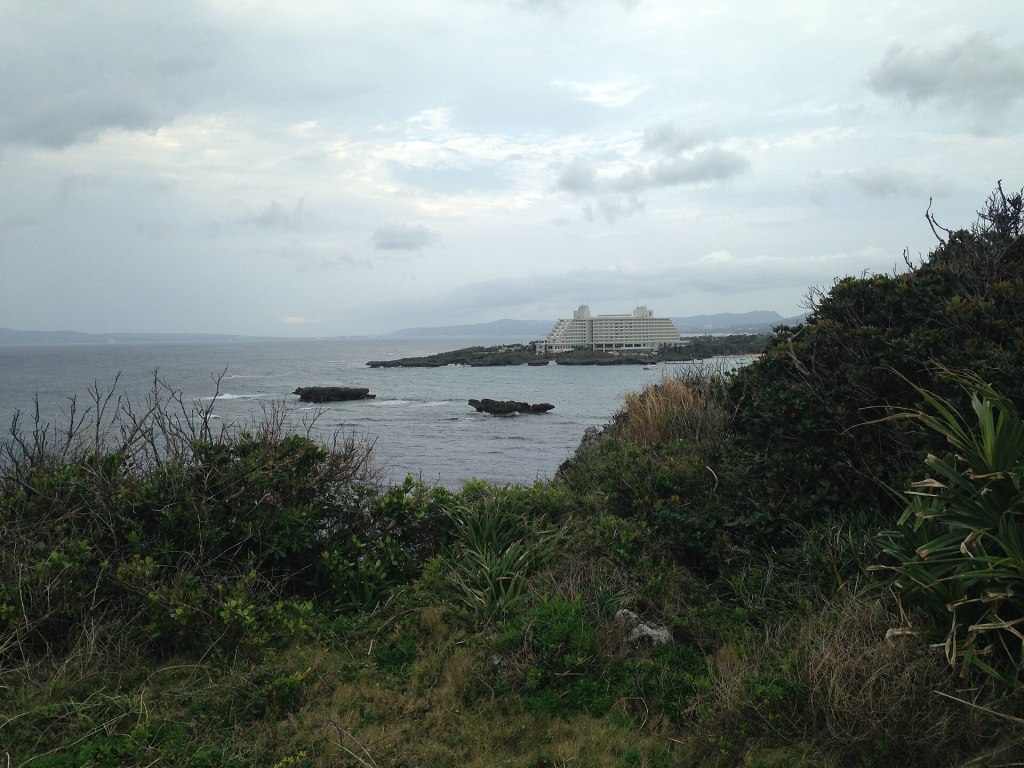
The second is the northern view towards Manza Beach and the Motobu Peninsula. From the fence you can see the bay, the white buildings of the ANA InterContinental Manza Beach Resort, and the green hills beyond. This is the view that appears on most postcards, and it is the one that explains why the cape was chosen for a resort in the first place. The beach is a short drive or a 15-minute walk down the hill, but the view from above is better than the view from the sand.
The third is the southern view along the Onna coast. The cliff continues in a series of small headlands, with the village strung out along Route 58 and the hills rising behind. On a clear day you can see the coastline towards Tancha and the resorts around Rizzan. This side is quieter, and it is a good place to sit on the grass and watch the light change.
Back at the facility, take the lift or stairs to the 3rd-floor observation deck. It is free, open to anyone, and usually empty. From there you look down on the path, the lawn and the elephant rock, with the sea beyond. It is a different angle from the clifftop, and it is especially good for photography when the sun is low. The 2nd-floor wooden deck is another option, with tables and shade, and it connects directly to the food court.
The path is barrier-free, with gentle slopes and no steps on the main loop. Wheelchairs and strollers can be borrowed free at the information desk, though supplies are limited. The surface is paved, but the natural ground beside it is uneven, and the wind can be strong. If you use a wheelchair, the main loop is manageable; the outer grass areas are not.
The 2020 facility: food, shops and a place to wait out the weather
For most of its modern history, Manzamo was a car park, a toilet block and a fence. That changed on 2 October 2020, when Onna Village opened the Cape Manzamo Surrounding Activation Facility at the back of the site. The name is bureaucratic; the building is not. It is a low, open structure with a wide entrance, a high ceiling, and a layout that deliberately funnels visitors towards the cape while giving them reasons to stay.
The ground floor has an information desk, coin lockers, a nursing room, a multipurpose toilet, and two shops. The larger one, SHOP MANZAMO, sells the usual Okinawan souvenirs — red sweet potato tarts, chinsuko biscuits, Orion beer goods — along with awamori from Onna distilleries and Manzamo-specific designs. The smaller shop, Zō no Hana, focuses on local products and cape-themed goods. Both are open longer than the viewing path, which makes them useful if you arrive after sunset.
The second floor is the food court. There are more than 100 seats inside and about 60 on the wooden terrace, and the windows face the sea. The vendors are local names rather than national chains: Ryukyu cuisine Matsunoshita, Ganso Umibudo, Mitsuya Hompo, Miki Bowl, Onna Kyodo Baiten and Parlor Yui. You order at the counter, take a tray, and find a seat. At lunchtime in high season it is busy but not chaotic. In the late afternoon it is one of the most pleasant places on the coast to wait for the sun to go down.
The third floor is the free observation deck. It is the least-known part of the building. Most visitors never go up, which is a shame, because the view over the cape and the sea is excellent and the deck is usually quiet. There is also a rental space on the same floor, used for meetings and events, but the deck itself is open to the public.
The facility is open every day, except when a typhoon or other natural disaster forces it to close. It is fully air-conditioned, which matters in summer, and heated enough in winter. It has elevators, ramps, accessible toilets, and free wheelchair and stroller loans. For a site that is essentially a cliff, it is remarkably easy to use.
What to eat: Okinawa soba, sea grapes and sata andagi
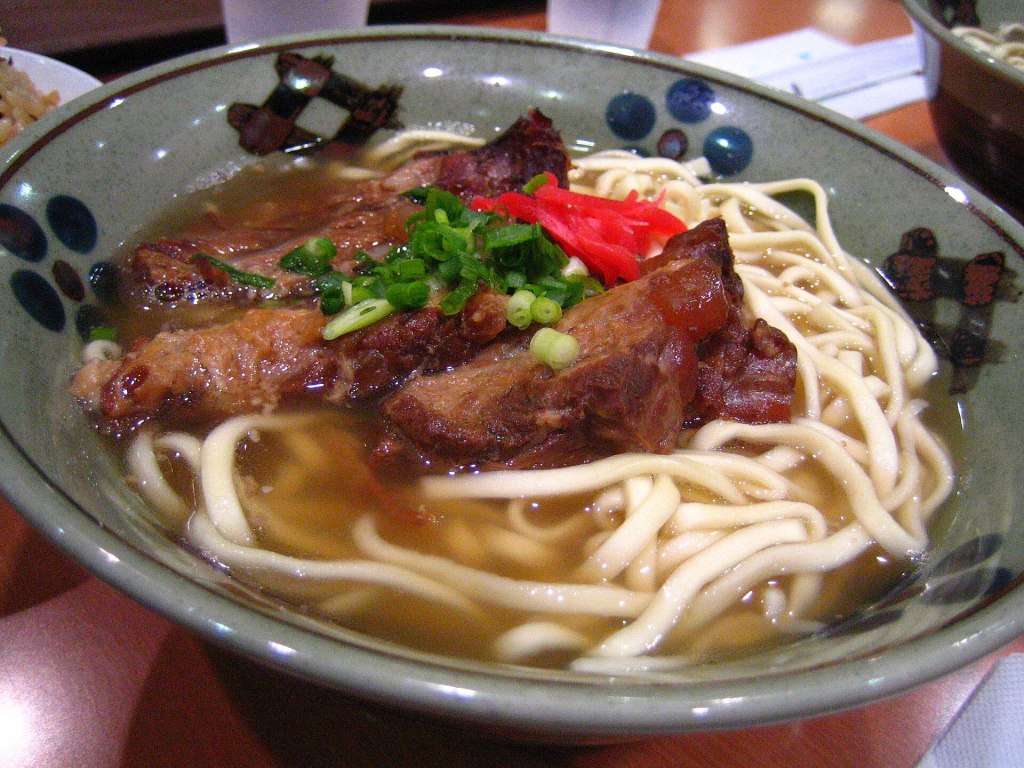
The food court is not a fine-dining destination, but it is a good introduction to Okinawan everyday food. The star is Okinawa soba: wheat noodles in a pork-and-bonito broth, topped with soki (braised pork ribs), sanmainiku (three-layer pork belly) or both. It is not related to Japanese buckwheat soba, despite the name. The noodles are soft and slightly chewy, the broth is mild and savoury, and the pork is sweet and rich. At Matsunoshita, the signature bowl comes with three kinds of pork, and the mozuku seaweed noodles are a lighter alternative.
Sea grapes, or umibudo, are the other local specialty. They look like tiny bunches of green grapes and pop in the mouth with a salty burst. Ganso Umibudo serves them over rice, in a bowl that is as much about texture as flavour. If you have never tried them, this is the place. They are farmed in Onna, and the village is one of the main producers in Okinawa.
For something sweet, Mitsuya Hompo sells sata andagi, the Okinawan deep-fried doughnut. The classic version is plain and slightly chewy; the shop’s “Mitsuya Ball” uses tapioca flour for a crisper shell and a softer centre. Miki Bowl turns miki, a traditional fermented rice drink, into a frozen yogurt-style bowl with fruit. Parlor Yui does Okinawan-style shaved ice with beans and condensed milk. The Onna Kyodo Baiten is a cooperative shop selling local snacks and produce, a good place to pick up something for the drive.
Opening hours vary by vendor, and they are shorter than the facility’s hours. As of October 2026, Matsunoshita is open from 10:00 to 17:00, Ganso Umibudo from 11:00 to 18:30, Mitsuya Hompo from 10:00 to 17:45, Miki Bowl from 9:00 to 18:00, Onna Kyodo Baiten from 10:00 to 18:00, and Parlor Yui from 9:30 to 17:45. In practice, the kitchens start closing before the building does. If you want to eat after sunset in summer, eat before you go out to the cliff, not after.
Outside the facility, Onna has a wide range of restaurants along Route 58 and in the resort hotels. The food court is the convenient option, not the only one. If you are staying in the area, ask your hotel for its current recommendations; the restaurant scene changes with the seasons and with the resort trade.
Manza Beach and the resort coast below the cape
The bay below the cape is Manza Beach, one of the most sheltered and photogenic beaches on the west coast. It is managed by the ANA InterContinental Manza Beach Resort, which means it is not a free public beach in the usual sense. Day visitors pay a facility fee of ¥500 per adult, which includes access to the beach, the beachside pool, showers, toilets and changing rooms. From 15 March to 12 October, parking is ¥3,000 for a car and includes the facility fee; outside that period, parking is free and the facility fee is paid separately.
The beach is a curve of white sand inside a reef, with relatively calm water and a lifeguard presence. Swimming hours vary by season: roughly 9:00–17:00 in spring and autumn, 9:00–18:00 in early summer and September, and 8:00–19:00 in July and August. The resort lists swimming as available year-round, though winter water is cool and most visitors use a wetsuit or stay on the sand. The beach also has a pool, a beachside cafe, snorkelling trips, a semi-submersible boat called Submarine Jr. II, and the Manza Ocean Park, a large inflatable obstacle course on the water.
From the cape, Manza Beach is about 800 metres away, roughly 15 minutes on foot down the hill. The walk is on a road with traffic, and the last part is inside the resort grounds. If you are driving, it is a three-minute trip. If you are relying on buses, the “Manza Beach-mae” stop is served by routes 20 and 120, and the beach is a five-minute walk from there. The airport limousine bus also stops at the resort, which makes the beach a possible base even without a car.
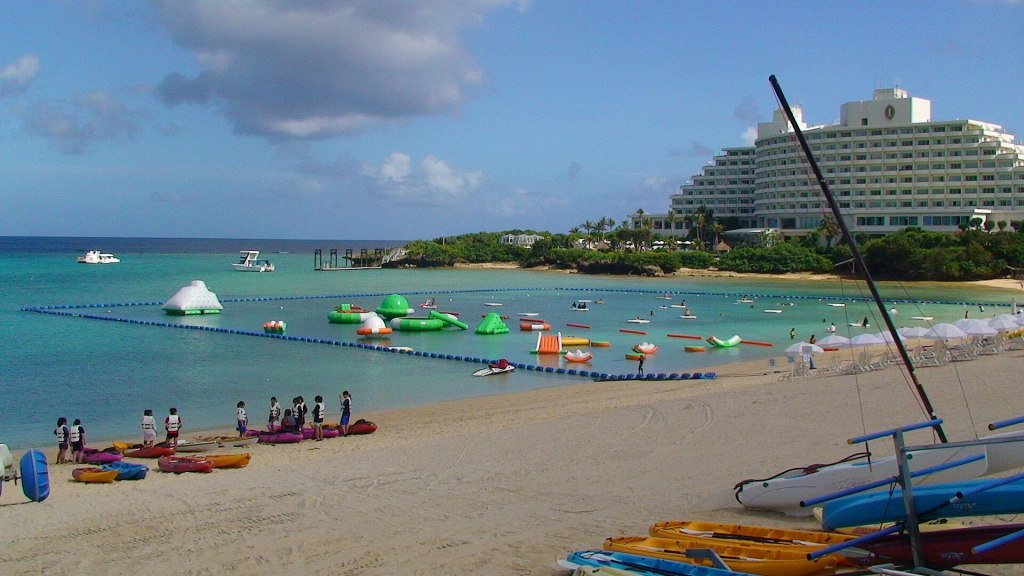
The resort itself, the ANA InterContinental Manza Beach Resort, opened in 1983 and sits on the Seragaki side of the bay. It is the only hotel within walking distance of the cape, and its beach is the one you see in the classic view. You do not need to stay there to use the beach, but you do need to pay the day fee and follow the resort’s rules. The hotel also has a garden pool, a spa, and several restaurants; none of them are necessary for a cape visit, but they are useful if you want a comfortable base.
Beyond the cape: the Blue Grotto, Ryukyu Mura and the northern coast
Cape Manzamo is well placed for a day of exploring the Onna coast. The following places are all within about 50 minutes by car, and most can be reached by bus with a little planning.
Cape Maeda and the Blue Grotto
Cape Maeda is about 25 minutes south of Manzamo, on the same limestone coast. It is famous for the Blue Grotto, a sea cave where sunlight enters through an underwater opening and turns the water an intense, luminous blue. The cape itself is a designated natural park, with a headland, a viewpoint, and a set of stairs down to the water. There is no admission fee, but parking costs ¥100 for the first hour and ¥100 for each additional hour. The car park has 180 spaces and fills early in summer.
Swimming and snorkelling are allowed only when conditions permit. The staff raise flags at the entrance: one colour means swimming is allowed, another means only with a diving instructor, and a third means no swimming. Life jackets or flotation belts are mandatory for snorkellers. The stairs can be closed in bad weather. Showers cost ¥200 for two minutes, lockers ¥100, and there are changing rooms and toilets. If you want to see the cave, go early in the morning, when the light is best and the tour groups have not arrived. If you are not confident in the water, join a guided tour rather than trying it alone.
Ryukyu Mura
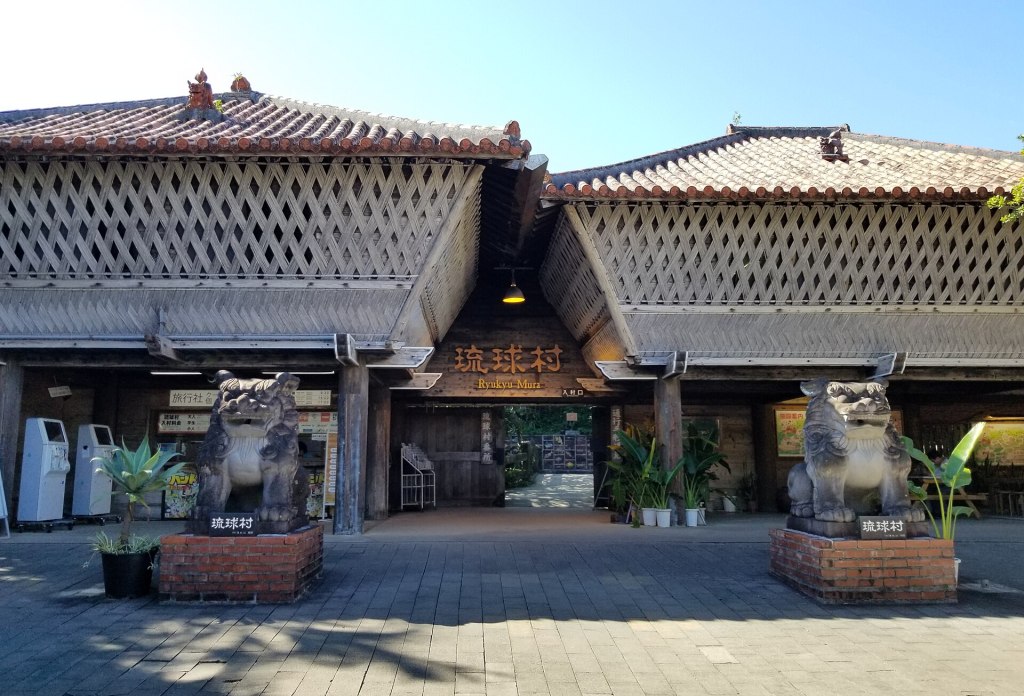
Ryukyu Mura is an open-air folk museum about 25 minutes south-east of the cape, in the hills above Onna. It is a reconstruction of a Ryukyuan village, with old houses moved from across Okinawa, craft workshops, and a daily eisa drumming show. It is a good rainy-day option and a good place to learn about the culture that produced the Manzamo story.
The museum is open from 9:30 to 17:00, with last entry at 16:00. Admission is ¥2,000 for adults, ¥1,500 for high school students with ID, and ¥800 for children aged 6–15; children under 6 are free. The eisa show runs four times a day, at 10:00, 12:00, 14:00 and 16:00, and is included in the admission price. Craft experiences such as shisa painting are available in the free zone and do not require admission, though they cost extra. The museum is served by routes 20 and 120 from the “Ryukyu Mura-mae” bus stop.
Busena Marine Park
Busena Marine Park is about 35–40 minutes north of the cape, in Nago. It has a glass-bottom boat and an underwater observation tower, both aimed at families and non-divers. The glass-bottom boat costs ¥1,560 for adults and ¥780 for children aged 4 to junior high school; the combined ticket with the tower is ¥2,100 and ¥1,050. The tower is open 9:00–18:00 from April to October (last entry 17:30) and 9:00–17:30 from November to March (last entry 17:00). The boat runs on a schedule through the day, with the last departure around 17:30 in summer and 17:00 in winter. The park closes on some maintenance days, so check the calendar before you go.
Further north and south
If you have a car, the cape is an easy stop on the way to the Okinawa Churaumi Aquarium in Motobu, about 50 minutes north. The aquarium is one of the island’s biggest attractions, and the drive along the coast from Onna is part of the experience. Bios no Oka, a subtropical garden and park about 20 minutes away, is another family-friendly option. To the south, the resorts around Tancha and the beaches of the central west coast are within 20–30 minutes. Naha is about 1 hour 15 minutes away on Route 58, or 50–60 minutes on the expressway.
Whale watching in winter
From late December to early April, humpback whales migrate to the warm waters around Okinawa to breed and give birth. Several operators run whale-watching trips from Naha, Chatan and Motobu, and in recent seasons there have also been trips from Maeda Fishing Port in Onna, usually from February to mid-March. The season varies by operator and by year. If you are visiting in winter and want to go, book ahead, choose an operator with a clear policy on cancellations and sea conditions, and do not expect a guaranteed sighting. The boats are small, the sea can be rough, and the whales are wild.
Getting there: car, bus, taxi and tours
By car
Driving is the easiest option. From Naha Airport, take Route 58 north through Naha, Urasoe, Ginowan, Chatan, Kadena, Yomitan and into Onna. The drive is about 50 kilometres and takes roughly 1 hour 15 minutes in normal traffic. The expressway is faster: join it near Naha, leave at Yaka Interchange, and follow Route 58 north for about 10 minutes to the cape. The toll is a few hundred yen; check the current rate when you rent the car.
The cape is signposted from Route 58. Turn off at the Manzamo sign, follow the narrow lane uphill for about a minute, and you arrive at the first car park. The first car park is next to the facility and has 97 spaces. The second is about a five-minute walk away and has 218 spaces. Both are free. At sunset in high season, the first car park fills quickly; staff will direct you to the second. Do not park on the lane or in the residential streets. The road is narrow, and local traffic needs it.
By bus
Routes 20 (Nago West Line) and 120 (Nago West Airport Line) run along Route 58 and stop at Onna Village Office, the closest stop to the cape. From Naha Bus Terminal, the fare is ¥1,570 on route 20 and ¥1,670 on route 120 as of the October 2026 timetable. The trip takes about 1 hour 40 minutes to 1 hour 50 minutes, depending on traffic and the number of stops. From Naha Airport, route 120 is direct and takes about 1 hour 50 minutes; the fare is higher because the route starts at the airport.
From Onna Village Office, walk north along Route 58 for a short distance, turn left at the Manzamo sign, and follow the lane uphill. The walk is about 1 km and takes roughly 15 minutes. It is partly on a sidewalk and partly on a narrow road, so keep to the side and watch for cars. The return is downhill, which is easier, but the lane has no street lighting for part of its length. If you are returning after sunset, bring a torch or use the flashlight on your phone.
The bus is infrequent by Japanese city standards: roughly two an hour during the day, with fewer in the evening. The last useful departure back to Naha is earlier than you might expect. Check the timetable before you commit to a sunset visit, and have a backup plan (taxi or a hotel nearby) if you miss the last bus. Taxis are scarce in Onna, especially after dark, and a taxi back to Naha is expensive. If you are staying in Onna, ask your hotel to book one in advance.
The airport limousine bus is another option. It stops at the ANA InterContinental Manza Beach Resort, about 800 metres from the cape, and takes about 100 minutes from the airport. The fare is around ¥1,800, but it varies by operator and season. From the resort, the cape is a 15-minute walk uphill. This is a good choice if you are staying at the resort or want a direct, comfortable ride without changing buses.
By taxi or tour
A taxi from Naha Airport takes about 70–90 minutes and costs a lot more than the bus. It is worth it if you are a group of three or four, or if you are combining the cape with other stops and want to avoid parking. Many visitors also join a half-day or full-day sightseeing tour that includes Manzamo, Ryukyu Mura and the Churaumi Aquarium. Tours are convenient but rushed; you usually get 30–40 minutes at the cape, which is enough for the path but not for a sunset.
When to go: seasons, light and crowds
Okinawa has a subtropical climate. Spring (March–May) is warm and often clear, with temperatures in the low to mid 20s. The rainy season usually runs from mid-May to late June, bringing heavy showers and high humidity. Summer (July–September) is hot, sunny and humid, with daytime temperatures around 31–33°C and a real risk of typhoons. Autumn (October–November) is one of the best times to visit: the heat eases, the sea is still warm, and the light is clear. Winter (December–February) is mild by mainland standards, around 17–20°C during the day, but the wind can make it feel colder, and the cape is fully exposed.
The cape is at its best in the hour before sunset. It faces west and slightly north, so the sun goes down over the sea, and the limestone turns gold, then pink, then grey. In summer, sunset is around 19:00–19:25; in winter, around 17:45–18:15. The exact time changes through the year, so check a sunset calculator for your date. Arrive 30–60 minutes early. The path closes at sunset, not after it, so you need to be inside the gate before the light goes.
Morning is the other good time. The facility opens at 8:00, and the first hour is usually quiet. The light comes from the east, behind the cape, so the cliff face is in shadow and the sea is a flat, bright blue. It is better for photographs of the lawn and the plants than for the elephant rock, which is backlit. If you want the rock lit, come in the afternoon. If you want solitude, come at 8:00.
Crowds follow the tour buses. The busiest periods are 10:00–15:00, when day tours stop on their way north or south, and the hour before sunset in summer. Golden Week (late April to early May), Obon (mid-August) and the New Year holidays are the busiest of all. If you visit during those periods, use the second car park, expect a queue at the ticket machine, and give yourself more time. The cape is not a place to rush.
Weather can close the site. Typhoons are the main risk from July to September, and occasionally in October. The facility closes when a typhoon is approaching, and the path may be closed after heavy rain. Check the official Manzamo website or the Onna Village tourism site before you go. Even on a normal day, the wind can be strong enough to make a hat useless and an umbrella dangerous. Bring a light rain jacket rather than an umbrella, and wear shoes with grip; the limestone can be slippery when wet.
How long to stay, and three ways to plan the day
The minimum visit is 30–40 minutes: ticket, loop, a few photographs, and back to the car. That is enough to see the cape, but not enough to understand it. An hour and a half gives you time for the path, the 3rd-floor deck, and a bowl of soba. Half a day lets you add Manza Beach or Cape Maeda. A full day lets you combine the cape with Ryukyu Mura, Busena or the Churaumi Aquarium.
The sunset visit (2 hours)
Arrive at 16:00–16:30, depending on the season. Park at the first car park if there is space. Walk the loop slowly, stopping at the elephant rock and the northern viewpoint. Go up to the 3rd-floor deck for the overhead view. Eat an early dinner at the food court before the kitchens close. Then go back out to the cliff about 30 minutes before sunset and find a spot at the fence. Stay until the light fades, then walk back through the facility and drive carefully; the lane is dark.
The half-day coast (4–5 hours)
Start at 8:00, when the cape opens. Walk the path in the quiet morning light, then drive down to Manza Beach for a swim or a coffee. Have lunch at the food court or at a resort restaurant. In the afternoon, drive south to Cape Maeda for the Blue Grotto, or north to Ryukyu Mura for the eisa show. Return to the cape for sunset if you have the energy. This is a relaxed day with plenty of buffer for traffic and weather.
The full Onna day (7–8 hours)
Start early at Cape Maeda, before the tour groups. Snorkel or walk the headland, then drive north to Cape Manzamo for late morning. Eat lunch at the food court, visit the shops, and take the 3rd-floor deck. In the afternoon, drive to Ryukyu Mura for the 14:00 eisa show, then continue north to Busena Marine Park for the glass-bottom boat. Finish with sunset at Manzamo, or with dinner in Nago if you are heading further north. This is a lot of driving, but the distances are short and the coast road is part of the experience.
If it rains
The cape is still worth a visit in light rain, but the cliff path is exposed and the view disappears. Use the facility: the food court, the shops, the observation deck, and the anniversary exhibition if it is running. Ryukyu Mura is a good rainy-day alternative, because much of it is under cover or in reconstructed houses. The Churaumi Aquarium is another option, though it is 50 minutes north and busy in bad weather. Do not try to walk the cliff path in a typhoon; the site will probably be closed anyway.
Where to stay near Cape Manzamo
Onna is a resort coast, and most accommodation is in hotels rather than small guesthouses. The closest option by far is the ANA InterContinental Manza Beach Resort, about 800 metres from the cape. It is a large, full-service resort with a private beach, pools, several restaurants and a spa. If you want to walk to the cape at sunset and walk back in the dark, this is the obvious choice.
A little further south, the Hyatt Regency Seragaki Island is about 2 km away, on a small island connected by a bridge. It is quieter and more design-focused, with a strong breakfast and a good spa. The Rizzan Sea-Park Hotel Tancha Bay is about 5.7 km south, a large family resort with a wide beach and a long list of activities. Halekulani Okinawa, about 7.6 km south, is the luxury option, with a long beachfront, meticulous service and a price to match. The Renaissance Okinawa Resort, about 9.8 km south, is another large family resort with a dolphin programme and extensive grounds.
If you are on a budget, Naha is the practical alternative. The city has far more hotels, restaurants and transport, and the drive to the cape is about 1 hour 15 minutes. It is a long day trip if you want sunset, because you will be driving back in the dark. A better compromise is to stay one night in Onna and one in Naha, using Onna for the coast and Naha for the city, Shuri Castle and the airport.
Book directly with the hotel or through a reputable booking site, and check the cancellation policy. Resort prices in Okinawa rise sharply during Golden Week, Obon and the New Year holidays, and the cheapest rooms often sell out months in advance. If you are visiting for the anniversary exhibitions in late 2026, check whether the hotel has a package that includes late checkout; sunset is early in November and December, so you do not need to stay up late.
Practical tips, accessibility and etiquette
- Bring small change. The admission is ¥100. The ticket machine accepts cash and, at the time of writing, major cards and IC payments, but a ¥100 coin is the simplest option.
- Protect yourself from the sun. There is almost no shade on the cliff. A hat, sunglasses, sunscreen and water are essential from May to September. The facility has shade, air conditioning and vending machines.
- Wear shoes with grip. The path is paved, but the limestone edges and the wooden deck can be slippery after rain. Sandals are fine in dry weather; flip-flops are not ideal for the walk to Manza Beach.
- Do not climb the fence. The cliff edge is unstable, and a fall would be serious. The best photograph is not worth the risk, and the fence is there to keep the plant community intact as well as to keep you safe.
- Stay on the path. The grass looks tough, but it is a protected plant community. Walking on it compacts the soil and damages the korai shiba.
- Check the sunset time. The gate closes at sunset, not after. If you arrive 10 minutes before sunset, you may be turned away or rushed. Arrive early and enjoy the change of light.
- Check the bus timetable. Services are infrequent and the last bus back to Naha leaves earlier than most visitors expect. If you are relying on public transport, plan the return before you go.
- Accessibility. The main loop is barrier-free and takes about 10 minutes. Wheelchairs and strollers are available free at the information desk, and there are accessible toilets, a nursing room and an elevator. The natural ground beside the path is uneven, and the wind can be strong.
- Etiquette. Do not pick plants, take rocks or feed the fish. Keep your voice down in the viewing areas. Carry your rubbish out; there are bins at the facility but not on the path. Do not fly a drone without checking the rules with the facility first.
- Weather. The cape is exposed to wind and rain. A light waterproof jacket is more useful than an umbrella. In a typhoon, the site closes; do not attempt to visit.
Before you go
Cape Manzamo is a public scenic site with a small admission fee, a large free car park and a modern visitor facility. It is open every day except in severe weather, and it is suitable for families, older travellers and wheelchair users. The main things to confirm before you travel are the sunset time for your date, the bus timetable if you are not driving, and whether the facility or path is closed for maintenance or typhoon preparation.
The anniversary exhibitions in late 2026 are a bonus rather than the main reason to visit. The cape itself does not need an event: the view, the history and the plant community are there every day. Go early or go late, stay longer than you planned, and eat something before the kitchens close. That is the whole trick.
Sources and further reading
- Manzamo Co., Ltd. — Cape Manzamo facility official site (hours, admission, parking, shops, access; checked 26 October 2026).
- Manzamo Co., Ltd. — facility information (opening date, 100 yen admission, 315 parking spaces, barrier-free path; checked 26 October 2026).
- Manzamo Co., Ltd. — shop and restaurant hours (checked 26 October 2026).
- Onna Village — Cape Manzamo (name origin, 1726, plant community; checked 26 October 2026).
- Onna Village newsletter, May 2025 (1972 designations, Nabii poem, 2024 vegetation restoration; checked 26 October 2026).
- Onna Village newsletter, September 2026 (1.4 million visitors, 300th anniversary exhibition dates and venues; checked 26 October 2026).
- Okinawa Bus — routes 20 and 120 timetable and fares (checked 26 October 2026).
- Okinawa Story — Manza Beach (facility fee, swimming hours, parking, access; checked 26 October 2026).
- Cape Maeda official site — facility information (parking, showers, lockers, hours; checked 26 October 2026).
- Ryukyu Mura — official information (hours, admission, access; checked 26 October 2026).
- Busena Marine Park — prices and hours (checked 26 October 2026).
- ANA InterContinental Manza Beach Resort — leisure facility schedule (beach and pool hours; checked 26 October 2026).
Related guides on Hidden Japan Guide: Okinawa Travel Guide, Churaumi Aquarium Travel Guide, and Shuri Castle Guide.


Leave a Reply