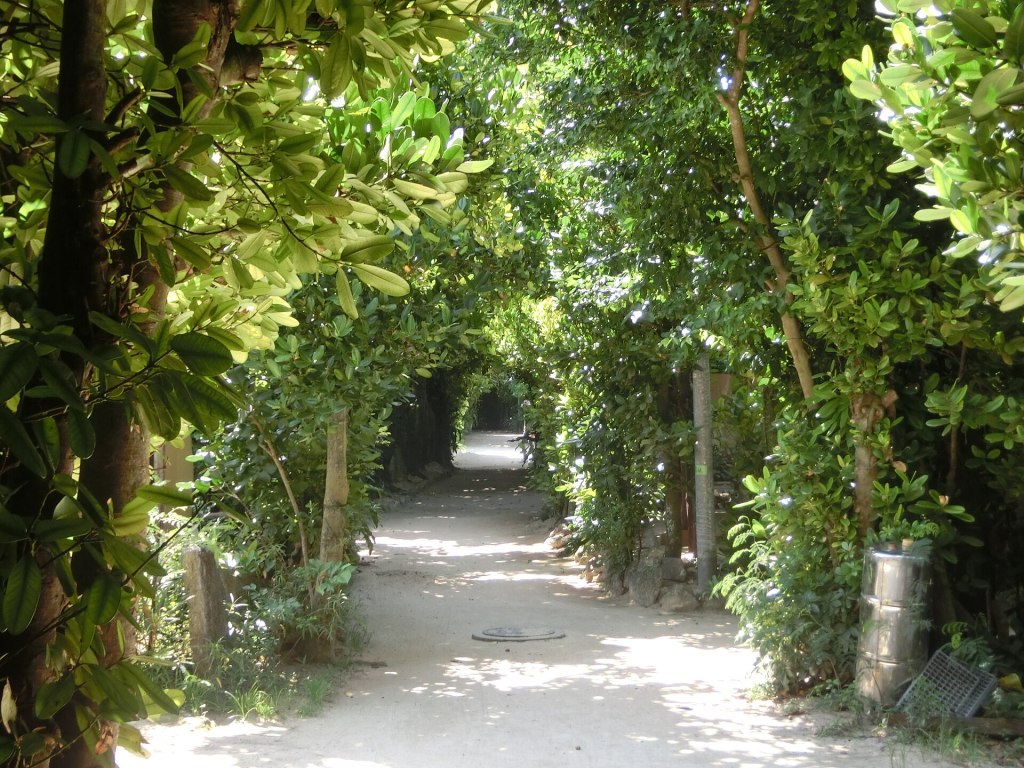
There is no gate, no ticket booth and no opening time at the Bise Fukugi tree road. You turn off the coast road near Okinawa Churaumi Aquarium, walk between two low stone walls, and the light changes. Within a few steps the sky is broken into small pieces by a canopy of dark green leaves, the air cools, and the sound of traffic disappears. This is one of the most photographed landscapes in northern Okinawa, but it is also simply a village where people live.
The Bise Fukugi tree road — Bise no Fukugi Namiki in Japanese — is a network of lanes in the Bise district of Motobu Town, on the Motobu Peninsula. Around 18,000 to 20,000 fukugi trees grow around the houses and along the lanes, forming a green tunnel that runs roughly one kilometre from the village entrance toward Cape Bise. The trees were planted as windbreaks and garden walls, not as a park. That distinction is the key to visiting well: you are walking through a working residential neighbourhood that happens to be extraordinarily beautiful.
This guide covers what the tree road is, how it came to exist, how to walk or cycle it, where to swim, what to eat, how to get there without a car, and how to enjoy it without intruding on the people who maintain it. It is written for travellers who want more than a photograph: a half-day or full-day route that connects the trees, the coast, the aquarium and the small cafes of Motobu.
Bise Fukugi Tree Road at a glance
- Location: Bise, Motobu Town, Kunigami District, Okinawa Prefecture (postcode 905-0207).
- What it is: A residential village whose lanes and house plots are enclosed by fukugi trees, with a main route of about 1 km to Cape Bise (Bisezaki).
- Number of trees: About 18,000–20,000 in the Bise district. A 2004 field survey counted 18,143.
- Age: The tree walls began forming around 250–300 years ago. Most of the trees standing today date from the late 19th century or later, not from the Ryukyu Kingdom period.
- Admission: Free. The lanes are public roads and paths; there is no facility fee.
- Time needed: 30–45 minutes for a quick walk, 1.5–2 hours with the cape and a cafe, half a day with the aquarium.
- Parking: Free car park for about 60 cars at the village entrance, open 24 hours. A separate paid car park at Bisezaki costs about ¥500 per day.
- Facilities: Toilets at the entrance car park and at Bisezaki; showers at Bisezaki (about ¥300); cafes and a few shops in and around the village.
- Best time: Early morning, before about 9:00, or late afternoon. Spring and autumn are the most comfortable seasons.
- Access: About 15 minutes on foot from Churaumi Aquarium, 3 minutes by car; direct airport shuttle to the village entrance; local buses from Nago Bus Terminal.
Those numbers matter because Bise is often described in superlatives that blur the facts. It is not a primeval forest, and it is not a formal garden. It is a managed landscape: each household has historically looked after the trees around its own plot and the lane in front of it. The result looks natural because it has been cared for for a very long time.
What exactly is the Bise Fukugi tree road?
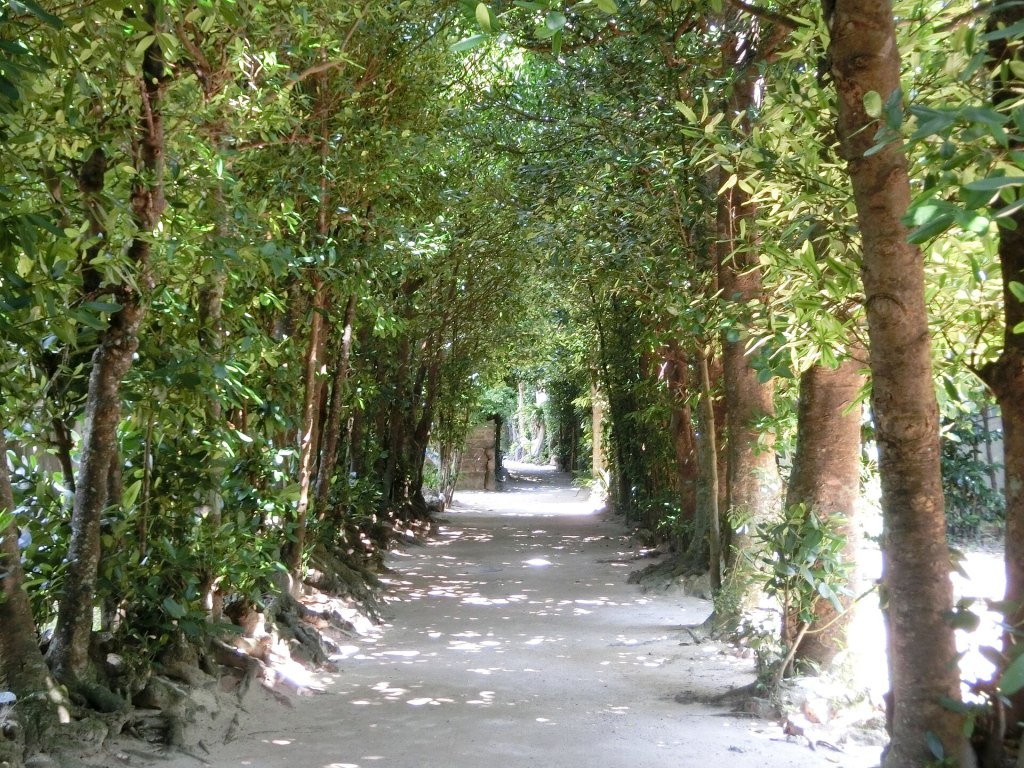
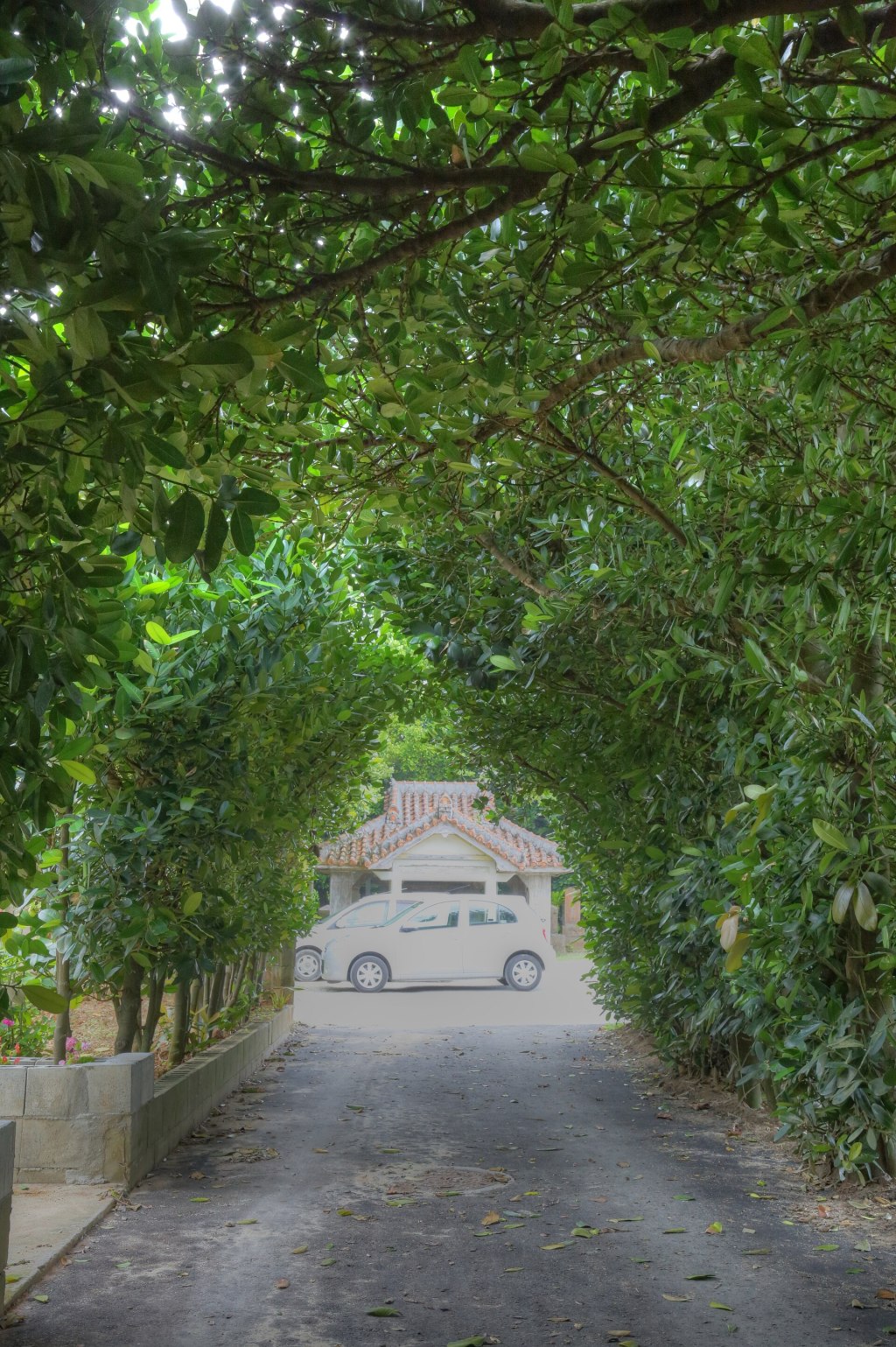
The name is slightly misleading. There is not one single avenue of trees. Bise is a compact village laid out on a grid, with a main lane called Nakanichi and smaller lanes called suji running between house plots. Fukugi trees are planted densely around the edges of those plots, so when you walk down a lane you are passing between two continuous green walls. The “tunnel” is the cumulative effect of hundreds of private garden windbreaks leaning over public paths.
The main walking route runs from the village entrance, near the free car park, to Bisezaki at the western tip of the village. The Motobu Town Tourism Association describes it as a tree-lined road of about one kilometre to the cape. On the way you pass stone walls, small gardens, traditional houses, a few cafes, and gaps between buildings where the sea appears unexpectedly. Near the coast the trees thin out, the ground becomes sandy, and the horizon opens toward Ie Island.
Because the lanes are narrow and the trees are tall, the experience changes constantly with the light. In the early morning, low sun comes through the leaves in shafts and the path is still cool. Around midday the canopy is a deep, even shade, and the contrast between the dark lane and the bright sea at the end is strongest. In the late afternoon the light turns gold and the shadows stretch across the sand. Photographers tend to arrive at opening time; everyone else tends to arrive when the aquarium does.
Why fukugi trees are planted around houses
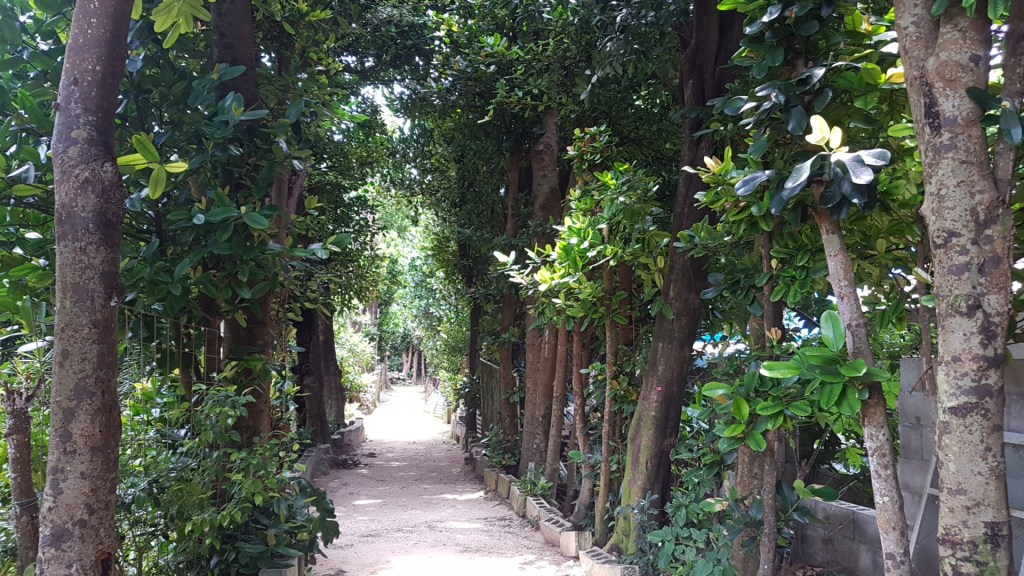
Fukugi (Garcinia subelliptica) is an evergreen tree in the mangosteen family, native to Okinawa and other parts of subtropical Asia. It grows slowly, keeps a dense crown, and tolerates salt-laden wind. Those qualities made it one of the standard trees of Okinawan village planning. The kanji used for it, 福木, literally means “fortune tree” or “happiness tree,” which is one reason it appears in auspicious planting and in tourism copy. The practical reasons are just as important.
A fukugi hedge around a house works as a combined windbreak, salt screen and dust filter. On a coast exposed to typhoons and the strong winter monsoon, that is not decorative. The trees reduce wind speed at roof level, catch salt spray before it reaches the walls, and hold sandy soil in place. Their density also provides shade and privacy, and because the trees are evergreen, the screen works all year. In older Okinawan settlements, a thick belt of fukugi could also slow the spread of fire between houses.
The trees are planted close together, often in several rows, and pruned into a wall rather than allowed to grow as free-standing specimens. This is why the Bise canopy looks like a single organism in places. It also means the landscape depends on maintenance. A fukugi wall that is not pruned becomes top-heavy and can be damaged in a typhoon; a wall that is pruned too hard loses its density. The village’s long continuity is a result of ordinary, repeated garden work.
The 2004 survey found an average of 65.5 fukugi trees per house plot in Bise, the highest figure recorded among the Okinawan villages studied. That density is the defining feature of the place. It is not the total number alone that makes Bise special; it is the fact that the trees are packed into a small residential area and still managed as garden walls.
How old are the trees?
This is one of the most commonly repeated questions, and the answer is more interesting than a single number. The fukugi garden walls of Bise are generally described as beginning about 250–300 years ago. The village itself is older: local histories date its formation to around 1609, and the separate settlement of Kohama was divided off in 1668. The current grid layout is usually linked to the land-division reforms around 1737, when house plots were regularised and planting along plot boundaries became part of the village structure.
However, a survey of the trees themselves found that most of the fukugi standing today are not 300 years old. Many have relatively slender trunks, suggesting they were planted after the late 19th century. The village lost trees when the central lane was widened in 1933, during the Second World War, and again in the postwar reconstruction and the electrification work of 1969. The canopy you see is therefore a living layer that has been replaced and renewed over generations, not a preserved original forest. A few individual trees may be much older, but the ensemble is the heritage, not any single trunk.
A short history of Bise and its tree walls
Bise sits on the northwest coast of the Motobu Peninsula, facing Ie Island across a narrow stretch of sea. The village’s location exposed it to wind and salt, but it also gave it access to reef fishing and, later, to the tourist economy of the Ocean Expo Park. For most of its history it was a small farming and fishing settlement, with houses clustered behind coral-limestone walls and fukugi hedges.
The 1737 land reforms are the usual starting point for explaining the village’s grid. The reform regularised plots and boundaries, and the planting of fukugi along those boundaries followed. Whether the grid was fully planned at that moment or developed gradually is still debated by historians, but the connection between the land system and the tree walls is well established. The trees marked property lines, protected houses, and gave each household a private windbreak.
The modern history of the village is a sequence of disruptions and adaptations. The 1933 widening of Nakanichi removed a line of trees. The war brought evacuation, bombing and damage. Postwar rebuilding required timber and new materials, and more trees were cut. The arrival of electricity in 1969 led to further pruning and removal. By the time the Okinawa Ocean Expo opened in 1975, Bise was already known for its remaining tree-lined lanes, and the expo brought visitors and employment to the area. Tourism gradually became part of the village economy.
Recognition followed. In 1983 the fukugi house gardens of Bise were included in the “Okinawa Nature 100” selection. In 2010 the village and Motobu Town received the 25th Handmade Hometown Award (手づくり郷土賞) from the national government for the community’s maintenance of the tree road and its visitor infrastructure. In February 2015, on February 9 — the date designated as Fukugi Day in Okinawa — Motobu Town issued the “Fukugi no Sato Declaration,” pledging to protect the trees, use them in town planning, and pass the culture to the next generation.
Since 2021, Ryukyu University and Bise residents have been conducting a tree-by-tree survey of the fukugi garden walls. The work records trunk diameter, height, orientation, cavities and damage, and is intended to provide a basis for long-term conservation. Early results described the trees as generally healthy compared with ordinary street trees, while identifying problems such as vines, wire and chain wrapped around trunks, and hollows that need monitoring. This is not a landscape that can be left alone; it is a landscape that is being actively kept alive.
Walking the Bise Fukugi tree road
The classic route is simple: start at the free car park at the village entrance, walk west along Nakanichi toward the sea, continue to Bisezaki, then return through the smaller lanes. The round trip is about two kilometres and takes roughly 30 minutes at a brisk pace. With photo stops, a cafe, and time at the cape, allow 1.5 to 2 hours. If you also visit the aquarium or the beach, give it half a day.
The entrance is easy to miss if you are driving. Look for the sign and the car park just inland from the coast road, near the northern end of Emerald Beach and the Hotel Orion Motobu Resort & Spa. From the car park, the main lane heads roughly northwest. There are no ticket gates or maps at every corner, so download an offline map or take a photo of the village map at the entrance. The lanes are narrow and mostly unsigned; getting slightly lost is part of the experience, but you should know which way the sea is.
The first stretch: Nakanichi
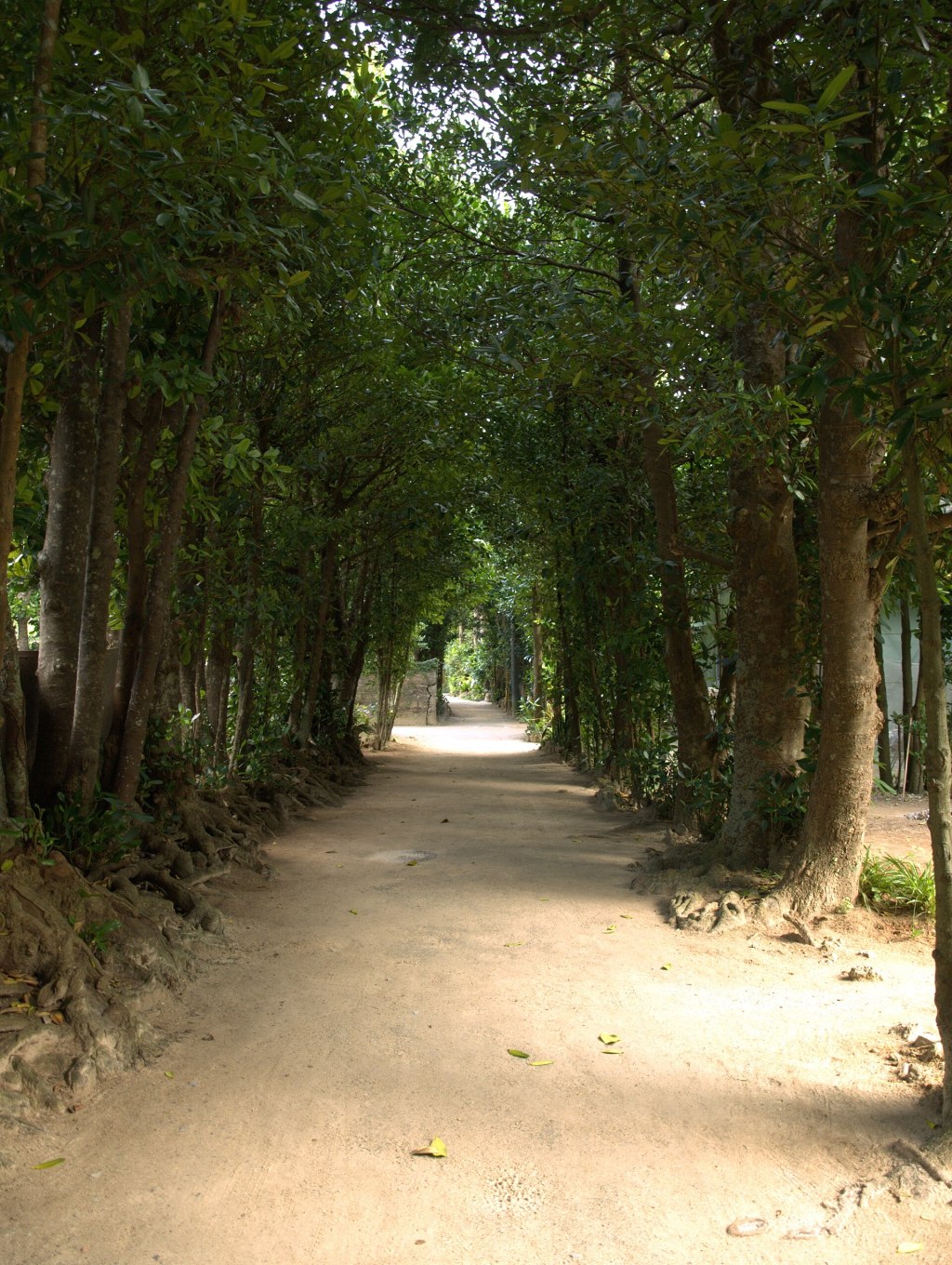
Nakanichi is the main lane, wide enough for a small car but used mostly by pedestrians and cyclists. The trees close overhead within the first minute. On either side are low walls of Ryukyu limestone, some made of coral blocks, and behind them are houses, gardens and the occasional shop. The atmosphere is deliberately unmonumental: no explanatory panels every ten metres, no reconstructed “old village” facades. The ordinariness is the point.
Walk slowly here. The lane is shaded, but the humidity is high, and the surface alternates between packed sand, concrete and stone. In the rainy season the shade keeps the ground damp and slippery. Good shoes matter more than a fancy camera. If you are visiting in summer, carry water; there are no drinking fountains along the route.
About halfway along Nakanichi, side lanes open to the left and right. The left-hand lanes tend to lead toward the coast and the beach; the right-hand lanes loop back through the residential grid. These small detours are where Bise feels most like a village and least like a tourist site. Take one, but remember that the paths between houses are also the residents’ frontages. Do not walk into gardens, do not open private gates, and do not assume that a quiet lane is a public attraction simply because it is photogenic.
The middle section: lanes, walls and small discoveries
The pleasure of the middle section is cumulative rather than landmark-based. You notice the way the fukugi trunks lean toward the light, the way the stone walls absorb heat, the small shisa figures on rooftops, the pots of herbs and tropical flowers, the cats sleeping in the shade. Some houses have kept traditional layouts; others are modern. The mixture is honest, and it is one reason the village does not feel like a film set.
Depending on the season, you may see mango, pineapple, papaya or shikwasa growing in gardens. These are private crops, not a pick-your-own farm. Do not pick fruit or flowers, and do not climb walls for a better photograph. The trees themselves are private property in many cases, even when their branches overhang a public lane.
If you are cycling, this is the section to slow down. The lanes are shared, sight lines are short, and residents may be walking, carrying shopping, or reversing a car. Ring a bell only when necessary, and give way. A bicycle lets you cover the side lanes quickly, but it also makes it easier to treat the village as a track rather than a neighbourhood. Walk the main lane at least once.
The last stretch: toward Bisezaki
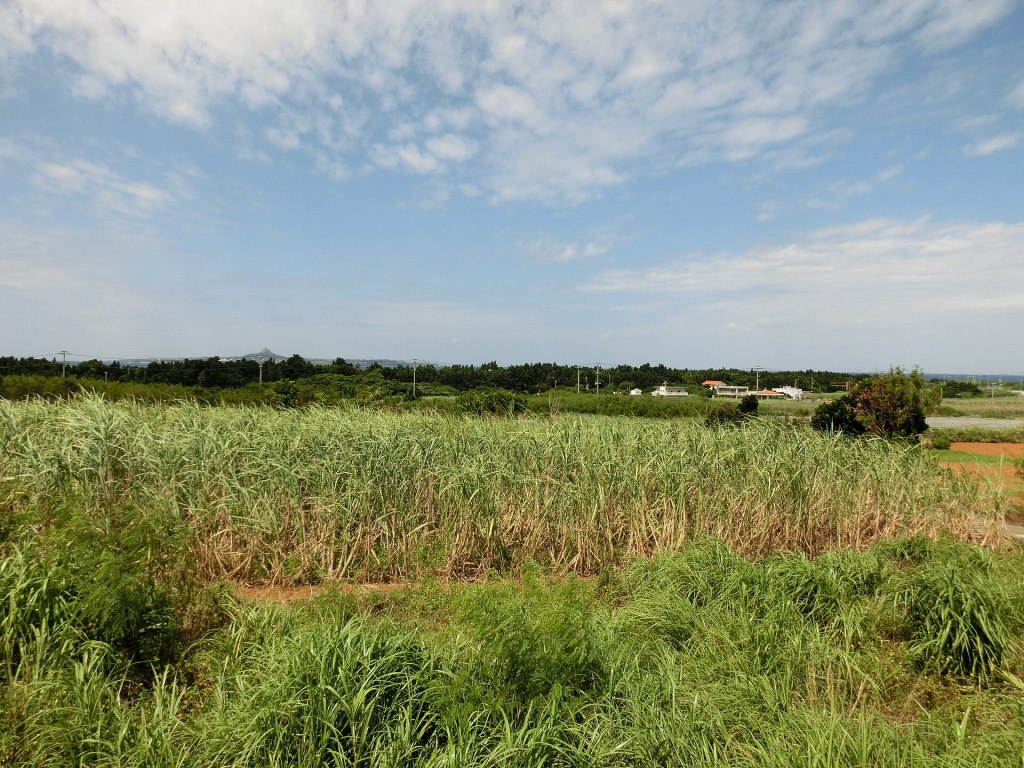
As you approach the coast, the canopy opens, the ground becomes sandier, and the sound of the sea returns. The trees here are lower and more wind-shaped. On a clear day you can see Ie Island, with its distinctive silhouette, across the water. The lane ends near Bisezaki, the cape at the western tip of the village, where a small paid car park, toilets, showers and a shop serve swimmers and snorkellers.
The transition from tunnel to open coast is the visual payoff of the walk. It is also a good place to sit and reset before returning. There are few benches, but the sea wall and the beach provide natural resting places. Take your rubbish with you; bins are scarce.
Bisezaki and the coast
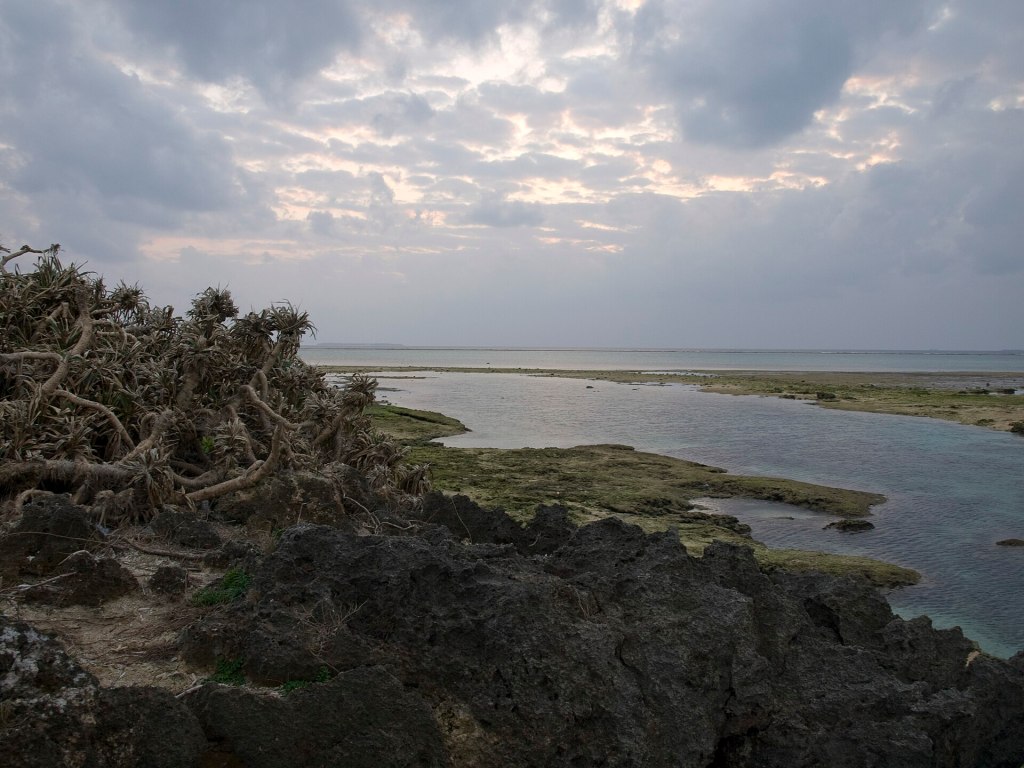
Bisezaki is not a landscaped resort beach. It is a rocky cape with a coral reef, a small sand beach, and a view across the water to Ie Island. Entry is free. The paid car park costs about ¥500 per day, and showers are about ¥300. There are toilets and a shop, and in season you may find snorkelling gear for rent. Facilities are limited and can be busy in summer.
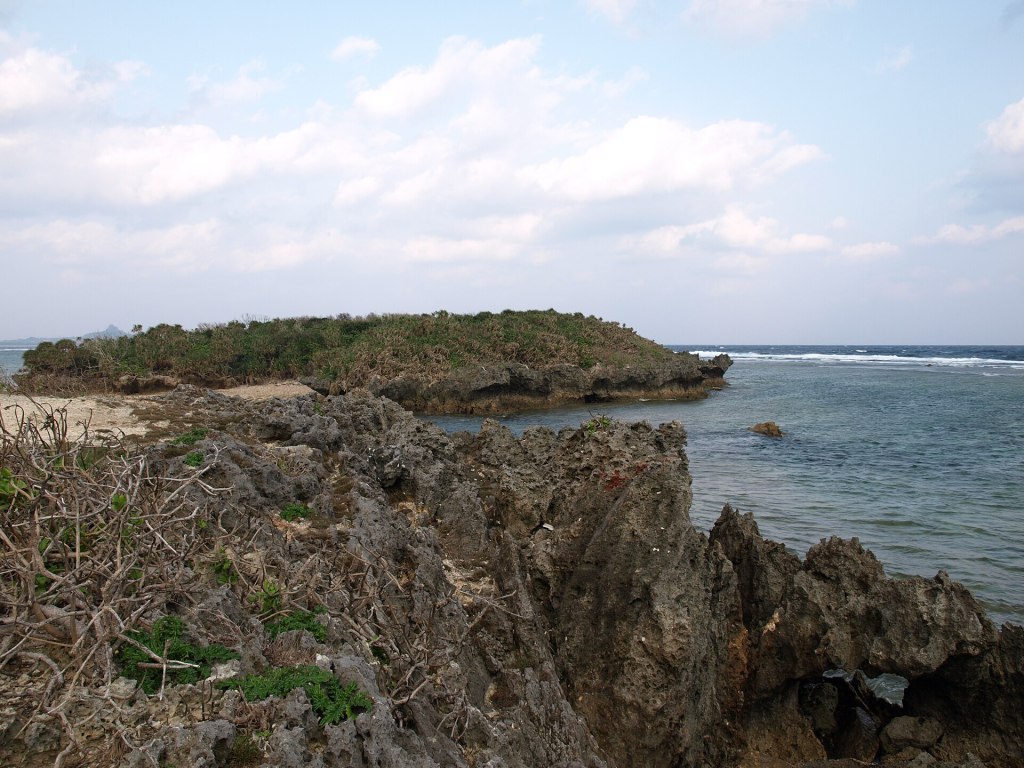
The beach immediately south of the cape, usually called Bise Beach, is a strip of white sand about 300 metres long. It is shallower and calmer than the rocky cape, and it is popular with families. The cape itself is the better place for reef views, but the entry and exit points are rocky. This is not a swimming pool: there are no lifeguards, no nets, and no marked swimming zones. The current can be strong, especially where the reef has gaps, and the tide changes the landscape significantly through the day.
Snorkelling at Bisezaki
Bisezaki is known for clear water and a shallow reef with tropical fish. On a calm day with good visibility, snorkelling just offshore can be excellent. But the site has a serious safety record, and the absence of supervision is not a technicality. People have drowned here. The reef edge, the channel between the cape and the small offshore rocks, and the area beyond the reef can all carry strong flow, particularly around the change of tide.
Go with at least one other person, wear a life jacket or snorkelling vest, use marine shoes to protect your feet on the coral and rocks, and stay inside the sheltered area you can clearly see. Check the tide and wind before entering. Low tide exposes the reef flat and creates tide pools that are good for careful exploring; high tide gives more water for swimming, but also more movement. If the sea is rough, if it is getting dark, or if you are tired or have been drinking, do not go in. There is no shame in looking at the water from the shore.
The reef is a living community. Do not stand on coral, do not touch it, do not collect shells or fish, and do not feed the fish. Use a reef-safe sunscreen or, better, a rash guard. The cumulative impact of thousands of visitors is real, and the local conservation effort around the fukugi trees is part of the same ethic.
Bise Beach and the view of Ie Island
Bise Beach is the easier place to swim or paddle. The sand is soft, the water is shallow close to shore, and the view toward Ie Island is one of the signature views of the Motobu coast. It is also a good sunset spot. The beach does not have the same level of facilities as the cape, so bring water, a towel and a bag for your rubbish. Avoid parking on the narrow lane; use the entrance car park or the cape car park.
At low tide, the exposed reef flat is fascinating for children, but it is also slippery and full of small hazards. Supervise closely, wear shoes, and do not let children walk far out on the reef. The tide can return faster than people expect.
The water buffalo cart
One of Bise’s most distinctive experiences is the water buffalo cart that plods through the lanes. It is not a theme-park ride. The pace is slow, the cart is open, and the guide usually explains the village and the trees along the way. For families with small children or anyone who finds the heat difficult, it is a gentle way to see the main lane.
As of 2026, the cart generally operates on Saturdays, Sundays and public holidays from 11:00 to 15:30. The fare is about ¥2,000 for up to four people, with an additional ¥500 for each extra person. The ride lasts around 20 minutes. Reservations are not accepted; it is first come, first served. Operation depends on the weather and the health of the animal, so it can be cancelled at short notice. Confirm on the day through the Motobu Town Tourism Association (0980-47-3641) before making a special trip.
The cart is popular in high season, and waits of 30 minutes to an hour are possible. Go early in the operating window if it is a priority. Bring cash; small local operators may not accept cards. And treat the animal with respect: do not shout, crowd it, or try to touch it without the handler’s permission.
Walking, cycling or driving?
Walking is the best way to experience the tree road. The main lane is flat and paved or packed sand, and the distance is short. Cycling extends your range to the cape, the beach and the edge of Ocean Expo Park, and it is useful if you have limited time or mobility. Driving through the village is possible on Nakanichi but defeats the purpose, and parking inside the residential lanes is not appropriate.
There are two rental cycle shops near the entrance. Rates in 2026 were roughly ¥300–500 per hour for a regular bicycle and ¥500–1,000 per hour for an electric-assist bicycle, depending on the shop. Some shops accept reservations, especially for child seats and children’s bikes; others are walk-in only. Bring cash and a piece of identification. The terrain is flat, but the lanes are narrow and the shade can hide pedestrians, so ride slowly.
If you are travelling with a stroller or wheelchair, the main lane is manageable with a companion, but the surface is uneven in places and the side lanes are too narrow and sandy for easy rolling. Bisezaki itself is rocky and not wheelchair-friendly. The entrance car park has toilets, and there are cafes where you can sit down, but do not expect a fully accessible visitor centre.
Where to eat and drink in Bise
Bise is a village, not a restaurant district. The cafes are small, the hours are short, and several close one or two days a week. That is part of the charm, but it requires a little planning. Lunch is the main meal; dinner is limited, and many visitors eat in Motobu town, Nago, or at their hotel. Carry cash, because not every small cafe takes cards.
Cahaya Bulan
A Hawaiian-style cafe at the edge of the trees, with indoor seats and a terrace facing the sea toward Ie Island. The menu includes pancakes, acai bowls, poke bowls, egg sandwiches and French toast, and it opens early enough for breakfast before the aquarium. The official site lists 7:30–18:00, no closing days, at Bise 429-1. It is a good choice for families and for anyone who wants a table rather than a bench. The shared car park holds about 50 cars.
okinawasun
A small, colourful cafe in a renovated old house, known for tropical fruit smoothies and generous sandwiches. The signature sandwich is made with Okinawan Agu pork and melted cheese. It is a good mid-walk stop, but the hours are limited: the Yambaru tourism site lists 12:00–16:00, closed Mondays, at Bise 224. Hours change with the season and the owner’s schedule, so check before you go.
Ryuka
A fruit cafe with a wooden deck and a view through the trees toward the sea. The menu focuses on Okinawan fruit drinks, shaved ice and a spiced curry, with fruit sourced from local farmers. It is at Bise 401. Published hours vary between sources, generally around 10:30–16:30, closed Thursdays. It is a good place to cool down after the walk, but do not plan your day around it without confirming.
Kokko Shokudo
A small local restaurant serving chicken-based Okinawa soba and chicken rice. The signature “golden chicken soba” uses a clear chicken broth, and the rice dish is served with hot chicken stock poured over it. It is at Bise 355, generally 11:00–16:00, closed Wednesdays. This is a good option if you want a proper sit-down lunch rather than a cafe snack.
For a broader choice, head to Motobu town or the area around Ocean Expo Park. There are convenience stores near the aquarium and the Orion hotel, and the hotel restaurants are useful if you are staying nearby and do not want to drive after dark. Okinawan specialties to look for include Okinawa soba, soki soba (with braised pork ribs), sea grapes (umibudo), bitter melon stir-fry (goya champuru), and locally grown mango or pineapple in season.
Where to stay near Bise
The most convenient base is the Hotel Orion Motobu Resort & Spa, which sits on the rise between Bise and Ocean Expo Park. It has about 200 parking spaces, is roughly a seven-minute walk from Churaumi Aquarium, and is one of the stops on the airport shuttle. Rooms facing the sea look toward Ie Island, and the hotel is well set up for families. It is a resort, not a village guesthouse, but it is the easiest option if you want to walk to the tree road at dawn and return for breakfast.
There are also small guesthouses and minpaku in and around Bise and Motobu. They offer a quieter, more local stay, but they come with responsibilities: keep noise down after dark, follow the house rules on shoes and rubbish, and do not treat the lanes as a private garden. Availability is limited, and many places require advance booking in high season.
Nago, about 30–40 minutes away by car, has a wider range of hotels and restaurants and is a practical base for the northern part of the island. Naha is possible as a day trip, but the journey takes around two hours each way, and you will miss the early morning and sunset, which are the best times in Bise.
Getting to Bise
By car
From Naha Airport, take the airport expressway and the Okinawa Expressway north to Kyoda Interchange (許田IC), then follow Routes 58, 449 and 505 toward Motobu and Ocean Expo Park. The drive is about 1 hour 50 minutes to 2 hours in normal traffic. The expressway toll between Naha and Kyoda is about ¥1,040 with ETC and ¥1,610 in cash for a standard car, as of October 2026. From Churaumi Aquarium, Bise is about 3 minutes by car or 15 minutes on foot.
At the village entrance there is a free car park for about 60 cars, open 24 hours. It fills on busy days, especially around lunchtime in summer. A second paid car park at Bisezaki costs about ¥500 per day and is the better choice if you are carrying snorkelling gear. Do not park on the lanes or in front of houses; the roads are narrow and residents need access.
By airport shuttle
The Okinawa Airport Shuttle is the simplest car-free option. It runs from Naha Airport to “Bise Fukugi Namiki Iriguchi” (Bise Fukugi Tree Road Entrance), the last stop on the northern route. The adult fare is about ¥2,400 one way, and the journey takes around two hours. Online reservation is recommended and can be made up to one month ahead; same-day reservations are not accepted online, but you can board if seats are available and pay the driver.
The catch is frequency. There are only a handful of departures a day, and the last return from Bise leaves in the mid-afternoon. If you want to stay for sunset, you will need a car, a taxi, or an overnight stay. Check the current timetable before you build your day around it, because seasonal suspensions and timetable changes are common.
By local bus
From Nago Bus Terminal, routes 65 (Motobu Peninsula Line, Toguchi route), 66 (Nakijin route) and 70 (Bise Line) stop at “Bise Iriguchi” on the main road. From the stop, walk about 10 minutes to the village entrance. Buses are infrequent, and the walk is along a road without much shade, so this option suits travellers with time and a light bag rather than a tight schedule.
Route 117, the express bus from Naha Airport to Churaumi Aquarium, is another option: it takes about 2 hours 10 minutes and costs about ¥2,880, and from the aquarium you can walk to Bise in about 15 minutes. This is a good choice if you want to combine the aquarium and the tree road in one day without a car.
By taxi
A taxi from Churaumi Aquarium takes about 5 minutes; from Nago it takes about 30–40 minutes and is relatively expensive. Taxis are useful for the last leg if you are staying at a hotel without a shuttle, but they are not a budget option for a day trip from Naha.
Best time to visit
The tree road is open all year, and the fukugi trees stay green through the winter. The best seasons for walking are spring (March to May) and autumn (October to December), when the humidity is lower and the light is softer. Summer is hot, bright and busy; the shade helps, but the combination of heat, humidity and mosquitoes can make a midday walk uncomfortable. Winter is quieter and cooler, with strong winds on the coast, but the light is clear and the village feels especially calm.
Okinawa’s rainy season usually runs from around May to June, and the typhoon season peaks from August to September. Rain does not close the tree road, but it makes the lanes slippery and the sea dangerous. Check the marine forecast before planning a snorkelling day, and have an indoor backup such as the aquarium or the Ocean Expo Park museums.
Time of day matters more than season. Early morning, from about 7:00 to 9:00, is the quietest and coolest. The cafes may not be open yet, but the light is beautiful and the lanes belong to residents and a few photographers. Late afternoon, from about 16:00 until sunset, is the other good window. In midsummer the sun sets around 19:20; in midwinter it sets around 17:50. If you want the classic golden-light photograph, check the local sunset time and arrive at the cape at least 30 minutes early.
Etiquette: this is someone’s neighbourhood
Bise welcomes visitors, but it is not a public park. The lanes are public, the houses and gardens are not. The following guidelines are not bureaucratic niceties; they are the difference between a village that can remain open to visitors and one that becomes exhausted by them.
- Keep your voice low. Sound carries under the trees and through open windows. Avoid phone calls on speaker, loud music and groups that block the lane.
- Do not enter private property. Gates, gardens, driveways and fields are private, even when they look abandoned or photogenic. Stay on the paved or sandy lanes.
- Ask before photographing people. This includes residents, children and workers. A smile and a gesture toward the camera is usually enough; if the answer is no, accept it.
- Do not fly drones without permission. Drones disturb residents and are subject to Japanese aviation rules. The village lanes are a poor place to fly one.
- Do not tie anything to the trees. Hammocks, ropes, signs and locks damage the bark and can kill a tree. Do not carve initials or pick leaves.
- Use the toilets at the entrance car park or Bisezaki. Do not use cafe toilets without buying something, and do not relieve yourself in the lanes.
- Take your rubbish with you. Public bins are rare. Carry a small bag until you reach your hotel or a convenience store.
- Do not smoke in the lanes. The risk of fire is real, and the smell lingers in a small village.
- Give way to residents. Step to the side for cars, scooters, bicycles and people carrying things. Do not stop in the middle of a narrow lane for a photo.
- Respect the cats. Some cafes have resident cats; do not feed them, pick them up, or let children chase them.
These rules apply especially to the side lanes, where tourists are fewer and the boundary between public path and private home is less obvious. If you are unsure whether a path is public, do not walk it. There is no shame in turning back.
Responsible travel and the reef
The fukugi landscape and the coral reef are both fragile, and both are under pressure from heat, development and visitor numbers. A few practical choices make a difference. Stay on the path rather than cutting through gardens or across planted ground; compacted soil and damaged roots harm the trees. Do not remove plants, shells, coral or stones. Use reef-safe sunscreen, or cover up with a rash guard. Do not feed fish or other marine life. Do not chase or touch turtles, fish or octopus. If you hire a kayak or join a snorkelling tour, choose an operator that briefs guests on reef etiquette and does not anchor on coral.
Overtourism is a genuine issue in Bise. The village is small, the lanes are narrow, and the free car park is finite. Visiting early or late, avoiding peak holidays, using public transport when possible, and spending money in local cafes are all small ways to reduce the load. If the car park is full, use the paid cape car park or the Ocean Expo Park car parks rather than circling the lanes.
Suggested itineraries
Half day: trees, cape and lunch
- 8:00 Arrive at the free car park. Walk Nakanichi while the village is quiet.
- 8:30 Continue to Bisezaki. Look at the reef, the beach and the view toward Ie Island.
- 9:15 Return through the side lanes. Stop for photographs at the stone walls and the small gardens.
- 10:00 Coffee or a late breakfast at Cahaya Bulan, or a smoothie at okinawasun if it is open.
- 11:00 Walk or drive to Churaumi Aquarium, or spend the rest of the morning at the beach.
Full day: aquarium, village and sunset
- 8:30 Enter Churaumi Aquarium at opening. See the Kuroshio tank before the crowds build.
- 11:30 Walk to Bise (about 15 minutes) and have lunch at Kokko Shokudo or a cafe.
- 13:00 Walk the tree road slowly, with detours into the side lanes.
- 14:30 Swim or snorkel at Bisezaki, or relax on Bise Beach.
- 16:30 Return to the cape for the late-afternoon light.
- 17:30 Watch the sunset, then drive to Motobu or Nago for dinner.
Car-free day
- Take the airport shuttle directly to Bise Fukugi Namiki Iriguchi.
- Walk the tree road and the cape, then have lunch in the village.
- Walk to Churaumi Aquarium (about 15 minutes) for the afternoon.
- Return by shuttle or route 117 from the aquarium. Check the last departure before you go.
Rainy day
The tree road is still walkable in light rain, and the canopy sheds a surprising amount of water. Wear a rain jacket rather than an umbrella in the narrow lanes, and watch your footing on the stone and sand. If the rain is heavy, go to the aquarium, the Ocean Expo Park museums, or the Churaumi Plaza shops. The village cafes are small and may be full; have a backup.
What to bring
- Comfortable shoes with grip for stone, sand and wet coral.
- Water (at least one litre per person in summer).
- Hat, sunglasses and reef-safe sunscreen.
- Insect repellent for the shaded lanes, especially in summer.
- Cash for parking, showers, the buffalo cart and small cafes.
- Swimsuit, towel and a dry bag if you plan to swim.
- Marine shoes for Bisezaki; the rocks and coral are sharp.
- A light rain jacket in the rainy season and typhoon season.
- A bag for your rubbish.
Nearby places worth combining with Bise
Okinawa Churaumi Aquarium is the obvious companion. It is about 15 minutes on foot or 3 minutes by car, and the Kuroshio Sea tank alone justifies the ticket. The aquarium is open 8:30–18:30, with last entry at 17:30, and admission is ¥2,180 for adults as of 2026. It is busiest in the middle of the day; go at opening or late afternoon. See our Churaumi Aquarium guide for the full layout and ticket advice.
Ocean Expo Park surrounds the aquarium and is free to enter. It includes Emerald Beach, the Okinawan Village, the Tropical Dream Center, the Ocean Culture Museum and dolphin shows. It is a good place to spend a few hours with children, and the park’s car parks are free. Emerald Beach is a short walk from Bise and has a view toward Ie Island.
Nakijin Castle Ruins, a UNESCO World Heritage site, is about 30 minutes away by car and makes a good half-day combination with Bise. The castle is known for its long stone walls and cherry blossoms in winter. See our Nakijin Castle guide for details.
Kouri Island and Sesoko Island are further afield but can be combined in a full-day drive around the Motobu Peninsula. Kouri is famous for its long bridge and clear water; Sesoko has a beach and a quieter pace. Both are popular, and the bridges can be congested in summer.
Yambaru National Park, covering the forests of northern Okinawa, is for travellers who want more nature after the village. It is a different landscape entirely: subtropical forest, mangroves and endemic species. See our Yambaru guide if you are heading further north.
Common questions
Is the Bise Fukugi tree road free?
Yes. There is no admission fee and no opening time. You pay only for parking at Bisezaki (about ¥500), showers (about ¥300), the buffalo cart, bicycle rental and food.
How long does the walk take?
The main route from the entrance to Bisezaki is about one kilometre. The round trip is about two kilometres, or 30–45 minutes at a steady pace. With photos, a cafe and time at the cape, allow 1.5–2 hours.
Can you swim at Bise?
Yes, at Bise Beach and around Bisezaki, but there are no lifeguards and no swimming nets. The reef can produce strong currents. Swim with a companion, wear a life jacket if you are not confident, use marine shoes, and check the tide and weather. Do not swim at dusk or in rough conditions.
Is Bise worth visiting?
If you want a quiet, beautiful village walk and a sense of how Okinawan settlements were shaped by wind and salt, yes. If you expect a theme park, a long list of attractions or a beach resort with facilities, it may feel too modest. The best way to enjoy it is to slow down and combine it with the aquarium and the coast.
Do you need a car?
Not necessarily. The airport shuttle goes directly to the village entrance, and route 117 connects the airport with Churaumi Aquarium. But a car gives you more flexibility, especially if you want to stay for sunset or visit nearby places such as Nakijin and Kouri.
Are there toilets and baby-changing facilities?
There are toilets at the entrance car park and at Bisezaki. Baby-changing facilities are limited; the larger aquarium and hotel facilities are more reliable. Plan nappy changes before you enter the lanes.
Is the tree road stroller-friendly?
The main lane is mostly flat and paved, but the surface is uneven in places and the side lanes are sandy and narrow. A stroller with good wheels is manageable with two adults, but Bisezaki is not suitable for strollers.
When is the quietest time?
Early morning, especially on weekdays outside Japanese school holidays. The village is busiest from late morning to mid-afternoon, when aquarium visitors arrive. Avoid Golden Week (late April to early May), Obon (mid-August) and the New Year holidays if you want calm.
Before you go
Bise is a small place with limited facilities, and conditions change with the season. Confirm the following before you travel: the airport shuttle timetable and last return, the opening hours of the cafe you plan to visit, the buffalo cart’s operating day, the tide and marine forecast if you intend to swim, and the aquarium’s opening hours during holidays. Carry cash, water and a rain jacket. Wear shoes you can walk in on sand, stone and wet ground. Most importantly, remember that the tree road is a residential neighbourhood: the best way to experience it is quietly, slowly, and with respect for the people who keep it alive.
Sources and further reading
- Motobu Town Tourism Association: Bise no Fukugi Namiki (official tourism page; checked 26 October 2026).
- Cabinet Office Okinawa General Bureau: Bise no Fukugi Namiki, 25th Handmade Hometown Award (checked 26 October 2026).
- University of Tokyo, Laboratory of Landscape Ecology: Bise village landscape report (history and grid layout; checked 26 October 2026).
- Ando and Ono, “Actual conditions of fukugi garden forests in Bise Village, Motobu Town, Okinawa Island,” Journal of Architecture and Building Science 73 (630), 2008 (tree count and age estimate).
- Ryukyu Shimpo: Motobu Town “Fukugi no Sato Declaration” (February 2015; checked 26 October 2026).
- Ryukyu Shimpo: Ryukyu University survey of Bise fukugi trees (January 2022; checked 26 October 2026).
- Okinawa Airport Shuttle: timetable and fares (checked 26 October 2026).
- Okinawa Churaumi Aquarium: hours and admission (checked 26 October 2026).
- NEXCO West: Okinawa Expressway tolls and ETC discount (checked 26 October 2026).
- Bus stops and routes at Bise Iriguchi (routes 65, 66 and 70; checked 26 October 2026).
All prices, hours and transport details were checked in October 2026. They can change; confirm with the official operator before you travel.


Leave a Reply