Ashikaga Flower Park is a flower garden in the flat farmland south of Ashikaga city, and for about five weeks a year it becomes one of the most photographed places in Japan. The rest of the year it is a pleasant, slightly old-fashioned park with a rose garden, a winter illumination and very few foreign visitors. Knowing which of those two places you are visiting is most of the planning.
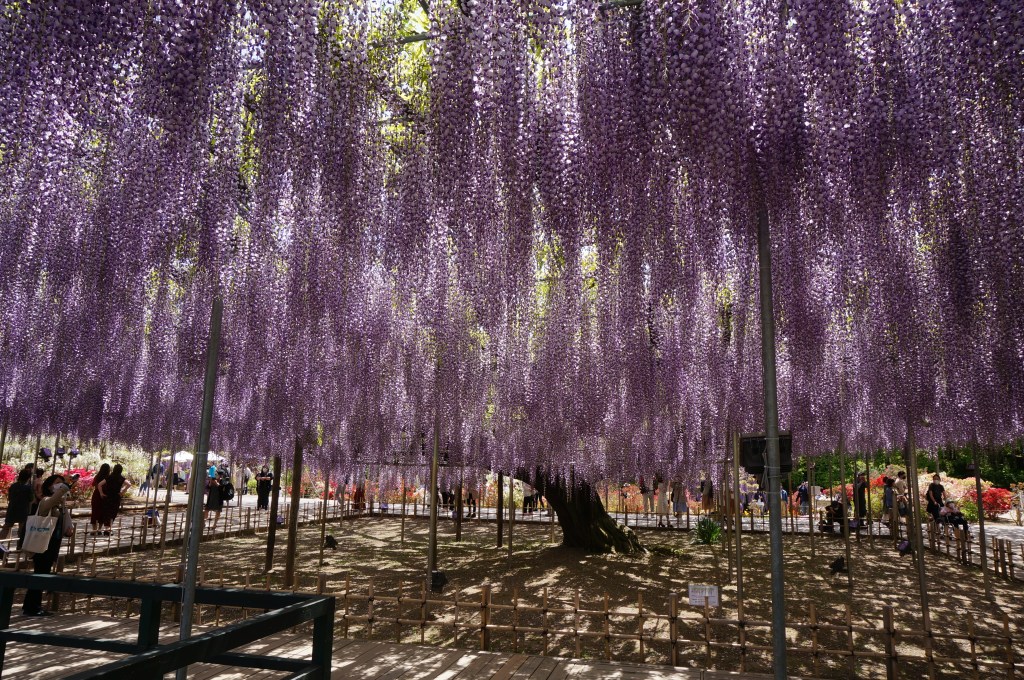
The thing that made its reputation is a single wisteria tree, more than 160 years old, whose trellis covers an area the park describes as 600 tatami mats — roughly 1,000 square metres. It is not a native wild plant but a cultivated specimen, pruned and trained for a century and a half, and when it flowers in late April the branches hang down in curtains of pale purple that reach almost to the ground.
Why visit
- It has the best wisteria display in Japan by breadth: more than 350 wisteria trees of several varieties, plus 5,000 azaleas, flowering in sequence rather than all at once.
- An 80-metre tunnel of white wisteria, a Tochigi prefectural natural monument, which you walk through rather than past.
- The night illumination of the wisteria is a genuinely different experience from the daytime visit, and cheaper.
- The town of Ashikaga has two other sites worth the trip: Japan’s oldest school and a National Treasure temple, both free or cheap and both within walking distance of each other.
- It is an easy day trip from Tokyo on a direct train, with no car needed.
The wisteria, in order
The park’s wisteria does not bloom simultaneously. It runs in a sequence over about a month, which is why the festival lasts five weeks and why the admission price moves with it.
- Pale red wisteria — mid to late April. A cherry-pink variety, the first to open, on trellises and a bridge.
- Purple wisteria — late April. The screens and standard trees.
- The great wisteria (O-fuji) — late April to early May. The 160-year-old tree, and the reason most people come.
- Double-flowered black dragon wisteria — late April to early May. A rare double-flowered form with dense clusters.
- White wisteria — early May. The 80-metre tunnel.
- Yellow wisteria — early to mid May. Uncommon in Japan, and later than the rest.
In 2026 the festival ran from 11 April to 20 May, with the illumination from 15 April. The park publishes a daily bloom report in season, and the dates shift by a week or more depending on the winter and spring temperatures, so a trip planned around a fixed date is a gamble. Late April into the first days of May is the safest window if you can only pick one, but it is also the busiest.
Day and night
The daytime visit is about walking under the trellises and photographing the hanging clusters against the sky. The night visit is about the same structures lit from below, with the reflection in the water channels, and it is a much quieter, slower experience. The park sells night entry from 17:30, and it is 200 yen cheaper than the daytime ticket. Night entry is not a separate session — you are not asked to leave and re-enter — so arriving in the late afternoon gets you both.
Photographers should note that the great wisteria is fenced and the most obvious angle is crowded at every hour. The white tunnel and the yellow wisteria at the far end of the park are usually quieter.
Admission and hours
This is the part that catches people out: the park uses variable pricing tied to the bloom, and the gate price in peak wisteria season is far higher than in summer.
- Peak wisteria season — adults 1,200 to 2,300 yen, children 600 to 1,200 yen, set day by day according to how the flowers are looking.
- Ordinary spring, before the wisteria — from 300 to 1,200 yen for adults.
- Summer and most of autumn — from 300 to 700 yen.
- Winter illumination evenings — 700 yen for adults, 350 for children, from late October to early February.
- Children’s rates apply from age four to elementary school. Groups of 20 or more get 10 percent off.
Hours also stretch in season. During the 2026 festival the park opened at 09:00 in the first few days, then 08:00, then 07:00 from 18 April to 6 May, and closed at 21:00 on the fullest days. Outside the illumination period it closes at 18:00. There is no closing day except a few maintenance days in late August, the first Wednesday and Thursday of February, and 31 December.
Other things in the park
Beyond the wisteria there is a rose garden that peaks in mid-May to early June and is lit in the evening for part of that period, a tulip and nemophila spring bedding display, a greenhouse, and a restaurant and food stands. The park’s own sweet is a wisteria-coloured cream soda, which is exactly what it sounds like. In winter the whole garden is covered with one of the largest illumination displays in the Kanto region, which is a separate reason to come between November and January.
Ashikaga town
The park is about 6 km from the city centre, and the two are usually combined. Ashikaga is a small textile town that was briefly the seat of the Ashikaga shoguns’ ancestors, and it has an unusual concentration of old institutions.
Ashikaga School
Founded in the Muromachi period and rebuilt in its present form in 1439, this is described as the oldest school in Japan and was called by Francis Xavier, in 1549, the largest and most famous university in the country. It is a walled compound with a Confucian shrine, a thatched main hall and a garden, and it functioned as a centre of Chinese learning until 1872.
Admission is 480 yen for adults, 240 for high school students and 120 for out-of-town schoolchildren, open 09:00 to 16:30 from April to September and 09:00 to 16:00 from October to March. It closes on the third Wednesday of each month and from 29 to 31 December. Note that the thatched roof of the main hall is being replaced between 21 August 2026 and 25 March 2027, which restricts access to the interior of the hall and to the path in front of the south garden; the rest of the site stays open.
Banna-ji
This Shingon temple occupies the fortified residence of the Ashikaga clan, a square enclosure of about 40,000 square metres still ringed by earthen walls and a moat, and its main hall is a National Treasure. The grounds are free and open daily, with free parking for about 50 cars. The sutra repository charges 300 yen on days when it is open, and a guided tour of the main hall has to be booked in advance and is charged per group. The temple is a 10-minute walk from JR Ashikaga station and about 15 from Tobu Ashikaga-shi station.
Around the station
The old shopping street between the two stations has a few coffee shops and bakeries in converted storehouses, and the Ashikaga Orihime shrine on the hill above the town is a short walk from the Tobu line. The textile heritage is real — this was a silk and knitwear town — but most of the mills have gone and what remains is scattered.
Getting there
- By train from Tokyo — Ueno to Oyama on the Utsunomiya line, then the Ryomo line to Ashikaga Flower Park station. The station is a purpose-built stop about a three-minute walk from the gate. Allow roughly two hours with the change, and note that the Ryomo line is infrequent and the return platform gets extremely crowded at the end of a festival evening.
- By train from the north — Takasaki or Isesaki on the Ryomo line, same station.
- By car — about 20 minutes from the Sano-Fujioka interchange on the Tohoku expressway, or 15 to 25 minutes from the Ashikaga, Ota-Kiryu, Sano-Tanuma or Izuruhara interchanges on the Kita-Kanto expressway. Parking is free, with 300 ordinary spaces and 40 bus spaces, and fills early on peak weekends.
- Do not plan around a shuttle bus from Tobu Ashikaga-shi station — the park states that no shuttle runs from there, and the usual route is via the Ryomo line.
There is also a park-and-ride scheme during the festival, with free car parks around JR Ashikaga station and the town centre, listed on the park’s site with walking times of 7 to 25 minutes to the station.
Where to stay
- Ashikaga city — business hotels near JR Ashikaga and Tobu Ashikaga-shi stations, the practical base if you want both the park and the town.
- Isesaki or Ota — more hotels, 20 to 30 minutes away by train or car.
- Nikko or Kinugawa — possible as a loop, but the connections are slow and it makes a long day.
- Tokyo — doable as a day trip, and the most common choice.
Best time to visit
- Late April to early May — the great wisteria, the peak price and the peak crowd. Weekday mornings are noticeably calmer.
- Early to mid May — the white tunnel and yellow wisteria, fewer people, slightly lower prices.
- Mid-May to early June — roses, and the wisteria crowds are gone.
- November to January — the winter illumination, cheap admission, cold evenings.
- July to September — hot, cheap and quiet; the garden is at its least interesting.
Practical tips
- Check the park’s daily bloom report and the day’s admission price before you commit; the price is published in advance and rises as the flowers open.
- Arrive at opening if you want the great wisteria without a crowd in the frame.
- Buy the night ticket after 17:30 and save 200 yen, or come late afternoon and stay through both.
- Charge your IC card before the return trip. The station is small and the queue at the ticket machine after a festival evening is long.
- Do not combine the park and the town on the same half-day. The park deserves three hours, and Ashikaga School closes at 16:30 or 16:00 depending on the season.
- Cash is not essential — the park takes cards and IC payment at the gate — but the small shops in town may not.
- Wear shoes you can stand in. The paths are paved but the visit is mostly standing and shuffling under the trellises.
Suggested itineraries
One day from Tokyo, in wisteria season
- Early train to Ashikaga Flower Park station, arriving at opening.
- Walk the pale red and purple wisteria, then the great wisteria, then the white tunnel.
- Lunch at the park or back in town.
- Ashikaga School and Banna-ji in the afternoon.
- Return to the park after 17:30 for the illumination, then the last trains back.
Two days, out of season
- Day one: Ashikaga School and Banna-ji in the morning, the old shopping street at lunch, the park in the afternoon for the roses or the greenhouse.
- Day two: the Orihime shrine and the textile shops, then on to Sano or Isesaki.
Before you go
Admission prices, opening hours, festival dates and the bloom sequence change every year and are set by the park according to the flowers, so treat every figure above as the 2026 case rather than a rule. The figures here were taken from the park’s official festival and fee pages, and from the city of Ashikaga and Banna-ji for the town sites, on 26 October 2026. Two things to reconfirm before travelling: the exact opening and closing times for your dates, which in peak season start as early as 07:00 and end as late as 21:00, and whether the Ashikaga School roof works are still restricting the main hall — the work is scheduled to run until 25 March 2027.
Sources
- Ashikaga Flower Park: Wisteria Story / Great Wisteria Festival 2026 (checked 2026-10-26)
- Ashikaga Flower Park: admission fees and opening hours (checked 2026-10-26)
- Ashikaga Flower Park: illumination dates and night discount (checked 2026-10-26)
- Ashikaga city: Ashikaga School admission and reception hours (checked 2026-10-26)
- Ashikaga city: Ashikaga School site, history and roof works notice (checked 2026-10-26)
- Ashikaga Tourism Association: Banna-ji (checked 2026-10-26)
- Banna-ji: access and admission (checked 2026-10-26)
Explore More of Japan
- Nikko Travel Guide — the other great day trip north of Tokyo
- Kawagoe Travel Guide — another old merchant town within reach of the city
- Hitachi Seaside Park Travel Guide — the other flower park in the Kanto region
- Chichibu Travel Guide — mountains and pilgrimage roads west of Tokyo
- Mount Takao Travel Guide — the closest proper hike to central Tokyo


Leave a Reply