Hagi is a castle town that ran out of reasons to grow. It sits at the mouth of the Abu river on the Japan Sea coast of Yamaguchi, ringed by mountains on three sides, and for 260 years it was the seat of the Mori domain — 360,000 koku, the second largest in western Japan. Then in 1863 the domain moved its administration to Yamaguchi, the castle was dismantled in 1874, and the town stopped.
That is the whole reason to come. Because nothing replaced the samurai quarter, the street plan, the plaster walls, the gates and the dry moats are still there, essentially unaltered, and the town has the slightly stunned quality of a place that was important once and has been quietly minding its own business since. It is also, unexpectedly, one of the birthplaces of modern Japan: the men who overthrew the shogunate largely came from this town and from a school of 50 students on its eastern edge.
Why visit
- It is the best-preserved castle town in western Japan, and the samurai district was the first in the country to be protected as a historic district, in 1976.
- The scale is human. You can walk from the castle ruins to the merchant streets to the school where the Meiji Restoration was argued into existence in about half a day.
- It is a UNESCO World Heritage site as one of the components of the Meiji industrial revolution listing, and the reason is specific rather than decorative.
- Hagi pottery is made here and has been for four centuries, and you can buy it from the kilns rather than from a department store.
- Almost nothing is crowded. Even in autumn, the main streets are quiet.
The town that made the Meiji Restoration
The connection is not a tourist board claim. Yoshida Shoin, a low-ranking samurai and military scholar, ran a small private school at the edge of Hagi from 1857, and in roughly a year and a half of teaching he produced a group that included Takasugi Shinsaku, Kusaka Genzui and Ito Hirobumi — the last of whom became Japan’s first prime minister. Kido Takayoshi, another of the three great figures of the restoration, was born in the merchant quarter and studied under Shoin as well.
Shoin’s teaching was not orthodox. He took students regardless of rank, taught military science alongside history and poetry, and argued that Japan needed to learn from the West without becoming it. The shogunate executed him in 1859 for plotting against the regime. His students then did what he had argued for: Takasugi formed the Kiheitai, a volunteer corps open to commoners as well as samurai, and the Choshu domain became the engine of the overthrow.
Hagi’s UNESCO listing is not for the town’s beauty. It is for a set of five industrial sites that show how a feudal domain tried to acquire Western technology in the 1850s: the castle town itself, the Hagi reverberatory furnace, the Ebisugahana shipyard, the Shokasonjuku academy and the Ohitayama tatara iron works. The furnace is a stone chimney about 10 metres tall, built in 1856 to experiment with iron smelting, and it is a ten-minute drive from the centre.
Top places and highlights
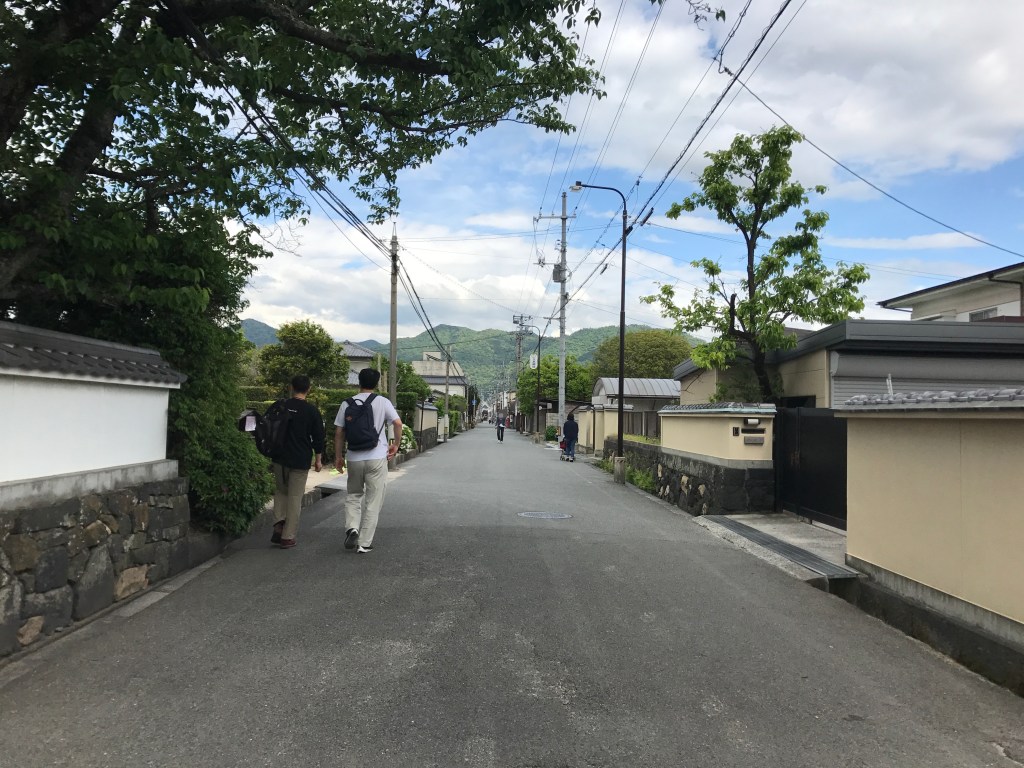
Horiuchi, the upper samurai quarter
The north-west quarter inside the outer moat was the third enclosure of the castle and the address of the senior retainers. What survives is a grid of lanes lined with long plaster walls on stone bases, interrupted by gatehouses and the occasional watchtower. The Masuda family’s arrow tower and the Shufu and Hodzumi gatehouses are the ones to look for, and the street pattern is the original layout.
The most photographed detail is the fruit. From the 1870s, when the samurai lost their stipends, the old estates were planted with summer mandarins, and the walls were kept because they sheltered the trees from wind. The result is a landscape unique to Hagi: white plaster walls with green fruit hanging over the top. 2026 marks 150 years since the first commercial orchard was planted here.
Walk the Kikuya lane and the Iseya and Edoya lanes off the old merchant street, and look for the namako-kabe walls — dark tiles laid in a raised grid on white plaster, like a sea cucumber’s skin. This is also where Takasugi Shinsaku and Kido Takayoshi were born, and both houses are open.
Hagi castle ruins and Shizuki Park
Mori Terumoto built the castle in 1604 at the foot of Mount Shizuki, combining a flat castle at the base with a mountain fort on top — one of the few hill-and-plain castles of its kind. The buildings were dismantled in 1874 and nothing was rebuilt, which is why the site is now a park of stone walls, moats and foundations rather than a concrete keep. The inner bailey is planted with cherry and azalea, and the view over the sea from the top of the hill is the reason to climb.
Entry to the park is free. It is open 08:00 to 18:30 from April to October, 08:30 to 16:30 from November to February, and 08:30 to 18:00 in March. There is a small charge for the tea house and for the boat, but the grounds cost nothing.
The merchant streets
South of the moat, the lower-ranking samurai and the merchants lived in a separate grid, and the old trade street still has the Kikuya family house, a wealthy wholesale merchant’s mansion with its shop front, storehouses and garden. The lanes here are narrower than in Horiuchi and the buildings are timber rather than wall, which makes the social geography of the town legible in a way that most castle towns are not.
Shokasonjuku and Matsushita village
East of the centre, in the village of Matsushita, a small thatched building of about 50 square metres is the school where Shoin taught. It is startlingly plain: a single room with a raised floor and a sunken area, built by his uncle and extended by Shoin himself. You can look in from outside, and that is all — the exterior is open to view at any time and there is no entry.
Next door is the hut where Shoin was confined during one of his periods of house arrest, and up the slope is Matsushita shrine, where he is enshrined. The shrine grounds are free and open at all hours, and the shrine’s small museum and the history hall nearby charge separately.
Hagi Museum
The city museum is the one indoor stop worth planning for. It occupies a building designed to look like a large samurai residence, on the site of the castle’s third enclosure, and covers the natural history, the castle town, the pottery and the restoration period, with original material relating to Shoin and Takasugi. Admission is 520 yen for adults, 310 for high school and university students and 100 for schoolchildren, open 09:00 to 17:00 with last entry at 16:30. It closes on Wednesdays from January to early March, and on a few days in January and June. Parking in front is 310 yen.
Hagi pottery
Hagi-yaki began when Korean potters were brought to the domain after the invasions of the 1590s, and it is still made in kilns around the town. The characteristic glaze is a soft off-white that crackles and stains with use, and the tea bowls are deliberately irregular. The Hagi-yaki Kaikan near Higashi-Hagi station sells work from the local kilns and runs a wheel-throwing session, and there are individual kilns you can visit further out.
The coast
Kikugahama is the beach at the north edge of the castle, a curve of sand looking out at a line of small volcanic islands, and it is a five-minute walk from the park. Hashimoto river, on the other side of town, has a row of pine trees and old villas along the bank, and a small sightseeing boat that runs from the bridge.
Food and drink
Hagi’s food is seafood and country cooking. The local fish comes from the Japan Sea and the Seto Inland Sea side, and the standard lunch is a seafood bowl or grilled fish set. The town is also known for its summer mandarins, sold as juice and marmalade, and for Hagi beef.
The local speciality that surprises people is kencho, a sweet made of rice flour and sugar pressed into a flat shape, sold by a shop that has been making it since the Edo period. The other is Hagi’s own sake, from breweries that have operated since the eighteenth century; the water in this valley is soft and the sake is correspondingly gentle.
Restaurants are concentrated along the streets between the station and the castle, and they close early. Dinner options are limited after 20:00, and many places shut on one weekday, so check before you commit to a late arrival.
Getting there and around
Hagi is the far side of Yamaguchi prefecture and the journey is the main planning problem.
- From Hiroshima or Fukuoka — Shinkansen to Shin-Yamaguchi, then the Super Hagi-go express bus from the north exit, about 60 minutes, 1,600 yen, six round trips a day. Note that the stop is the north (conventional line) exit, not the Shinkansen exit.
- Cheaper but slower — the ordinary Bocho bus from Shin-Yamaguchi via Mine takes about 100 minutes and costs 2,090 yen.
- By train — the San’in line runs along the coast to Higashi-Hagi, but from the Shinkansen you need to change at Masuda or Nagatoshi, and it takes hours. The bus is the sane option.
- By air — Hagi-Iwami airport, 75 minutes by taxi or a shared taxi booked a day ahead; Yamaguchi Ube airport, about 90 minutes by taxi.
- By car — about 25 to 30 minutes from the Eda interchange on the Ogori-Hagi road, which connects to the Chugoku expressway.
Inside the town, the Hagi Junkan Maru loop bus runs two routes around the main sights, and a one-day pass pays for itself in three rides. The walk from Higashi-Hagi station to the castle is about 25 minutes, and the town is flat enough that most people walk the centre and take the bus for the outer sights. Parking in the centre costs around 310 yen at the museum and central parks, and the second car park is free if you have paid at the first.
Where to stay
- Horiuchi and the castle area — a handful of small ryokan and guesthouses in the old samurai quarter, which is the atmospheric choice.
- Around Higashi-Hagi station — business hotels and the practical option, with restaurants and the bus stop nearby.
- Hagi Onsen — a few hotels with hot spring baths on the coast, ten minutes out.
- Yamaguchi or Masuda — possible, but Hagi is a two-hour detour from either and the town deserves the night.
Best time to visit
- Late March to April — cherry blossom in Shizuki Park and along the moats, and the busiest week.
- May — green, mild, and the Hagi festival at the beginning of the month.
- October to November — the best combination of weather and light, with the mandarins turning yellow on the walls.
- December to February — cold, quiet, and the sea is grey; the castle park closes at 16:30, which limits the day.
Summer is hot and humid, and the walk up Mount Shizuki is unpleasant in August. Hagi is a walking town in a valley, so the shoulder seasons do most of the work.
Practical tips
- Take the Super Hagi-go from the north exit at Shin-Yamaguchi, and check the return times first — the last bus leaves in the early evening.
- Do the castle park and Horiuchi in the morning and the Matsushita village in the afternoon, or the reverse; they are 20 minutes apart by bus.
- Shokasonjuku is exterior only. Do not expect to go inside.
- Bring cash for the smaller kilns, the museums and the loop bus.
- Restaurants close early. Eat lunch properly and plan dinner near your hotel.
- A car helps for the reverberatory furnace, the shipyard site and the outlying kilns, all of which are outside the walkable centre.
- The town is quiet on weekdays out of season, and some shops close without notice.
Suggested itineraries
One day, the town on foot
- Arrive on the morning bus and walk from Higashi-Hagi to the merchant streets.
- Kikuya lane, the namako walls and the birthplaces of Takasugi and Kido.
- Hagi Museum for the background, then lunch.
- Horiuchi and the castle park, and the view from Mount Shizuki.
- Bus to Matsushita for Shokasonjuku at the end of the day.
Two days, with the industrial sites
- Day one as above, with a night in the samurai quarter.
- Day two: the Hagi reverberatory furnace and the Ebisugahana shipyard site by car or taxi, then a kiln or the pottery hall.
- Finish at Kikugahama at sunset before the bus back.
Before you go
Opening hours, closure days, bus times and museum fees change, and the figures above come from the Hagi city tourism association, Hagi Museum, Matsushita shrine and Yamaguchi prefecture tourism, checked on 26 October 2026. Two things are worth reconfirming: the Super Hagi-go timetable, which has been revised more than once and has run from both exits of Shin-Yamaguchi at different times, and whether your dates fall in the museum’s winter Wednesday closures. The castle park closes at 16:30 from November, which is earlier than most visitors expect.
Sources
- Hagi City Tourism Association: castle town walking route and sites (checked 2026-10-26)
- Hagi City Tourism Association: sight list, hours and closures (checked 2026-10-26)
- Hagi Museum: hours, admission and closures (checked 2026-10-26)
- Hagi city: Horiuchi and castle town heritage map (checked 2026-10-26)
- Hagi City Tourism Association: Super Hagi-go bus from Shin-Yamaguchi (checked 2026-10-26)
- Matsushita shrine: access and precinct information (checked 2026-10-26)
- Hagi-yaki Kaikan: access and nearby sites (checked 2026-10-26)
Explore More of Japan
- Iwami Ginzan Travel Guide — the silver mine and its town, further along the same coast
- Matsue Castle Travel Guide — the next castle town east along the Japan Sea
- Tomonoura Travel Guide — an old port town on the Inland Sea side
- Kurashiki Bikan Travel Guide — merchant storehouses on the other side of the region
- Hiroshima Peace Memorial Travel Guide — the nearest big city, on the Shinkansen line you arrive on


Leave a Reply