Obihiro is not a sightseeing town. It is the capital of the Tokachi plain, a grid of wide streets in the middle of one of the most productive farming regions in Japan, and it makes no effort to look like anything else. That is exactly why it works. The food is grown and raised within an hour of the table, the pork bowl served here is the original rather than a regional imitation, and there is a horse racing discipline that exists nowhere else on earth.
Most travellers pass through Obihiro on the way to Kushiro or Akan, see the station, and leave. Give it a night and a car, or two nights and a bicycle, and the plain opens up: straight roads running to a flat horizon, dairy farms, sugar beet, a station that exists only because of its name, and the largest public pasture in the country.
Why visit
- Butadon was invented here in 1933, and the shops that made it famous are still running, still arguing about whose sauce is better.
- Ban’ei, the only heavy-horse racing in the world, runs at the Obihiro racecourse almost every weekend and costs nothing to watch.
- The Tokachi plain is Japan’s food bowl, and the farm shops sell milk, cheese and vegetables at prices that make Sapporo look expensive.
- Kofuku Station is ten minutes from the airport and one of the country’s more charming pieces of railway nostalgia.
- It is a working city, so accommodation and food cost less than in the resort towns.
Butadon: what it is and where it came from
Butadon is pork on rice, but the Obihiro version has a specific shape: thick slices of pork loin, grilled over charcoal, dipped in a soy, sugar and mirin glaze, and laid over hot white rice. That is all. The variation between shops is in the cut, the grill and the balance of the sauce, and locals hold strong opinions about all three.
The dish has a documented birthday. In 1933 a former Western-food cook named Abe Shuji opened a small restaurant called Pancho and, wanting to use the pork that was already common on Tokachi farms, put a grilled pork bowl on the menu with the slogan that it was better than eel. The shop became a butadon specialist in the mid-1960s, and the family still runs it. Around the same period a cluster of other old Obihiro restaurants — Shinbashi, Sekai-ichi Shokudo, Hageten, Kintoki — took up the dish, each with its own technique: charcoal, frypan, electric grill, caramel-dark sauce. The competition between them is what turned a local lunch into a regional identity.
The butadon shops
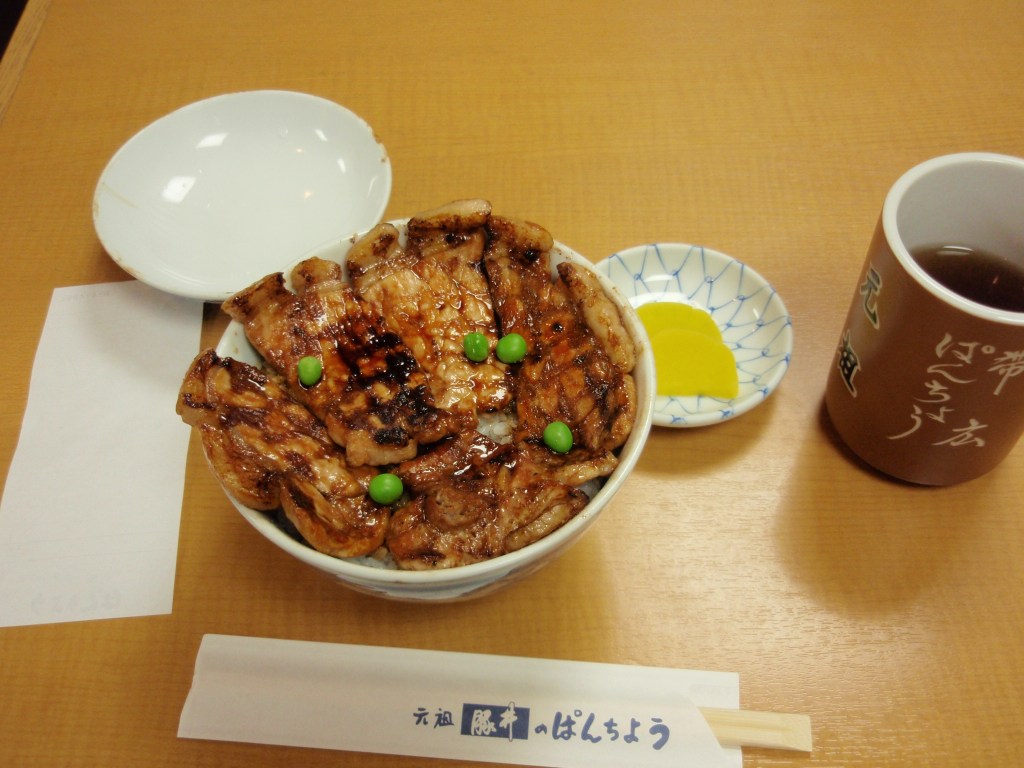
Pancho
The original, a short walk south-west of the station, with a menu that runs 松竹梅 — pine, bamboo, plum — in ascending size, and a quirk from the founder: plum, the smallest, is listed first out of gratitude to his wife. The standard bowl was around 1,250 yen in 2026. Opening hours are roughly 11:00 to 19:00, closed Mondays and the first and third Tuesdays, and there is usually a queue at lunch. Go at 11:00 or after 14:00.
Tonta
The shop that the internet queues for. It opened as a butadon restaurant in 2003, out of a family butcher business, and cuts every slice by hand from Tokachi pork; you choose loin, fillet or belly, all at a similar price, and the set comes with miso soup and pickles. The loin bowl was 780 yen in 2026, which is why the queue can run to hours in summer. Hours are about 11:00 to 18:00, closed Sundays, and service ends when the day’s meat runs out.
Hageten and the old guard
Hageten, from 1934, is a tempura and local-cuisine restaurant that also does a grilled pork bowl, using an electric grill to get the tenderness of charcoal without the smoke. Shinbashi, older still, fries the pork in a pan and uses a darker caramel sauce. These are the places to go if you want the dish with a table, a beer and no queue, and they are a fair representation of how the city actually eats.
Practical note: butadon is a lunch dish here. The famous shops sell out or close by early evening, and the ones that stay open late are not the ones worth planning around.
Ban’ei: the racing that exists only in Tokachi
Ban’ei is not horse racing as most people know it. Draft horses — the heavy, patient animals that pulled ploughs and timber carts across Hokkaido — pull an iron sled weighing close to a tonne along a 200-metre straight sand track, and have to get it over two raised earthen banks on the way. The horses weigh around a tonne themselves. Watching a pair of them dig into a bank, stop dead, and then haul the sled over it is a completely different spectacle from a flat race, and the crowd noise when one refuses is half the entertainment.
The Obihiro racecourse is at West 13, South 9, about 20 minutes on foot from the station or a short bus ride; on race days there is a free shuttle from the station. Admission is free. Races are normally held on Saturdays, Sundays and Mondays, with a season that runs from mid-April to late March, and most of the year the meetings are at night — the 2026 season scheduled 95 night meetings, with the last race around 20:30. That makes ban’ei one of the few things in Hokkaido you can do after dinner.
Inside the grounds there is a free museum of horses and farming equipment, and a small petting zoo that opens from gate time until 17:00 and closes on Tuesdays. Betting is straightforward: 100 yen a ticket, windows with English signage, and a beginner corner. You do not have to bet to enjoy it, but the sled makes more sense once you have a ticket in your hand.
Kofuku Station
Kofuku means happiness, and in the 1970s a national campaign built on the idea of a ticket from Aikoku ("love country") to Kofuku ("happiness") turned this tiny station on the Hiroo line into a phenomenon. The line closed in 1987; the station did not. Two orange diesel railcars, the platform, the wooden building and a bell remain as a free railway park, and visitors still stick pink tickets and business cards to the walls with wishes written on them.
Entry is free and there is no fixed closing time for the outdoor area, though the shop runs roughly 9:00 to 17:30 in summer and 9:30 to 15:00 in winter. It is about 30 minutes by car from central Obihiro, 10 minutes by car or taxi from Tokachi-Obihiro airport, and the airport bus stops at Kofuku for 400 yen — which makes it a plausible first or last stop of a trip. Allow 40 to 60 minutes. If you come by public transport, the local bus from Obihiro station takes 40 to 50 minutes and drops you at the Kofuku stop, five minutes’ walk away.
The plain: farms, pasture and a garden that has closed
Naitai Highland Farm
An hour north of the city, at the top of a long ridge, is the largest public pasture in Japan: about 1,700 hectares, roughly 358 Tokyo Domes, with a herd of dairy cattle and a road running seven kilometres along the spine of the ridge to a terrace at 800 metres. The view is the point — the whole Tokachi plain laid out in field patches, with the Hidaka range behind. Entry is free, the terrace cafe serves soft cream and Naitai beef burgers, and there is a car park at the top.
The season is short. In 2026 the terrace ran from 25 April to 31 October, 9:00 to 17:00, and the access gate is closed outside that window; the gate opens 7:00 to 18:00 in spring and autumn and until 19:00 in midsummer. If you are visiting between November and late April, this is not an option, and the road can be icy at the edges of the season.
Tokachi Millennium Forest
One warning for anyone working from an older guidebook: the garden at Tokachi Millennium Forest, in Shimizu, closed permanently on 12 October 2026. It had run since 2008, won the British Society of Garden Designers grand award in 2012, and was the best-known landscape garden on the plain. Forest management continues and the Kisara Farm cheese is still sold, but there is no garden to visit. Do not build an itinerary around it.
Farm shops and roadside stands
The plain is covered in direct-sale sheds and farm shops, usually with an honesty box or a small counter, selling milk, yogurt, cheese, ice cream, potatoes, beans and corn in season. They are not attractions and most have no English, but they are the real reason to have a car here. Ask at your hotel which ones are open on your dates — many shut in winter — and buy whatever is in the cooler.
Sweets, cheese and wine
Two Tokachi brands are worth a stop. Ryugetsu, the confectioner behind Sanporoku, runs Sweetpia Garden in Otofuke, 20 minutes from the station: a factory with a free viewing corridor over the production lines, a cafe with a kinako soft cream you cannot get elsewhere, and free parking. Summer hours are 9:00 to 18:00, the cafe closes at 17:00, and factory viewing runs until 16:00; winter hours are an hour shorter at each end.
An hour east, in Ikeda, the town’s wine institute sits in a mock castle on a hillside and is universally called Wine Castle. Admission is free, it is open 9:00 to 17:00 and closed over New Year, and the underground cellar holds oak barrels and old vintages, with a tasting and shop on the ground floor. The fourth-floor restaurant serves Tokachi ingredients with the local wine, 10:30 to 17:00, closed Tuesdays.
Rokkatei, the other great Tokachi confectioner, has shops in the city centre; the Marusei butter sandwich is the thing to buy, and it survives a flight home.
The zoo and the museums
Obihiro Zoo, in Midorigaoka Park, is a small, well-run city zoo with a focus on northern species. Adult admission was 420 yen in 2026 and rises to 500 yen from April 2027; children of junior high age and under are free, and a shared ticket covering the zoo, the centennial museum and the children’s hall costs 800 yen. The summer season runs late April to 3 November, then the zoo closes for a month and reopens only at weekends and on public holidays from 5 December to the end of February, 11:00 to 14:00. From 2027 the city also plans two closed days a month in summer, so check the calendar rather than assuming it is open.
The Obihiro Centennial Museum, next door, covers the settlement of the plain and the Ainu and pioneer history of Tokachi, and is the right place to understand what you have been driving through. The horse museum at the racecourse, free, covers the agricultural horses that made all of this possible.
Getting there
From Sapporo by train
The limited express Ozora runs from Sapporo to Obihiro in about 2 hours 20 minutes to 2 hours 45 minutes, with roughly eleven departures a day, some of them Tokachi services that terminate here. The fastest in the October 2026 timetable is Ozora 7, leaving Sapporo at 13:57 and arriving at 16:18. The fare is around 8,120 yen for the reserved seat. The line runs inland through Tomamu and Shin-Yubari, and the ride is scenic in winter.
From Tokyo by air
Tokachi-Obihiro airport is south of the city and handles flights from Haneda in about 1 hour 40 minutes. The airport bus to Obihiro station takes 38 minutes and costs 1,000 yen, timed to arrivals; it also stops at the racecourse (55 minutes) and at Kofuku Station (400 yen), so you can land and go straight to either. Several city hotels are on the hotel-loop bus, also 1,000 yen.
By car
From Sapporo it is about three hours via the Doto Expressway, and from Kushiro about two hours. A car is the difference between seeing Obihiro and seeing Tokachi: the pasture, the farm shops, the wine castle and the coast are all outside the city, and buses are sparse.
Getting around
Central Obihiro is flat and walkable, and the station, the butadon shops and Kita no Yatai are all within 15 minutes on foot. For everything else you need wheels. Rental cars are available at the station and the airport; rental bicycles work for the city and the riverside paths but not for the plain. Local buses run to the outskirts but infrequently, and a taxi to Kofuku Station or the racecourse is affordable if you are splitting it.
Where to stay and what to eat
Business hotels cluster around the station and are good value, with parking usually charged separately. There are a few larger hotels on the north side of the city and a handful of farm-stay and guesthouse options on the plain, which are worth it if you want to see the morning on a working farm.
For dinner, Kita no Yatai is the obvious choice: twenty tiny stalls on a covered lane five minutes from the station, each with six to eight seats, running from 17:00 to 24:00 with individual closing days. It opened in 2001 on the site of a burnt-out market and marked its 25th anniversary in 2026; the ninth intake of tenants started in April 2026 with nine new shops, because the lane replaces its cooks every three years. Menus run from yakitori and oden to French, Italian and Mexican, and everything is cooked in front of you. No reservations, no parking, cash is safest.
Beyond the yatai, Tokachi beef, jingisukan, sushi and izakaya are all cheaper here than in Sapporo, and the city has a serious cake and coffee culture built on local dairy.
Best time to visit
- June to August — the plain is green, the days are long, and the nights are cool enough to sleep. Book butadon lunches early.
- September and October — harvest, root vegetables, new rice and the best farm shops of the year, with the pasture still open until the end of October.
- November to March — deep snow, night ban’ei, and very cold mornings; the plain is beautiful and the driving is not for the unprepared.
- April and May — brown fields, muddy edges and the start of the racing season, with few visitors.
Obihiro is one of the coldest cities in Japan in winter, and the wind off the plain makes it feel colder. The compensation is that the snow is dry, the skies are often clear, and the night races run through it.
Suggested itineraries
One day without a car
- Arrive on the morning Ozora, leave your bag at the station and walk to Pancho for an early butadon lunch.
- Walk to the racecourse for the afternoon races if it is a race day, or take the bus to Kofuku Station if it is not.
- Return to the city, check in, and eat dinner at Kita no Yatai.
Two days with a car
- Day one: pick up a car, drive to Naitai Highland Farm for the morning, stop at a farm shop for lunch, return via Sweetpia Garden in Otofuke.
- Evening: ban’ei at the racecourse, then butadon or yatai in the city.
- Day two: Kofuku Station on the way to the airport, or Ikeda Wine Castle if you are heading east towards Kushiro.
Practical tips
- Butadon is lunch. Plan the famous shops for 11:00 or mid-afternoon, not 19:00.
- Race days are Saturday, Sunday and Monday; check the meeting calendar before you build a trip around ban’ei.
- The pasture and most farm shops close for winter. Between November and April, plan the city instead.
- Carry cash for farm shops, small restaurants and the yatai.
- If you are driving in winter, take the snow tyres seriously; the plain roads drift.
- Do not plan a same-day connection from the airport bus to a tight train; the bus is timed to flights, not to JR.
Before you go
Details above were checked against official sources on 26 October 2026: Obihiro city, the Tokachi tourism association, the ban’ei authority, JR Hokkaido, Tokachi Bus, the zoo, Ryugetsu and Tokachi Wine. The items most likely to move are butadon prices and shop closing days, the zoo’s admission price (rising in April 2027), the Naitai terrace season dates, and train times after the next timetable revision. Reconfirm the small shops by phone or social media on the day — several close without warning when the meat runs out.
Sources
- Banei Tokachi: race schedule, free admission and access (checked 2026-10-26)
- Obihiro city: zoo opening dates and admission (checked 2026-10-26)
- Obihiro city: Kofuku Station and Aikoku Station access (checked 2026-10-26)
- Kamishihoro town: Naitai Terrace season and hours (checked 2026-10-26)
- Tokachi Millennium Forest: closure notice, 12 October 2026 (checked 2026-10-26)
- Tokachi-Obihiro airport: bus times and fares (checked 2026-10-26)
- JR Hokkaido: Ozora and Kochi timetable, October 2026 (checked 2026-10-26)
- Kita no Yatai: current stalls and hours (checked 2026-10-26)
- Ryugetsu Sweetpia Garden: hours and free factory tour (checked 2026-10-26)
- Tokachi Wine: Ikeda Wine Castle admission and hours (checked 2026-10-26)
Explore More of Japan
- Kushiro Marsh Travel Guide — the next stop east, and a different Hokkaido
- Akan-Mashu Travel Guide — caldera lakes and forest north of Kushiro
- Asahikawa Travel Guide — the other great northern food city
- Biei and Furano Travel Guide — farm landscapes on the other side of the island
- Sapporo Travel Guide — where the Ozora starts


Leave a Reply