Mount Hiei sits on the border of Kyoto and Shiga, and for more than a thousand years it has been the most consequential religious site in Japan that most visitors have never heard of. Saicho founded a temple here in 788, gave it the era name of the emperor who supported him — Enryaku — and built an institution that trained, at one point or another, the founders of almost every major school of Japanese Buddhism. The mountain is a World Heritage site, part of the Historic Monuments of Ancient Kyoto listing from 1994.
It is also a working monastery rather than a monument, spread across three separate areas on a ridge above Lake Biwa, and it takes planning. People arrive expecting a single temple and find a forest with a hundred halls in it, connected by a shuttle bus and a lot of walking.
Why visit
- The birthplace of Japanese Buddhism as an organised force: Tendai, and through its students, Zen, Pure Land and Nichiren.
- A National Treasure main hall and a flame said to have been burning since the ninth century.
- Three distinct precincts, each with a different atmosphere, from the ceremonial east to the almost empty west.
- Views over Lake Biwa to the east and Kyoto to the west from the same ridge.
- A genuinely uncrowded World Heritage site, once you are 20 minutes from the bus stop.
A short history
Saicho, later known as Dengyo Daishi, was born in 766 and trained in Nara before withdrawing to Mount Hiei, where he established a small temple in 788 with a statue of Yakushi, the medicine Buddha, as its principal image. He later travelled to Tang China and returned with the Tendai teachings, and the mountain became the centre of a new kind of Japanese Buddhism that was less tied to the court and the old capital.
His model was unusual. Instead of a single temple, he set up a system in which monks trained on the mountain for twelve years, and the institution he built produced an extraordinary roll call: Honen of the Pure Land school, Shinran of True Pure Land, Eisai and Dogen of Zen, Nichiren, and Ryogen, who rebuilt the mountain’s organisation. That is why Hiei is called the mother mountain of Japanese Buddhism.
In 1571 Oda Nobunaga burned the entire complex in retaliation for the temple’s support of his enemies, and the halls that stand today are reconstructions funded by Toyotomi Hideyoshi and the Tokugawa shoguns, with Tenkai, the great abbot of the early Edo period, directing much of the work. The buildings are therefore mostly 17th century, but the institution and the site are not.
The three areas
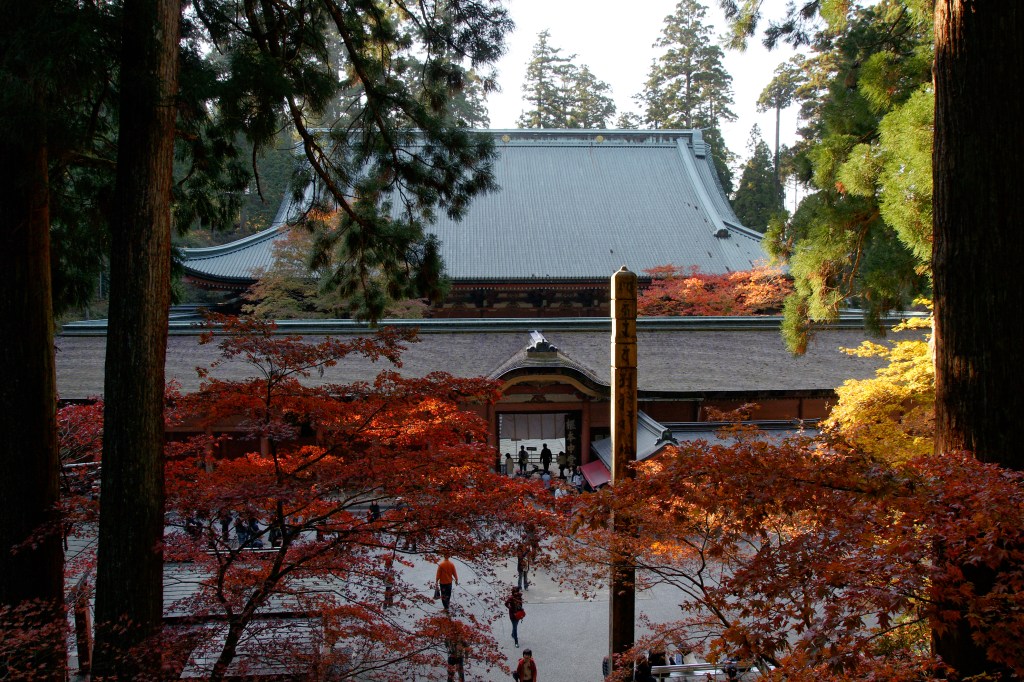
Todo, the East Pagoda area, is where Saicho began and where most visitors spend their time. The Konpon Chudo, the main hall, is a National Treasure and the largest building on the mountain, built on a stone platform with a sunken floor and a long approach through a courtyard. Inside, in normal times, the eternal flame is kept in a lamp that has reportedly burned without interruption since Saicho lit it, fed from a reservoir of oil.
Saito, the West Pagoda area, is quieter and older in feel. Its centrepiece is the Shakado, the oldest building in the complex, in the Tendai style with a steep roof, and the area also holds the Ninai-do, a hall split into two halves by a corridor, and the Jodo-in, the mausoleum where Saicho is said to be buried and where monks still bring offerings daily.
Yokawa, the farthest north, is the most remote and the least visited. The Yokawa Chudo is built on a stage against the hillside, painted vermilion, and below it are the Konpon Nyoho-to and the Ganzan Daishi-do, where people come for the small printed charms against bad luck.
The 2026 renovation: what is actually closed
This is the single most important thing to check before a visit. The Konpon Chudo is in the middle of a major restoration, and the interior has been closed to worshippers from 6 January 2026 for about two years, into early 2028.
The temple has not simply shut the experience. From 8 January 2026 the stand-in image of the hidden Yakushi Buddha and the eternal flame were moved to the Manpai-do hall nearby, where they are on temporary display, and the restoration work itself can be viewed from a designated area. So you can still see the objects and the work, but you cannot stand in the main hall, and the interior photographs you have seen in guides are not what you will get. The outer buildings, the courtyard and the rest of the Todo precinct remain open.
Tickets and hours
- Common ticket — one ticket covers Todo, Saito and Yokawa: 1,000 yen for adults, 600 for junior high and high school students, 300 for elementary school children. Groups of 20 or more pay slightly less.
- Kokuhoden — the treasure hall, with its own charge of 500 yen for adults, 300 for students and 100 for children. It holds the temple’s most important manuscripts and statues, and is worth the extra if you care about the objects rather than the buildings.
- Hours — Todo opens 09:00 to 16:00 all year. Saito and Yokawa open 09:00 to 16:00 from March to November, and 09:30 to 16:00 in December, January and February. Last reception in all areas is 15:45.
- Note — the ticket is checked at each area, so keep it. The mountain shuttle bus is separate and is not covered by the temple ticket.
Getting up the mountain
There are four routes, and they are not equivalent. The mountain is 848 metres high and the temple areas are spread over several kilometres of ridge, so the route you choose determines what you can see.
From Kyoto by bus
The simplest option: the Keihan bus 57 or the Kyoto bus 51 from Kyoto station, Keihan Sanjo or Demachiyanagi, about 60 minutes to Hieizan summit and the Enryaku-ji bus centre. The bus climbs the Hieizan Driveway and drops you at the door of the Todo area. This is the most direct route and the one to take if you have limited time.
From Kyoto by cable car
The scenic route: the Eizan railway from Demachiyanagi to Yase-Hieizanguchi, then the Eizan cable car, which climbs 561 metres on the steepest track in Japan, then a ropeway, then the shuttle bus to the temple. The cable car costs 600 yen one way or 1,200 return, and the ropeway 400 one way or 800 return. It is beautiful in autumn and closed in winter, from 5 January to 19 March in 2026.
From Shiga by cable car
The Sakamoto cable car runs from Cable Sakamoto station near Hieizan-Sakamoto to Cable Enryaku-ji station at the top, covering about two kilometres in 11 minutes, the longest cable car line in Japan, with Lake Biwa filling the window. It costs 870 yen one way or 1,660 return. It links to the Keihan Keishin line at Sakamoto-Hieizanguchi and to JR Hieizan-Sakamoto, and it makes a sensible through-route: up from Kyoto, down to Shiga, and back to Kyoto on the train. It was scheduled to be suspended for construction from 24 February to 1 March 2026, so check before relying on it in late winter.
By car
The Hieizan Driveway is a toll road that enters at the Tanotani gate and reaches the Todo area in about 10 minutes and Yokawa in about 25. Parking is available at each precinct. Note that the driveway closes at night and in snow, and that the road is one of the few places in the region where you can drive to a World Heritage temple.
Getting between the three areas
Todo, Saito and Yokawa are 10 to 30 minutes apart by road and much longer on foot, and the connecting trails are steep. The mountain shuttle bus runs between them and is the practical way to see more than one. A one-day bus pass for the mountain costs 1,200 yen, and the various Kyoto and Keihan combination tickets cover the bus as well: the Hieizan day ticket is 3,100 yen, and the Hieizan free pass 3,500 yen, sold until early December. Note that none of these include the temple admission, which is charged separately.
What to do beyond looking
- Shojin ryori — the temple’s own vegetarian cuisine, served at the Enryaku-ji Kaikan near the Todo area. It is a proper monastic meal rather than a restaurant version, and it needs booking in most cases.
- Shakyo and zazen — sutra copying and seated meditation sessions at the same facility, for two people or more, by reservation.
- Goshuin — the Todo area alone has several stamp offices, and the temple is one of the better places in Japan to start a collection, since each hall has its own.
- The walk to Jodo-in — in the Saito area, a path through cedar leads to Saicho’s mausoleum, which is one of the quietest places on the mountain and is often empty.
At the foot of the mountain
Sakamoto, at the Shiga end of the cable car, was the temple town and still has a street of large monastic residences, the monzeki temples, behind stone walls. Two of them, Shiga-in and Enyu-ji, are part of the World Heritage listing and have gardens and painted screens that are open to visitors. The stone-paved Naka-sendo path climbs from the town to the top and takes a couple of hours if you want to walk up rather than ride.
Where to stay
- Enryaku-ji Kaikan — on the mountain itself, next to the Todo area, with simple rooms and shojin meals. The obvious choice if you want the precincts at dawn.
- Sakamoto — small inns at the foot of the cable car, cheap and quiet.
- Kyoto — the practical base, an hour away by bus, and where most people stay.
- Otsu or Biwako — useful if you are combining the mountain with Lake Biwa.
Food and practicalities
There is very little to eat on the mountain outside the temple’s own restaurant and a few small stalls near the bus centre, and the options close early. Bring water and something to eat, especially if you are walking between areas. The precincts are at 848 metres, several degrees cooler than Kyoto, and in winter the paths ice over; in summer the cedar forest is humid and mosquito-heavy.
Dress respectfully. This is an active monastery, not a ruin, and the halls are places of worship before they are sights. Photography is generally allowed outdoors but restricted inside many buildings.
Best time to visit
- April — cherry and mountain cherry along the ridge, and the clearest views of Lake Biwa.
- Late October to November — the cable car through autumn colour, and the busiest weeks of the year.
- December to February — cold, quiet, and the only season when the mountain feels like a monastery. Some transport is suspended.
- June — green and wet, with few visitors and the cedars at their most atmospheric.
Suggested itineraries
Half day from Kyoto
- Morning bus from Kyoto station to the Enryaku-ji bus centre.
- Konpon Chudo and the Manpai-do display, then the Daikodo and the Todo precinct.
- Shuttle bus to Saito for the Shakado and the walk to Jodo-in.
- Back to Kyoto, or down the Sakamoto cable car for the afternoon.
Full day, both sides of the mountain
- Up from Kyoto by bus in the morning, Todo and Saito before lunch.
- Shojin lunch at the temple hall.
- Shuttle to Yokawa in the early afternoon.
- Down the Sakamoto cable car, walk the monzeki street, and take the train back to Kyoto from Sakamoto.
Before you go
The Konpon Chudo restoration is the decisive fact for any visit before 2028, and the details of what is on display change as the work progresses. Ticket prices, cable car times and the mountain bus are seasonal and occasionally suspended for construction. The information above was taken from the temple’s own ticket page, the Hieizan and Lake Biwa tourism site, Kyoto city’s tourism site and the Keihan bus ticket guide, checked on 26 October 2026. Two things are worth reconfirming before travelling: whether the Manpai-do display is still open on your date, and whether the Sakamoto cable car and the Eizan ropeway are running, since both close for maintenance in winter.
Sources
- Enryaku-ji: worship hours and ticket prices (checked 2026-10-26)
- Hieizan and Lake Biwa tourism: the three areas, cable car and bus fares (checked 2026-10-26)
- Kyoto city tourism: Enryaku-ji history and access (checked 2026-10-26)
- Kyoto city tourism: current closures, including the Konpon Chudo interior (checked 2026-10-26)
- Keihan bus: Hieizan combination tickets (checked 2026-10-26)
Explore More of Japan
- Kurama and Kibune Travel Guide — the mountain temples north of Kyoto
- Ohara Sanzen-in Travel Guide — another quiet temple valley outside the city
- Hikone Castle Travel Guide — the castle town on Lake Biwa’s eastern shore
- Kyoto Higashiyama Travel Guide — the city at the foot of the mountain
- Amanohashidate Travel Guide — the other great viewpoint in Kansai


Leave a Reply