Sado is the big island off Niigata, about 855 square kilometres, shaped roughly like the letter S and sitting 30 to 45 km out in the Sea of Japan. It has a mountain ridge down the middle, two small cities on the coasts, and a population that has halved in fifty years. It also has a gold mine that ran for nearly four centuries, a town of shipowners’ houses built from boat planks, and the last wild population of the Japanese crested ibis.
It is not a resort island. It is a working agricultural island with a lot of history in it, and it takes effort to see: the ferries are expensive, the distances are long, and the buses are infrequent. The reward is one of the least-visited World Heritage sites in Japan, and a landscape of rice terraces and cedar that has barely changed.
Why visit
- The Sado Island Gold Mines, inscribed as a UNESCO World Heritage site in 2024, with tunnels you can walk through.
- Ogi and Shukunegi, two historic port districts where the houses are built with ship’s timbers and the boats are wooden tubs.
- The Japanese crested ibis, extinct in the wild in Japan and brought back by a captive breeding programme on this island.
- One of the emptiest, quietest coastlines in Japan, with a 167-metre rock rising straight out of the sea.
- A ferry ride that feels like a proper journey rather than a transfer.
Getting there
There is no bridge and no airport with scheduled service. Everything goes by ship, and the choice of ship is the main decision of the trip.
- Jetfoil from Niigata — 67 minutes to Ryotsu, all seats reserved, around 8,250 yen one way in the 2026 summer season. Fastest and most expensive, and it can be cancelled in rough weather.
- Car ferry from Niigata — 2 hours 30 minutes to Ryotsu, second class around 3,570 yen one way, and the only option if you want to bring a car. There is a deck to stand on and a cafeteria, and it is the more pleasant crossing.
- Car ferry from Naoetsu — 2 hours 40 minutes to Ogi, on the south coast, which puts you close to the tub boats and Shukunegi but far from the gold mine.
- Fares — both vessels charge by class and season, and the jetfoil has a separate baggage allowance. Check the operator’s site rather than an old guide; the figures move with fuel and season.
Niigata port is a bus ride from Niigata station, and the terminal is large enough that you should arrive 30 minutes before departure. Book the jetfoil in advance in summer and during the autumn festival season.
The gold mine
The Sado gold and silver mine began large-scale operation in 1601, was taken under direct shogunate control, and supplied metal for the Tokugawa coinage for two and a half centuries. It kept operating through the Meiji period with machinery imported from the West, and finally closed in 1989 — which is why the site has both hand-cut Edo tunnels and a Meiji-era industrial plant on the same hillside.
There are two walking courses, and you can buy either or both.
- Sotayu-kō, the Edo picture-scroll course — about 30 minutes through hand-dug tunnels with life-size figures of miners at work. The rock walls still show the chisel marks.
- Doyu-kō, the Meiji government mine course — about 40 minutes, covering the mechanised era, with the machinery and the shafts that went with it.
- Tickets — 1,000 yen for adults and 500 for elementary school children per course, or 1,500 and 750 for both.
- Hours — 08:00 to 17:30 from April to October and 08:30 to 17:00 from November to March, open daily, with last entry 30 minutes before closing.
- Warning — the main building was scheduled for renovation during 2026 and the operator warned that opening arrangements could change. Check before you travel.
Outside the tunnels, the site’s emblem is the Doyu no Wareto, a cliff face split down the middle by centuries of surface mining, which now stands as two halves with a gap between them. Ten minutes away by car, the Kitazawa flotation plant ruins — a concrete skeleton of the ore-processing works on a hillside — are the island’s most photographed industrial relic and are free to walk around.
Ogi and the tub boats
Ogi is a small port on the south coast that made its money shipping gold and silver out and, later, as a port of call for the kitamaebune trading ships that worked the Japan Sea. The old streets of Ogi and the village of Shukunegi, 5 km west, are both designated Important Preservation Districts, and Shukunegi is the more striking of the two: about a hundred houses packed into a narrow valley behind the beach, many of them built with curved ship’s timbers for walls, with stone-weighted roof tiles and low eaves.
- Shukunegi — free to walk, with three houses open to visitors for a fee. Visitors are asked for a townscape preservation contribution of around 100 yen.
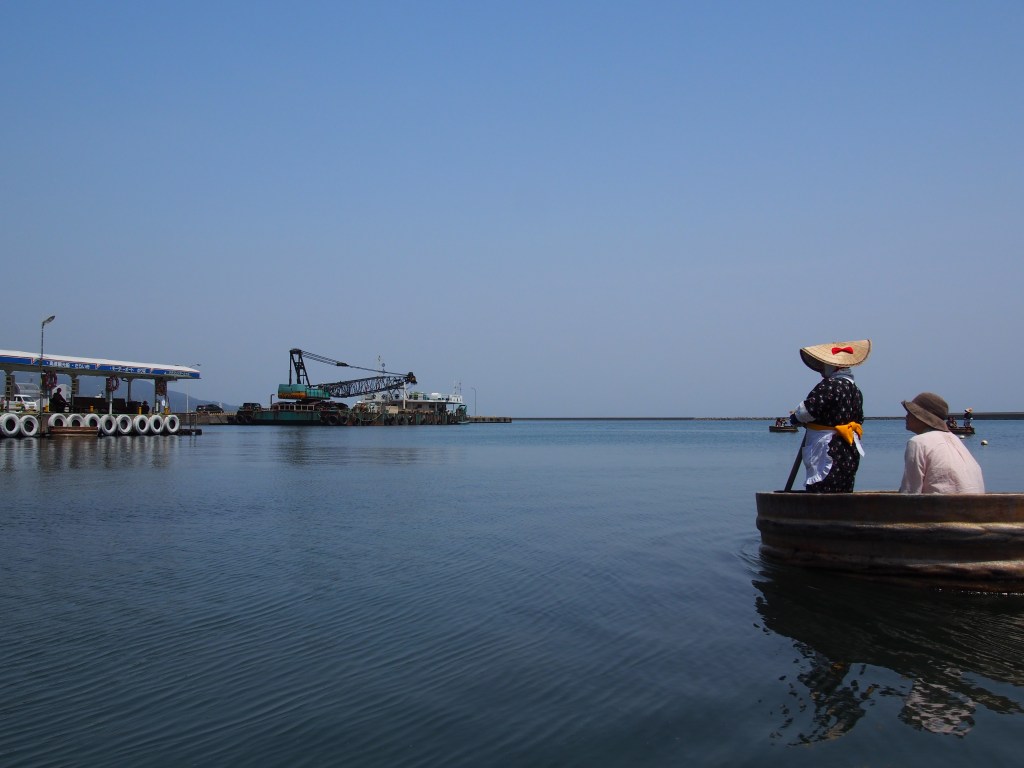
- Taraibune — the round wooden tub boats, originally used for gathering seaweed and abalone, now used to take visitors around the bay at Ogi. A ride is about ten minutes, so allow 20 for the whole thing, and costs 800 yen for adults and 450 for children at Rikiya Kanko Kisen, from 1 March 2026. No reservation is needed for individuals.
- Season — the boats run daily, from 08:20 to 17:00 between March and late October, with shorter hours in winter.
The boat is steered standing up with a single oar, and it spins in place, which is much harder than it looks. The red drum bridge behind the bay is the photograph everyone takes.
The crested ibis
The toki, or Japanese crested ibis, was reduced to a handful of birds in Japan by the 1970s and the last wild individual died in 2003. The species survived because China had a breeding population, and Japan’s birds today descend from pairs sent from China, bred in captivity on Sado and released into the island’s rice terraces.
- Toki Forest Park — 15 to 20 minutes by car from Ryotsu port, with a conservation centre and an outdoor enclosure where the birds are visible at close range. Open 08:30 to 17:00 with last entry at 16:30, closed Mondays outside the March to November season. Admission is 500 yen for adults and 200 for schoolchildren.
- Sado as an agricultural heritage site — the island was recognised as a Globally Important Agricultural Heritage System for the way its rice terraces and satoyama woodland support the birds. It was the first such site in Japan.
- Seeing one in the wild — possible, and entirely a matter of luck and patience. The released birds feed in flooded paddies, particularly in winter and spring, and the tourist offices can tell you where recent sightings have been.
The coast and the north
Onogame is the island’s signature landform: a single 167-metre rock rising out of the sea on the north coast, with a low ridge of grassland behind it. In late May and early June the slopes are covered with tobi-shima kanzo, a yellow day lily, and the site holds something like half a million plants. It is free and there is parking.
Senkaku-wan, near the north-west coast, is a bay of sharp rock towers where a glass-bottomed boat runs out to the cliffs, and Kamo Lake, the brackish lagoon beside Ryotsu, produces oysters that are served grilled at shacks around the shore in winter. The island also has several sake breweries, including ones that export, and they take visitors by appointment.
History in brief
Sado’s remoteness made it a place of exile. The retired emperor Juntoku was sent here after the Jokyu disturbance in 1221, the monk Nichiren was exiled here in 1271, and the playwright Zeami in the 1430s. The island’s Noh tradition, which is unusually strong for a rural area, is generally traced to Zeami’s exile and to the patronage that followed.
The gold mine made Sado strategically important and also made it a place of forced labour and harsh conditions, a part of the story the site does not hide. The World Heritage inscription in 2024 came after years of negotiation over how that history is presented.
Getting around
This is the hard part, and it determines the shape of any trip.
- By car — essential if you want to see more than one area. Ryotsu to Aikawa, the gold mine, is about 50 minutes; Aikawa to Ogi about 60; a full circuit of the island takes seven to eight hours. Rentals at Ryotsu and Ogi sell out in high season, so book ahead.
- By bus — the island bus network is thin. Ryotsu to the gold mine has few direct services, Ryotsu to Ogi requires a change and takes about two hours, and the buses to Shukunegi and the tub boats are rare. Plan around specific departures or you will lose the day.
- Organised tours — the ferry company sells day tours from Niigata that cover the mine, the ibis park and the flotation plant with a bus and a guide, which is the least flexible but most efficient option for a single day.
Where to stay
- Aikawa — the old mining town near the gold mine, with small inns and a couple of hotels, and the most atmosphere.
- Ryotsu — the port, with business hotels, convenient for an early ferry.
- Ogi — guesthouses near the tub boats and Shukunegi, quiet and close to the south coast.
- Niigata city — possible as a day trip on the jetfoil, but the island deserves a night and the last crossing is early.
Food
Sado’s winter yellowtail is the local celebrity: only fish over 8 kg get the name, and they are served as sashimi, shabu-shabu and teriyaki across the island in January and February. The other specialities are Kamo Lake oysters, Sado beef, and the rice and sake that come from the island’s paddies. Sobagaki, a soft buckwheat dumpling eaten with a dipping sauce, is the local comfort food. Outside the towns, restaurants are few and close early; if you are staying at a ryokan, take the dinner.
Best time to visit
- Late May to early June — the day lilies on Onogame, green rice fields, and the best weather of the year.
- August — the Earth Celebration, the taiko drumming festival run by Kodo, which fills the island.
- October — rice harvest, clear air and the start of the yellowtail season.
- January to February — yellowtail and oysters, grey seas and empty roads, and the possibility of ferry cancellations.
Practical tips
- Bring or rent a car. This is the single biggest factor in whether the trip works.
- Check the ferry status in the morning. The jetfoil is cancelled in high seas more often than the car ferry, and the car ferry is the fallback.
- Do not try to see the whole island in one day. Pick either the gold mine and the north, or Ogi and the south.
- Carry cash for the tub boats, the small museums and the Shukunegi contribution.
- Book accommodation and rental cars together and early, especially in August and during the autumn food season.
- Pack for wind. The island is exposed and the ferry crossing is cold even in spring.
- The mine tunnels are cool and damp; a jacket helps even in summer.
Suggested itineraries
Two days, with a car
- Day one: morning car ferry to Ryotsu, Toki Forest Park on the way out, then across to Aikawa for the gold mine and the flotation plant in the afternoon. Overnight in Aikawa.
- Day two: down the west coast to Ogi for the tub boats and Shukunegi, then back to Ryotsu for the evening ferry.
One day from Niigata, without a car
- Early jetfoil to Ryotsu and the ferry company’s coach tour, which covers the ibis park, the gold mine and the flotation plant.
- Back on the evening car ferry, which is slower and cheaper and lets you stand on deck as the island goes.
Before you go
Ferry fares change with season and fuel, the jetfoil can be cancelled at short notice, and the gold mine was scheduled for building work during 2026 that could alter its opening arrangements. The figures above were taken from Sado Tourism’s official guide and 2026 visitor pamphlet, the Sado Kisen ferry company, Niigata prefecture tourism material and operator pages for the individual sites, checked on 26 October 2026. Three things are worth reconfirming: the current ferry timetable and fare for your date, whether the gold mine courses are both open during the renovation, and whether the tub boats are running, since Ogi’s operations slow down in winter.
Sources
- Sado Tourism: first-time visitor guide, ferry times and island driving times (checked 2026-10-26)
- Sado Tourism: 2026 visitor pamphlet, sites, fees and seasons (checked 2026-10-26)
- Sado Kisen: day tour itineraries and ferry information (checked 2026-10-26)
Explore More of Japan
- Tateyama Kurobe Travel Guide — the mountain route on the mainland
- Kanazawa Travel Guide — the other Japan Sea castle town
- Eiheiji Travel Guide — the Zen monastery in Fukui
- Gokayama Ainokura Travel Guide — another remote community preserved intact
- Shirakawa-go Travel Guide — thatched houses in the mountains


Leave a Reply