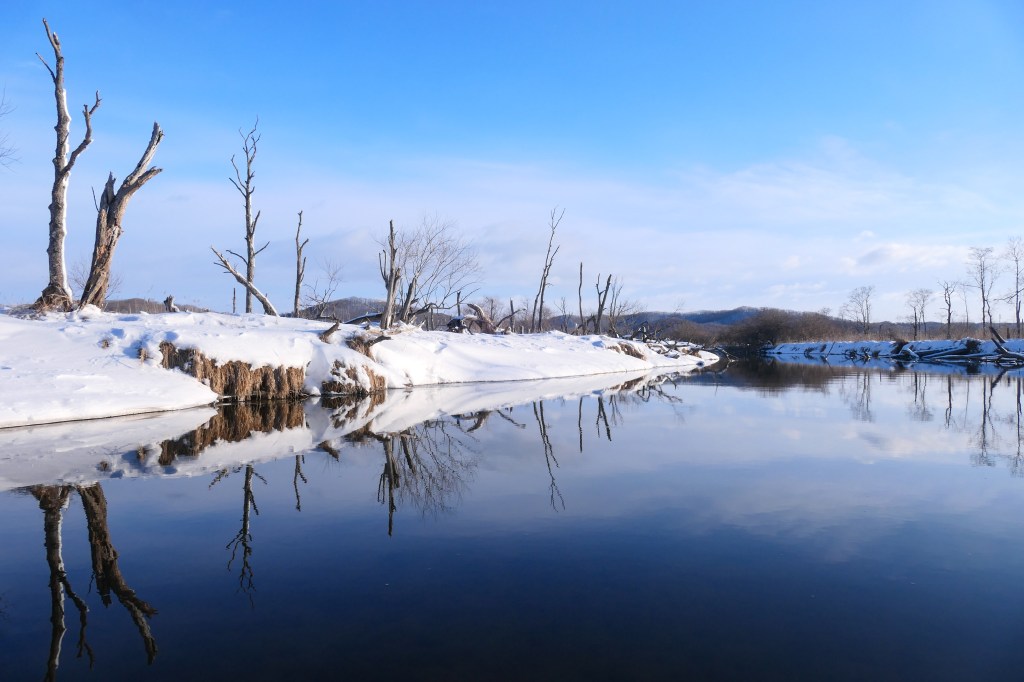
Kushiro Marsh is the largest wetland in Japan, 28,788 hectares of reed bed, alder scrub and meandering river in eastern Hokkaido, and it is not a place you look at so much as a place you look across. Almost all of it is flat. The pleasure is standing on a ridge at the edge, in wind, with the whole thing laid out below you and the Kushiro river drawing slow loops through it.
It became a national park on 31 July 1987, the first in Japan created mainly to protect a wetland rather than a mountain or a coastline. Before that it had been regarded, in the language of the time, as useless land that could not be farmed, and drainage and development had already eaten into its edges. What saved it was a campaign by local researchers and conservation groups that led to Japan’s first Ramsar designation in June 1980, covering 7,863 hectares of the marsh. The national park that followed is the larger boundary.
Why visit
- Japan’s largest marsh, and one of the few places in the country with a genuinely horizontal landscape.
- Wild red-crowned cranes, a national special natural monument, wintering at feeding stations in the villages to the north.
- Two completely different viewpoints on the east and west edges of the marsh, each free or almost free.
- A railway that runs along the marsh’s eastern rim, with small stations that put you on the edge of the reed bed in 20 minutes from Kushiro.
- Very few foreign visitors, and in winter, very few visitors of any kind.
The marsh and the river
The Kushiro river is the reason the marsh exists and the reason it is worth seeing from above. It enters the wetland and slows down, dropping its sediment in loops that shift slightly every year, so the channel you photograph is not quite the one in last year’s photograph. Around it are stands of yachibozu — tussocks of sedge that rise out of the water like small haystacks — and behind them a low horizon of alder and oak on the surrounding hills.
The wildlife list is long for a place this close to a city of 160,000 people: about 700 species of plant and around 1,300 species of animal have been recorded, including 39 mammals and roughly 200 birds. Red fox and Ezo deer are common at the edges, white-tailed eagles and Steller’s sea eagles come down in winter, and the marsh is one of the last strongholds of the Japanese huchen, a large salmonid now rare in the rest of the country.
Which viewpoint to choose
This is the single most common planning mistake at Kushiro. The marsh is big enough that the east and west viewpoints are not combinable in an afternoon; there is impassable wetland between them, and the road goes around. Pick one side for the day.
East side: Hosooka Observatory
Hosooka is the classic view, the one on the posters: the river’s meanders seen from a bluff with the Akan mountains behind, and nothing between you and the horizon. It is free, it has no closing time, and it is a 15 to 20 minute walk along a forest track from Kushiro-Shitsugen station, which makes it the only major viewpoint reachable by train.
The walk in is flat and easy in summer and icy in winter, so bring shoes with grip. There is a small visitor lounge near the station with displays, toilets and a rest area, usually open 10:00 to 16:00 in the winter months and longer in summer. Sunset is the reason many people come, and the marsh turns orange while the river goes silver.
West side: Kushiro City Marsh Observatory
On the other side, closer to the city, the municipal observatory is a building shaped like a yachibozu tussock, with an exhibition floor, a shop and restaurant, a rooftop viewing deck and a 2.5 km boardwalk loop through the forest and wet meadow outside. Entry to the observatory is 480 yen. The boardwalk is barrier-free and open to all.
Akan bus runs from Kushiro station to the observatory in about 40 minutes for 690 yen, and sells a combined bus and admission ticket. About 500 metres north of the observatory, a roadside parking area has the small Hokuto viewpoint, also called the satellite observatory, which is free and faces the sunrise.
The other viewpoints
Sarubo Observatory looks over Lake Toro, the largest lake in the marsh, and is a well-known spot for photographing the tourist train as it crosses the wetland. Sarurun, about 800 metres further on, is quieter and looks over Sarurun pond. On the north side, the Kottaro Marsh Observatory overlooks the area with the largest concentration of cranes in the park, and Onnenai has a visitor centre and a long wooden boardwalk into the reeds. All of these need a car.
The cranes
The red-crowned crane is the reason many people come to eastern Hokkaido at all, and Kushiro is where the population is. The birds were thought to be extinct in Japan in the late nineteenth century, were rediscovered in the Kushiro marshes in 1924, and were pulled back from a few dozen individuals by winter feeding that local farmers began in the 1950s. There are now well over a thousand, and the species is still listed as endangered.
The crucial thing to understand is that the cranes are not scattered across the marsh for visitors to find. In winter they concentrate at a handful of feeding stations in Tsurui village and around Kushiro, and that is where you see them, at close range and in numbers.
- Tsurui Ito Tancho Sanctuary — run by the Wild Bird Society of Japan on land donated by Yoshitaka Ito, who fed the cranes for decades. It is open from 1 October to 30 March, 09:00 to 16:00, closed Tuesday, Wednesday and the first Thursday of the month, plus the new year period, and admission is free. Feeding happens in winter and the nature centre explains the birds’ calls and behaviour. It is about an hour by car from Kushiro station, or the Akan bus to Tsurui village office and a 15 minute walk.
- Tsurui-midai — the best-known feeding station, where feeding runs from mid-November to early March, usually once around 09:00 and once in the early afternoon, dropping to the morning only by March. On a good day more than a hundred birds are present at once. Akan bus runs from Kushiro station to the area in about 50 minutes.
- Kushiro City Tancho Crane Natural Park — a semi-natural enclosure on the edge of the city where birds are kept and bred, so cranes are guaranteed rather than hoped for. Open from 09:00, closing at 16:00 between 15 October and 9 April and at 18:00 in summer, closed 31 December to 3 January. This is the right choice if you are travelling outside winter or cannot match a feeding time.
Keep your distance, do not feed the birds yourself and do not use a drone. The feeding stations are working farms and conservation sites, not attractions built for photographers.
Trains and the marsh line
The Senmo line runs from Kushiro north-east along the marsh edge to Abashiri, and it is the cheapest way into the wetland.
- Kushiro to Kushiro-Shitsugen — 17.6 km, about 19 to 20 minutes, 440 to 470 yen. This is the station for Hosooka Observatory.
- Kushiro to Toro — about 40 to 50 minutes, 640 yen, at the north end of Lake Toro and the base for canoe trips.
- Frequency — a handful of ordinary trains a day. Miss one and you may wait two or three hours, so check the timetable before you set out and build the day around the return train.
- The Norokko — the seasonal open-window observation train that ran between Kushiro and Toro from spring to autumn, slowing at the best stretches and announcing wildlife. Reports in 2026 said the train had reached the end of its run, with the final regular service on 10 October 2026. If you were planning a trip around it, check JR Hokkaido’s current information rather than any older guide.
- The winter steam train — the SL Fuyu no Shitsugen-go runs between Kushiro and Shibecha from January to March, with reserved seats that sell out quickly. It is the winter equivalent and the more spectacular of the two.
Getting there
- By air — Kushiro airport, about 95 minutes from Haneda, then 20 minutes by car to the west observatory or 40 minutes to the city.
- By train — the Super Ozora limited express from Sapporo to Kushiro takes about four hours. From Kushiro station, the Senmo line or the Akan bus.
- By bus — Akan bus from Kushiro station to the marsh observatory, about 40 minutes, 690 yen, with a bus-plus-admission ticket available.
- By car — the most flexible option by a wide margin. The marsh’s viewpoints are spread over 30 to 40 km of back roads, and the cranes are another 30 km north. Rent a car in Kushiro or at the airport if you want to see more than one site in a day.
Where to stay
- Kushiro city — the practical base, with the most hotels, restaurants and transport. The marsh is 20 to 40 minutes away.
- Toro and Lake Toro — a handful of guesthouses and canoe operators on the north side, the quietest option and the best for early morning on the water.
- Tsurui village — farm stays and small inns near the crane feeding stations, which is what you want if cranes are the priority.
- Akan — hot spring hotels an hour north, a sensible combination with the marsh in winter.
Food
Kushiro is a fishing port, and the local speciality is kushiro ramen, a thin, light soy broth that is deliberately restrained compared with Sapporo’s miso. The city also has a strong sushi and shellfish scene, and the Robata grill area near the station does charcoal-grilled fish and scallops in the evening. Around the marsh there is almost nothing: a restaurant at the west observatory, a cafe at Toro, and otherwise nothing for 30 km. Carry food and water.
Best time to visit
- January to March — cranes at the feeding stations, the steam train, and the marsh under snow. The best season, and the coldest.
- June to August — green, mild, around 20 degrees, and the season for canoe trips on the river and lake.
- Late September to October — reed beds turning gold, and the clearest air of the year.
- April to May — snowmelt and high water, good for birds, but the roads and trails can still be wet.
Winter temperatures drop well below freezing and the wind across the marsh is constant. The upside is that the cranes are concentrated and the crowds are almost nil.
Practical tips
- Decide east or west before you leave the city. Trying to do both in one day is a waste of the day.
- Check the Senmo line timetable first and plan backwards from the return train.
- Bring binoculars. The marsh is flat and wide and most of what you want to see is far away.
- Do not walk into the reed beds. The ground is waterlogged and the trails exist for a reason.
- The east viewpoint has no shop. Buy food in Kushiro.
- For the cranes, arrive before the morning feeding, not after.
- Rent a car if you have more than one day. Public transport reaches the two main viewpoints but not the cranes, the northern observatories or the canoe put-ins.
- In winter, check road closures and train cancellations; blizzards shut the line.
Suggested itineraries
One day without a car
- Morning train from Kushiro to Kushiro-Shitsugen station.
- Walk to Hosooka Observatory, and stay an hour.
- Back to Kushiro for lunch, then the Akan bus to the west observatory and its boardwalk.
- Return to the city for dinner.
Two days with a car, in winter
- Day one: west observatory in the morning, Toro and Lake Toro after lunch, overnight in Kushiro or Toro.
- Day two: Tsurui-midai before the morning feeding, the Ito sanctuary at midday, and the Tancho natural park on the way back if the weather closes in.
Before you go
Opening days, train times, feeding times and the status of the seasonal trains all change, and in eastern Hokkaido the weather can rewrite a day’s plan by breakfast. The information above was taken from the Ministry of the Environment’s park material, the Kushiro Marsh national park liaison council, Hokkaido’s official tourism site, the Akan bus company and the Kushiro city crane park, checked on 26 October 2026. Three things are worth reconfirming: whether the Norokko observation train is running at all, since 2026 was reported as its final season; the exact feeding times at Tsurui-midai, which shift with the birds; and whether the Senmo line is operating normally, since winter storms suspend it.
Sources
- Ministry of the Environment: Kushiro Marsh National Park overview (checked 2026-10-26)
- Kushiro Marsh national park liaison council: Tsurui Ito Tancho Sanctuary (checked 2026-10-26)
- Hokkaido tourism: Kushiro Marsh viewpoints, wildlife and fares (checked 2026-10-26)
- Akan bus: access, observatories and seasonal trains (checked 2026-10-26)
Explore More of Japan
- Akan Mashu Travel Guide — the caldera lakes an hour north
- Shiretoko Travel Guide — the World Heritage peninsula further east
- Abashiri Drift Ice Travel Guide — the end of the same railway line
- Biei and Furano Travel Guide — the other great Hokkaido landscape
- Sapporo Travel Guide — where the limited express to Kushiro starts


Leave a Reply