Gero is a small hot spring town in the Hida mountains of Gifu, built on both banks of the Hida river where the valley narrows, and it has been trading on one claim for about 400 years: the water is unusually good for your skin. The town was named one of Japan’s three great springs by the Edo-period Confucian scholar Hayashi Razan, alongside Arima and Kusatsu, and the comparison has stuck ever since.
The claim is chemically defensible. Gero’s water is an alkaline simple spring around pH 9.1, colourless, close to 55 degrees at the source, and the alkalinity gives it the slippery, slightly soapy feel that Japanese bathers call a beauty bath. What that means in practice is that a night here is cheap, the bathing is excellent, and the town itself is small enough to walk in an afternoon.
Why visit
- Excellent water at a low price: three public baths, all under 500 yen, with no need to book a ryokan to use them.
- A compact, walkable town with the river running through the middle and free foot baths along the bank.
- A museum devoted entirely to hot springs, which sounds like a joke and is actually interesting.
- Gassho Village, a collection of relocated thatched farmhouses including an Important Cultural Property, without the crowds of Shirakawa-go.
- An easy stop between Nagoya and Takayama on the same railway line, so it fits into a Hida itinerary without a detour.
The water
The town takes its springs seriously in a way that is more than marketing. Since 1974 it has operated a centralised system: water from 12 sources is collected, mixed, cooled to the right temperature and then distributed to every hotel and bathhouse in town. That is why the water in a cheap public bath and in an expensive ryokan is essentially the same, and why the town can promise a consistent temperature instead of letting each property manage its own source.
The source temperature is around 55.6 degrees Celsius, and the water is delivered at roughly 42. The mineral content is low, the water is clear, and the effect on skin comes mostly from the alkalinity rather than from sulphur or salt. People with sensitive skin generally find it gentle; the trade-off is that it does not have the dramatic colour or smell of a sulphur spring, and if you want that, you are in the wrong valley.
Bathing in town
Gero has three public baths, all run by the same local company, all within a few minutes of each other, and all cheap enough that you can try more than one in a day.
- Shirasagi-no-Yu — 470 yen for adults, 180 for elementary school children and 100 for infants, open 10:00 to 20:45 with the last entry at 20:00, closed Wednesdays (Friday when Wednesday is a holiday). The building is a white Taisho-era structure from 1926 with a hinoki indoor bath and, unusually, a tatami-covered floor around the tub, which is easier on the feet and rarer than it sounds. There is no soap or shampoo in the bath; you buy sachets at the counter or bring your own.
- Kuagarden open-air bath — 700 yen for adults, 400 for elementary children, open 08:00 to 20:45, closed Thursdays (the next day when Thursday is a holiday). Six different baths, including outdoor tubs facing the river, and the one to choose if you want to sit outside.
- Kouno-yu — 470 yen for adults, open 14:00 to 21:00, closed Monday and Tuesday. A bathhouse attached to a ryokan, with a sauna, on the far side of the river.
Combination tickets cut the cost further: Shirasagi-no-Yu plus the museum is 650 yen for adults against 870 separately, and all three of Shirasagi-no-Yu, Kuagarden and the museum is 1,300 yen against 1,670. The ticket is sold at each of the three counters.
Hotels also sell day passes, and the ryokan association issues a bathing pass that covers three member hotels, which is the best way to see the more elaborate outdoor baths without staying. Ask at the tourist information office by the station.
The Funsenchi
The symbol of the town is a pool of source water on the gravel bank of the Hida river, right in the middle of the streets, with steam coming off it in cold weather. It was a mixed open-air bath for centuries and is now closed to bathing — that changed on 1 December 2021 — but it remains a free foot bath and the place everyone photographs. It is cleaned between 07:00 and 08:00, so do not plan a dawn soak.
There are several other free foot baths through the town, including one in front of Shirasagi-no-Yu built around a statue of Venus. Bring a small towel; none of them provide one.
Gero Onsen Museum
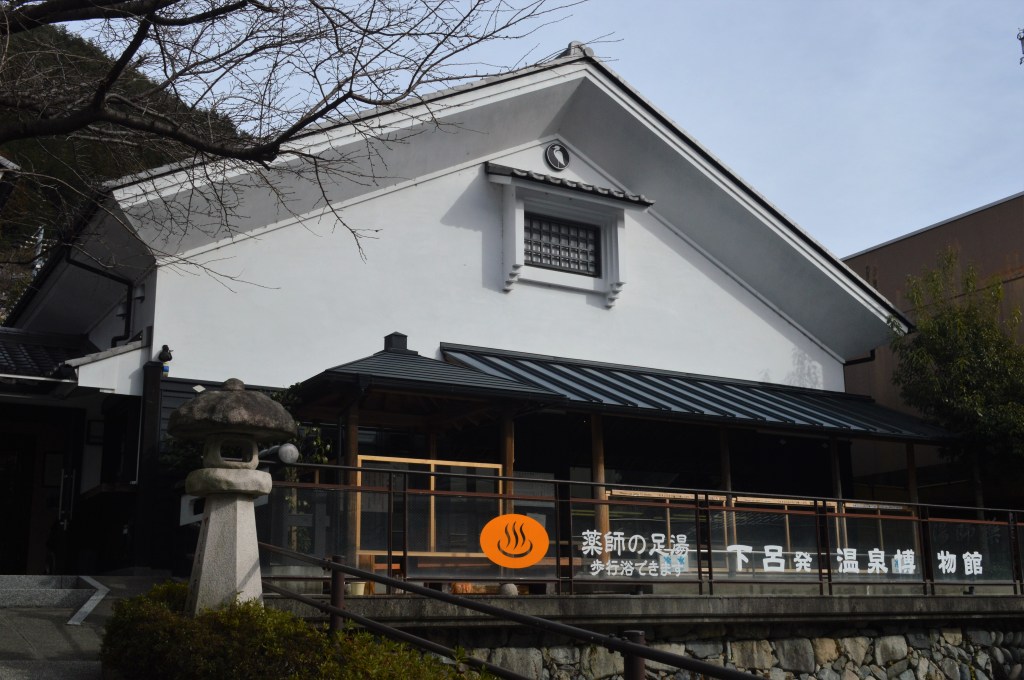
The Gero Onsen Museum is a small, genuinely odd museum about hot springs as a subject: the geology, the chemistry, the history of bathing, and the bathing cultures of other countries. It is open 09:00 to 17:00 with last entry at 16:30, closed Thursdays (the next day when Thursday is a holiday) and 30 and 31 December. Admission is 400 yen for adults and 200 for elementary school children, with infants free.
The best thing in it is outside the exhibition rooms: a walking foot bath where you alternate between warm spring water and cold water, stepping around a circular channel. It is free with admission, but you need a towel, and if you have forgotten one the museum sells them for 250 yen.
Gassho Village
On the hill above the station, Gero Gassho-mura is a reconstruction of a mountain village made of ten thatched gassho-style houses moved here from Shirakawa-go and elsewhere in the region. The centrepiece is the former Oto family house, an Important Cultural Property, and the others hold a folklore museum with farm tools and household goods, a hall of Enku Buddhist carvings, a teahouse and workshops for pottery, painted ceramics and handmade paper.
It is open 08:30 to 17:00 with no closing days, costs 800 yen for adults and 400 for children, and takes about an hour. It is a 20-minute walk from Gero station or six minutes on the Nohi bus. Compared with the real Shirakawa-go it is small and slightly artificial, but it is also empty, and on a rainy afternoon that counts for a lot.
Around the town
The main pleasure of Gero is walking the two streets that run along either bank, crossing the bridges, and stopping at whatever foot bath is in front of you. It takes about an hour to see the centre, and there is not much more to it than that, which is the point.
Above the town on the western hill is Onsenji, the temple tied to the shirasagi legend that explains how the spring was found. According to the story, a wounded white heron was seen healing itself in the river, and the villagers followed it to the source. The temple is reached by a long flight of stone steps through the trees, and the climb is worth it for the view back over the valley and the steam rising between the roofs. The grounds are free, and the walk up takes about 15 minutes from the bridge.
At the station end of town there is a small morning market with pickles, dried fish and rice crackers, and a few shops selling Hida woodwork and sarubobo dolls, the red faceless amulets that are the region’s most ubiquitous souvenir. Neither is worth a special trip; both are pleasant if you are waiting for a train.
The river itself is the other attraction. In summer the town runs fireworks over the water on some evenings, watched from the bridges and the banks, and in winter the same stretch of river carries steam off the hot water that drains into it, which on a cold morning looks like the whole town is on fire.
Getting there
- From Nagoya — the JR Hida limited express on the Takayama main line to Gero, about 90 minutes. This is the easiest approach and the one most people use.
- From Takayama — the same line in the other direction, about 45 minutes by limited express.
- From Tokyo — Shinkansen to Nagoya, then the Hida; roughly four hours in total.
- By car — about 60 minutes from the Nakatsugawa interchange on the Chuo expressway via route 257, or about two hours from Nagoya. There are several paid car parks in the town centre.
Gero station is on the east bank, and the town centre is a 5 to 10 minute walk across the bridge. Many ryokan run free shuttles from the station, and the tourist office is immediately outside the exit.
Where to stay
- Along the Hida river — the classic ryokan strip, with rooms facing the water and outdoor baths on the roof or the bank. The most expensive and the most atmospheric.
- Near the station — business hotels and cheaper ryokan, practical for a one-night stop between Nagoya and Takayama.
- On the hill above town — a few larger hotels with big baths and views, slightly further from the streets.
- Takayama — possible as a day trip in the other direction, but Gero is a night-place and the town is dull in the middle of the day.
Food
This is Hida, so the food is Hida beef, soba and hoba-miso — miso and spring onion grilled on a dried magnolia leaf over a small flame, which arrives at almost every ryokan dinner in the region. The town has a handful of restaurants around the station and the river, plus a morning market near the bridge with pickles and rice crackers. Kei-chan, the local chicken and cabbage dish, is worth ordering if you see it.
Dinner is mostly eaten at your hotel. Independent restaurants are limited and close early, so if you are not on half board, plan to eat before 19:00.
Best time to visit
- Early April — cherry blossom along the Hida river, and the town at its best.
- Late October to mid November — autumn colour on the valley walls, visible from the outdoor baths.
- January to February — snow on the town, steam on the river, and the quietest season.
- Golden Week and summer weekends — busiest, with fireworks over the river on some summer evenings.
Practical tips
- Bring a small towel. The public baths charge 250 yen for one, and the free foot baths assume you have your own.
- The public baths have no soap or shampoo. Buy sachets at the counter or bring them.
- Carry cash. Shirasagi-no-Yu does not take cards.
- Check the closing day before you plan a bath: Shirasagi-no-Yu closes Wednesday, Kuagarden Thursday, Kouno-yu Monday and Tuesday.
- The town is small. Two nights is generous; one night plus an afternoon is enough for the baths and the museum.
- If you are coming from Takayama, buy the limited express ticket in advance; the Hida is a two-car train in some seasons and fills up.
- Do not expect much nightlife. Gero is a place to bathe, eat and sleep.
Suggested itineraries
One night between Nagoya and Takayama
- Arrive early afternoon and walk the river and the Funsenchi.
- The hot spring museum and its walking foot bath.
- Check in, dinner, then a late bath.
- Next morning, Shirasagi-no-Yu before the train.
Two nights, with the village
- Day one: arrive, museum and town walk, evening bath.
- Day two: Gassho Village in the morning, Kuagarden in the afternoon, dinner in town.
- Day three: an early public bath, then on to Takayama or back to Nagoya.
Before you go
Bath prices, closing days and museum hours at Gero are stable but do change, and the town’s official pages and the individual bathhouses have sometimes quoted different figures for the same facility. The numbers above come from the bathhouses’ own pages and the city of Gero, checked on 26 October 2026. Two things are worth reconfirming: the current price at Shirasagi-no-Yu, where the city page still shows an older rate, and whether the bathing pass for member ryokan is being sold, since it is issued by the local association and is not always available out of season.
Sources
- Shirasagi-no-Yu: hours, prices and water quality (checked 2026-10-26)
- Gero city: hot spring history, water quality and public bath list (checked 2026-10-26)
- Gero Onsen Museum: hours, admission and the walking foot bath (checked 2026-10-26)
- Gifu prefecture tourism: Gero Gassho Village (checked 2026-10-26)
Explore More of Japan
- Takayama Travel Guide — the old merchant town up the same line
- Shirakawa-go Travel Guide — the real gassho village, where Gero’s houses came from
- Gokayama Ainokura Travel Guide — the quieter World Heritage village in Toyama
- Kamikochi Travel Guide — the valley walk in the northern Alps
- Magome and Tsumago Travel Guide — the old post road on the Nagoya side


Leave a Reply