Planning a trip? Hotels near Zao Onsen · Tickets and tours (affiliate links)
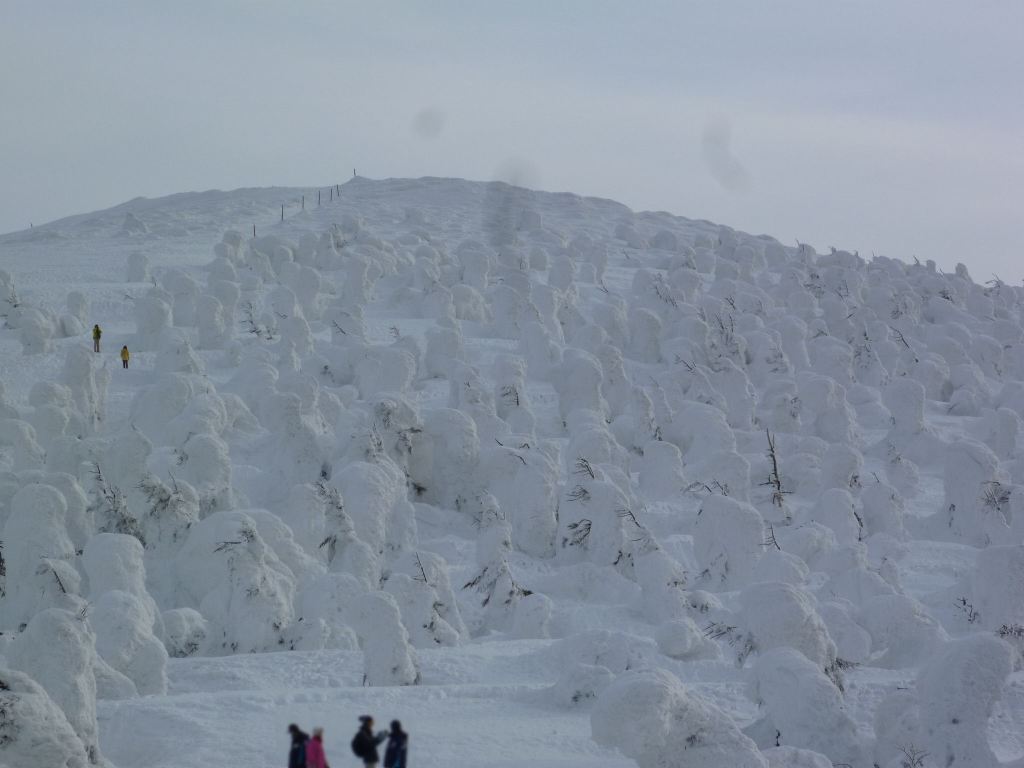
Zao Onsen is a single street of ryokan and bathhouses at 880 metres on the Yamagata side of the Zao massif, and for two months a year it becomes the base camp for one of the strangest landscapes in Japan. The maru-momi fir trees on the ridge above the resort are killed by wind-driven ice in winter and buried in snow, and what is left when the snow sets hard is a field of white shapes that look like hunched figures — the juhyo, or snow monsters.
The town itself is older than the skiing. It has been a spa for a very long time by Japanese standards; the local foundation legend puts its discovery around 1,900 years ago, during the legendary eastern campaign of Yamato Takeru, and it was a busy pilgrim resort on the western approach to the Zao shrines well before the ropeway existed. The water is the reason people kept coming: strongly acidic, sulphur-rich, milky, and unlike almost anything else in the country.
Why visit
- The juhyo, which you ride a ropeway to see rather than hike to, and which can be seen by day or floodlit at night.
- Some of the most aggressive hot spring water in Japan, at pH 1.25 to 1.6, in baths that cost 300 yen.
- A large, genuinely varied ski area on the same mountain, with terrain for beginners and for people who want to ski through the snow monsters.
- A single compact village where everything is within a 15-minute walk of the bus terminal.
- One of the few places where you can combine a volcanic summit hike and a sulphur bath in the same afternoon in summer.
What the juhyo actually are
They are not a species of tree and they are not frozen waterfalls. The host is the maru-momi, a type of fir that grows on the exposed ridge, and the process needs three things at once: temperatures well below freezing, supercooled fog or cloud driven by strong wind, and trees tall enough to catch it. The ice builds on the windward side and the tree is gradually encased, then buried, until only the shape remains. The Japanese name for them is juhyo; the English name, snow monsters, comes from the way the weighted tops lean like heads.
The best window is late January to late February, when the snow is deep and the shapes are fully formed. The season runs from late December to late March, but early and late in that window the monsters are smaller and patchier. The trees that host them are declining in number, which is one reason the local tourism bodies push the season so hard: this is a landscape with an expiry date.
The ropeway
Access to the juhyo is by the Zao Ropeway, a two-stage lift from the base station at the edge of the village.
- Sanroku line — 1,734 metres and 464 metres of height in about 7 minutes, in a 53-passenger cabin.
- Sancho line — 1,872 metres in about 10 minutes, in a 16-cabin circulating gondola of the type used in the Alps, which is steadier in wind.
- Juhyo Kogen station — 1,331 metres, the middle stop, with the Iroha pond and Misho-daira walks in summer. Return fare 2,200 yen for adults.
- Jizo Sancho station — 1,661 metres, the top, with the Zao Jizo statue, the alpine plant garden and the trailheads for Jizo-dake, Kumanodake and Katta-dake. Return fare 4,400 yen for adults, 2,200 for children, or 2,200 and 1,100 one way.
- Hours — base line 08:30 to 17:00, summit line 08:45 to 16:45, with the last upward run to Jizo Sancho leaving the base at 16:00. The lift stops in high wind and whiteout.
In winter the summit station is the viewing point: you step out onto a deck above the juhyo field, and the ridge below is a slope of white shapes with skiers threading between them. In summer the same lift gives access to the crater lake at Okama on the Miyagi side, but that is a hike of an hour and a half or more each way along the ridge, and the Zao Echo Line road, which is the direct route to the lake from the Miyagi side, is closed from early November to late April.
The Zao Juhyo Festival
During the season the resort runs a festival with a light-up of the juhyo from 17:00 to 21:00, which is a separate experience from the daytime view: the shapes are lit in colour against a black sky, and the effect is closer to a stage set than a landscape. In 2026 the festival ran from 27 December to 23 February, and the headline event was the torchlight ski descent on 7 February, when a few hundred skiers come down the Uwanodai slope carrying lights, followed by a short fireworks display. There are also snow-play areas for children and a stamp-collecting walk around the ski area’s power spots.
The night viewing depends entirely on the weather, and the ropeway will not run in wind or heavy cloud. Build a second night into your plans if the juhyo are the main reason for the trip.
The onsen
Zao’s water comes out at 45 to 66 degrees Celsius at a rate of about 5,700 litres a minute, and it is acidic enough that the bathhouse fittings are visibly corroded. The sulphur turns silver black and the acidity stings broken skin; the local advice is not to wear jewellery and not to stay in for long. The claimed effects are on skin and circulation, and the water is emphatically not for everyone — the resort’s own guidance lists skin and mucous membrane sensitivity, acute illness, active tuberculosis, serious heart and kidney disease and pregnancy as reasons to stay out.
- Three public bathhouses — Kami-yu, Shimo-yu and Kawa-ra-yu, all open 06:00 to 22:00 all year, 300 yen for adults and 100 for children, paid into a box at the entrance. These are the cheapest and most local option, and the buildings themselves are part of the streetscape.
- Dai Rotenburo — the large open-air bath in the ravine, 09:00 to 17:00 on weekdays and to 18:00 at weekends, closed from late November to mid-April when the gorge is under snow.
- Other day-use baths — Genshichi Rotenburo and the Kawaraya bath, among others, with hotel day passes in the 500 to 1,500 yen range.
- Three foot baths in the village, free, including one at Shimo-yu that is open the same hours as the bathhouse.
Note that the public bathhouses are unstaffed and cash-only, that some close for cleaning in the middle of the day, and that the whole village smells of sulphur. That is not a fault. It is what you came for.
Skiing
The Zao Onsen ski area is one of the largest in Tohoku, with slopes on several faces of the mountain and a run that takes you through the juhyo field itself, which is the reason many people come. Beginners have wide, gentle slopes at the base around Uwanodai; the upper mountain is steeper and more exposed, and the summit lift can close for wind. In January and February the snow is reliable and the trees are at their heaviest, but visibility on the ridge can drop to nothing in minutes. Rentals and ski school are available in the village.
Getting there
- By bus — from the east exit bus terminal at JR Yamagata station, the Yamako bus to Zao Onsen takes about 40 minutes and drops at the Zao Onsen bus terminal. From there it is a 15-minute walk uphill to the ropeway base station.
- By car — about 30 minutes from central Yamagata city, and about 20 minutes from the Yamagata-Zao interchange. Parking at the ropeway is paid in winter and fills early on weekends.
- By taxi — roughly 7,000 yen from Yamagata station, which is worth it if you are a group and arriving late.
- Combined tickets — the bus company sells a return bus plus ropeway package from Yamagata station in the green season, which is cheaper than buying separately but not sold on the bus or at other counters.
- From Sendai — the Yamagata Shinkansen to Yamagata, then the bus; about two hours in total.
Where to stay
- Zao Onsen village — the obvious choice, from large ryokan with their own baths to small pensions and minshuku. Book months ahead for the festival weekends in February.
- Yamagata city — cheaper and with more restaurants, 40 minutes away by bus, workable if you start early.
- On the Miyagi side — the Zao Sanroku area near the Echo Line, useful for Okama in summer but a long way round to the juhyo in winter, since the road is closed.
Food
Village food is mountain food: soba, ramen, curry and grilled meat, aimed at skiers and served in large portions. Yamagata’s own specialities are worth seeking out in the city rather than the resort — imoni, a pork and taro stew cooked outdoors in autumn, and Yonezawa beef. In the village, the practical choice is to book half board at your hotel, because the number of independent restaurants is small and they close early.
Best time to visit
- Late January to late February — the juhyo at full size, the festival, and the coldest, clearest air. Also the busiest.
- Late December to early January — snow and festival lights, smaller monsters, holiday crowds.
- May to June — green season, the Iroha pond walk from the middle station, and the alpine plants coming out.
- Late September to October — autumn colour on the upper mountain, and the ropeway at its most comfortable.
- July to August — the summit ridge and the Okama hike, with the village 10 degrees cooler than the plain.
Practical tips
- Check the ropeway’s operating status on the morning of your visit. Wind closures are common and the website updates early.
- Wear proper boots and gloves for the summit. The deck is exposed and the wind chill is severe.
- Bring goggles rather than sunglasses in winter; the wind drives ice into your face at the top.
- Do not wear jewellery into the baths. The acid will discolour it.
- Carry cash for the 300-yen bathhouses and for the small shops.
- The village is on a slope, and the walk from the bus terminal to the ropeway is uphill. Pack light or take the local taxi.
- If you are skiing, note that the juhyo run is a marked course and the area off it is closed; the trees collapse and the holes underneath are deep.
Suggested itineraries
Two days for the juhyo
- Day one: bus up from Yamagata in the late morning, a public bath, an early dinner, then the ropeway for the night light-up if the weather holds.
- Day two: first cabin up in the morning for the daytime view, a walk on the summit deck, a bowl of soba in the village, and the afternoon bus down.
Two days in green season
- Day one: ropeway to the middle station and the Iroha pond walk, then an afternoon in the Dai Rotenburo.
- Day two: summit line early, ridge walk toward Kumanodake as far as the weather allows, then down for the bus.
Book a stay or a ticket around Zao Onsen
Klook lists hotels, rail passes, and attraction tickets for this area. Search results and prices change by date, so check the dates you want before you rely on a price.
See tickets and tours in Zao Onsen ↗
Affiliate disclosure: these are affiliate links. We may earn a commission if you book through them, at no extra cost to you. Listing a seller is not a partnership with the places named above.
Before you go
Ropeway fares, hours, festival dates and the condition of the snow are all seasonal, and the mountain decides the schedule more than the timetable does. The figures above were taken from the Zao Ropeway operator, the Zao Onsen resort association, the Yamagata prefecture tourism site and the Yamako bus company, checked on 26 October 2026. Two things to reconfirm before travelling: whether the summit line is running on your date, since wind closes it without warning, and whether the Dai Rotenburo has opened for the season, since it shuts entirely from late November to mid-April.
Sources
- Zao Ropeway: fares, hours and lift specifications (checked 2026-10-26)
- Zao Onsen resort association: springs, water quality and public baths (checked 2026-10-26)
- Zao Juhyo Festival: dates, light-up and events (checked 2026-10-26)
- Yamagata prefecture tourism: juhyo season and access (checked 2026-10-26)
- Yamako bus: bus and ropeway package tickets (checked 2026-10-26)
Explore More of Japan
- Ginzan Onsen Travel Guide — the other great hot spring town in Yamagata
- Yamadera Travel Guide — the cliff temple on the same rail line into Yamagata
- Nyuto Onsen Travel Guide — remote milky baths in the mountains further north
- Hirosaki Park Travel Guide — the cherry blossom castle in Aomori
- Oirase Gorge Travel Guide — the stream walk in Aomori’s lake country


Leave a Reply