Shuri Castle is the symbol of Okinawa and the heart of the Ryukyu Kingdom, and from 23 November 2026 it becomes a different visit. The main hall, the Seiden, burned down on 31 October 2019 and has been under reconstruction since November 2022. It reopens to the public at noon on 23 November 2026, with a new timed-reservation system and higher admission prices. Anyone planning a trip to Naha in late 2026 or 2027 needs to know this before they arrive.
The castle is more than one building. It is a walled royal complex on a hill above Naha, with Chinese-influenced gates, Ryukyu limestone walls, sacred groves and a view across the city to the Kerama Islands. Even while the main hall was closed, the free outer precinct and the paid area around the ruins remained open, and the walk through the gates was worth the trip on its own.
This guide explains what changes on 23 November, how the reservation system works, what the new fees are, the history behind the reconstruction, the route through the castle, and how to combine Shuri with the rest of Naha.
The 2026 reopening: what changes
The Seiden was completed in autumn 2026, and the park has announced a precise schedule. A completion ceremony takes place on 22 November 2026, and the entire park is closed that day. On 23 November, the free area of the castle opens at 11:15 and the paid area at 12:00, when the main hall opens to the public.
From that day, admission to the paid area rises to 1,000 yen for adults, 760 yen for high school students and 370 yen for elementary and junior high students, with under-sixes free. Group rates are 800, 610 and 300 yen. The annual pass becomes 2,000 yen for adults, or 1,500 yen for Okinawa residents. Until 21 November 2026, the old prices still apply: 400 yen for adults, 300 for high school students and 160 for children.
The bigger change is the reservation system. Viewing the interior of the Seiden requires a timed ticket in 30-minute slots, bought in advance online. There is no surcharge for the time slot, and the ticket also covers the rest of the paid area, which can still be visited without a reservation. Same-day tickets are sold online or at the Kofukumon ticket office only if slots remain, up to 15 minutes before the entry time. Visitors who enter free, including annual-pass holders, people with disability certificates and Okinawa residents aged 70 or over, still need a reservation for the Seiden interior. Preschool children do not.
Demand for the first weeks will be high. Tickets for 23 November to 31 December 2026 went on sale in two rounds, on 1 September and 1 October 2026, and from 2027 tickets open two months before the visit date at 13:00. If you are travelling for the opening, book as soon as your dates are fixed and expect the paid area to be busy at midday.
The park also holds its Shuri Castle Reconstruction Festival from 1 to 3 November 2026, before the reopening, with processions and performances in the castle grounds and the surrounding streets.
Why visit
Because Shuri is the one place where the Ryukyu Kingdom becomes visible. For about 450 years, from 1429 until 1879, the Ryukyu kings ruled from this hill, trading with China, Japan and Southeast Asia and building a court culture that was neither Japanese nor Chinese. The castle was the royal residence, the government headquarters and the centre of a religious network, all inside one set of walls.
The architecture shows that mixture clearly. The gates follow Chinese forms, the stonework is Ryukyu limestone, and the Seiden combines Chinese and Japanese elements in a way found nowhere else. The result is a building that looks familiar and slightly wrong at the same time, in the best sense.
The setting is also excellent. The castle sits on a hill about 130 metres above sea level, and from the western lookout you see the whole of Naha, the port and, on a clear day, the Kerama Islands. Very few city sights in Japan combine this much history with this much view.
A short history
Shuri Castle began as a gusuku, one of the fortified sites of Okinawa, and became the royal palace when the Ryukyu Kingdom was unified in 1429. The inner enclosure was completed in the early 15th century and the outer walls in the mid-16th century. The castle faced west, towards the sea and the ports, which was unusual and reflects the kingdom’s orientation towards trade.
In 1879 the Meiji government abolished the kingdom and established Okinawa Prefecture; the king was removed and the castle became a military base and then a school. In 1945, during the Battle of Okinawa, it was destroyed. The site later became a university campus, and in 1992 the castle was restored as a national park to mark the 20th anniversary of Okinawa’s return to Japan. In December 2000 the castle site was inscribed as part of the UNESCO World Heritage property “Gusuku Sites and Related Properties of the Kingdom of Ryukyu”, Japan’s eleventh World Heritage site.
The restored buildings were based on the castle as it stood from the 18th century onwards. On 31 October 2019, a fire destroyed the Seiden and several other halls. Reconstruction of the main hall began in November 2022, using traditional techniques and materials, and the result is what opens in November 2026. Other halls are being rebuilt in stages, so parts of the complex will still be a work in progress.
The kingdom behind the castle
The Ryukyu Kingdom was a maritime state, and its wealth came from sitting between China, Japan and Southeast Asia. From the 15th century, Ryukyu ships carried spices, sappanwood, ceramics and Japanese silver across the region, and the kingdom’s ports were busy with traders from Fujian, Korea and the Malay world. Chinese emperors recognised the Ryukyu kings through investiture missions, and the envoys who arrived at Shuri left the poems and steles that still mark the castle.
That trade explains the architecture. Chinese gate forms, Japanese roof details and local limestone are combined because the kingdom drew from all three traditions at once. It also explains the castle’s religious role: the king ruled with the support of noro, female priestesses stationed across the islands, and the castle was the centre of that network. The Una was not only a courtyard for ceremonies but a stage for the kingdom’s relationship with the sacred.
In 1609 the Satsuma domain invaded and forced Ryukyu into a subordinate relationship with Japan, while the kingdom continued to trade with China. The arrangement lasted until 1879, when Japan abolished the kingdom and established Okinawa Prefecture. The castle’s later history, as a military site, a school and finally a ruin, follows from that annexation.
The route through the castle
Shureimon
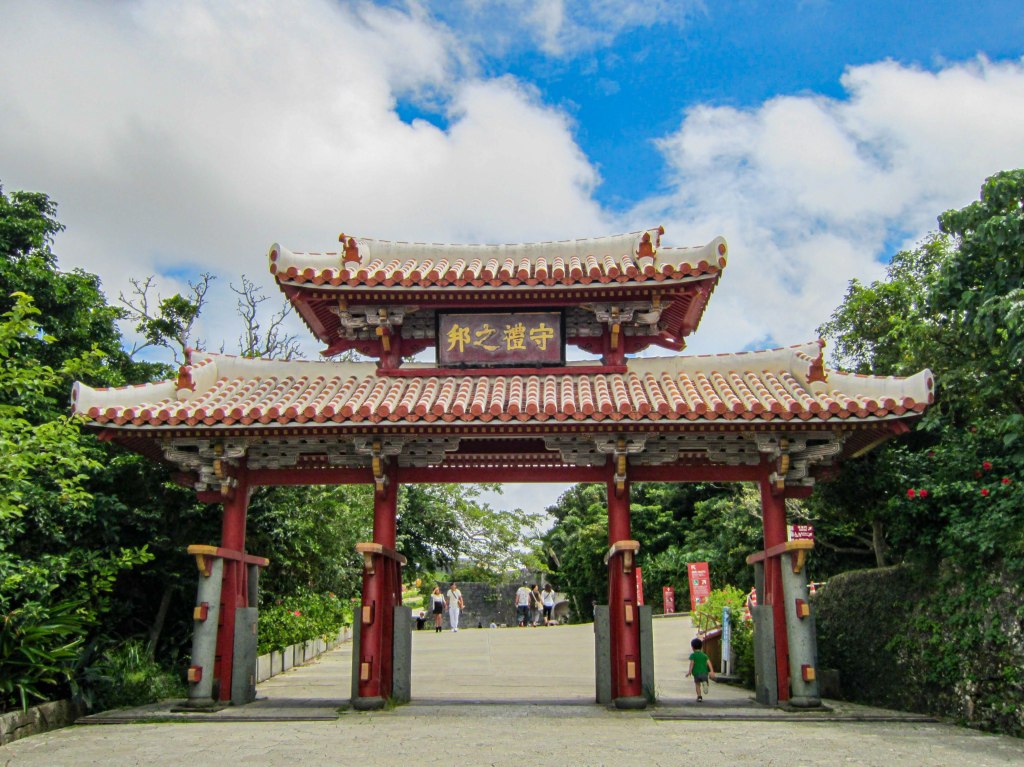
The visit begins at Shureimon, the elegant Chinese-style gate with the plaque reading “Shurei no Kuni”, the land of propriety. The gate was first built in the 16th century, destroyed in 1945 and rebuilt in 1958, and it appears on the 2,000-yen note. It is the image most people associate with Okinawa, and it is free to see.
Sonohyan-utaki and Kankaimon
Just past Shureimon is the Sonohyan-utaki stone gate, a Ryukyu limestone monument built in 1519 where the king prayed for safety before leaving the castle. It looks like a gate but was never meant to be walked through; it is a place of worship, and it is part of the World Heritage listing.
Kankaimon, the first main gate of the outer enclosure, was built between 1477 and 1500 and rebuilt in 1974. A pair of shisa, the Okinawan lion guardians, stand on either side. From here the path climbs through a series of gates and stone walls, each with a name and a purpose, and the castle reveals itself slowly.
Ryuhi and the seven steles
Inside the walls, the Ryuhi is a dragon-headed water spout carved in 1523, still fed by a spring. The water was used by the royal household, and envoys from China are said to have praised it in poetry. The surrounding steles record those visits; most were destroyed in 1945, and the present stones are reconstructions based on rubbings.
Hoshinmon and the Una
Hoshinmon is the last gate before the Una, the inner courtyard in front of the main hall. It has three doors, and in the kingdom’s time only the king and the highest envoys could use the central one. The gate was restored in 1992, and the morning opening ceremony, the Ukejo, is held here.
Beyond it is the paid area and the Seiden. The courtyard is deliberately wide and plain so that the main hall dominates it, and the effect still works: the red building with its curved roof and gold details is theatrical in a way that few Japanese castles are.
The Seiden
The main hall is a three-storey wooden building in red lacquer, with a Chinese-style roof and Japanese-style interior details. The front is flanked by two large dragon pillars, about 3.1 metres high and 1.5 tonnes each, carved from Yonaguni sandstone; the pair that survived the fire were repaired and used as models for the new ones. Inside, the king’s throne and the royal dais are recreated in red and gold, and the decoration is denser and more colourful than anything in a mainland castle.
The reconstruction used traditional materials and techniques, including Ryukyu limestone, local timber and urushi lacquer, and the interior is intended to show how the hall looked in the 18th century. Because the number of visitors inside is capped, the experience should be calmer than the old free-for-all, even with the opening crowds.
Nishi no Azana
On the western edge of the paid area, the Nishi no Azana is a lookout on the castle wall about 130 metres above sea level. The view takes in Naha, the port and the Kerama Islands on the horizon. In the kingdom’s time a flag was raised here and a bell was used to announce the time. It is the best place in the castle to sit down and understand the geography.
Free area and paid area
The castle is split into two zones, and it is worth knowing which is which. The free area includes Shureimon, Sonohyan-utaki, Kankaimon, the outer walls, the Kofukumon area and several gates, and it is open from 8:00 to 19:30 from April to November and 8:00 to 18:30 from December to March. The paid area includes Hoshinmon, the Una, the Seiden, the Seikoden and the eastern lookout, and opens 30 minutes later, closing at 19:00 from April to November and 18:00 from December to March, with last entry 30 minutes before closing.
If you are short on time or on a tight budget, the free area alone is a worthwhile hour. If you want the Seiden, book the timed slot and allow two hours for the whole site.
Around Shuri
Tamaudun, the royal mausoleum of the Second Sho dynasty, is a five-minute walk from the castle and part of the same World Heritage listing. It was built in 1501 and is a quiet, dignified stop after the crowds. The Kinjo stone-paved road, a lane of Ryukyu limestone slabs lined with old walls and gardens, leads down from the castle towards Shuri’s residential streets and is best walked slowly.
The Shuri district itself is worth an hour: small shops, pottery, bingata dyeing, and cafes in old houses. It is far less commercial than Kokusai Street and gives a sense of the city beyond the resort image.
Food
Okinawa soba is the local staple, with a clear pork broth and thick noodles, and there are several shops around Shuri. Sata andagi, the deep-fried dough balls, are sold everywhere as a snack, and beni imo, the purple sweet potato, appears in ice cream, cakes and tarts. For a sit-down meal, the streets around Shuri Station and the castle approach have small restaurants serving goya champuru, rafute and jushi.
Inside the paid area, the Shuri Castle tea house serves Ryukyu sweets with tea, and there are cafes in the Suimui-kan rest house at the entrance. Prices are higher than in the city but convenient.
Getting there
The simplest route is the Yui Rail monorail from Naha Airport to Shuri Station, about 27 minutes and 360 yen for adults, 180 yen for children. From Shuri Station it is about 15 minutes on foot to Shureimon, mostly uphill. Several buses also stop at Shuri Castle-mae, one minute from the gate, and at Shuri Castle Park entrance, five minutes away.
By car, the castle is about 40 to 60 minutes from the airport depending on traffic, and the Suimui-kan car park is limited to three hours. It fills early, especially on weekends; the monorail is usually faster and cheaper.
When to go
Early morning is the best time for the free area: the gates open at 8:00, the light is soft, and the tour groups have not arrived. For the Seiden, the first timed slots after opening will be the quietest, so book the earliest available time rather than midday. Late afternoon is the second-best window, with cooler air and the sun behind the city.
Okinawa’s summer is hot and humid, and the castle has little shade on the walls; spring and autumn are more comfortable. The rainy season runs from around May to June, and typhoons are possible from summer to early autumn. Winter is mild and quiet, and the castle is pleasant in clear, cool weather.
If you are visiting for the reopening, avoid the first weekend if you can. The opening ceremony on 22 November closes the park, and 23 November will be exceptionally busy from noon. Late November and early December weekdays are a better bet, with reservations made well in advance.
Suggested itineraries
Half day at Shuri
Arrive by monorail at 8:00, walk to Shureimon, then through Kankaimon and the gates at your own pace. Enter the paid area when your slot opens, see the Seiden and the Nishi no Azana, then walk down to Tamaudun and the Kinjo stone road. Lunch in Shuri before returning to the city.
With Kokusai Street
Do the castle in the morning, then take the monorail to Makishi or Miebashi for Kokusai Street in the afternoon. This is the classic Naha day and works well on a first visit.
With the Okinawa Prefectural Museum
The museum in Omoromachi, a few monorail stops away, explains Ryukyu history and is the best complement to the castle. Visit the museum first if you want context, or after if you want to make sense of what you saw.
Rainy day
The Seiden interior and the museum are the obvious choices, and the castle walls are dramatic in rain. The stone paths get slippery, so wear shoes with grip and skip the outer wall walk if it is wet.
Practical tips
- From 23 November 2026, the Seiden requires a timed reservation; book online before you travel.
- The park is closed all day on 22 November 2026 and opens late on 23 November.
- Admission rises to 1,000 yen for adults on 23 November 2026; the old 400-yen price applies until 21 November.
- Wear shoes with grip; the approach is uphill and the stone paths are uneven.
- Carry water in summer; there is little shade on the walls.
- The monorail is faster than driving on busy days, and the car park has a three-hour limit.
- Allow two hours for the paid area and another hour for the free area and Shuri streets.
- Check the official site for closures, ceremony dates and ticket sales.
- Photography is allowed in most areas, but be considerate inside the Seiden and follow staff instructions.
Before you go
Decide whether you want the Seiden interior or only the free area, because that choice determines whether you need a reservation and how much you pay. If you are travelling in the first weeks after 23 November 2026, book as soon as your dates are fixed and expect the ticket site to be busy. Confirm the park’s opening hours for your month, and check that no ceremony or maintenance closure overlaps your visit. Bring cash for small shops in Shuri, wear shoes for stone and stairs, and leave time for Tamaudun and the Kinjo road, which are quieter and, for many visitors, the most memorable part of the day.
Sources
- Shurijo Castle Park: main hall opening from 23 November 2026 (checked 2026-10-26)
- Shurijo Castle Park: new fees and timed reservations (checked 2026-10-26)
- Shurijo Castle Park: temporary closure on 22 and 23 November 2026 (checked 2026-10-26)
- Shurijo Castle Park: opening hours and closed days (checked 2026-10-26)
- Shurijo Castle Park: history and World Heritage listing (checked 2026-10-26)
- Shurijo Castle Park: access by monorail and bus (checked 2026-10-26)
Explore More of Japan
- Churaumi Aquarium Travel Guide — the other must-see in Okinawa
- Nakagusuku Castle Travel Guide — Ryukyu stone walls and sea views
- Sefa-utaki Travel Guide — the kingdom’s most sacred site
- Okinawa Travel Guide — islands, beaches and planning


Leave a Reply