Fukuoka is the easiest big city in Japan to arrive in and the hardest to leave on schedule. The airport is five minutes from the main station by subway, the yatai stalls open at dusk along the river, and the food is cheap enough that you can eat four times a day without thinking about it. It is also a working port with a merchant history older than most of the country’s capitals, and the difference between Fukuoka and Hakata is not just a naming quirk.
Most visitors use the city as a gateway to the rest of Kyushu and give it a night. Two nights is better: one for the yatai and the ramen, one for the castle, the park and the shrine, with a half-day left over for Dazaifu or the coast.
Why visit
- Hakata is the home of tonkotsu ramen, and the local style — thin noodles, a second helping of noodles, a broth you can taste through the pork — is the standard for the whole country.
- The yatai, open-air food stalls along the river, are a real institution rather than a tourist show, and there are around a hundred of them.
- Gion Yamakasa in July is one of the most physical festivals in Japan, with one-tonne floats carried through the streets at dawn.
- The airport is five minutes from Hakata station, which makes a short stop genuinely practical.
- It is a compact city: most of what you want is within two subway stops or a 25-minute walk.
Hakata and Fukuoka are not the same word
The city is Fukuoka; the old merchant district on the east bank of the Naka river is Hakata. The two were separate towns until they merged in 1889, and the compromise was to keep Fukuoka as the city name while Hakata stayed on the station, the port, the festival and most of the food. Locals will say they are going to Hakata when they mean the station area, and the ramen, the dolls and the weaving are all called Hakata. It is a small distinction that explains a lot of the city’s character: the castle and the administration are on the west side, the merchants and the kitchens on the east.
Tonkotsu ramen
Pork-bone ramen reached Fukuoka from Kurume, inland, and by 1946 was being served in Hakata from stalls as a flat-noodle bowl in a cloudy pork broth. The thin, straight noodle that defines the style today came from Nagahama, the fish-market district on the coast, where stalls needed to serve dock workers fast: thin noodles cook in seconds, so the bowl went out quickly, and the portion stayed small so the noodles would not go soft. The answer was kae-dama — a second helping of noodles for a small charge, added to the same bowl of broth.
That system is still how you eat it. Order a bowl, eat the noodles while they are firm, and order kae-dama before you finish, usually for 100 to 150 yen; some shops let you choose how hard the second batch is boiled. The broth is pork bone cooked hard until the collagen emulsifies, which gives the white, thick texture. It is rich, and it is salty, and the local habit of ordering a second round is the reason the bowl is not larger to begin with.
A few names are worth knowing. Ichiran started in 1960 in Fukuoka and is now the chain everyone has heard of, with solo booths and a red chilli tare that it claims as its own invention. Ippudo opened in Daimyo in 1985 and made tonkotsu fashionable, with a milder broth and a room designed for women to eat alone in comfort. The shops that locals actually queue for are smaller and change: the station ramen floor and the Tenjin area have a dozen reliable options, and a bowl should cost 800 to 1,100 yen.
Yatai: how they work
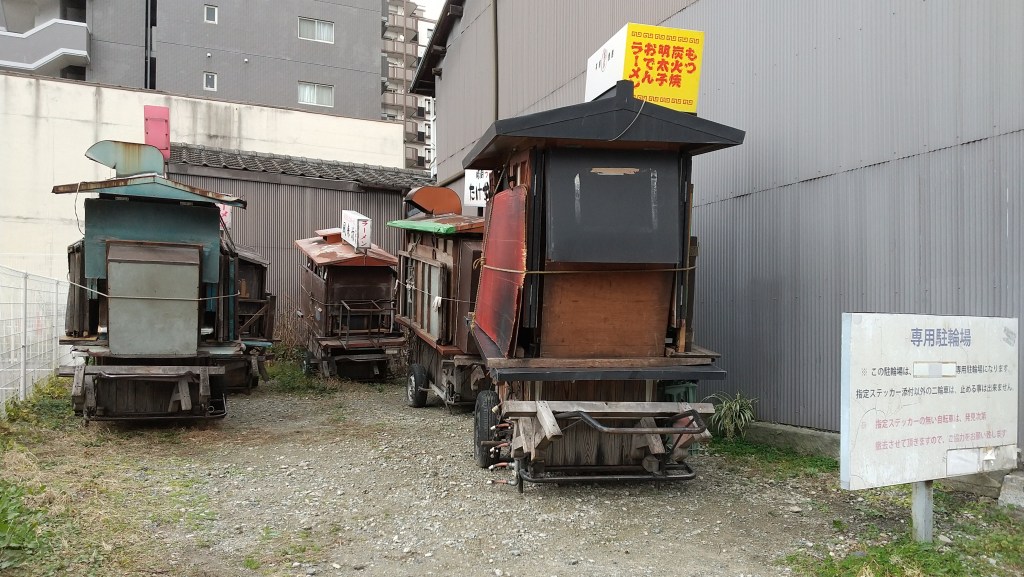
Fukuoka is the only city in Japan with a significant number of licensed street food stalls, and the city regulates them closely. As of 31 March 2026 there were 95 licensed stalls: 32 in Nakasu, 39 in Tenjin, 11 along Watanabe-dori and 7 in Nagahama, plus a couple near Hakata station. About 100 were operating in April 2026, and the number moves as operators retire and new ones are selected through a public process.
They are not permanent buildings. A stall must be within 3 metres wide and 2.5 metres deep including seating, is limited to the hours between 17:00 and 04:00 for setup, service and removal, and must be operated by the licence holder in person. Raw food is not allowed — everything is cooked to order — and there is no takeaway. In practice most open around 18:00 and close between 01:00 and 02:00, and they shut in strong wind or heavy rain, not just rain.
The Nakasu cluster along the river is the postcard: a row of stalls on the promenade with the lights of the entertainment district behind. Tenjin has more stalls and more variety, including French, Italian and creative cooking alongside the ramen and oden. Nagahama, near the fish market, was revived in 2023 and is quieter. There is no reservation system, seating is shared, and you will be talking to strangers within a minute. Expect 1,000 to 2,000 yen a head for a few dishes and a drink, cash in most stalls, and an English menu in the busier ones.
Since March 2026 the city’s tourism site has shown live opening status for individual stalls, using sensors on the stall lights, so you can check before walking over. It is worth doing: a stall that is closed has no fallback on the same corner.
Kushida Shrine and Gion Yamakasa
Kushida Shrine, in the old merchant quarter, is the guardian shrine of Hakata and the start and finish of the Yamakasa. It is free, open all day, and two minutes from Kushida-machi station on the Nanakuma line. The grounds hold a display of the festival’s decorated floats and a giant cedar stump said to be hundreds of years old. At New Year it is the busiest shrine in the city.
Gion Yamakasa runs from 1 to 15 July and is a UNESCO intangible cultural heritage event with more than 780 years behind it. From 1 July, 13 large decorated floats are displayed around the city, each several storeys high and built by local doll makers. From 10 July the festival turns physical: seven districts carry their own float, weighing about a tonne, through the streets at speed. The climax is Oiyama at 04:59 on 15 July, when the first float enters the shrine grounds and the carriers sing the Hakata iwai-uta, a song only the first float is allowed to sing, before the run continues for five kilometres. The 2026 dates are confirmed: display floats from 1 July, Oiyama-narashi on 12 July at 15:59, the group display on 13 July at 15:30, and Oiyama on 15 July at 04:59.
If you are in the city during the festival, watch from the side streets rather than the shrine itself, which becomes impassable. Outside the festival, the shrine and the Kawabata arcade next to it are a good half-hour, and the arcade is where to buy mentaiko and the local sweets.
Canal City and the shopping districts
Canal City Hakata is a large complex built around an artificial canal, with a fountain show on the hour, a theatre, a hotel and a floor of ramen shops from around the country. It is five minutes on foot from Hakata station and ten from Nakasu, and it is the practical answer to a rainy afternoon or a late arrival. The fountain show runs through the day and is free.
Tenjin is the shopping and entertainment centre on the west bank, with department stores, the underground mall that connects the subway stations, and a dense grid of bars and restaurants. Nakasu, between the two rivers, is the nightlife district and the yatai strip. The Kawabata arcade on the Hakata side is older and more local, with food stalls and small shops.
Ohori Park and Fukuoka Castle
Ohori Park is a large lake park built on the moat of the old castle, with a two-kilometre loop path, a boathouse and a Japanese garden on an island at the south end. The garden charges 250 yen for adults, 120 yen for children under 15, is free for the over-65s, and is closed on Mondays; from October to April it opens 09:00 to 17:00. The subway gets you there in seven minutes on foot from Ohori-koen station.
Next to it, Maizuru Park holds the ruins of Fukuoka Castle, built by Kuroda Nagamasa in the early seventeenth century. The park is free, and the surviving stone walls, the Shimoyanagi gate, the Shiomi turret and the Tamon turret give a better sense of a working castle than many reconstructed keeps. One warning for 2026: the main keep platform (tenshudai) has been closed for excavation and preparation since 26 May 2026 and is scheduled to stay closed until the end of December, so do not plan on the view from the top. The Korokan ruins on the same site are the remains of an ancient guest house for foreign envoys, which says something about how long this harbour has been a gateway.
Fukuoka Tower and the bay
The tower on the western waterfront is 234 metres tall and the observation deck is at 123 metres, with a full view over the bay and the city. Admission is 1,000 yen for adults, open 09:30 to 22:00 with the last entry at 21:30. It is a taxi or bus ride from the subway, and best at sunset. Nearby, the Seaside Momochi area has the city museum, a beach and the wedding-photo skyline that the local tourist board likes to use.
Uminonakamichi and the east bay
Uminonakamichi Seaside Park occupies a long sandbar across the bay, with flower fields, a cycle path, a water park in summer and a small train. Admission is 450 yen for adults, 210 yen for over-65s and free for children of junior high age and under, open 09:30 to 17:30 from March to October and to 17:00 in winter. It is closed on Tuesdays in several periods of the year and on the third Monday of January plus the following days, so check the calendar. The adjacent Marine World is a separate aquarium with its own ticket.
Getting there takes about 20 minutes by JR Kagoshima line to Kashii and then the JR Kashii line to Uminonakamichi, or a bus from Hakata station. It is a full half-day and best in spring or autumn.
Day trips
Dazaifu, the old administrative capital of Kyushu, is 30 minutes by train from Tenjin and makes an easy half-day with its shrine, museum and plum trees. Yanagawa, a canal town south of the city, is an hour by train and best done by punt. Karatsu, on the Saga coast, is about 90 minutes by subway and JR and has its own castle and a famous November festival. All three are covered in separate guides.
Getting there
By air, Fukuoka airport is the closest major airport to a city centre in Japan. The subway runs from the domestic terminal to Hakata station in about five minutes for 260 yen, and to Tenjin in about 11 minutes for the same fare. The international terminal is across the runway and connected by a free shuttle bus; allow 10 to 15 minutes for the transfer, and note that the subway does not serve the international building. Buses from Hakata station to the international terminal take about 17 minutes and cost 400 yen.
By shinkansen, Hakata is the western end of the Sanyo line: about 2 hours 30 minutes from Osaka, and roughly 5 hours from Tokyo with a change at Shin-Osaka or a direct Nozomi. The station is also the gateway to Kyushu’s own shinkansen network, with trains south to Kumamoto and Kagoshima.
By sea, international ferries and hydrofoils connect Hakata with Busan in Korea, which is one reason the city feels more connected to the continent than most of Japan.
Getting around
The subway is the backbone: three lines, cheap, and covering the airport, Hakata, Tenjin, Nakasu and Ohori. A one-day pass costs 640 yen for unlimited rides, which pays for itself if you are moving between the station, Tenjin and Ohori more than twice. Buses fill the gaps and are useful for the tower and the bay. Most of the centre is flat and walkable, and the walk from Hakata station to Tenjin through Nakasu takes about 25 minutes, which is a good way to see the river.
Where to stay and what else to eat
Hakata station is the practical base: hotels of every price, the shinkansen overhead and the airport five minutes away. Tenjin is better for shopping and nightlife, and Nakasu is best if you plan to be at the yatai until closing. The city is compact enough that the choice is about atmosphere rather than distance.
Beyond ramen, the local dishes are mentaiko (spiced cod roe), motsunabe (offal hotpot with cabbage and garlic), mizutaki (chicken hotpot), and the street food of the arcades: yaki-ramen, gyoza and skewers. For a sit-down meal, the fish market area and the restaurants around Nakasu serve the catch from the Genkai Sea. The city also takes its cafés seriously, and the local sweet is torimon, a small cake filled with white bean paste.
Best time to visit
- March and April — mild, with cherry blossom in Ohori Park and Maizuru Park.
- 1 to 15 July — Gion Yamakasa, hot and crowded, with the climax at dawn on the 15th.
- October and November — the most comfortable months, with good food and few crowds.
- Winter — cold but rarely freezing, and the yatai are at their most atmospheric in the steam.
The rainy season runs from early June to mid-July, ending just in time for the festival. Late summer brings typhoons, and the city is hot and humid in August.
Suggested itineraries
One night
- Land, subway to Hakata, drop bags and walk to Kushida Shrine and the Kawabata arcade.
- Ramen at an early dinner, then the yatai in Nakasu from 19:00.
- Next morning Ohori Park and the castle ruins before the flight.
Two nights
- Day one: as above, with Canal City if it rains.
- Day two: Dazaifu in the morning, Fukuoka Tower at sunset, yatai again in Tenjin.
- Day three: Uminonakamichi or the fish market, then the shinkansen south.
Practical tips
- Yatai are cash-first and shared-seat; order a couple of dishes, not a full meal.
- Check the live stall status before crossing the city for one specific yatai.
- Order kae-dama before you finish the noodles, not after.
- The international terminal needs a shuttle bus; build in 15 minutes.
- Do not schedule a tight connection through the airport on a festival weekend.
- The castle keep platform is closed through 2026; plan the park, not the view.
Before you go
Prices, hours and dates above were checked against official sources on 26 October 2026: Fukuoka city, the city tourism site, JR Kyushu and the festival organisers. The items most likely to move are yatai opening nights, ramen prices, the castle excavation schedule and the festival programme. Reconfirm the small stalls on the day; they close for weather and for the operator’s health without much notice.
Sources
- Fukuoka city: yatai licensing, hours and rules (checked 2026-10-26)
- Fukuoka city: Hakata Gion Yamakasa 2026 schedule (checked 2026-10-26)
- Fukuoka city tourism: airport and city transport guide (checked 2026-10-26)
- Ohori Park Japanese Garden: hours and admission (checked 2026-10-26)
- Maizuru Park and Fukuoka Castle: access and 2026 closure (checked 2026-10-26)
- Uminonakamichi Seaside Park: hours and admission (checked 2026-10-26)
- Fukuoka city: yatai culture and stall history (checked 2026-10-26)
- Ippudo: company history (checked 2026-10-26)
- Ichiran: ramen and the red secret sauce (checked 2026-10-26)
Explore More of Japan
- Karatsu Travel Guide — castle, pottery and the Kunchi festival
- Kumamoto Castle Travel Guide — the next stop south on the shinkansen
- Dazaifu Travel Guide — the old capital half an hour away
- Nagasaki Travel Guide — the other great Kyushu port
- Yufuin Travel Guide — onsen town in the hills of Oita


Leave a Reply