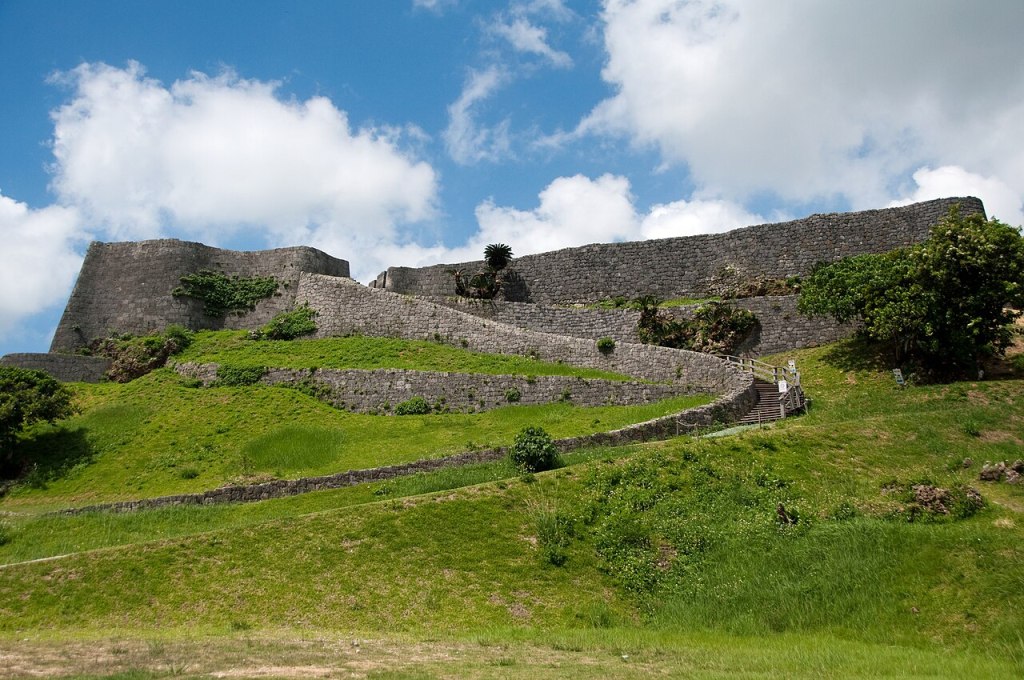
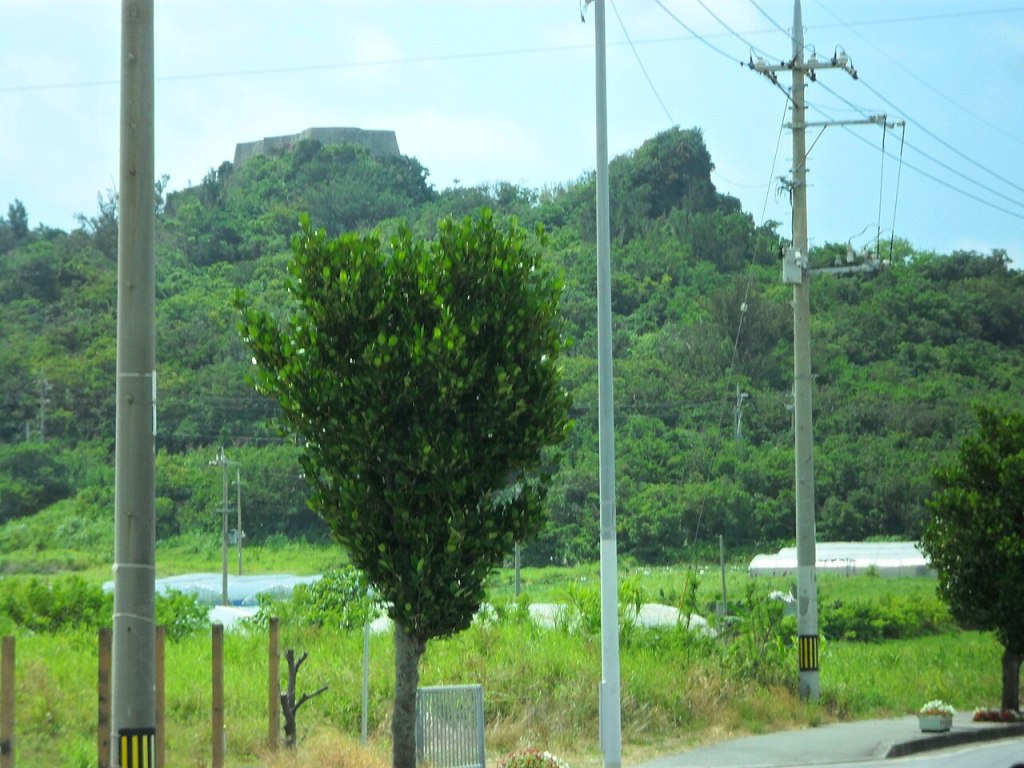
Katsuren Castle sits on a hill above the east coast of Okinawa, and you can see it from the road long before you know what it is: a line of grey limestone walls running along the ridge, with the sea behind and the roofs of Uruma below. There is no keep, no rebuilt gate, no ticket booth with a mascot at the summit. What survives is the shape of the place, five enclosures stepped across a ridge, and one of the best views on the island.
For most of the year, Katsuren is quieter than Shuri Castle and easier to reach than the castles of the north. It is also a World Heritage site, one of the nine components of the Gusuku Sites and Related Properties of the Kingdom of Ryukyu, and the castle of Amawari, the fifteenth-century lord whose rebellion against the Ryukyu court is one of the great stories of Okinawan history.
This guide covers what the ruins are, how to read them, the 2026 fees and hours at the site and the Amawari Park museum below it, the buses and driving routes, and the coast around it, including the Kaichu Doro, Hamahiga Island and the salt factory on Miyagi Island. Prices and times were checked on 27 October 2026 and should be reconfirmed before you go.
Why Katsuren is worth the drive
Three things make Katsuren worth an afternoon. The first is the setting: a isolated hill with a clear view north, east and south, which is exactly why a castle was built here. The second is the walls, which are Ryukyu limestone, laid in curves that follow the ridge rather than in the rectangular lines of a Japanese castle. The third is the story, because Katsuren is not a royal ruin but the castle of a man who almost broke the Ryukyu kingdom.
It is also practical. The castle is about an hour from Naha by expressway, the car park is free, the site is open every day, and the visit takes half a day at most. That makes it a good first castle if you are based in the south, and a good companion to the more famous sites at Nakagusuku and Nakijin. If you have already seen Shuri, Katsuren shows you what the kingdom was like before it was a kingdom: local lords, trade money, and walls built to keep each other out.
What it is not is a theme park. There are no reconstructed buildings, no costumed staff walking the walls, and almost no shade. The paths are uneven, the steps are steep, and the drop from the top enclosure is real. People who come expecting a castle with rooms and exhibits are disappointed; people who come for the landscape and the history usually are not.
What a gusuku actually is
The Okinawan word for these castles is gusuku, and they are different from anything on the Japanese mainland. The first stone castles in Okinawa were built about a century earlier than the stone castles of Honshu, and they were not designed around a central tower. Instead, a gusuku is a series of walled enclosures, or wards, placed on different levels of a hill, with the most important enclosure at the highest point. The walls are made of coral limestone, stacked without mortar, and they curve to fit the ground rather than cutting it into rectangles.
The purpose was less about a last stand than about status and control. A gusuku was the seat of an aji, a local lord, and it held his residence, his storehouses, his administrative rooms and the people who served him. The walls controlled movement: to reach the lord, a visitor passed through gate after gate, each one overlooked from above. The same pattern appears at Nakagusuku, Nakijin, Zakimi and the other walled sites of the island.
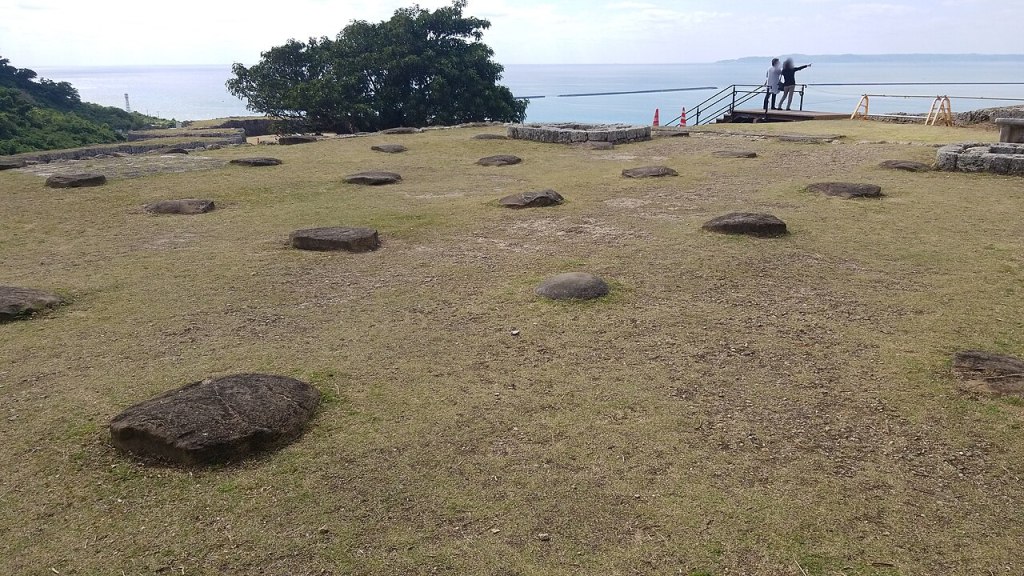
Katsuren is a particularly clear example because so little has been rebuilt. The wards are still legible, the gates still line up, and the foundations of the main hall are still in place. The site covers about 11,897 square metres and runs from roughly 60 to 98 metres above sea level, with the sea on three sides of the peninsula below.
The castle in the UNESCO listing
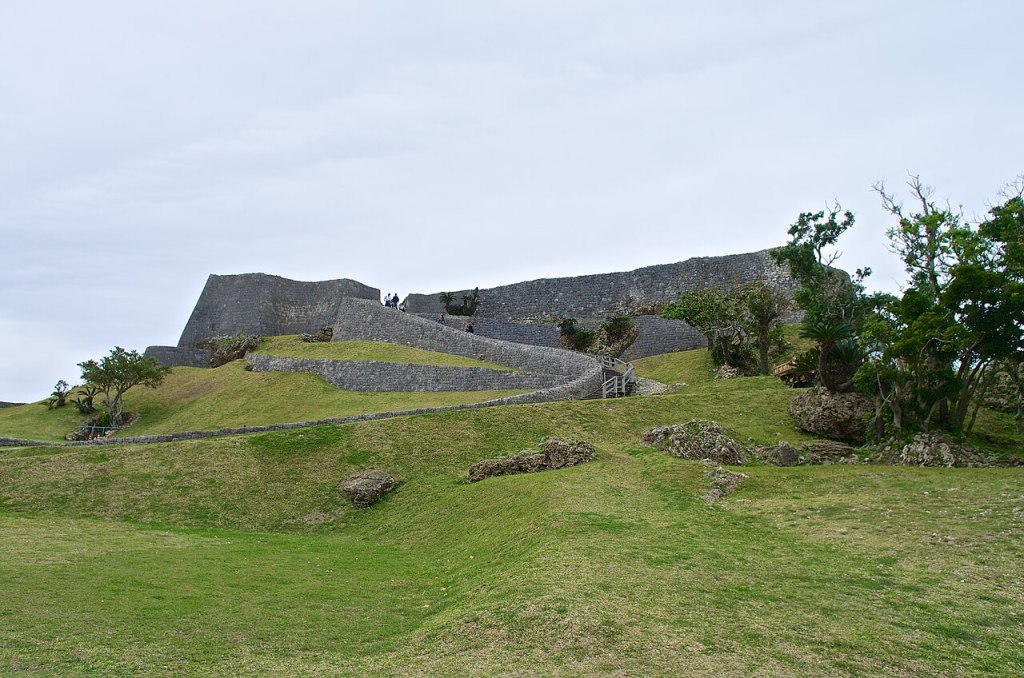
Katsuren was designated a national historic site on 15 May 1972, the day Okinawa returned to Japanese administration, and it was inscribed on the UNESCO World Heritage list in 2000 as part of the Gusuku Sites and Related Properties of the Kingdom of Ryukyu. The listing brings together nine properties across the island, including Shuri Castle, Sefa Utaki, Nakagusuku, Nakijin and Zakimi. Together they are meant to show the material culture of the Ryukyu Kingdom from the twelfth to the seventeenth century: its castles, its sacred sites, its royal tombs and its ports.
The UNESCO listing is a useful corrective to the idea that Okinawan history begins with the Shuri court. Katsuren was the seat of a regional lord who traded with China and Southeast Asia and who, for a time, was powerful enough to threaten the king. The ceramics excavated here include Chinese celadon from the Song and Yuan periods and pottery from Southeast Asia, which is the archaeological trace of that trade. The castle is not a footnote to Shuri; it is evidence of the world that Shuri had to overcome.
The site was excavated between 1965 and 1967 by the cultural properties committee of the Ryukyu government, which clarified the layout of the wards, the gates and the stairways, and produced the finds that now fill the exhibition room at the foot of the hill. If you want to understand what you are looking at before you climb, start there rather than at the top.
Amawari, the lord who challenged the king
The story of Katsuren is the story of Amawari, its tenth lord. The standard account, repeated by the city and by the national cultural properties database, is that he was not born into the ruling line. He is said to have risen from ordinary origins, replaced the previous lord, Motodzuki, and then built up the castle and the port below it through overseas trade. Okinawan chants collected in the Omoro Soshi describe the prosperity of Katsuren in his time, and the imported ceramics found on the site support the idea that this was a wealthy place.
Amawari’s power worried the king in Shuri, Sho Taikyu, who gave him his daughter, Momoto Fumiagari, in marriage. That is the classic move of a court trying to bind a dangerous subordinate, and it did not work. In 1458 Amawari attacked Gosamaru, the lord of Nakagusuku and a close ally of the king, and destroyed him. He then marched on Shuri. The campaign failed, Amawari was killed, and the kingdom moved a step closer to the centralised state that would dominate the island for the next two centuries.
The details are contested, and it is worth knowing that. The sources are few, they were written later, and they were written by the winners. Was Amawari a usurper and a traitor, or a local hero who resisted a court that was swallowing the independence of the regional lords? The city’s own materials lean toward the second reading, and the live performance at Amawari Park tells the story with sympathy. Modern historians are more careful. What is not in doubt is the outline: a wealthy castle, a lord with trade connections, a royal marriage, a war in 1458, and a defeat.
If you want the story in full, the exhibition room and the theatre at Amawari Park are the place to get it. If you want the atmosphere, climb the hill first, stand in the top enclosure, and look south toward Nakagusuku. From there the geography of the conflict is obvious: two castles within sight of each other, and Shuri beyond.
Gosamaru, Nakagusuku and the war of 1458
To understand what happened at Katsuren you need the castle across the bay. Gosamaru was the lord of Zakimi, on the west coast, and a close ally of the king. According to the standard account, the court moved him east to Nakagusuku and told him to strengthen that castle as a check on Katsuren. The two strongholds sit on opposite sides of Nakagusuku Bay, within sight of each other on a clear day, and the geography explains the politics: the king wanted a loyal castle between Shuri and the ambitious lord of the east coast.
In 1458 Amawari attacked Nakagusuku and killed Gosamaru. It was a bold move and, in the short term, a successful one. The king then sent his own forces against Katsuren, and this time the result went the other way. Amawari died, his castle was taken, and the Ryukyu court was left without a rival strong enough to challenge it. The conventional reading is that 1458 was the moment the kingdom became a kingdom, with Shuri at the centre and the regional lords reduced to subordinates.
Both castles are worth visiting for this reason. Nakagusuku is inland, green and quiet, with walls that show the same curved limestone technique in a different setting. Katsuren is coastal and exposed, with the sea in every view. Seeing both turns a list of ruins into a single story about two men, one king and a very small island.
What the excavations found
The castle was excavated between 1965 and 1967 by the cultural properties committee of the Ryukyu government, before Okinawa returned to Japan. The work clarified the layout of the wards, the positions of the gates and the stairways between them, and the plan of the main hall in the second enclosure. It also produced a large quantity of imported pottery: Chinese celadon from the Song and Yuan periods, ceramics from Southeast Asia, and local wares. For a small island castle, that is a lot of foreign crockery, and it is the clearest evidence that Katsuren was a trading port as much as a fortress.
The finds matter because written records are thin. The Omoro Soshi, the collection of Ryukyuan chants compiled in the sixteenth century, includes verses that describe the prosperity of Katsuren and the reputation of its lord, but they are poetry, not chronicles. Archaeology fills in the rest: what people ate from, what they stored, where they walked, and how the castle was rebuilt over time. Some of that material is displayed in the exhibition room at Amawari Park, and the national cultural properties database holds a detailed description of the site.
The excavations also showed that the castle was not built in one go. The walls were repaired, gates were moved, and the wards were remodelled as the lord’s power grew. What you see today is the end of that process, not the beginning, and the oldest parts of the site may predate Amawari by a century or more.
Walking the ruins
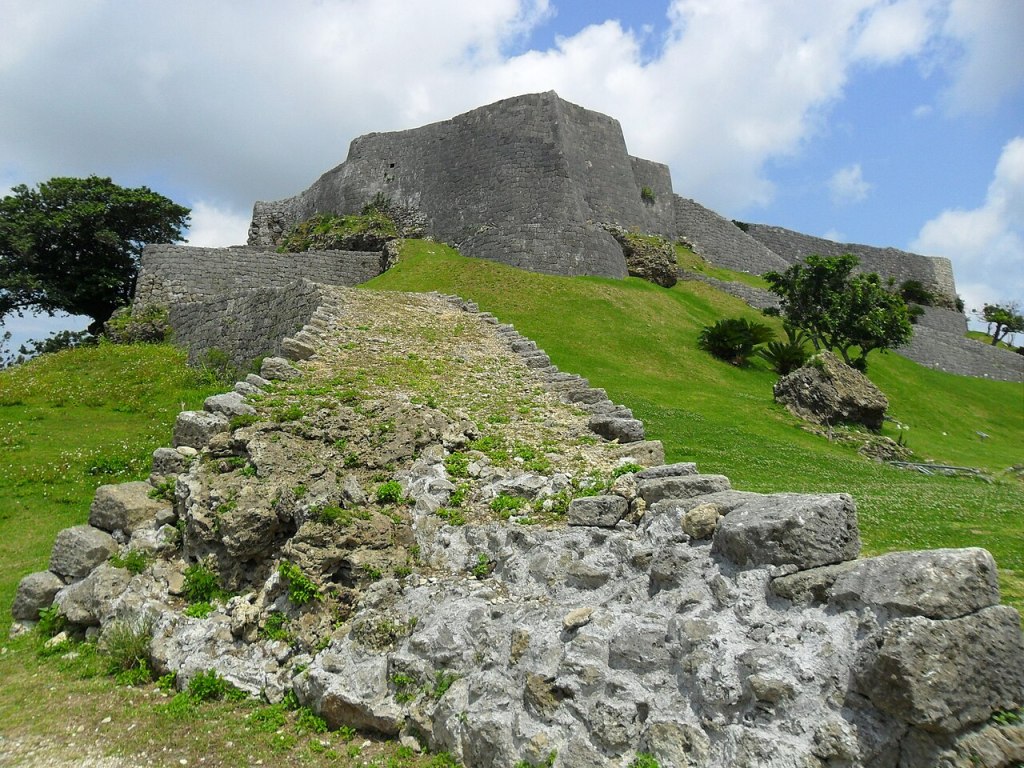
The visit starts at Amawari Park, at the foot of the hill, where you buy your ticket. Cross the road, climb the stone steps, and you enter the lower wards. The route is not long, but it is steep in places, and the surface is uneven: coral limestone worn smooth, loose gravel, and steps of different heights. Allow 40 to 50 minutes for the castle alone, and about an hour if you also want the exhibition room.
The wards are arranged in sequence. From the north-west, the highest point, the first enclosure steps down to the second, third and fourth, and then the ground rises again to the east ward on the south-east side. The first enclosure is the summit and the reason for the climb. The second is the largest of the upper wards and holds the foundations of the main hall, a building of about 17 by 14.5 metres whose pillar stones are still in place. The third has the trace of a four-legged gate. The fourth is lower and quieter, and the east ward looks back along the ridge.
Do not rush the gates. At each ward the path passes through a narrow opening that was once controlled from above, and the walls turn with the ground in a way that is easy to miss if you are looking at your feet. Stop at the corners, look back, and the design becomes obvious: every approach is watched, and every ward is a stage.
The walls
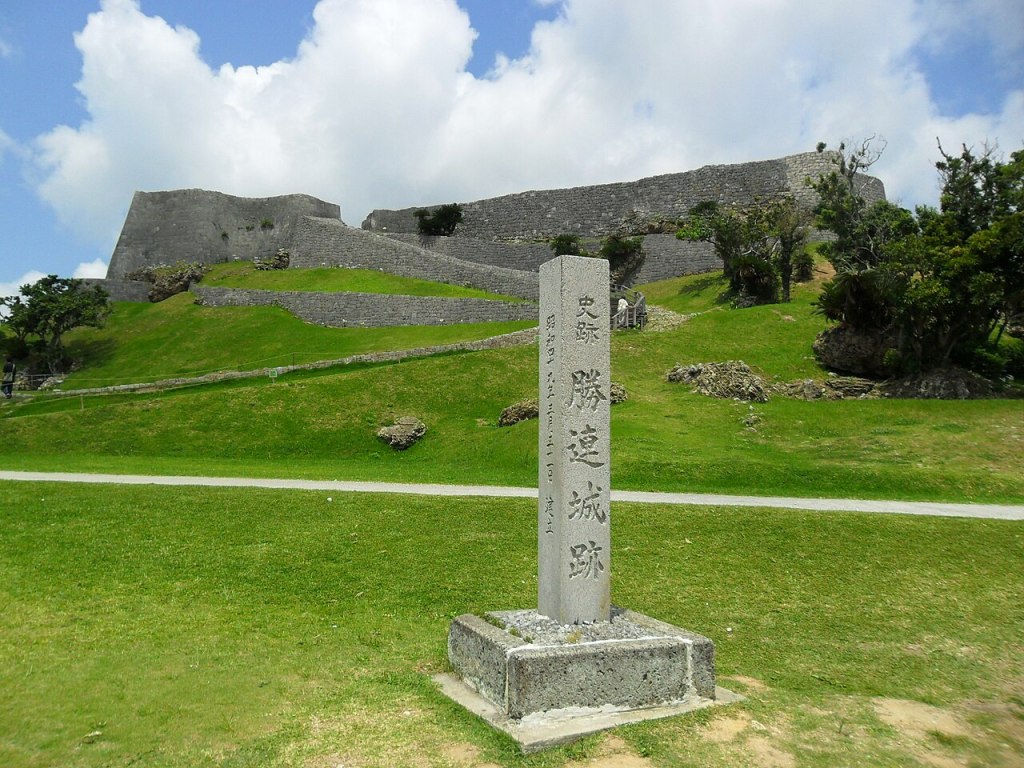
The walls are the reason Katsuren is often described as the most elegant of the gusuku. They are built of coral limestone, cut and stacked without mortar, and they follow the curve of the ridge in long, sweeping lines. The stones are not uniform: some are large, some small, and the joints are packed with smaller pieces to lock the structure together. This is a technique that rewards close looking, and it is also a technique that fails when people climb on it. The walls are fragile, and the site asks visitors to stay on the paths.
The masonry is not just decorative. The curve distributes weight and resists the typhoons that cross Okinawa every summer, and the lack of mortar allows water to drain rather than build up behind the wall. The same principles appear at Nakagusuku and Nakijin, but Katsuren’s walls are especially readable because they sit on a narrow ridge with the sea on both sides.
The view
From the top enclosure the whole east coast opens up. On a clear day you can see the Chinen peninsula and Kudaka Island to the south, the Pacific to the east, and the ridges of the Motobu peninsula to the north-west. The light is best in the morning, when the sun comes up over the sea and the walls are still cool; in the afternoon the site is hot and the view is hazy.
This is also the place to understand why the castle mattered. The hill controls the neck of the Katsuren peninsula, the port below it, and the sea lanes that connected Okinawa to the wider world. A lord here could tax trade, watch for rivals and, if he was ambitious, march south. The view is not scenery; it is strategy.
Photography
Katsuren is a photographer’s castle, but not an easy one. The classic shot is from below, on the approach road, where the walls run along the ridge with the sea behind; it needs a clear day and a long lens to compress the layers. Inside the walls, the curves work best early, when the light rakes across the stone and the joints show. By mid-morning the sun is high and the contrast is harsh.
The summit is wide enough for a tripod but exposed, and the wind can be strong. Sunrise is the best light, but the site opens at 9:00, so a true dawn shot has to be taken from the road or from outside the gate. Sunset is behind the hill, which means the east coast falls into shade while the sky turns; the night events are the better option for evening photographs, with the walls lit and the coast below. Check the rules before flying a drone: the site is a national historic site and a World Heritage property, and the surrounding area includes private land and active shrines.
Katsuren and the other gusuku
Okinawa has more castle sites than most visitors realise, and they are not interchangeable. Nakagusuku, south of Katsuren across the bay, is the castle of Gosamaru and sits inland on a ridge above the Nakagusuku coast; its walls are among the best preserved on the island, and its position made it a lookout over both coasts. Nakijin, on the Motobu peninsula, is the largest gusuku in Okinawa, with long walls, a royal enclosure and a famous grove of cherry trees that blooms in January. Zakimi, on the west coast, is small and neatly restored, and Shuri, in Naha, is the royal castle, rebuilt in concrete after the war and partly destroyed by fire in 2019.
If you have time for two, pair Katsuren with Nakagusuku: they are close, they face each other across the water, and together they tell the story of the 1458 war. If you have time for three, add Nakijin, which shows the scale of a regional capital rather than a frontier stronghold. Shuri is a different experience altogether, with reconstructed halls, crowds and a museum, and it is best visited as the centre of the kingdom rather than as a ruin.
What Katsuren offers that the others do not is emptiness. There is no reconstruction to walk through and no exhibition inside the walls, just the enclosures, the stone and the view. That is either the best thing about it or the worst, depending on what you came for.
Amawari Park
At the foot of the hill, across the road, is Amawari Park, a city-run history and culture facility that opened on 14 October 2021 as part of a larger plan to develop the area around the castle. The main building holds a permanent exhibition room, a special exhibition room and a theatre, plus a shop and a tourist information desk. It is the place to buy your ticket, and it is worth an hour even if you are impatient to climb.
The permanent exhibition displays artefacts from the castle and explains the history of Uruma and the Ryukyu Kingdom. Four video programmes run on a large screen, including an animated history adventure aimed at children and a film about Amawari and Katsuren. On Saturdays, Sundays and public holidays there are live performances in the exhibition room at 11:00, 13:00 and 15:00, lasting about 25 minutes. Seating is free and unreserved, there is room for about 120 people including standing space, and no booking is needed. Photography is allowed for personal use; commercial photography needs permission.
The park is also where the castle’s paid guides start. The Uruma City Cultural Heritage Guide Association runs tours of about an hour for groups of two or more, by reservation at least three days in advance, and the fee includes insurance and the guide’s honorarium. Prices are not published on the castle website, so ask when you book. For a site with so little signage in English, a guide is money well spent.
The area around the park is being redeveloped, with plans for a larger park, food and retail space and a tourist information centre. Construction is phased, so parts of the surroundings may be fenced or noisy when you visit. The castle route and the exhibition room are separate from the building work and are not affected by it.
Tickets, hours and the 2026 price change
Admission is combined: one ticket covers the castle and the permanent exhibition room. Prices went up on 1 April 2026, so older guides and some travel sites still show the previous rates. The current prices are 850 yen for adults and high school students and 550 yen for children, or 600 yen and 300 yen if you only want the exhibition room. Groups of 20 or more get a discount, and there is a resident rate for Okinawa Prefecture of 400 yen for adults and 200 yen for children, which requires photo ID with an address. Children of elementary and junior high school age who live in Uruma enter free, as do children under six.
The site is open every day from 9:00 to 18:00, with the last ticket sold at 17:30. It closes only for weather or maintenance, which in practice means typhoons and the occasional inspection day. Payment at reception is by cash, credit card, QR code or electronic money. There is an annual passport, which makes sense only if you live on the island.
Parking is free, with 148 spaces for cars and six for large buses, open from 9:00 to 18:00. The car park fills on weekends, Japanese holidays and during school trips, and the tour buses tend to arrive in the middle of the morning. Coming at opening time gives you the castle with far fewer people, and better light.
A small EV cart runs on the approach route for visitors who cannot manage the climb; ask at reception for the current operating hours and conditions. It does not run during the night events, and it does not replace the steps inside the wards.
Night openings and seasonal events
Katsuren occasionally opens in the evening, and these are the best-value visits of the year. In 2026 the site ran a summer evening opening in September and a Halloween-season event called Katchin Night in October, both on Wednesdays, Fridays and Sundays. Entry was 500 yen, from 17:30 with last entry at 19:30, and the gates closed at 19:50. The exhibition room was closed and the EV cart did not run, but the castle was lit and the view over the coast at night was the point.
The pattern is likely to continue, but the dates change every year and are announced on the official site a few weeks ahead. If you are in Okinawa in September or October, check before you plan an evening; if you are there at another time, assume the site closes at 18:00. The night events are also weather-dependent, and a typhoon will cancel them without much notice.
Getting there
Katsuren is in Uruma, on the east coast of central Okinawa, about 30 minutes by car from the Okinawa-Kita Interchange of the Okinawa Expressway. From Naha Airport the drive is roughly 60 to 80 minutes depending on traffic, and longer on holiday weekends. Take the expressway north, leave at Okinawa-Kita, and follow the signs for Katsuren and Uruma; the last part is on ordinary roads through suburban Uruma, with rice fields and low hills rather than resort coastline.
By bus, route 52, the Yokatsu line, runs from Naha Bus Terminal to Yagena Bus Terminal and stops at Katsuren Castle Mae, one minute from the entrance. The ride takes about one hour 45 minutes to two hours depending on traffic, and the timetable is thin outside the morning and late afternoon. Route 61, the Maehara line, connects PARCO City in Urasoe with the same stop in about 80 minutes. Both are run by Okinawa Bus, and both are ordinary route buses with no luggage space, so a suitcase is awkward.
By taxi, expect about 60 to 80 minutes from Naha Airport and a fare that makes a rental car look reasonable, especially for two or more people. There is no train in this part of Okinawa; the Yui Rail monorail ends in Naha. If you are staying in Nago or Motobu, the drive south is about 40 to 50 minutes.
Once you are at the site, everything is on foot. The car park, the ticket office, the exhibition room and the start of the castle path are within a couple of minutes of each other, and there is no shuttle.
When to go
The best months are October and November, and March and April. The typhoon risk is lower, the light is clear, and the temperature is bearable on the exposed ridge. Winter, from December to February, is mild and quiet, with daytime temperatures around 15 to 20 degrees Celsius and a cold wind on the summit; it is a good time for walking and for having the place to yourself. The rainy season runs from May into June, when the steps are slippery and the view disappears into cloud.
July and August are hot, humid and crowded, and the castle has almost no shade. If you come then, start at 9:00, carry more water than you think you need, and plan the exhibition room for the hottest part of the day. September is still hot and is also the peak of the typhoon season; a storm can close the site and cancel flights with a day’s notice.
Time of day matters more than season. The castle faces east, so the morning light is the reason to come early: the walls are lit from the sea side, the coast is sharp, and the tour buses have not arrived. Late afternoon is second best, with softer light and a chance of an evening opening. Midday in summer is the worst of all worlds.
Around the peninsula
Katsuren is at the neck of the Katsuren peninsula, which means the coast around it is worth as much time as the castle. The roads are quiet, the sea is on both sides in places, and the drive connects several small islands by bridge.
The Kaichu Doro
The Kaichu Doro, or road in the sea, is a 4.75-kilometre causeway that runs from the Yonashiro coast to Henza Island, most of it on an embankment just above the water. It opened in 1972, was widened to four lanes in 1999, and has a roadside station, Ayahashi Hall, roughly halfway across, with shops, restaurants and a car park. On a calm day the water on both sides is green and shallow; on a windy day it is white and the causeway feels very exposed. The drive takes about 15 minutes from Katsuren, and it is the most popular scenic road in Uruma.
Beyond Henza, bridges continue to Miyagi Island and Ikei Island, so you can drive from the castle to a quiet beach in under half an hour. The islands are small, the roads narrow, and the beaches are mostly unpatrolled; swim only where there are facilities and other people.
Hamahiga Island
Hamahiga is reached by the 1.43-kilometre Hamahiga Bridge, which opened in February 1997 and connects the island to Henza. It is about seven kilometres around, with two villages, red-tiled houses, stone walls and a lot of shrines. In Ryukyuan mythology it is the island where the creator deities Amamikiyo and Shinerikiyo lived, and the two main sites, the Shirumichu cave and the tomb of Amamikiyo, are city-designated cultural properties. Both are active places of worship, so behave accordingly: no loud voices, no climbing on the rocks, and no photographs inside the cave unless it is clearly permitted.
The lanes inside the villages are narrow, sometimes single-lane, and pass close to houses. Drive slowly, park only in marked spaces, and do not block a driveway to take a photograph. The island is a living place, not a film set.
Miyagi Island and the salt factory
Miyagi Island, the next one out, is home to the Nuchi Masu salt factory, which makes sea salt from the Pacific water offshore using a process it describes as crystallising the salt in the air at room temperature. The factory is open for free self-guided viewing from 9:00 to 17:30, with short free guided tours through the day, a shop and a restaurant with a view. It is a working factory rather than a museum, which is part of the appeal: you watch the salt fall like snow behind glass, then buy a bag of it.
The drive from Katsuren takes about 25 minutes, and the route crosses the Kaichu Doro, so it combines well with the causeway and Hamahiga. Allow an hour if you want the tour, the shop and lunch.
Other castles and the south
If you are collecting gusuku, Nakagusuku Castle is about 30 minutes south, on the other side of the Nakagusuku Bay, and it is where Amawari’s rival Gosamaru lived. Nakijin Castle is an hour north on the Motobu peninsula, and Shuri Castle is in Naha, about an hour south. Each is a different shape of the same idea, and seeing two or three in a trip makes the history much easier to follow than seeing one.
The Churaumi Aquarium and the Motobu coast are about an hour north, which makes Katsuren a possible stop on the way between Naha and the northern resorts. It is not on the direct expressway route, so treat it as a deliberate detour rather than a roadside break.
Food and where to stay
There is no restaurant inside the castle or the park, and the nearest food is in the villages around it. The local speciality is Okinawa soba, and there are several small canteens within a short drive, including places near the castle that serve tebichi soba and yushi dofu soba to a mostly local clientele. Hours are short, closing days are irregular, and the kitchen often stops before the sign says it will, so eat lunch before 14:00 or plan to eat later in Uruma city.
On the coast, the roadside station on the Kaichu Doro has a restaurant with sea views and a food court, and the islands have a handful of cafes and set-meal shops, some in old houses. On Hamahiga, the local restaurants are small and family-run, with menus built around mozuku, fish and island vegetables; on Miyagi, the salt factory restaurant is the most reliable stop for a sit-down meal. None of these places is expensive, and almost all of them take cash only.
For dinner, base yourself in Naha, Chatan or Nago. Uruma is a city of about 120,000 people, but it is spread out and the evening restaurant scene is thin outside the shopping centres. Staying on the coast near Yonashiro or on the islands is quiet and scenic, with a car essential and very little open after dark.
If you want a beach base, the resorts of Onna and Nago are 40 to 60 minutes away and have far more choice. If you want the castle at sunrise, stay in Uruma or Okinawa City and drive over in the dark; the roads are easy and the car park opens at 9:00, which is a problem for a true sunrise visit. In practice, the earliest you can be at the castle is opening time, and the light is still good then.
How to spend the day
With half a day, start at Amawari Park at 9:00, watch the exhibition and one of the films, then climb the castle and walk the wards slowly. Come down for lunch in the area, and drive the Kaichu Doro in the afternoon. That is a comfortable day with children or with a hire car, and it leaves time for a beach.
With a full day, add Hamahiga and Miyagi. Do the castle first, while it is cool, then drive the causeway, stop at Ayahashi Hall, cross to Hamahiga for the shrines and the village lanes, and finish at the salt factory before it closes at 17:30. Allow 45 minutes for the castle, an hour for the park, and two to three hours for the islands.
If it rains, the exhibition room and the theatre are the obvious shelter, and the drive around the islands still works, though the views will be grey. The castle path becomes slippery and the limestone shines; wear shoes with grip and take the steps slowly. Lightning on an exposed ridge is a real risk in summer, so come down if you hear thunder.
Before you go
Check the official site for the current hours, prices and any closure before you drive out, because the 2026 price change caught some guidebooks and travel sites out. Bring cash for small restaurants and the islands, water for the castle, and shoes with grip for the limestone. There is little shade and no shop at the top, and the nearest convenience store is a few minutes away by car.
The site is not fully accessible: the castle route is stone steps and uneven ground, and the exhibition room is the accessible part. Visitors with limited mobility can see the museum and the view from the lower area, but not the summit. The EV cart helps on the approach, not inside the wards.
Finally, treat the place with some care. The walls are 500 years old and unprotected, the shrines on Hamahiga are in use, and the islands are home to people who are not on holiday. Stay on the path, do not climb the walls, and do not fly a drone without checking the rules. Katsuren has survived because it was left alone; the least a visitor can do is leave it that way.
Quick checklist
- Buy the combined ticket at Amawari Park before climbing; the castle gate is not a separate ticket office.
- Go at 9:00 if you want the ridge to yourself and the best light on the walls.
- Wear shoes with grip; the limestone steps are uneven and polished in places.
- Carry water and sun protection; there is no shade and no shop at the top.
- Check the official site for the day’s hours, closures and any evening opening.
- Bring cash for small restaurants and island shops.
- Allow 40 to 50 minutes for the castle and an hour for the museum and the films.
- Combine the visit with the Kaichu Doro and one island, not three.
- Do not climb or sit on the walls, and keep your voice down at the shrines on Hamahiga.
Related guides
- Nakagusuku Castle Travel Guide — Gosamaru’s castle, across the bay
- Nakijin Castle Travel Guide — the northern gusuku on the Motobu peninsula
- Shuri Castle Guide — the royal court that Amawari marched against
- Churaumi Aquarium Travel Guide — the northern coast, an hour away
- Okinawa Travel Guide — the whole island, from Naha to the north


Leave a Reply