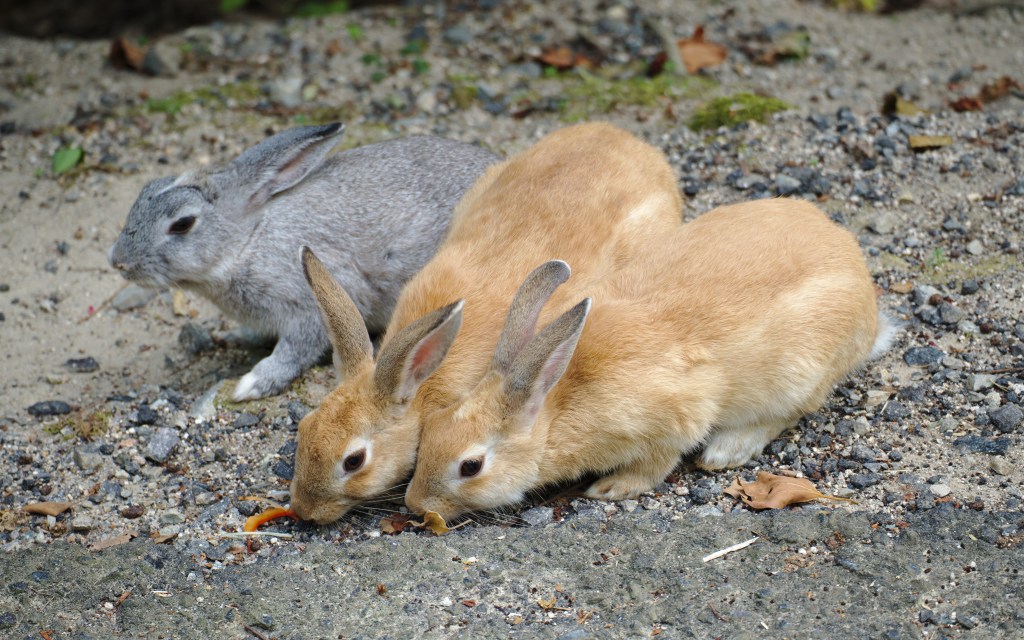
Okunoshima is a small island in the Seto Inland Sea, about three kilometres off Tadanoumi in Takehara, Hiroshima Prefecture. It is known around the world as Rabbit Island, and the nickname is not an exaggeration: within a minute of stepping off the ferry you will be surrounded by wild rabbits, sitting in the sun, digging in the grass, and trotting after anyone who looks like they might have food.
It is also one of the strangest places in Japan. Between 1929 and 1945 the island was a secret army facility that produced chemical weapons, and it was erased from maps so thoroughly that most Japanese people did not learn what had happened there until 1984. The ruins of that industry are still standing in the woods: a power station wrapped in vines, concrete storage bunkers sunk into the hillside, the foundations of a research laboratory. Rabbits run through all of it, and the Takehara tourism association publishes a route through the war relics.
That combination is why Okunoshima is worth more than the half-hour photo stop that some day tours give it. This guide covers the ferries and the last-boat problem, the 2026 hours and fees at the Poison Gas Museum, the rules for the rabbits, the walk around the island and its ruins, the hotel onsen, and the practical question of how to see the place without treating it as a theme park. Prices and times were checked in October 2026 and should be reconfirmed before you travel.
Why cross to Okunoshima
The first reason is the rabbits. There are several hundred of them, they are wild rather than tame, and they are unusually relaxed around people because generations of visitors have fed them. In the early morning and late afternoon they are at their most active; in the middle of a hot summer day they flatten themselves in the shade and refuse to move. Watching a dozen of them appear out of the grass when a bag rustles is genuinely funny, and it is the kind of thing that children remember longer than any museum.
The second reason is the history, which is not cute at all. Okunoshima is one of the few places where you can walk through the physical remains of Japan’s chemical weapons programme. The museum is small, plain and devastating; the ruins are unmarked in places and more affecting for it. Hiroshima has the Peace Memorial Park, which explains the end of the war. Okunoshima explains a different part of the same war, and it does so without a multimedia show.
The third reason is that the island is beautiful in an ordinary, unperformed way. The loop road passes small beaches, pine woods, a lighthouse, and viewpoints over the islands of the Geiyo group. There are no chain shops, no arcades, and almost no cars. On a weekday in autumn, with the ferry crowds gone by three o’clock, it is one of the quietest places in the Inland Sea.
What it is not is a resort island in the usual sense. The only hotel is a Kyukamura, the only restaurant is in that hotel, there is no convenience store, and the beach did not operate in 2026. If you want waterslides and beach bars, go elsewhere. If you want rabbits, ruins and a very good onsen at the end of a walk, this is your island.
The island at a glance
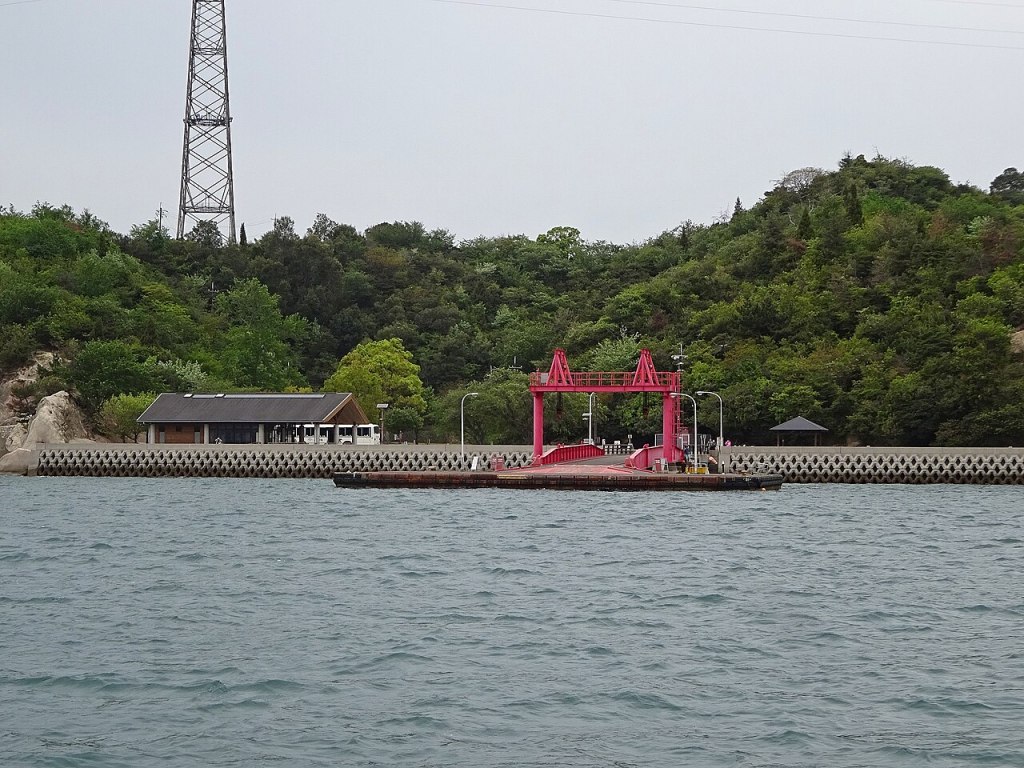
Okunoshima is about 70 hectares, with a coastline of roughly 4.3 kilometres and a low summit of about 100 metres. Almost the whole island belongs to the national government and sits inside Setonaikai National Park; the hotel, the campsite and the museum are the main built facilities. A free shuttle bus runs between the piers and the hotel, but the rest is on foot or by bicycle.
The geography is simple once you are on it. The two piers are on the south-east side, facing Tadanoumi. The hotel and its open ground are a short walk west of the piers. The museum and the visitor centre are close to the hotel. The loop road circles the island, and the ruins are scattered along the north and west coasts, with the summit observatory reached by a path from the middle of the loop. The ferry from Tadanoumi takes about 15 minutes and arrives at the second pier; the hotel’s own boat may use either pier depending on the day.
There is no bridge. Everything comes and goes by boat, including supplies, staff and rubbish, which is one reason the island feels so contained. It also means the ferry timetable is not a detail to check later; it is the shape of your day.
Before the rabbits: a fortress, then a secret factory
Okunoshima was not always uninhabited. Until the early twentieth century a handful of farming families lived on it, growing crops and fishing the sheltered water. That life ended when the army arrived. In 1902, before the Russo-Japanese War, the island became part of the Geiyo Fortress, a chain of gun batteries built to guard the approaches to the Inland Sea. The batteries on Okunoshima were never fired in anger, and the fortress was decommissioned in 1924, but the concrete gun positions are still there, some of them now half-buried in the forest.
In 1927 the army took over the whole island for a new purpose: the manufacture of chemical weapons. The farmland was cleared, the residents were moved off, and the island was closed to civilians. The Tadanoumi Weapons Manufacturing Plant opened on 1 April 1929, with a formal ceremony in May, and production continued until the end of the war in 1945. At its peak the island was a small industrial town, with factories, a hospital, a school, a shrine, a power station, dormitories and its own water supply.
The secrecy was obsessive. The island was removed from publicly sold maps, and workers were forbidden to tell even their families what they did. The army argued that the site was ideal: it was offshore, so an accident would be contained; it was close enough to the mainland for labour and materials; and it was easy to guard. The same qualities made it easy to hide.
What was made on Okunoshima
The plant produced several classes of chemical agent, including mustard gas and lewisite, which burn and blister the skin and lungs, along with sneeze and vomiting agents and blood agents such as hydrogen cyanide. The agents were made on the island, shipped to a filling plant at Sone in Fukuoka, loaded into shells and other munitions, and then used or stockpiled by the army. Japanese accounts put total production at around 6,600 tonnes over the life of the plant, a figure that appears in materials connected with the museum; the exact number is less important than the scale, which was industrial.
Around 6,500 people worked on the island over the years, including army technicians, civilian employees, conscripted Korean labourers and, towards the end of the war, thousands of school students mobilised as labour. Many of them were exposed to low doses of gas over long periods. Protective equipment was inadequate by the end of the war, and the accounts collected by the museum describe skin disease, respiratory illness and cancers that appeared years later. The island was dangerous even when nothing went visibly wrong.
The war ended before the plant could be bombed. In the last year of the war, production of chemical agents was scaled back and part of the workforce was shifted to making parts for the balloon bombs that Japan sent across the Pacific. After August 1945 the occupying forces took over the island and began the long, dirty work of destroying the stockpile. Some agents were burned, some were sealed in concrete and dumped in the Pacific, and some were buried. The consequences surfaced for decades, in fishermen injured by drums pulled up in nets and in arsenic contamination found at the north battery in 1996, which was remediated in 1999.
From secret island to rabbit island
The postwar history is almost as strange as the wartime one. The island was requisitioned again during the Korean War, this time as an ammunition depot, and returned to Japan in the mid-1950s. In 1950 it had been included in Setonaikai National Park, and in July 1963 the national holiday village system opened a Kyukamura here, turning the former poison gas plant into a seaside resort. The transformation was deliberate: the government wanted the island to become a place of rest rather than a place of fear.
For a long time the past was simply not discussed. The chemical weapons programme became public knowledge in Japan only in 1984, when reporting on Japanese chemical warfare forced the story into the open. The memorial to the workers who died was erected in 1985, and the Poison Gas Museum opened in 1988, in a plain building near the hotel. It is run by Takehara City and is deliberately low-tech: photographs, tools, uniforms, testimonies, and a small room where you can watch documentary footage. It is not a comfortable place, and it is not meant to be.
The rabbits arrived in 1971, according to the account accepted by the Environment Ministry’s Okunoshima Visitor Centre: eight domestic rabbits that a local primary school could no longer keep were released on the island. DNA analysis has since shown a mixture of types, which suggests that other rabbits were brought over later, and the population grew because the island has a mild climate, plenty of grass and few predators. By the 2000s there were a few hundred; by 2018 the visitor centre counted more than 900. The Covid years cut the food supply and the numbers fell sharply, and a 2025 survey counted 449. The population is now closely tied to how much visitors feed it, which is the uncomfortable heart of the island’s modern identity.
The rabbits and their rules
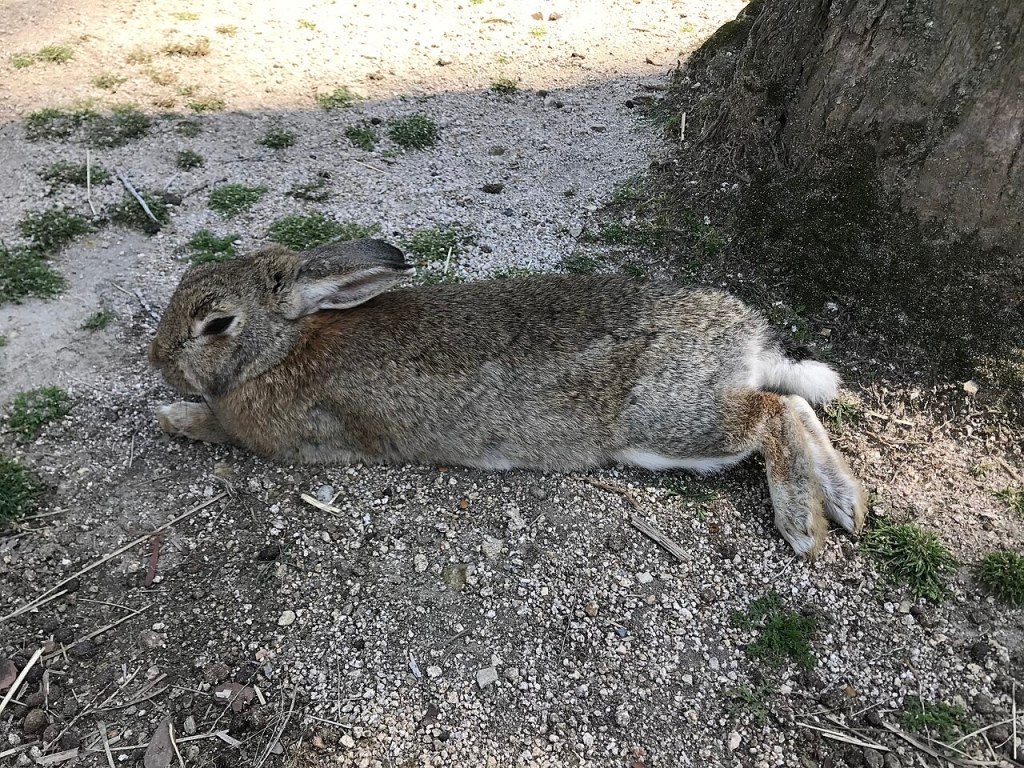
The rabbits are wild animals, not pets and not exhibits. The Environment Ministry’s guidance is blunt: do not chase them, do not pick them up, do not feed them from your hand, and do not feed them on the road. A rabbit that is cornered or lifted can struggle, fall and break its own back; a rabbit that is fed in the road can be hit by the shuttle bus. Children need to be told this before they arrive, not after.
Feeding is the complicated part. Pellets are sold at Tadanoumi port and at the hotel shop, and feeding them on the grass is part of the island’s culture; a 2024 environment ministry survey found that about 82 percent of visitors supported it. But the rules matter: put the food on the ground rather than in your hand, do not feed them human snacks, bread, rice or sweets, stay with the food until it is finished, and take any leftovers away. Do not feed them near the piers, the road or the museum entrance, where the concentration of animals creates traffic and stress. Never bring a pet, and never release a rabbit on the island; domestic rabbits cannot survive there and are often attacked by the resident population.
The island also asks visitors not to leave litter, fishing line or cigarette butts, all of which injure wildlife. There are limited bins, so carry your rubbish back to the mainland. Photography is fine, but do not use a flash at close range, do not block a rabbit’s escape route, and do not lie down in the middle of the path to get a low angle during ferry arrival, when the pier area is busiest. The rabbits are the reason many people come; the least a visitor can do is leave them wild.
Walking the island
The loop road is about four kilometres, with a few short climbs and one longer ascent to the summit. Allow two to three hours if you want the museum, the ruins and the viewpoints without rushing; allow four if you are photographing or travelling with small children. The surface is a mix of asphalt, gravel and grass, and after rain the concrete paths around the ruins are slippery.
A sensible route is clockwise. From the second pier, walk west along the coast to the first pier and the hotel, then continue along the south shore to the museum and the visitor centre. Pick up the loop road along the west coast, where the ruins begin, climb to the summit observatory in the middle of the island, and come down the north side past the batteries and the storage bunkers. Finish at the hotel for the onsen or a drink, then walk back to the pier. This order puts the museum early, while you still have the patience for it, and leaves the rabbits and the views for the end.
The alternative is to go anticlockwise and save the museum for last, which works if you arrive on a late ferry and want to walk while the light is good. Either way, do not try to see everything in ninety minutes. The island rewards a slower pace, and the last ferry is not until the late afternoon for most of the year.
The piers and the hotel front
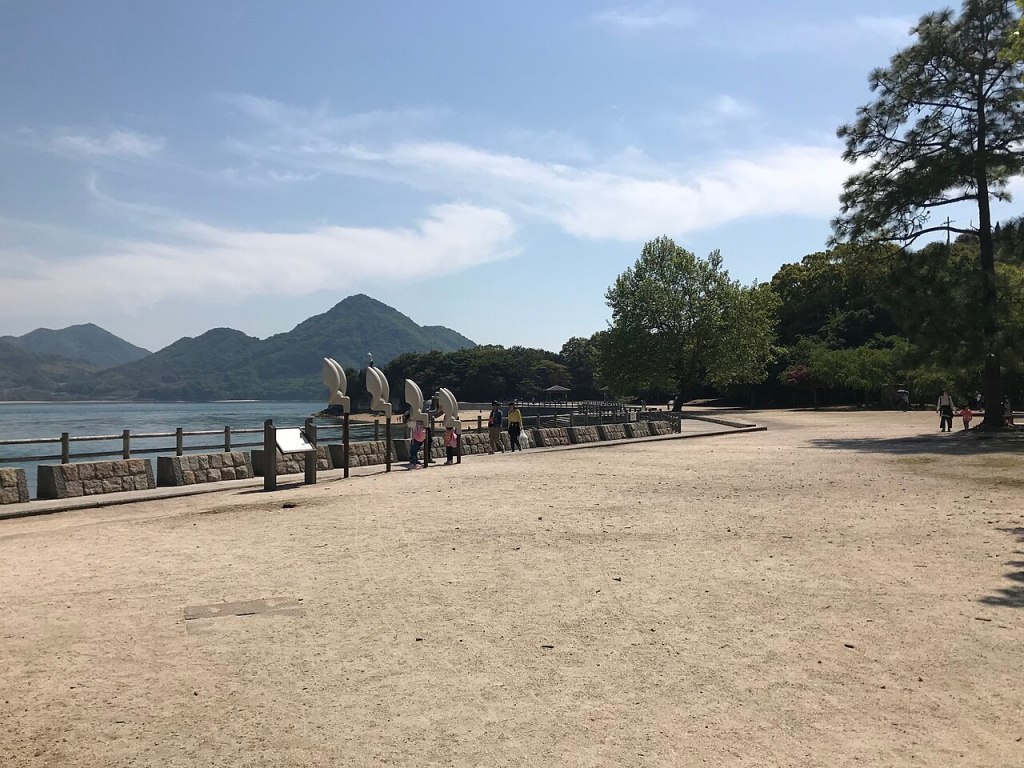
The second pier is where the Omishima ferry ties up, and it is the busiest rabbit spot on the island. The first pier, a few minutes west, is used by the hotel boat and has the rabbit-ear sculptures: large fibreglass ears mounted along the shore, designed as sound collectors, so you can put your head inside and listen to the wind and water. They are a little silly and very popular with children.
The hotel front is the other concentration of rabbits, and the open ground between the buildings and the sea is the easiest place to sit and watch them. There is a shop, toilets, a restaurant and the onsen here, and the free shuttle bus stops nearby. If you are travelling with someone who cannot walk far, this is the part of the island to base yourself in.
The summit and the observatory
A path climbs from the loop road to the Hyokkori Observatory, a small viewing platform near the island’s high point at about 100 metres. The name means something like “peeking”, and on a clear day you can see the islands of the Geiyo group, the Shimanami bridges away to the east, and the hills of Shikoku on the horizon. The climb takes 15 to 20 minutes from the road and is steep in places, with tree roots and loose gravel. It is worth it for the sense of the island’s position: a small, green lump in a very busy sea lane.
The summit is also where the island’s military layers are easiest to read. Below the observatory are the remains of gun positions from the Geiyo Fortress, and further down the slopes are the concrete mouths of air-raid shelters. Okunoshima was fortified before it was poisoned, and the same high ground served both purposes.
The ruins
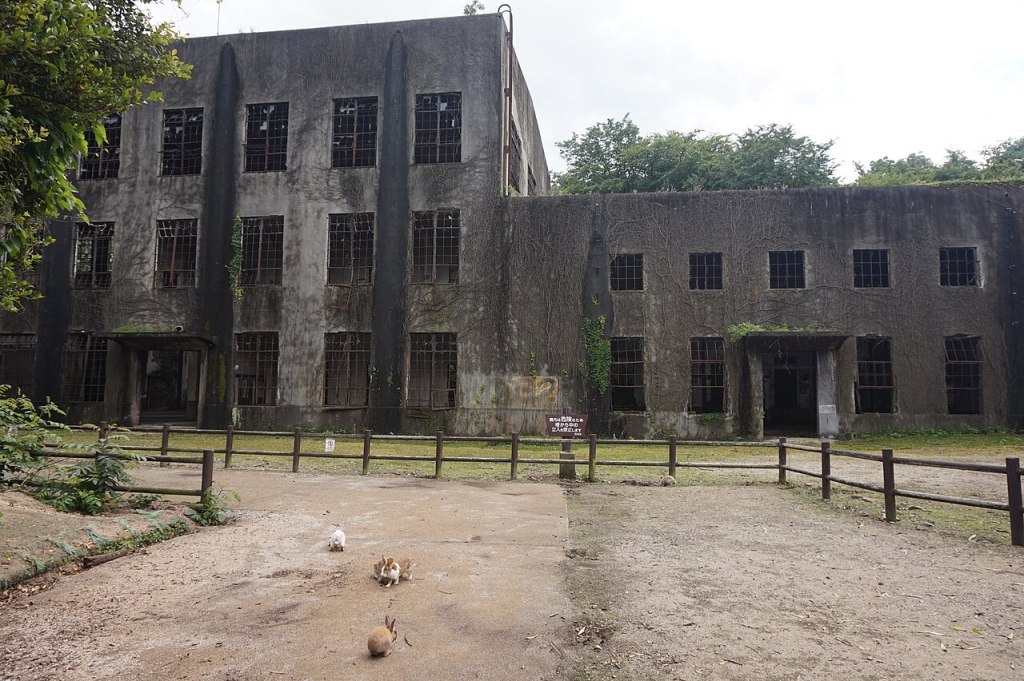
The ruins are not a single site but a scatter of structures along the north and west coasts. The largest is the power station near the second pier, a tall concrete shell with empty window frames and a roof open to the sky, now covered in ivy. It held diesel generators that supplied the plant, and later received power from a submarine cable laid from Tadanoumi in 1941. Near the end of the war, female students are said to have worked on balloon bomb components in the building. The interior is closed, and the structure is unstable; look from the outside and keep children away from the openings.
Further west is the Nagaura storage site, the largest of the island’s gas stores, where six tanks of about 100 tonnes each stood inside a concrete building. The interior was burned after the war to destroy residual agent, and the blackened walls are still visible. Nearby is an open-air storage area with 32 concrete pedestals where tanks were once mounted, now surrounded by trees. Other bunkers are dotted through the woods, some with domed concrete roofs, some cut into the hillside. None of them should be entered.
The laboratory and inspection building stand on the west side, a white block and a grey block side by side, both fenced and closed. This is where agents were developed and tested; the buildings are among the most evocative on the island precisely because they look like ordinary mid-century offices. The poison gas memorial, a stone monument with the names of workers who died, stands near the museum, and a memorial service is held every October. The island shrine, moved to its present site when the plant opened, is still a quiet place of worship, and visitors should behave accordingly.
The batteries and the north coast
On the north side are the remains of the Geiyo Fortress batteries. The north battery once held eight guns; the middle battery had six 28-centimetre howitzers, two of which were removed and sent to Korea for the attack on Port Arthur. The concrete gun positions and a barracks building survive, and the barracks was later used to store gas products and raw materials. The ground here was found to be contaminated with arsenic in 1996 and was washed in 1999, a reminder that the island’s military history did not end neatly in 1945.
The north coast is also the quietest part of the walk, with small beaches, pine trees and views across to the other islands. If you want a few minutes away from the ferry crowds, this is where to find them.
The Poison Gas Museum
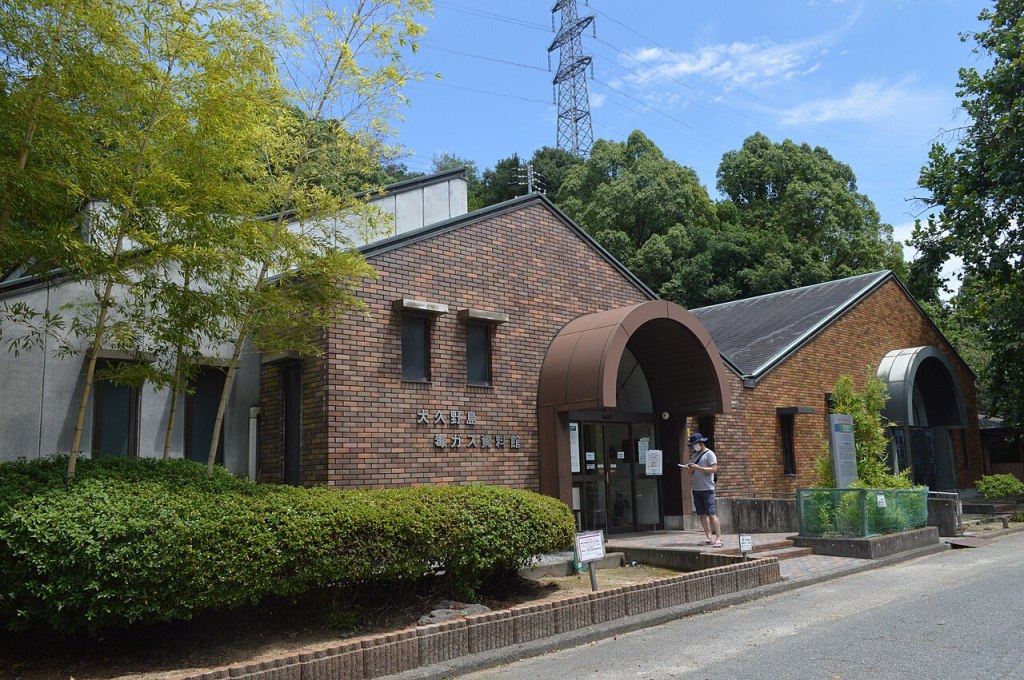
The museum is small, and that is part of its power. It occupies a plain building near the hotel, and its displays are the kind of ordinary objects that make history physical: workers’ notebooks, uniforms, a section of a liquid gas production apparatus, the outer casing of a shell, photographs and panels. A separate room shows documentary films, including testimonies from people who worked on the island. There is no animatronics and no gift shop theatrics; the effect comes from the accumulation of detail.
It opened in 1988, four years after the chemical weapons programme became public, and it is run by Takehara City rather than by a private company. The city’s own description is direct: the museum exists to convey the suffering caused by the manufacture of poison gas and to argue for the elimination of chemical weapons. That makes it a memorial as much as a museum, and visitors should treat it with the quiet that the subject deserves. Photography is allowed for personal use, but flashes and tripods may be restricted; ask at the desk.
The practical details for 2026 are these. The museum is open from 9:00 to 16:00, with last entry at 15:40, and it closes from 29 December to 3 January. Admission is 150 yen for visitors aged 19 and over; under-19s enter free, as do holders of a disability certificate. Groups of 20 or more pay 120 yen. Some older guidebooks and websites still list 100 yen and a 16:30 closing time, and the city’s own cultural facilities page carries a different figure; the tourism association’s listing and the museum page are the ones to trust. In 2026 the museum was closed for several weeks after storm damage cut the island’s power supply, reopening on 8 August, which is a reminder to check the official page before a special trip.
The museum is not large, and 30 to 45 minutes is enough for most visitors, longer if you watch the films. It is also not suitable for very young children, not because of graphic imagery but because the material is dense and the tone is sombre. The visitor centre next door is a better first stop for families: it explains the island’s nature and history in a lighter way, and it is free.
The visitor centre
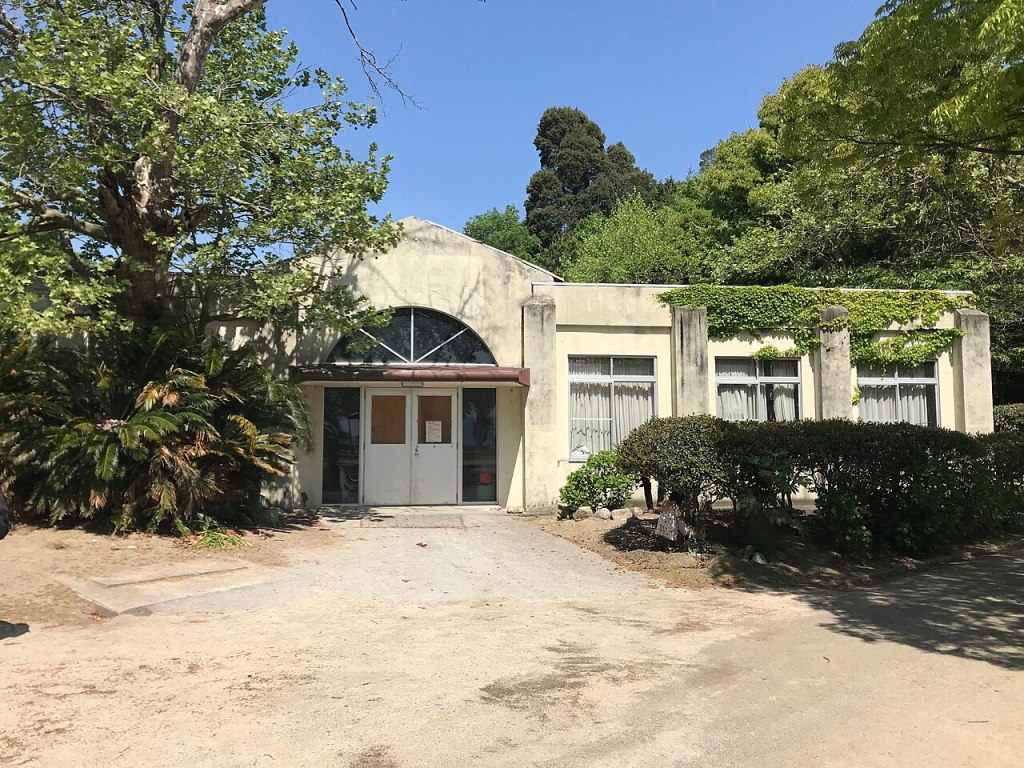
The Okunoshima Visitor Centre is run by the Ministry of the Environment and is the best free introduction to the island. It has displays on the Seto Inland Sea, the island’s plants and animals, and the history of the site, plus a lecture room with changing exhibitions. The building itself is a demonstration of off-grid technology, using solar power, a cool tube, daylighting and a greywater system. It is a good place to start if you want to understand what you are looking at before you walk.
It is open from 9:00 to 16:00 and admission is free. It closes on Wednesdays, and from December to February also on Thursdays, plus the New Year holidays. The rabbit displays are modest but useful, and the staff can tell you where the animals are congregating and which paths are closed. There are toilets here, which matters more than it sounds on an island with limited facilities.
Swimming, the beach and the pool
Okunoshima has small beaches, and in a normal year the one near the hotel is the island’s swimming spot. In 2026 it did not open: after the June power outage the hotel announced that the beach would be closed for the season, and the tourism association confirmed in August that the beach would not operate that year. The closure followed the June power outage, and the tourism association confirmed in August that the beach would not operate that year.
If the beach reopens, treat it as a small, sheltered bay rather than a resort beach. There are no lifeguards advertised, facilities are minimal, and the water is calm but cold outside midsummer. Check the current status at the hotel or the tourism association before you pack a swimsuit, and do not assume that a beach on a map means a beach with services. The rest of the coast is rocky and not suitable for swimming.
The onsen at Kyukamura Okunoshima
The hotel’s Seto Onsen is open to day visitors, which makes it a good end to the walk. There are two baths: the larger Okutsu no Yu, with a view over the hotel grounds, and the smaller Kokutsu no Yu, which looks out to the sea and is the better of the two at sunset. The water is a simple weak radioactive cold mineral spring, marketed as a radium onsen, and the usual claims are made for it: relief for sore muscles, cold hands and fatigue. After four kilometres of hills, that is enough.
Day-use hours in 2026 were 11:30 to 17:00 on weekdays, with reception closing at 16:30, and 11:30 to 15:00 on weekends and holidays, with reception closing at 14:30. The bathing fee is 550 yen for adults and 500 yen for children; children aged three and under are free. A face towel costs 110 yen and a bath towel rental is 110 yen. The hotel closes the baths for maintenance from time to time, and the schedule changes in busy seasons, so confirm at the front desk when you arrive. Guests of the hotel can use the baths from early morning until midnight.
Camping and sleeping on the island
There is a campsite on the island, run by the hotel, with pitches in the trees near the coast. It is a genuine option for people who want the island at dawn and dusk, when the rabbits are most active and the day visitors have gone. Reservations are made through Kyukamura Okunoshima, and you should ask about equipment rental, cooking rules and whether the site is open in winter before you rely on it. The campsite is not a wild camping area; fires and generators are controlled.
For most travellers, though, the choice is between the hotel and the mainland. Staying on the island means one night of quiet, a sunset over the Inland Sea and a very early walk, but it also means limited food options and a fixed ferry timetable. Staying in Tadanoumi, Takehara, Onomichi or Hiroshima is cheaper and gives you more choice, at the cost of an early start.
Getting there
All ferries leave from Tadanoumi Port in Takehara. The port is a five- to seven-minute walk from JR Tadanoumi Station on the Kure Line, and there are coin lockers at the port (500 yen) if you are travelling with a suitcase. The walk is flat and signposted, and the ferry terminal has a shop selling rabbit food, soft ice cream and tickets.
From Hiroshima, take the Sanyo Shinkansen to Mihara (about 25 minutes), then the JR Kure Line to Tadanoumi (about 20 minutes). From Onomichi, take the JR Sanyo Line to Mihara (about 20 minutes) and change to the Kure Line. From Hiroshima Airport, a limousine bus reaches Takehara Station in about 30 minutes, and the train from Takehara to Tadanoumi takes about 12 minutes. There is also a highway bus, the Kaguyahime, from Hiroshima Bus Center to Tadanoumi, which takes around 100 minutes and is useful if you are staying in central Hiroshima.
By car, Tadanoumi Port is about 25 minutes from the Sanyo Expressway’s Hongo Interchange and about 40 minutes from the Kawachi Interchange. Parking at the port is free, with around 100 spaces, and it fills on weekends and holidays; the hotel recommends public transport on busy days. Cars can be carried on the ferry only with the hotel’s prior permission, because the island is closed to ordinary vehicles, and the crossing is short enough that most people simply leave the car behind.
Two operators run the crossing, and this is where timetables matter. The Omishima Ferry, part of the Sanyo Shosen group, runs from Tadanoumi to Okunoshima and on to Sakari on Omishima. The Tadanoumi to Okunoshima leg takes about 15 minutes and costs 360 yen one way for adults and 180 yen for children, or 720 yen and 360 yen return, according to the published fare table. In 2026 its departures from Tadanoumi were at 08:30, 09:40, 10:50, 12:00, 14:05, 15:15 and 16:25, with returns from the island at 07:25, 08:20, 09:20, 10:30, 11:40, 13:48, 14:56 and 16:06, plus a 17:16 sailing from February to October only. In November, December and January the last ferry back is the 16:06.
The hotel also runs its own passenger boat, which does not carry cars and has more sailings. In 2026 its first departure from Tadanoumi was at 07:40, and its last return from the island was around 19:15, with separate weekday and weekend timetables and a crossing of 10 to 15 minutes. The fare is the same 360 yen. The boat may use either pier depending on conditions, and the timetable is revised in April, so check the hotel’s access page for the current PDF rather than relying on a blog post.
The last boat is the one thing to plan around. There is no bridge and no taxi rank on the island, and if you miss the final sailing your options are limited to whatever rooms the hotel has left. In summer the last ferry back is at 17:16 and the last hotel boat around 19:15; in winter the ferry goes at 16:06, which means a day trip is still possible but an afternoon walk needs watching. Set an alarm for 45 minutes before your intended boat, and check the operator’s website for cancellations in rough weather.
Fares and a realistic budget
The fixed costs are modest. The return ferry is 720 yen for an adult, the museum is 150 yen, the onsen is 550 yen, and a locker at the port is 500 yen. The train fare depends on where you start; the shinkansen leg from Hiroshima to Mihara is the largest single cost, and a Japan Rail Pass covers it if you have one. Food on the island is limited to the hotel, so budget for a hotel lunch or bring a packed lunch from Takehara or Tadanoumi.
A bare-bones day trip from Hiroshima, using the train and carrying your own food, can be done for roughly 3,000 to 4,000 yen plus the shinkansen fare. Adding the museum, the onsen and lunch at the hotel pushes it higher, and staying overnight is a different budget altogether. Cash is useful for the museum, the lockers and small shops; the ferry ticket machines and the hotel take cards, but not every small restaurant in Tadanoumi does.
When to go
The best months are April, May, October and November. The Inland Sea climate is mild, the light is clear, and the walk is comfortable. Spring brings new green and fewer crowds than cherry-blossom season on the mainland; autumn brings crisp air and the best light for photographs. Winter is quiet and mild, with daytime temperatures around 5 to 10 degrees Celsius, and the island can feel wonderfully empty, but the last ferry leaves early and some facilities keep shorter hours.
Summer is hot, humid and crowded. The rabbits are least active in the middle of the day, the ruins are shaded but the loop road is not, and the beach may or may not be open. If you go in July or August, take the earliest boat you can, carry more water than you think you need, and plan the museum for the hottest part of the afternoon. September is still hot and is also the peak of the typhoon season; a storm can cancel ferries with a day’s notice.
Time of day matters as much as season. The first ferry at 08:30 brings a wave of day trippers, and the pier area is busiest between 09:00 and 11:00. By 15:00 the island is emptying, the light softens, and the rabbits come out again. If you are staying overnight, dawn and dusk are the reward: the paths are quiet, the ferries are gone, and the island feels like itself.
How to spend a half day
Take the 08:30 ferry from Tadanoumi, arrive at 08:45, and walk straight to the museum before the school groups arrive. Spend 30 to 45 minutes there, then visit the visitor centre for context and a map. Walk the west coast ruins slowly, climb to the observatory if the weather is clear, and come down for the rabbits and the hotel front. Eat lunch at the hotel or from your bag, have a quick onsen if you have time, and take the 14:56 or 16:06 ferry back. That is a full half day without rushing, and it leaves the afternoon free for Takehara or Onomichi.
How to spend a full day
Take the hotel boat at 07:40 if it is running, or the 08:30 ferry, and walk the island anticlockwise: hotel front first, then the museum, the west coast ruins, the summit, the north batteries, and back along the east shore. Stop for lunch at the hotel, then spend an hour on the rabbits and the pier sculptures, and finish with the onsen before the 17:16 boat in summer or the 16:06 boat in winter. This is the version for photographers and for anyone who wants to read the ruins rather than tick them off.
Combining Okunoshima with Takehara and Onomichi
Takehara is 12 minutes away by train and is worth the rest of the day. Its historic district is a preserved street of wooden merchant houses, sake breweries and narrow lanes, often described as a little Kyoto without the crowds. The Takehara tourism association publishes walking routes and a model course that pairs the island with the town, and the combination makes sense: rabbits and ruins in the morning, sake and old houses in the afternoon.
Onomichi is about 40 minutes away by train via Mihara, and makes a good base for the Shimanami Kaido. If you are cycling the Shimanami route, Okunoshima is a detour rather than a stop on the way, but it fits neatly into a rest day. Hiroshima is about 90 minutes away and is the natural base for a longer trip; from there you can pair the island with Miyajima or the Peace Memorial Park on separate days.
Food and drink
Do not arrive on the island hungry and assume you will find something. The only restaurant is in the Kyukamura, and while it serves lunch to day visitors at set hours, it is primarily a hotel dining room and can be busy. The hotel shop sells snacks, drinks and rabbit pellets, and there are vending machines, but there is no convenience store and no street food.
The better plan is to eat in Tadanoumi or Takehara before or after the crossing. Tadanoumi has a handful of small restaurants and cafes near the station and port, serving set meals, noodles and okonomiyaki; hours are short and closing days are irregular. Takehara has more choice, including sake breweries and cafes in the historic district. Onomichi is famous for its ramen and its lemon-flavoured sweets, and Hiroshima for okonomiyaki. Carry water, especially in summer, and take your rubbish off the island.
Where to stay
Kyukamura Okunoshima is the only hotel on the island, with rooms facing the sea, a restaurant, the onsen and direct access to the rabbits. It is a Japanese resort hotel rather than a luxury property: spacious, family-friendly, a little dated in places, and priced accordingly. Staying here is the only way to experience the island outside ferry hours, and for many people that is worth the premium.
On the mainland, Tadanoumi has a few small guesthouses and business hotels, Takehara has more options in and around the historic district, and Onomichi and Hiroshima have the widest range. If you are dependent on public transport, stay near Hiroshima Station or Onomichi Station and make the journey in the morning. If you have a car, a night in Takehara gives you the best of both worlds: the island at opening time and the old town in the evening.
Photography
The classic shot is a rabbit in front of the abandoned power station, and it is not hard to get: the rabbits congregate near the piers and the hotel, and the power station is a few minutes’ walk away. The light is best in the early morning, when the sun comes from the east and the ruins are still in shadow, and again in the late afternoon, when the west coast turns gold. Midday is harsh and the rabbits are flat out under the bushes.
For the landscape, the summit observatory gives the broadest view, and the west coast gives the best sunset. The rabbit-ear sculptures near the first pier are a good foreground for portraits, and the pier itself is a good place to photograph the ferry arriving. Bring a longer lens for the rabbits, since they will not always let you close, and a wide lens for the ruins. Tripods are allowed on the paths but not inside the museum or the visitor centre, and drone use should be checked with the authorities before you fly: this is a national park and a former military site, and local rules apply.
Accessibility and travelling with children
The island is hilly and much of it is steps, gravel and uneven concrete. The pier, the hotel front, the museum and the visitor centre are the flattest and most accessible parts, and the free shuttle bus connects the pier to the hotel. The loop road has gradients, and the summit path is not suitable for wheelchairs or pushchairs. If you are travelling with someone who has limited mobility, base yourselves at the hotel front, visit the museum and the visitor centre, and skip the ruins and the summit.
Children generally love the island, but the combination of wild rabbits, cliff paths and unstable ruins needs supervision. Keep children away from the fenced buildings, do not let them chase or corner rabbits, and explain the feeding rules before you arrive. Toilets are available at the pier, the visitor centre, the museum and the hotel, and there is a shop at the hotel, but there are no other services on the island.
Okunoshima and the wider trip
Okunoshima is usually visited as a day trip from Hiroshima, Onomichi or Takehara, and it works well in that role. It can also be combined with the Shimanami Kaido, the chain of bridges and islands that runs from Onomichi to Imabari, if you have a car or a bicycle and a spare day. The ferry to Sakari on Omishima connects the island to the Shimanami route, which makes a pleasant loop: Okunoshima in the morning, Omishima and the bridges in the afternoon.
For a longer Hiroshima trip, give the island its own day rather than squeezing it in before a flight. The Peace Memorial Park and Miyajima are each worth a full day, and Okunoshima is a third, different story about the same war. Seeing all three in one trip gives you a more complete picture than any one of them alone: the city that was bombed, the shrine that survived, and the island where the weapons were made.
Etiquette and the future of the island
Okunoshima is a memorial, a national park and a working community, and it is easy to forget all three when a rabbit is sitting on your foot. Keep your voice down near the memorial and the shrine, stay out of closed buildings, do not climb on the ruins, and do not treat the island as a petting zoo. The rabbits are wild, the ruins are fragile, and the people who work on the island live there all year, not just for the ferry timetable.
The island’s future is genuinely uncertain. The rabbit population rises and falls with visitor numbers and feeding, the ruins are decaying, and the museum depends on public money. In 2024 and 2025 the island also had to deal with a well-publicised case of cruelty towards rabbits, which led to calls for tighter rules and better monitoring. Visitors can help by following the guidance, reporting abuse to staff, and treating the animals as wildlife rather than props. That is not a small thing; it is the difference between an island that works and one that is loved to death.
Before you go
Check the ferry timetable for your date, not for the season in general: the last boat changes in November, and the hotel boat has separate weekday and weekend schedules. Confirm the museum and visitor centre are open, especially on Wednesdays and in winter, and check for storm damage or maintenance closures. Book the hotel or campsite well ahead if you want to stay overnight, and book the onsen only if you are staying, since day use is first come, first served.
Bring cash for the museum, the lockers and small restaurants, water and a packed lunch if you are on a budget, shoes with grip for the ruins, and a rain jacket even on a sunny forecast. Do not bring a pet, do not bring food that is not rabbit pellets, and do not plan to swim unless you have confirmed that the beach is open. Most of all, leave time. Okunoshima is small, but it is not a quick stop, and the best moments are the ones between ferries.
Quick checklist
- Take the 08:30 ferry from Tadanoumi, or the 07:40 hotel boat if it is running.
- Check the last ferry: 17:16 from February to October, 16:06 from November to January.
- Buy a return ticket at the port and keep it somewhere dry.
- Visit the museum before lunch; last entry is 15:40.
- Feed rabbits only on the grass, never from your hand, and never with human food.
- Stay out of fenced ruins and off unstable concrete.
- Carry water and take your rubbish back to the mainland.
- Finish with the onsen at the hotel before the boat.
- Reconfirm hours, fares and closures on the official pages before travelling.
Related guides
- Hiroshima Peace Memorial Travel Guide — the city, the park and the museum
- Miyajima Travel Guide — Itsukushima Shrine and the floating torii
- Onomichi Travel Guide — temple walks and the Shimanami Kaido gateway
- Shimanami Kaido Travel Guide — the island-hopping cycle route
- Tomonoura Travel Guide — a tide-waiting port in Fukuyama
- Kurashiki Travel Guide — the Bikan canal district


Leave a Reply