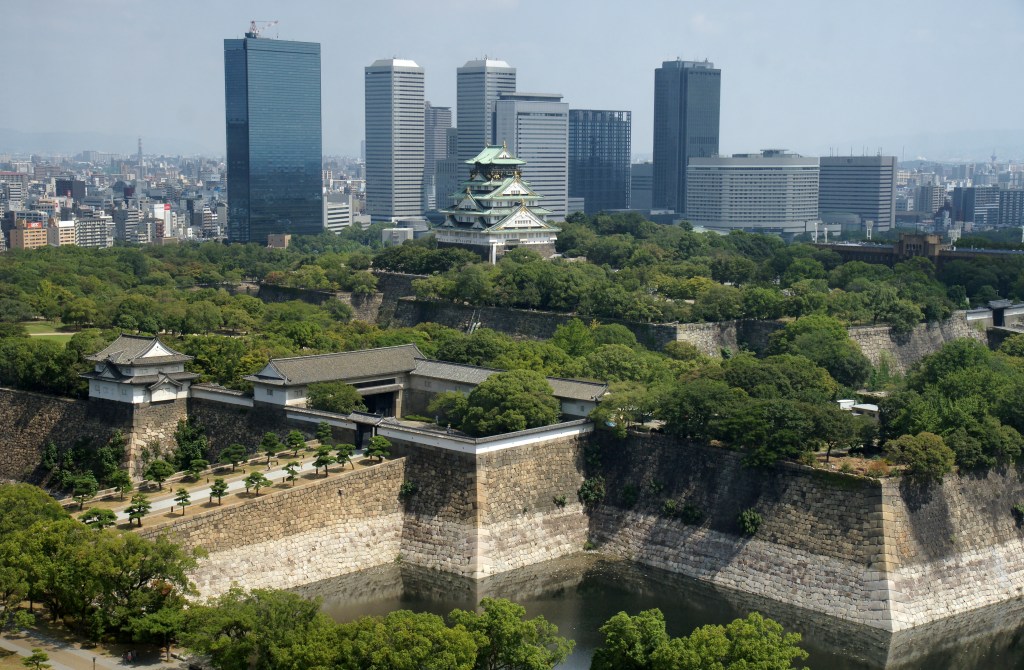
Osaka Castle is the most photographed building in the city and the least understood. The keep that stands on the platform today is a 1931 concrete reconstruction with an elevator, not a sixteenth-century tower. The walls below it, however, are genuine Tokugawa work, built by sixty-four daimyo after the Toyotomi family was destroyed here in 1615. That contrast, a modern museum sitting on top of four hundred years of engineering, is the reason to come.
The park around it is free and open at all hours, which makes it the easiest major sight in Osaka to fit into a day. The keep and one walled garden charge admission. This guide explains what you are looking at, what the tickets cost in 2026, how to avoid the worst of the crowds, and where to walk when the keep is closed.
Why visit
Because the castle is where the story of early modern Japan ends. The siege of 1615 finished the Toyotomi clan, confirmed the Tokugawa shogunate for the next two and a half centuries, and turned Osaka from a fortress town into a merchant city. Standing on the same ground is worth more than reading about it.
It also works as a straightforward sight. The park is free and flat, the station is close, the keep has an English-language museum and a view over the whole city, and the surrounding moats and gates can be walked in an hour without paying anything. On a first visit to Osaka, it is the obvious half-day.
The honest caveat: if you want an original castle keep, go to Himeji or Inuyama. Osaka is a reconstruction, and a busy one in spring. Its value is the site and the scale of the fortifications, not the age of the tower.
The story in five scenes
1. A fortress temple
Before there was a castle, there was Ishiyama Hongan-ji, the fortified headquarters of the Jodo Shinshu sect. Oda Nobunaga besieged it for eleven years from 1570, and the monks eventually surrendered in 1580. The site was already chosen for defence: a plateau above the Yodo river system, with water on two sides.
2. Hideyoshi’s capital
Toyotomi Hideyoshi began his castle in 1583, on the same ground, as the seat of a unified Japan. Contemporary accounts describe a keep covered in gold leaf, a town of merchants drawn in from around the region, and a scale that rivaled anything in Europe. Hideyoshi died in 1598, leaving a young heir and a regency that never held.
3. The summer siege
In 1615, Tokugawa Ieyasu attacked the castle in the Osaka Summer Campaign. The Toyotomi defenders were outnumbered, the outer works were taken, and the keep burned. Toyotomi Hideyori and his mother Yodo-dono died in the flames. The Tokugawa victory ended the last serious resistance to their rule, and the era of civil war with it.
4. The Tokugawa rebuild
The shogunate then did something deliberate: it buried the Toyotomi castle and built a new one on top, higher and heavier. Hidetada ordered the work in 1619, sixty-four daimyo were assigned sections of wall, and the stone faces you walk past today are the result. The keep was struck by lightning and burned in 1665 and was not rebuilt for the rest of the Edo period.
5. Army ground, then a museum
In 1868, during the unrest around the Meiji Restoration, much of what remained burned. The site became an army base, and the inner compound was closed to the public for decades. The present keep was rebuilt in 1931 with donations from Osaka citizens, registered as a national tangible cultural property in 1997, and designated an Osaka city cultural property in 2025. It has been a museum since it reopened.
The result is a castle where almost everything you see is either Tokugawa stonework or twentieth-century concrete, and the labels tell you which is which. That is not a disappointment if you know it in advance.
Inside the keep
The keep is about 55 metres tall, five storeys from the outside and eight floors inside. The route is a museum: exhibits on Hideyoshi, on the castle’s construction, on the summer campaign and on the city that grew around it, with an observation deck at the top.
Tickets cost 1,200 yen for adults, 600 yen for university and high school students with identification, and are free for junior high school students and younger with proof of age. The same ticket covers the Toyotomi Stone Wall Hall, which opened in the park in 2025. Hours are 9:00 to 18:00, with the last entry at 17:30, and the keep closes from 28 December to 1 January. The museum may extend its hours in busy seasons, so check the official page for your date.
The building is not step-free in the usual sense, but it is close. A lift takes visitors to the fifth floor; from there the eighth-floor observatory is reached by stairs. Wheelchair users and visitors who cannot manage stairs can ask staff to use the lift for every floor, and there is a separate outside lift from the ticket area to the entrance. Pushchairs are not allowed inside and are stored free at the gate.
The sixth floor is a closed corridor with no exhibition, which surprises people counting floors. The third and fourth floors hold important cultural properties and photography is prohibited there; everywhere else, including the top floor and the life-size replica corner on the second floor, you can take pictures. Lockers at the ticket counter cost 100 yen per bag, and the counter closes at 17:30. Allow 50 to 60 minutes at an average pace, or 90 minutes if you read the panels.
The observation deck sits about 50 metres above the ground and gives a 360-degree view: the park and its moats directly below, the Osaka Business Park towers to the north-east, Osaka Castle Hall to the west and the city running out to the hills. On a clear day you can pick out the Umeda skyline. It is the best free view in the city once you have paid for the ticket, and the reason to go up even if museums bore you.
The Toyotomi Stone Wall Hall
In 2025 the city opened a facility that changes how the castle is understood. When the Tokugawa rebuilt the castle, they covered the Toyotomi walls with new ones, and those older stones stayed underground, protected by the later work. The hall exposes a section of them.
The visit starts in a guidance room on the surface with an explanation of how the walls were found and how the two castles differ, then a short film, then a descent to the stone wall exhibition hall. What you see is nozurazumi, the older style of dry-laid, roughly shaped stone, without the precise interlocking of the Tokugawa walls above. It is a different aesthetic and a different technology, and seeing the two within a few minutes is the point.
The hall is south-east of the keep, near the Sakuramon gate, and entry is included in the keep ticket. Hours are the same, 9:00 to 18:00 with last entry at 17:30, and it closes over New Year. If you only have an hour, do the keep and the stone hall together and skip the garden.
Walking the grounds for free
The park costs nothing, and the walk from the outer moat to the keep passes most of the important structures. Start at the Otemon gate on the west side if you arrive from Tanimachi 4-chome, or at Sakuramon on the south if you come from Morinomiya.
Otemon was the main entrance to the inner compound and is a Tokugawa-era gate, rebuilt after a fire in the nineteenth century but in the original style. Inside, the route climbs past the Tamon Turret, a long two-storey defensive building with slots for arrows and guns, and the Sengan Turret, both designated important cultural properties. These are among the few original castle buildings left, and they are easy to walk past because they look like walls.
Sakuramon, the south gate, is a reconstruction from 1887, but the stones around it are the reason to stop. The Tako-ishi, or Octopus Stone, is the largest in the castle: about 5.5 metres high, 11.7 metres wide and roughly 108 tonnes, named for a pattern on its face that looks like an octopus. It was brought from Bizen, in modern Okayama, in the 1620s. Next to it are the Dragon and Tiger stones; local tradition says their patterns show best after rain. Look for the carved marks on the blocks around the gate, which record which daimyo supplied which stone.
From Sakuramon the path crosses the inner moat at the Gokurakubashi bridge. The view back up at the keep from the bridge is the classic photograph, and the moat below it is where the castle boat leaves. The inner honmaru compound, around the keep, is free and has benches, vending machines and toilets; it is a good place to sit rather than fight for a table in a cafe.
Around the outside, the outer moat is a loop of about four kilometres with a running track, turf and cherry trees. The Osaka Business Park side, north-east of the keep, gives a clear view across the water and is much quieter than the main approach.
Nishinomaru Garden
The walled garden on the west side of the inner compound is a separate ticket and the best place to photograph the keep with something in front of it. It has a large lawn, a teahouse, and about 300 cherry trees, mostly Somei Yoshino with some weeping cherries.
Admission is 300 yen for adults from 1 April 2026, when it rose from 200 yen, and free for junior high school students and younger and for Osaka residents aged 65 and over with proof. It opens 9:00 to 17:00 from March to October and 9:00 to 16:30 from November to February, with last entry 30 minutes before closing. It is closed on Mondays, or the next weekday when Monday is a holiday, and from 28 December to 4 January.
In cherry season the garden stays open late for the night viewing. In 2026 that ran from 20 March to 12 April, 9:00 to 21:00 with last entry at 20:30, at a special price of 350 yen for high school students and older. The dates move each year, so treat those as an example of the pattern rather than a fixed calendar. Outside that period the garden is quiet, cheap and a good place to eat a picnic lunch.
Seasons and crowds
The park has roughly 3,000 cherry trees and about 1,270 plum trees, according to the castle’s own figures, which makes it one of the best flowering spots in the city. Plum comes first, usually from early February into March, in the grove on the north side. Cherry usually peaks in late March or early April, and the keep is lit from sunset until 00:30, so an evening walk is possible even when the garden is closed.
Spring is also when the park is at its worst. The main paths between the station and the keep become a slow queue, the lift inside the keep has a long line, and the ticket machines back up. If you visit in sakura season, arrive at opening, walk the grounds first and go up the keep before 10:00, or come after 16:00 when the day trippers have left.
The 2026 spring festival ran from 10 March to 24 May, with food stalls and events around the park. The festival dates and the night viewing are announced each winter on the park’s official site, and they are worth checking before booking a hotel.
Summer is hot and humid, with little shade on the stone approaches; carry water and go early. Autumn is the most comfortable season, with ginkgo and maple colour from late November, though the garden closes at 16:30 from November. Winter is quiet and the air is clear, and the castle looks its best after rain.
The moat boat
The Gozabune is a gold-leafed wooden boat that circles the inner moat in about 20 minutes, passing directly under the stone walls and giving a view up at the keep that you cannot get on foot. It is a reconstruction, inspired by a boat painted on a sixteenth-century screen of the castle town, and it is unashamedly a tourist ride. It is also the only way to see the scale of the wall from water level.
Tickets cost 1,800 yen for adults, 900 yen for primary and junior high school students and 1,200 yen for visitors aged 65 and over. Boats run from 10:00 to 16:30, with the last departure at 16:30, roughly every 10 to 15 minutes. Tickets go on sale at 9:30 at the booth north-west of the Gokurakubashi bridge, on the day only, and there are no reservations for individual seats. The boat does not run from 28 December to 3 January and stops in bad weather.
It is included in the Osaka Amazing Pass, but the pass excludes the boat on some cherry-blossom dates, so check the pass list if that is why you are buying it. In busy periods the day’s tickets can sell out by mid-afternoon.
Nearby: the history museum and the hall
Across the road to the south-west, the Osaka Museum of History sets the castle in a longer story, from the Naniwa palace to the modern city. Admission to the permanent collection is 600 yen for adults and 400 yen for university and high school students, free for junior high school students and younger. It opens 9:30 to 17:00, with last entry at 16:30, and closes on Tuesdays, or the following day when Tuesday is a holiday, and from 28 December to 4 January.
Allow an hour to 90 minutes. The top-floor galleries include a full-scale reconstruction of the Naniwa Palace council hall, and the exhibits on the medieval and early modern city explain why Osaka became a merchant capital after the castle fell. It is the best rainy-day complement to the castle and a ten-minute walk from Tanimachi 4-chome Station.
Osaka Castle Hall, the large concert and event venue inside the park on the west side, hosts concerts, ceremonies and the odd sumo tour. Check its schedule only if you are interested in what is on; it is not a sight in itself. The park’s north side, near Osakajokoen Station, has JO-TERRACE OSAKA, a small complex of restaurants and cafes built in 2017, which is the most convenient place to eat before or after the castle.
Getting there
The castle has more stations around it than any other sight in Osaka, and the right one depends on which gate you want.
- Tanimachi 4-chome (Tanimachi and Chuo subway lines), exits 1-B and 9: about 10 to 15 minutes on foot to Otemon, and the most direct route from the city centre.
- Morinomiya (Chuo line, Nagahori Tsurumi-ryokuchi line and JR Osaka Loop): the east side, closest to Sakuramon and the stone wall hall.
- Osakajokoen (JR Osaka Loop): the north side, near JO-TERRACE and the plum grove, about 15 minutes to the keep.
- Osakajo-kitazume (JR Tozai line): the north-west corner, quiet and close to the outer moat.
- Temmabashi (Keihan and Tanimachi line): the west side, about 15 minutes to Otemon.
- Osaka Business Park (Nagahori Tsurumi-ryokuchi line): the north-east, good for the moat view and the boat.
From Umeda, take the JR Osaka Loop to Osakajokoen, which is two stops and about ten minutes, or the Midosuji subway to Tanimachi 4-chome with a change. From Namba, the Midosuji line to Tanimachi 4-chome or the Sennichimae line to Tanimachi 9-chome both work. From Shin-Osaka, the Midosuji line runs direct to Tanimachi 4-chome in about 20 minutes.
Driving is possible but not pleasant in spring. The two park car parks, at Osakajokoen Station and Morinomiya, charge 400 yen an hour on weekdays and 500 yen an hour at weekends between 8:00 and 22:00, and 200 yen an hour overnight. They fill early on cherry weekends, and the approach roads queue.
Where to stay
The park itself has no hotels and is quiet at night, which suits some travellers and not others. Most visitors stay in Umeda or Namba and come for half a day. Umeda is convenient for the JR loop and for Kyoto; Namba is better for food and nightlife; Tennoji, south of the park, is quieter and well connected to the airport.
If the castle is the main reason for the trip, a hotel near Tanimachi 4-chome or Temmabashi puts you within a ten-minute walk of the Otemon gate and gives you an early start, which matters far more than the room. Book well ahead for the last week of March and the first week of April.
Where to eat
Inside the park, JO-TERRACE has a handful of restaurants and cafes with terraces, plus a convenience store, and the kiosks near the keep sell ice cream, drinks and light snacks. The sit-down options are limited and priced for tourists, but they are convenient.
Better food is a short walk away. Tanimachi 4-chome has udon, curry and coffee shops used by office workers, and the arcade streets west of the station are reliable at lunch. Temmabashi and Tenma, to the north-west, have a dense cluster of izakaya and standing bars that fill up after work. For a proper Osaka food day, the Kuromon market and Dotonbori are a short subway ride south, and our Osaka neighbourhoods guide covers where to go and what to order.
Suggested itineraries
Three hours, first visit
Enter at Otemon, walk past the Tamon and Sengan turrets to the inner compound, cross Gokurakubashi for the classic view, then go up the keep and the stone wall hall. Finish with a loop of the inner moat and leave by Sakuramon to Morinomiya. This is the minimum that does the castle justice.
Half day, with the garden
Do the three-hour route, then add Nishinomaru Garden for the lawn view and a rest, and walk out through the outer park to Osakajokoen for lunch at JO-TERRACE. In cherry season, swap the order and do the garden in the evening for the night viewing.
Full day, with context
Start at the Osaka Museum of History when it opens, spend 90 minutes there, walk to the castle for the keep and the stone hall, then take the boat if the queue is short. Finish with the outer moat at sunset. This is the version to choose if you want to understand the place rather than photograph it.
Rainy day
The keep and the stone wall hall are both indoors, and the museum of history is a five-minute walk from the subway. Skip the garden and the boat, which close or stop in bad weather, and use the covered arcades at Tenmabashi for lunch.
Practical tips
- Buy the keep ticket online in advance if you are visiting at a weekend or in spring; the official site links to a web ticket service, and it saves the machine queue.
- Cash is not needed: the ticket machines and counters take cards, electronic money and QR payments.
- The ticket is single-entry. Do not leave the keep and expect to come back in on the same ticket.
- There is no re-entry to the keep, and no food or drink sales inside beyond vending machines.
- Photography is banned on the third and fourth floors but allowed on the observation deck and at the replica corner.
- The lift only goes to the fifth floor for most visitors, so budget time for stairs and crowds.
- Wear shoes with grip. The stone steps and the slopes through the gates are slick after rain.
- Toilets are in the honmaru compound and near the stations; there are few inside the keep itself.
- The park is open 24 hours and free, so an early morning or late evening walk is a good way to see the walls without crowds.
- If you plan to visit several sights in one day, compare the Osaka Amazing Pass: 3,500 yen for one day or 5,000 yen for two, covering the castle, the boat and about 40 attractions plus subway and bus travel.
Before you go
Check the official castle site for the day’s opening hours and any closure before travelling, especially in late December and early January and during typhoon season. Confirm the cherry-blossom dates rather than assuming them, since the festival and night viewing change every year. If the keep is the priority, arrive at opening or after 16:00, and if the garden is the priority, remember it closes on Mondays and at 16:30 in winter. Book accommodation early for the first week of April, and keep a light rain jacket in your bag: the walk from the station to the keep is 15 minutes with little shelter.
Sources
- Osaka Castle: hours and admission (checked 2026-10-26)
- Osaka Castle: FAQ, cherry and plum tree counts, lift and lockers (checked 2026-10-26)
- Osaka Castle: access and parking (checked 2026-10-26)
- Osaka Toyotomi Stone Wall Hall (checked 2026-10-26)
- Osaka Castle Park: 2026 spring festival and night viewing (checked 2026-10-26)
- Osaka Amazing Pass: participating attractions (checked 2026-10-26)
- Osaka Castle Gozabune: fares and times (checked 2026-10-26)
- Osaka Museum of History: admission and hours (checked 2026-10-26)
Explore More of Japan
- Osaka Neighbourhoods and Food Guide — where to eat after the castle
- Umeda Sky Building Travel Guide — the other great Osaka view
- Himeji Castle Travel Guide — an original keep, an hour away
- Nara Park and Naramachi Travel Guide — deer, temples and old streets


Leave a Reply